Saudi Arabia Meat, Poultry, Seafood Packaging Market Size, Share & Growth Rate
The Saudi Arabia Meat, Poultry, Seafood Packaging Market was estimated at USD 248 Million in 2025 and is projected to reach USD 317 Million by 2032, growing at a CAGR of 3.6% from 2026 to 2032. This growth is driven by an increasing demand for convenience and hygienic packaging solutions among consumers, reflecting the evolving lifestyles and dietary preferences in Saudi Arabia. As the retail and hospitality sectors expand and consumer awareness regarding food safety escalates, the market is poised to witness significant advancements and innovations in packaging technology.
Saudi Arabia Meat, Poultry, Seafood Packaging Market Year-wise Growth Rate and Key Drivers
This graph highlights how the Saudi Arabia Meat, Poultry, Seafood Packaging Market has steadily grown over the years, supported by major growth factors.
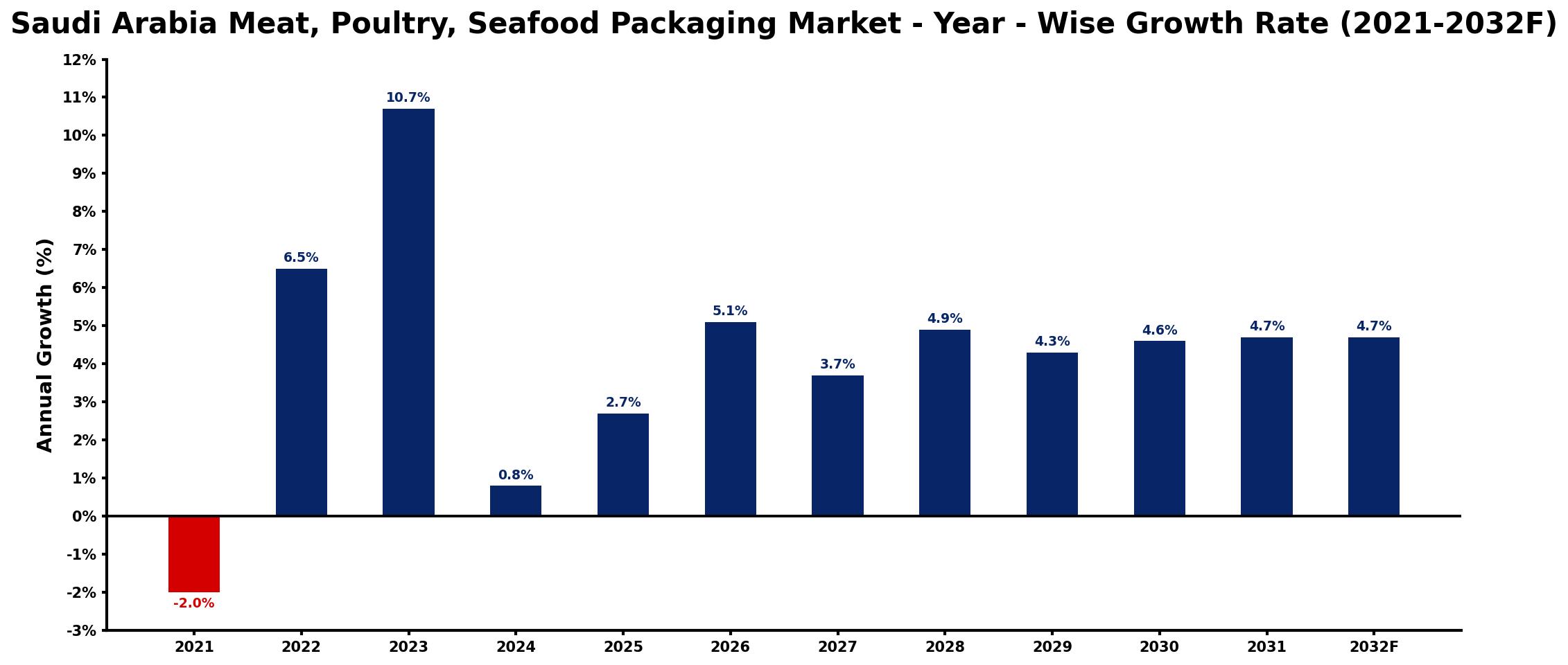
The table below presents the year‑wise growth rates along with the key drivers influencing the market
| Year | Growth Rate | Major Drivers |
| 2021 | -2.0% | supply chain disruptions affecting production |
| 2022 | 6.5% | increased consumer health consciousness |
| 2023 | 10.7% | growing demand for convenience products |
| 2024 | 0.8% | rising investment in automation technologies |
| 2025 | 2.7% | expansion of retail distribution channels |
| 2026 | 5.1% | enhanced sustainability practices adopted |
| 2027 | 3.7% | rising end-use demand growth |
| 2028 | 4.9% | growth in e-commerce food sales |
| 2029 | 4.3% | rising popularity of premium offerings |
| 2030 | 4.6% | rising demand from electronics |
| 2031 | 4.7% | increased collaboration with logistics partners |
| 2032 | 4.7% | growing trend towards local sourcing |
Note: Market size estimations and growth projections presented in this report are based on 6Wresearch's proprietary forecasting methodology, utilizing the latest available industry data, government publications, and primary research inputs.
Saudi Arabia Meat, Poultry, Seafood Packaging Market Synopsis
Convenience is the most powerful force shaping the Saudi Arabia Meat, Poultry, Seafood Packaging Market today. Consumers are increasingly favoring packaged products that offer ready-to-eat options and longer shelf life, pushing manufacturers to develop more advanced and efficient packaging solutions. This trend aligns closely with the rapid urbanization and changing consumption habits observed in the region.
Additionally, environmental considerations are becoming a pivotal aspect of product development. As consumers express greater concern for sustainability, the demand for eco-friendly packaging alternatives is rising, challenging manufacturers to innovate while also adhering to stringent food safety regulations. This dynamic is reshaping the market landscape in Saudi Arabia.
Saudi Arabia Meat, Poultry, Seafood Packaging Market Key Takeaways
- The market is driven by a surge in demand for convenient and hygienically packaged food products.
- Consumer preferences are shifting towards sustainable and eco-friendly packaging solutions.
- Innovations in packaging technology are crucial for extending the shelf life of perishable products.
- The growth of the retail and hospitality sectors is enhancing market opportunities.
- Strict food safety regulations are a significant consideration for packaging solutions.
Evaluation of Restraints in Saudi Arabia Meat, Poultry, Seafood Packaging Market
Despite the promising growth trajectory, the Saudi Arabia Meat, Poultry, Seafood Packaging Market faces notable restraints. Meeting the increasing demand for longer-lasting and safe packaging while minimizing environmental impact presents a dual challenge for manufacturers. The heightened consumer awareness surrounding sustainability necessitates the development of eco-friendly packaging materials, which can be both complex and costly. Moreover, complying with stringent food safety regulations requires continuous investment in quality assurance practices. Ensuring supply chain integrity and preventing contamination during packaging processes remains a critical focus for market participants, as any lapse could damage consumer trust and brand reputation.
Saudi Arabia Meat, Poultry, Seafood Packaging Market Trends
Current trends indicate a marked shift towards smart packaging solutions that enhance safety and convenience. Technologies such as vacuum-sealed bags and modified atmosphere packaging are gaining traction as they provide extended shelf life and freshness for meat, poultry, and seafood products. Furthermore, advancements in materials science are leading to the development of biodegradable and recyclable packaging options, addressing the increasing consumer demand for environmentally friendly alternatives. As e-commerce continues to rise, companies are also focusing on packaging that withstands logistical challenges while ensuring product integrity.
Saudi Arabia Meat, Poultry, Seafood Packaging Market Opportunities
The market presents substantial growth opportunities, particularly in the development of innovative and sustainable packaging materials. Manufacturers who invest in R&D to create biodegradable options can tap into the rising consumer preference for sustainability. Additionally, the expansion of the hospitality industry offers a lucrative avenue for companies to supply packaging solutions tailored to the needs of restaurants and catering services. Collaborations with food producers to implement customized packaging that enhances the visual appeal of products can further drive market growth.
Government Initiatives in the Saudi Arabia Meat, Poultry, Seafood Packaging Market
The Saudi Arabian government has been actively promoting the food industry through various initiatives aimed at enhancing food safety and quality standards. Regulatory frameworks have been established to ensure that packaging materials meet safety requirements, thereby protecting public health. Additionally, public spending on infrastructure improvements and food processing capabilities supports the growth of the meat, poultry, and seafood sectors, indirectly benefiting the packaging market. Incentives for local manufacturers to adopt sustainable practices further highlight the government's commitment to fostering an eco-conscious industry.
Future Insights of the Saudi Arabia Meat, Poultry, Seafood Packaging Market
Looking ahead to 2026-2032, the Saudi Arabia Meat, Poultry, Seafood Packaging Market is expected to evolve significantly. The integration of technology into packaging solutions will likely transform product presentation and shelf life, driven by consumer preferences for freshness and safety. Sustainability will remain a central theme, influencing purchasing decisions and prompting manufacturers to innovate accordingly. Overall, a focus on convenience, product integrity, and environmental responsibility will shape the future landscape of this burgeoning market.
Saudi Arabia Meat, Poultry, Seafood Packaging Market Latest Developments (2025 - 2026)
In recent months, the Saudi Arabia Meat, Poultry, Seafood Packaging Market has witnessed several innovative developments. Companies are increasingly adopting advanced materials that enhance durability while reducing environmental impact. Collaborative efforts between packaging suppliers and food producers are becoming more prevalent, aimed at creating tailored solutions that cater to specific consumer segments. Additionally, there has been a noticeable uptick in interest surrounding smart packaging technologies, which offer real-time tracking and freshness indicators, responding to modern consumer demands.
Saudi Arabia Meat, Poultry, Seafood Packaging Market - Key Attractiveness of the Report
- 10 Years of Market Numbers
- Historical Data Starting from 2022 to 2025
- Base Year: 2025
- Forecast Data until 2032
- Key Performance Indicators Impacting the Market
- Major Upcoming Developments and Projects
Key Highlights of the Report:
- Saudi Arabia Meat, Poultry, Seafood Packaging Market Outlook
- Market Size of Saudi Arabia Meat, Poultry, Seafood Packaging Market, 2025
- Forecast of Saudi Arabia Meat, Poultry, Seafood Packaging Market, 2032
- Historical Data and Forecast of Saudi Arabia Meat, Poultry, Seafood Packaging Revenues & Volume for the Period 2022-2032F
- Saudi Arabia Meat, Poultry, Seafood Packaging Market Trend Evolution
- Saudi Arabia Meat, Poultry, Seafood Packaging Market Drivers and Challenges
- Saudi Arabia Meat, Poultry, Seafood Packaging Price Trends
- Saudi Arabia Meat, Poultry, Seafood Packaging Porter's Five Forces
- Saudi Arabia Meat, Poultry, Seafood Packaging Industry Life Cycle
- Historical Data and Forecast of Saudi Arabia Meat, Poultry, Seafood Packaging Market Revenues & Volume By Packaging Type for the Period 2022-2032F
- Historical Data and Forecast of Saudi Arabia Meat, Poultry, Seafood Packaging Market Revenues & Volume By Rigid Packaging for the Period 2022-2032F
- Historical Data and Forecast of Saudi Arabia Meat, Poultry, Seafood Packaging Market Revenues & Volume By Flexible Packaging for the Period 2022-2032F
- Historical Data and Forecast of Saudi Arabia Meat, Poultry, Seafood Packaging Market Revenues & Volume By Product Type for the Period 2022-2032F
- Historical Data and Forecast of Saudi Arabia Meat, Poultry, Seafood Packaging Market Revenues & Volume By Containers for the Period 2022-2032F
- Historical Data and Forecast of Saudi Arabia Meat, Poultry, Seafood Packaging Market Revenues & Volume By Pre-made Bags for the Period 2022-2032F
- Historical Data and Forecast of Saudi Arabia Meat, Poultry, Seafood Packaging Market Revenues & Volume By Food Cans for the Period 2022-2032F
- Historical Data and Forecast of Saudi Arabia Meat, Poultry, Seafood Packaging Market Revenues & Volume By Coated Films for the Period 2022-2032F
- Historical Data and Forecast of Saudi Arabia Meat, Poultry, Seafood Packaging Market Revenues & Volume By Others for the Period 2022-2032F
- Historical Data and Forecast of Saudi Arabia Meat, Poultry, Seafood Packaging Market Revenues & Volume By Material Type for the Period 2022-2032F
- Historical Data and Forecast of Saudi Arabia Meat, Poultry, Seafood Packaging Market Revenues & Volume By Polypropylene (PP) for the Period 2022-2032F
- Historical Data and Forecast of Saudi Arabia Meat, Poultry, Seafood Packaging Market Revenues & Volume By Polystrene (PS) for the Period 2022-2032F
- Historical Data and Forecast of Saudi Arabia Meat, Poultry, Seafood Packaging Market Revenues & Volume By Polyester (PET) for the Period 2022-2032F
- Historical Data and Forecast of Saudi Arabia Meat, Poultry, Seafood Packaging Market Revenues & Volume By Thermoform for the Period 2022-2032F
- Historical Data and Forecast of Saudi Arabia Meat, Poultry, Seafood Packaging Market Revenues & Volume By Aluminium for the Period 2022-2032F
- Historical Data and Forecast of Saudi Arabia Meat, Poultry, Seafood Packaging Market Revenues & Volume By Others for the Period 2022-2032F
- Saudi Arabia Meat, Poultry, Seafood Packaging Import Export Trade Statistics
- Market Opportunity Assessment By Packaging Type
- Market Opportunity Assessment By Product Type
- Market Opportunity Assessment By Material Type
- Saudi Arabia Meat, Poultry, Seafood Packaging Top Companies Market Share
- Saudi Arabia Meat, Poultry, Seafood Packaging Competitive Benchmarking By Technical and Operational Parameters
- Saudi Arabia Meat, Poultry, Seafood Packaging Company Profiles
- Saudi Arabia Meat, Poultry, Seafood Packaging Key Strategic Recommendations






































