Singapore Digital Forensics Market Size & Growth Rate (2026-2032)
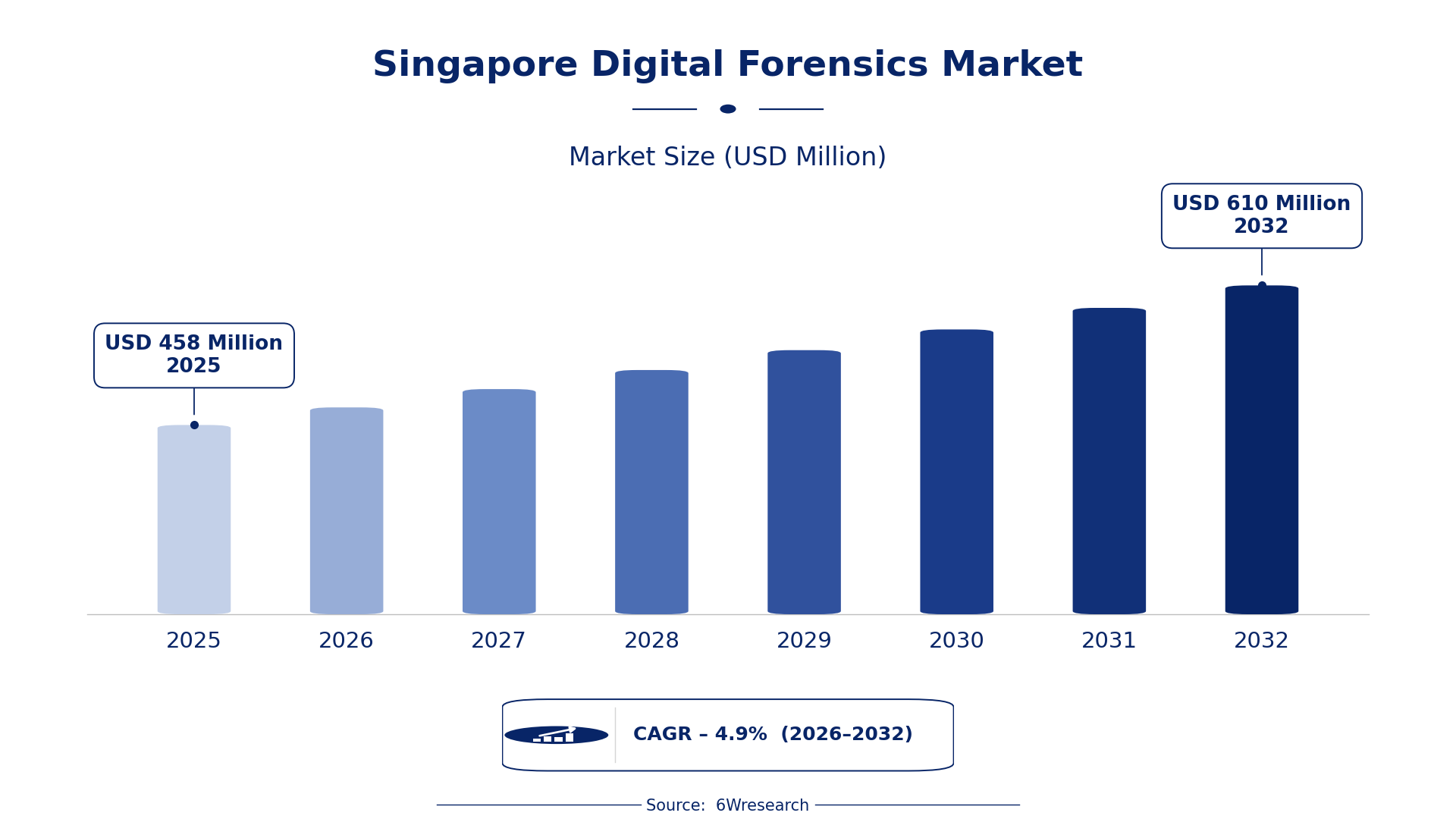
The Singapore Digital Forensics Market was estimated at USD 458 Million in 2025 and is projected to reach USD 610 Million by 2032, growing at a CAGR of 4.9% from 2026 to 2032.
Singapore Digital Forensics Market Synopsis
Cybercrime is on the rise, and Singapore is not immune. The urgency for effective digital forensics solutions has become evident, especially as organizations face unprecedented cyber threats. The market for digital forensics is witnessing heightened demand from law enforcement and private sectors alike, all striving to safeguard sensitive information and tackle criminal activities head-on.
As digital investigations gain prominence, the Singapore Digital Forensics Market is evolving rapidly. Companies and government bodies alike are recognizing the necessity of specialized tools and services designed for recovering and analyzing digital evidence. This focus on digital evidence is crucial for legal compliance and effective incident response strategies.
Singapore Digital Forensics Market Year-wise Growth Rate and Key Drivers
This graph illustrates the annual growth rates of the Singapore Digital Forensics Market from 2021 to 2032, highlighting a steady upward trajectory and projected expansion over the forecast period.
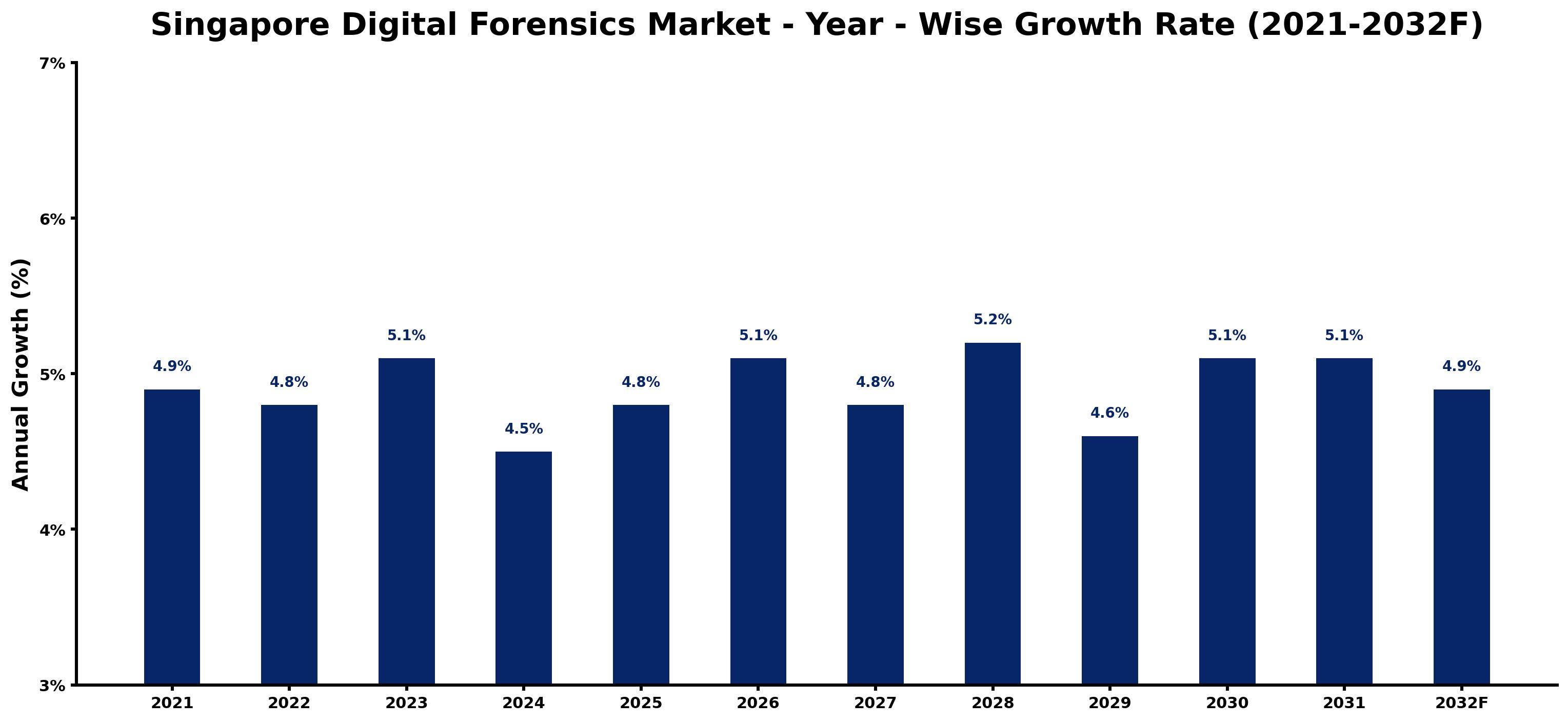
The table below presents the year‑wise growth rates along with the key drivers influencing the market
| Year | Growth Rate | Major Drivers |
| 2021 | 4.9% | Singapore's Cybersecurity Act mandates digital forensics capabilities. |
| 2022 | 4.8% | Increased cyber attack incidents drive forensic service demand. |
| 2023 | 5.1% | Growing fintech sector enhances need for digital investigations. |
| 2024 | 4.5% | Government initiatives promote data protection and privacy laws. |
| 2025 | 4.8% | Rising adoption of blockchain enhances forensic analysis requirements. |
| 2026 | 5.1% | Telecommunication sector growth necessitates advanced digital evidence handling. |
| 2027 | 4.8% | Expanding e-commerce highlights fraud detection and forensic needs. |
| 2028 | 5.2% | Emergence of AI tools boosts digital forensics efficiency. |
| 2029 | 4.6% | Educational programs in cybersecurity promote forensic skill development. |
| 2030 | 5.1% | Increased regulatory scrutiny on data breaches fuels forensics growth. |
| 2031 | 5.1% | Hosting major international events escalates cybersecurity preparedness demands. |
| 2032 | 4.9% | Growing remote work trends increase digital forensic investigations. |
Note: Market size estimations and growth projections presented in this report are based on 6Wresearch's proprietary forecasting methodology, utilizing the latest available industry data, government publications, and primary research inputs.
Singapore Digital Forensics Market Key Takeaways
Below are some of the specific key takeaways from the market, including:
- The market is driven by increasing incidents of cybercrime and the demand for data security solutions.
- Technological advancements are enhancing the capabilities of digital forensics tools.
- There is a pressing need for skilled professionals to maintain integrity in digital evidence collection.
- Government policies are evolving to support better infrastructure for digital investigations.
- The COVID-19 pandemic significantly impacted market growth, accelerating the need for digital forensics services.
Evaluation of Restraints in Singapore Digital Forensics Market
One of the primary challenges in the Singapore Digital Forensics Market is the complexity associated with maintaining the integrity of digital evidence. Professionals in this field must navigate evolving technologies that cybercriminals employ, often outpacing the methods used by investigators. This gap complicates investigations, as does the necessity of ensuring that collected evidence remains admissible in court. Additionally, the shortage of qualified digital forensics experts exacerbates these challenges, limiting the availability of timely expertise for organizations facing cyber incidents.
Singapore Digital Forensics Market Trends
Emerging trends indicate a shift towards AI-driven solutions in digital forensics. These technologies streamline the process of data analysis, allowing for quicker identification of threats and evidence. on top of that, there is an increasing focus on collaboration between private firms and government agencies, aimed at enhancing investigative capabilities. As organizations recognize the value of proactive measures, investment in preventive digital forensics is becoming a standard practice.
Singapore Digital Forensics Market Opportunities
With the rise in cyber threats, investment in digital forensics presents substantial opportunities. Companies can capitalize on advanced forensic software and analytics tools to improve their security postures. Additionally, as legal frameworks adapt to digital evidence, firms specializing in compliance will find new markets. The government’s push for better cybersecurity infrastructure also opens avenues for partnerships and technological advancements in the field.
Government Initiatives in the Singapore Digital Forensics Market
The Singapore government is increasingly aware of the implications of cybercrime, which has prompted a more proactive regulatory approach towards digital forensics. With an emphasis on both security and legal compliance, government policies are shaping the digital forensics market to ensure that investigative processes are both efficient and reliable. Investment in training and technology is critical to keeping pace with the challenges faced by law enforcement and private organizations alike.
- A recent national cybersecurity initiative launched in 2023 focuses on enhancing digital forensics capabilities among law enforcement agencies.
- The establishment of a dedicated task force aimed at promoting collaboration between public and private sectors is currently underway.
- A planned training program for digital forensics professionals is expected to begin in 2025, aimed at improving skillsets in evidence handling.
- Regulatory updates introduced in early 2024 are enhancing legal frameworks surrounding the use of digital evidence in investigations.
- Ongoing discussions about a public-private partnership aimed at upgrading digital forensic tools and techniques are expected to yield results by mid-2026.
Future Insights of the Singapore Digital Forensics Market
Looking ahead, the Singapore Digital Forensics Market is set for continuous growth driven by the persistent threat of cybercrime. The integration of advanced technologies such as artificial intelligence and machine learning will revolutionize data analysis, significantly reducing the time taken to investigate incidents. As regulatory demands increase, organizations will have no choice but to enhance their digital forensics capabilities, paving the way for sustained market expansion through 2032.
Singapore Digital Forensics Market Latest Developments
In the last year, the Singapore Digital Forensics Market has experienced notable activity, with companies striving to enhance their offerings in response to escalating cyber threats. This has included the launch of innovative tools designed to facilitate faster data recovery and analysis. The collaboration between various sectors has also intensified, aimed at fortifying the cybersecurity landscape.
- A leading cybersecurity firm launched an advanced digital forensics tool in Q2 2023, enhancing incident response times significantly.
- A major technology vendor is currently expanding its digital forensics service suite to include AI-driven analytics, expected to launch by late 2023.
- An initiative aimed at creating a national repository for digital evidence commenced in early 2024 and is ongoing.
- A partnership between tech startups and law enforcement agencies is focused on training investigators in new forensic methodologies, set to commence in early 2025.
- An upcoming conference in late 2025 will focus on best practices in digital forensics, bringing together experts from various sectors.
Singapore Digital Forensics Market - Key Attractiveness of the Report
- 10 Years of Market Numbers
- Historical Data Starting from 2022 to 2025
- Base Year: 2025
- Forecast Data until 2032
- Key Performance Indicators Impacting the Market
- Major Upcoming Developments and Projects
Key Highlights of the Report:
- Singapore Digital Forensics Market Outlook
- Market Size of Singapore Digital Forensics Market, 2025
- Forecast of Singapore Digital Forensics Market, 2032
- Historical Data and Forecast of Singapore Digital Forensics Revenues & Volume for the Period 2022-2032F
- Singapore Digital Forensics Market Trend Evolution
- Singapore Digital Forensics Market Drivers and Challenges
- Singapore Digital Forensics Price Trends
- Singapore Digital Forensics Porter's Five Forces
- Singapore Digital Forensics Industry Life Cycle
- Historical Data and Forecast of Singapore Digital Forensics Market Revenues & Volume By Component for the Period 2022-2032F
- Historical Data and Forecast of Singapore Digital Forensics Market Revenues & Volume By Hardware for the Period 2022-2032F
- Historical Data and Forecast of Singapore Digital Forensics Market Revenues & Volume By Software for the Period 2022-2032F
- Historical Data and Forecast of Singapore Digital Forensics Market Revenues & Volume By Services for the Period 2022-2032F
- Historical Data and Forecast of Singapore Digital Forensics Market Revenues & Volume By Type for the Period 2022-2032F
- Historical Data and Forecast of Singapore Digital Forensics Market Revenues & Volume By Computer Forensics for the Period 2022-2032F
- Historical Data and Forecast of Singapore Digital Forensics Market Revenues & Volume By Network Forensics for the Period 2022-2032F
- Historical Data and Forecast of Singapore Digital Forensics Market Revenues & Volume By Mobile Device Forensics for the Period 2022-2032F
- Historical Data and Forecast of Singapore Digital Forensics Market Revenues & Volume By Cloud Forensics for the Period 2022-2032F
- Historical Data and Forecast of Singapore Digital Forensics Market Revenues & Volume By Tool for the Period 2022-2032F
- Historical Data and Forecast of Singapore Digital Forensics Market Revenues & Volume By Vertical for the Period 2022-2032F
- Singapore Digital Forensics Import Export Trade Statistics
- Market Opportunity Assessment By Component
- Market Opportunity Assessment By Type
- Market Opportunity Assessment By Tool
- Market Opportunity Assessment By Vertical
- Singapore Digital Forensics Top Companies Market Share
- Singapore Digital Forensics Competitive Benchmarking By Technical and Operational Parameters
- Singapore Digital Forensics Company Profiles
- Singapore Digital Forensics Key Strategic Recommendations






































