Singapore Electrical Components Market Size, Share & Growth Rate
The Singapore Electrical Components Market was estimated at USD 383 Million in 2025 and is projected to reach USD 521 Million by 2032, growing at a CAGR of 4.5% from 2026 to 2032. This robust growth trajectory can be attributed to the ongoing advancements in electrical technology and an upsurge in infrastructure projects that necessitate reliable power distribution and control solutions. Additionally, the increasing adoption of energy-efficient systems and IoT-enabled components underscores the market's expanding role in supporting Singapore's evolving energy landscape.
Singapore Electrical Components Market Year-wise Growth Rate and Key Drivers
This graph highlights how the Singapore Electrical Components Market has steadily grown over the years, supported by major growth factors.
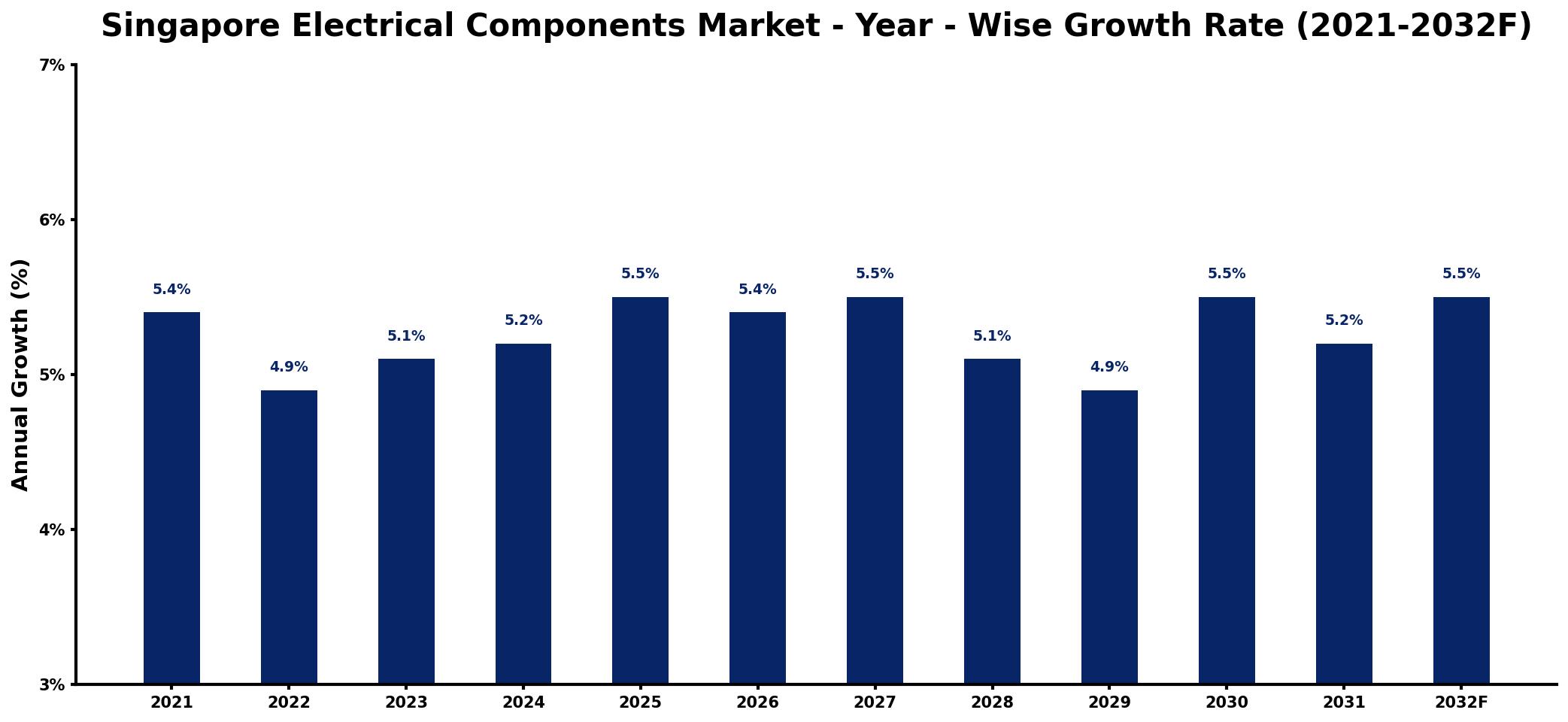
The table below presents the year‑wise growth rates along with the key drivers influencing the market
| Year | Growth Rate | Major Drivers |
| 2021 | 5.4% | Rising demand from technology sector |
| 2022 | 4.9% | Increased investments in renewable energy |
| 2023 | 5.1% | Expansion of smart home solutions |
| 2024 | 5.2% | Growth in automotive electronics sector |
| 2025 | 5.5% | Surge in industrial automation projects |
| 2026 | 5.4% | Emergence of IoT applications |
| 2027 | 5.5% | Development of sustainable energy initiatives |
| 2028 | 5.1% | growing regional consumption patterns |
| 2029 | 4.9% | Increased focus on energy efficiency |
| 2030 | 5.5% | growing commercial sector adoption |
| 2031 | 5.2% | increased overall sector activity |
| 2032 | 5.5% | Investments in green technology solutions |
Note: Market size estimations and growth projections presented in this report are based on 6Wresearch's proprietary forecasting methodology, utilizing the latest available industry data, government publications, and primary research inputs.
Singapore Electrical Components Market Synopsis
In recent years, the Singapore electrical components market has witnessed significant momentum, bolstered by strong demand across various sectors. As the market transitions towards the future, it is set to face new challenges, yet the continuous emphasis on safety and efficiency remains a constant driving force. With the emergence of smart technologies and a greater focus on sustainability, the landscape is evolving.
While the recent pandemic highlighted the essential nature of electrical components in critical infrastructure, the market is now poised for growth as industries ramp up their investments in automation and renewable energy solutions. A commitment to enhancing the electrical infrastructure will further propel the sector, providing numerous opportunities for innovation and expansion.
Singapore Electrical Components Market Key Takeaways
- Resilience during the COVID-19 pandemic underscored the critical role of electrical components across industries.
- Infrastructure development and industrial automation drive a consistent demand for electrical solutions.
- The growing adoption of smart technologies and IoT-enabled components is reshaping the market landscape.
- Manufacturers are increasingly focused on sustainability and energy-efficient solutions to meet regulatory demands.
- The competitive landscape is defined by rapid technological advancements and global supplier competition.
Evaluation of Restraints in Singapore Electrical Components Market
Despite its promising growth outlook, the Singapore electrical components market grapples with several constraints. Rapid technological advancements lead to a constant need for product innovation, which can strain manufacturers striving to keep pace with trends. Additionally, the presence of international competitors exacerbates cost pressures, compelling local players to balance quality and price effectively. As the market evolves, these challenges necessitate strategic agility and ongoing investment in R&D to maintain relevance.
Singapore Electrical Components Market Trends
Emerging trends are poised to shape the Singapore electrical components market significantly. The rise of renewable energy systems is driving demand for components that support energy efficiency and grid reliability. Moreover, the integration of smart technologies, such as IoT solutions, is redefining traditional applications, fostering a shift toward smarter electrical systems. These trends not only enhance operational efficiency but also align with Singapore's sustainability goals, making them pivotal in determining market dynamics.
Singapore Electrical Components Market Opportunities
Genuine growth opportunities in the Singapore electrical components market lie in innovation and collaboration. The increasing focus on smart buildings and green technologies presents a fertile ground for manufacturers to introduce advanced solutions that meet evolving consumer demands. Additionally, partnerships with tech companies to develop IoT-enabled components can further enhance market presence. As industries across construction and energy sectors invest in modern electrical systems, the potential for growth is substantial.
Government Initiatives in the Singapore Electrical Components Market
The Singapore government actively supports the electrical components market through various initiatives aimed at enhancing infrastructure and promoting sustainability. Public spending on smart city projects and renewable energy systems drives demand for innovative electrical solutions. Furthermore, incentives and programs targeting energy efficiency and technology adoption encourage manufacturers to invest in cutting-edge technologies, reinforcing the sector's growth potential while aligning with national sustainability objectives.
Future Insights of the Singapore Electrical Components Market
Looking ahead to 2026-2032, the Singapore electrical components market is likely to continue its upward trajectory, fueled by a blend of technological advancements and increased investment in infrastructure. As industries embrace smart solutions and prioritize energy efficiency, the demand for advanced electrical components will surge. Additionally, government initiatives aimed at fostering innovation will further empower manufacturers to meet market needs, creating a dynamic environment ripe for growth.
Singapore Electrical Components Market Latest Developments (2025 - 2026)
In the recent months leading up to mid-2026, the Singapore electrical components market has seen a shift towards more digital and energy-efficient solutions. Manufacturers have been actively adopting new technologies to enhance product offerings, particularly in response to heightened environmental awareness. There has been a noticeable push for integrating IoT capabilities within electrical components to support the demand for smart home and industrial applications. This direction underscores a collective effort to enhance sustainability and operational efficiency across various sectors.
Singapore Electrical Components Market - Key Attractiveness of the Report
- 10 Years of Market Numbers
- Historical Data Starting from 2022 to 2025
- Base Year: 2025
- Forecast Data until 2032
- Key Performance Indicators Impacting the Market
- Major Upcoming Developments and Projects
Key Highlights of the Report:
- Singapore Electrical Components Market Outlook
- Market Size of Singapore Electrical Components Market, 2025
- Forecast of Singapore Electrical Components Market, 2032
- Historical Data and Forecast of Singapore Electrical Components Revenues & Volume for the Period 2022-2032F
- Singapore Electrical Components Market Trend Evolution
- Singapore Electrical Components Market Drivers and Challenges
- Singapore Electrical Components Price Trends
- Singapore Electrical Components Porter's Five Forces
- Singapore Electrical Components Industry Life Cycle
- Historical Data and Forecast of Singapore Electrical Components Market Revenues & Volume By Building Automation for the Period 2022-2032F
- Historical Data and Forecast of Singapore Electrical Components Market Revenues & Volume By Datacom Accessories for the Period 2022-2032F
- Historical Data and Forecast of Singapore Electrical Components Market Revenues & Volume By Security & wiring Accessories for the Period 2022-2032F
- Historical Data and Forecast of Singapore Electrical Components Market Revenues & Volume By Cables & Wires for the Period 2022-2032F
- Historical Data and Forecast of Singapore Electrical Components Market Revenues & Volume By Datacom Cables for the Period 2022-2032F
- Historical Data and Forecast of Singapore Electrical Components Market Revenues & Volume By LV Cables for the Period 2022-2032F
- Historical Data and Forecast of Singapore Electrical Components Market Revenues & Volume By MV&HV Cables for the Period 2022-2032F
- Historical Data and Forecast of Singapore Electrical Components Market Revenues & Volume By Special Cables for the Period 2022-2032F
- Historical Data and Forecast of Singapore Electrical Components Market Revenues & Volume By Industrial Automation for the Period 2022-2032F
- Historical Data and Forecast of Singapore Electrical Components Market Revenues & Volume By Automation Controls for the Period 2022-2032F
- Historical Data and Forecast of Singapore Electrical Components Market Revenues & Volume By Auxiliary Controls for the Period 2022-2032F
- Historical Data and Forecast of Singapore Electrical Components Market Revenues & Volume By Drives & Motion Controls for the Period 2022-2032F
- Historical Data and Forecast of Singapore Electrical Components Market Revenues & Volume By Measurement Controls and Relays for the Period 2022-2032F
- Historical Data and Forecast of Singapore Electrical Components Market Revenues & Volume By Lighting for the Period 2022-2032F
- Historical Data and Forecast of Singapore Electrical Components Market Revenues & Volume By Fixtures for the Period 2022-2032F
- Historical Data and Forecast of Singapore Electrical Components Market Revenues & Volume By Lamps & LEDs for the Period 2022-2032F
- Historical Data and Forecast of Singapore Electrical Components Market Revenues & Volume By Power Distribution for the Period 2022-2032F
- Historical Data and Forecast of Singapore Electrical Components Market Revenues & Volume By Cable Management for the Period 2022-2032F
- Historical Data and Forecast of Singapore Electrical Components Market Revenues & Volume By Enclosures & Panels for the Period 2022-2032F
- Historical Data and Forecast of Singapore Electrical Components Market Revenues & Volume By LV Electrical Distribution for the Period 2022-2032F
- Historical Data and Forecast of Singapore Electrical Components Market Revenues & Volume By Renewable Energies for the Period 2022-2032F
- Historical Data and Forecast of Singapore Electrical Components Market Revenues & Volume By HVAC for the Period 2022-2032F
- Historical Data and Forecast of Singapore Electrical Components Market Revenues & Volume By Renewable energy for the Period 2022-2032F
- Historical Data and Forecast of Singapore Electrical Components Market Revenues & Volume By Safety & Tools for the Period 2022-2032F
- Historical Data and Forecast of Singapore Electrical Components Market Revenues & Volume By Safety Equipment for the Period 2022-2032F
- Historical Data and Forecast of Singapore Electrical Components Market Revenues & Volume By Working Tools & Accessories for the Period 2022-2032F
- Singapore Electrical Components Import Export Trade Statistics
- Market Opportunity Assessment By Building Automation
- Market Opportunity Assessment By Cables & Wires
- Market Opportunity Assessment By Industrial Automation
- Market Opportunity Assessment By Lighting
- Market Opportunity Assessment By Power Distribution
- Market Opportunity Assessment By Renewable Energies
- Market Opportunity Assessment By Safety & Tools
- Singapore Electrical Components Top Companies Market Share
- Singapore Electrical Components Competitive Benchmarking By Technical and Operational Parameters
- Singapore Electrical Components Company Profiles
- Singapore Electrical Components Key Strategic Recommendations






































