Singapore Fiberglass Wall Meshes Market Summary
The singapore fiberglass wall meshes market was estimated at USD 188 Million in 2025 and is projected to reach USD 244 Million by 2032, growing at a CAGR of 4.9% from 2026 to 2032.
Singapore Fiberglass Wall Meshes Market Year-wise Growth Rate and Key Drivers
This graph highlights how the Singapore Fiberglass Wall Meshes Market has steadily grown over the past five years, supported by major growth factors.
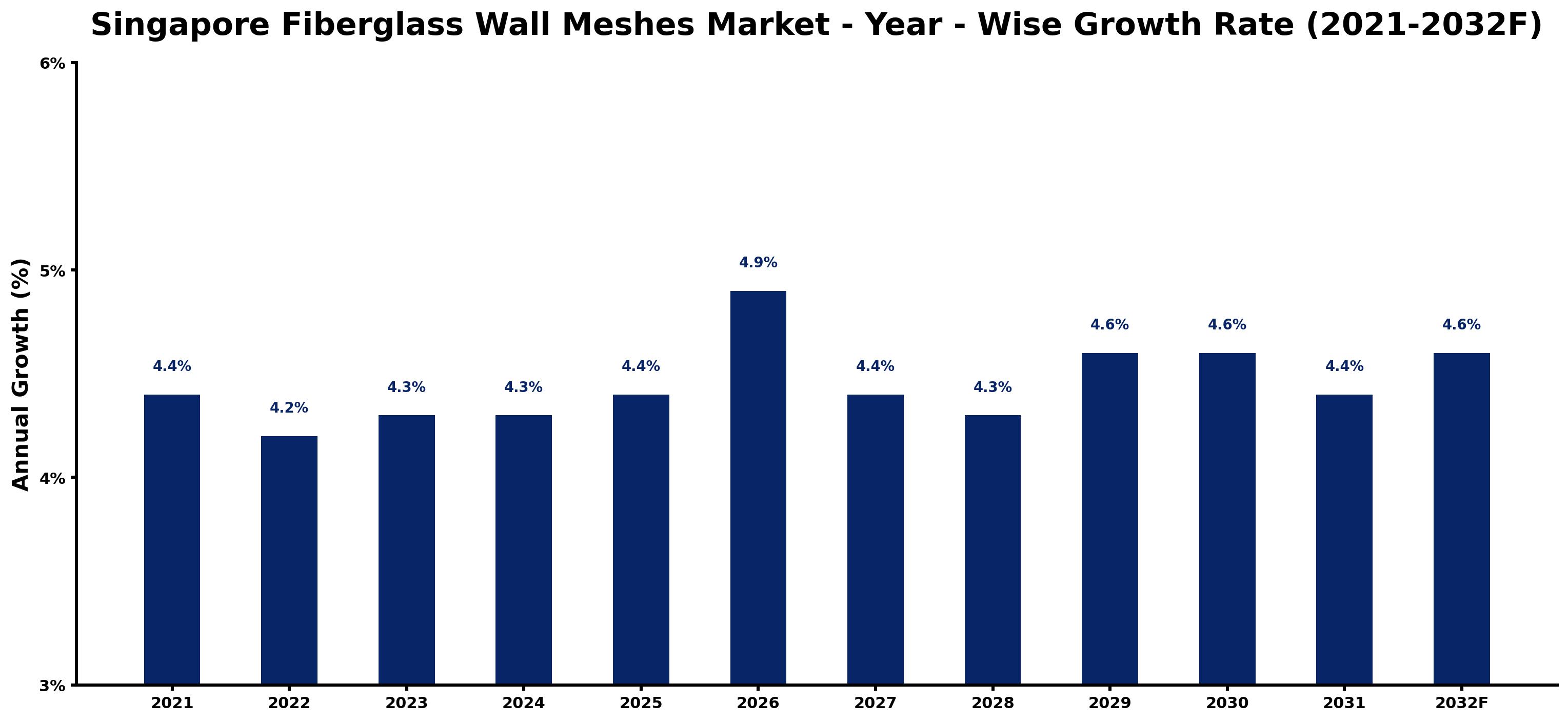
The table below presents the year wise growth rates along with the key drivers influencing the market
| Year | Growth Rate | Major Drivers |
| 2021 | 4.4% | Post-lockdown construction projects catalyze heightened interest in durable fiberglass wall meshes. |
| 2022 | 4.2% | Urban redevelopment initiatives in Singapore emphasize the need for stronger building materials. |
| 2023 | 4.3% | Growing awareness about the benefits of fiberglass in moisture-rich environments shapes preferences. |
| 2024 | 4.3% | Increased focus on sustainable construction materials propels fiberglass mesh market acceptance. |
| 2025 | 4.4% | Technological advancements in manufacturing create more efficient production methods for fiberglass meshes. |
| 2026 | 4.9% | Collaborations between builders and suppliers enhance quality control in fiberglass mesh installations. |
| 2027 | 4.4% | Rising demand for resilient materials in high-humidity conditions influences product development. |
| 2028 | 4.3% | Market players begin offering tailored solutions for specific architectural designs and requirements. |
| 2029 | 4.6% | Construction sector expansion drives the need for lightweight and versatile wall mesh options. |
| 2030 | 4.6% | Awareness of the energy efficiency benefits of fiberglass materials grows among developers. |
| 2031 | 4.4% | Increased exports of Singapore-manufactured fiberglass meshes boost regional market competitiveness. |
| 2032 | 4.6% | Emerging trends in smart building technologies create new applications for fiberglass wall meshes. |
Note - Market size estimations and growth projections presented in this report are based on 6Wresearch's advanced forecasting approach, validated with industry datasets as of June 2026.
Singapore Fiberglass Wall Meshes Market Synopsis
The Singapore Fiberglass Wall Meshes Market is projected to reach 4.9% and witness significant growth during the forecast period (2026-2032). This expansion is primarily driven by the increasing demand for durable and flexible construction materials that exhibit strong resistance to corrosion and fire hazards. As the construction industry evolves, builders, architects, and designers are increasingly recognizing the benefits of integrating fiberglass mesh into their projects, which is expected to further bolster market growth. In addition, the rise in infrastructure investments and government initiatives promoting sustainable building practices are anticipated to support market expansion over the forecasted years.
Singapore Fiberglass Wall Meshes Market Growth Drivers
Various factors are propelling the growth of the Singapore Fiberglass Wall Meshes Market. Firstly, the escalating need for these materials in end-use industries such as construction, automotive, and electrical & electronics underpins market demand. Furthermore, technological advancements have led to improved performance characteristics of fiberglass wall meshes, making them more appealing to a broader consumer base. Stringent environmental regulations have also encouraged industries to adopt fiberglass meshes as a sustainable alternative, which is gaining acceptance across numerous sectors. This is complemented by the increasing availability of cost-effective raw materials, which enhances profit margins for manufacturers. Moreover, the favorable economic conditions in Singapore are facilitating investments in research and development activities aimed at product innovation, thereby enriching the market landscape.
Singapore Fiberglass Wall Meshes Market Challenges and Restraints
Despite the promising growth prospects, the Singapore Fiberglass Wall Meshes Market faces several challenges that could impede progress during the forecast period. A significant barrier is the lack of awareness regarding the specific advantages and features of fiberglass wall meshes among smaller enterprises, particularly within the residential sector. Additionally, fluctuations in raw material prices can introduce uncertainty for investors and manufacturers, complicating pricing strategies and market entry. Stringent import regulations may also pose challenges for new entrants aiming to penetrate the market, limiting opportunities for expansion and innovation. Furthermore, evolving trends within the construction industry may create obstacles for companies that struggle to adapt quickly, potentially affecting overall market competitiveness.
Singapore Fiberglass Wall Meshes Market Government Investment and Initiatives
The Singapore government has been proactive in advocating for sustainable building practices, providing a conducive environment for the growth of the fiberglass wall meshes market. Public spending on infrastructure development is being prioritized, with significant investments aimed at enhancing the country's structural integrity through advanced materials like fiberglass. Initiatives promoting green building certifications further encourage the use of eco-friendly materials in construction projects. Additionally, incentives for research and development in the building materials sector are fostering innovation, allowing businesses to improve product offerings in alignment with market demand and regulatory requirements. These efforts underlie the government's commitment to driving sustainable development while enhancing the overall quality of construction projects in Singapore.
Singapore Fiberglass Wall Meshes Market Latest Developments (May 2025 - June 2026)
In the period from May 2025 to June 2026, the fiberglass wall meshes market in Singapore has witnessed notable developments. Manufacturers are increasingly focusing on enhancing their production capabilities to meet rising demand, driven by the ongoing recovery in the construction sector post-pandemic. Innovations in material formulations and manufacturing processes have led to the introduction of higher-performance fiberglass meshes that cater to diverse applications. Additionally, strategic partnerships and collaborations among stakeholders in the industry are facilitating knowledge exchange and resource sharing aimed at overcoming challenges presented by fluctuating raw material costs. These efforts are collectively aiming to align product offerings with the evolving needs of the market, ensuring that businesses remain competitive in a dynamic economic landscape.
Singapore Fiberglass Wall Meshes Market - Key Attractiveness of the Report
- 10 Years of Market Numbers
- Historical Data Starting from 2022 to 2025
- Base Year: 2025
- Forecast Data until 2032
- Key Performance Indicators Impacting the Market
- Major Upcoming Developments and Projects
Key Highlights of the Report:
- Singapore Fiberglass Wall Meshes Market Outlook
- Market Size of Singapore Fiberglass Wall Meshes Market, 2025
- Forecast of Singapore Fiberglass Wall Meshes Market, 2032F
- Historical Data and Forecast of Singapore Fiberglass Wall Meshes Revenues & Volume for the Period 2022-2032F
- Singapore Fiberglass Wall Meshes Market Trend Evolution
- Singapore Fiberglass Wall Meshes Market Drivers and Challenges
- Singapore Fiberglass Wall Meshes Price Trends
- Singapore Fiberglass Wall Meshes Porter's Five Forces
- Singapore Fiberglass Wall Meshes Industry Life Cycle
- Historical Data and Forecast of Singapore Fiberglass Wall Meshes Market Revenues & Volume By Type for the Period 2022-2032F
- Historical Data and Forecast of Singapore Fiberglass Wall Meshes Market Revenues & Volume By C-Glass for the Period 2022-2032F
- Historical Data and Forecast of Singapore Fiberglass Wall Meshes Market Revenues & Volume By E-Glass for the Period 2022-2032F
- Historical Data and Forecast of Singapore Fiberglass Wall Meshes Market Revenues & Volume By Others for the Period 2022-2032F
- Historical Data and Forecast of Singapore Fiberglass Wall Meshes Market Revenues & Volume By Applications for the Period 2022-2032F
- Historical Data and Forecast of Singapore Fiberglass Wall Meshes Market Revenues & Volume By External Wall Insulation for the Period 2022-2032F
- Historical Data and Forecast of Singapore Fiberglass Wall Meshes Market Revenues & Volume By Building Waterproof for the Period 2022-2032F
- Historical Data and Forecast of Singapore Fiberglass Wall Meshes Market Revenues & Volume By Others for the Period 2022-2032F
- Singapore Fiberglass Wall Meshes Import Export Trade Statistics
- Market Opportunity Assessment By Type
- Market Opportunity Assessment By Applications
- Singapore Fiberglass Wall Meshes Top Companies Market Share
- Singapore Fiberglass Wall Meshes Competitive Benchmarking By Technical and Operational Parameters
- Singapore Fiberglass Wall Meshes Company Profiles
- Singapore Fiberglass Wall Meshes Key Strategic Recommendations






































