Singapore Greenhouse, Nursery, and Flowers Market: Import Trend Analysis
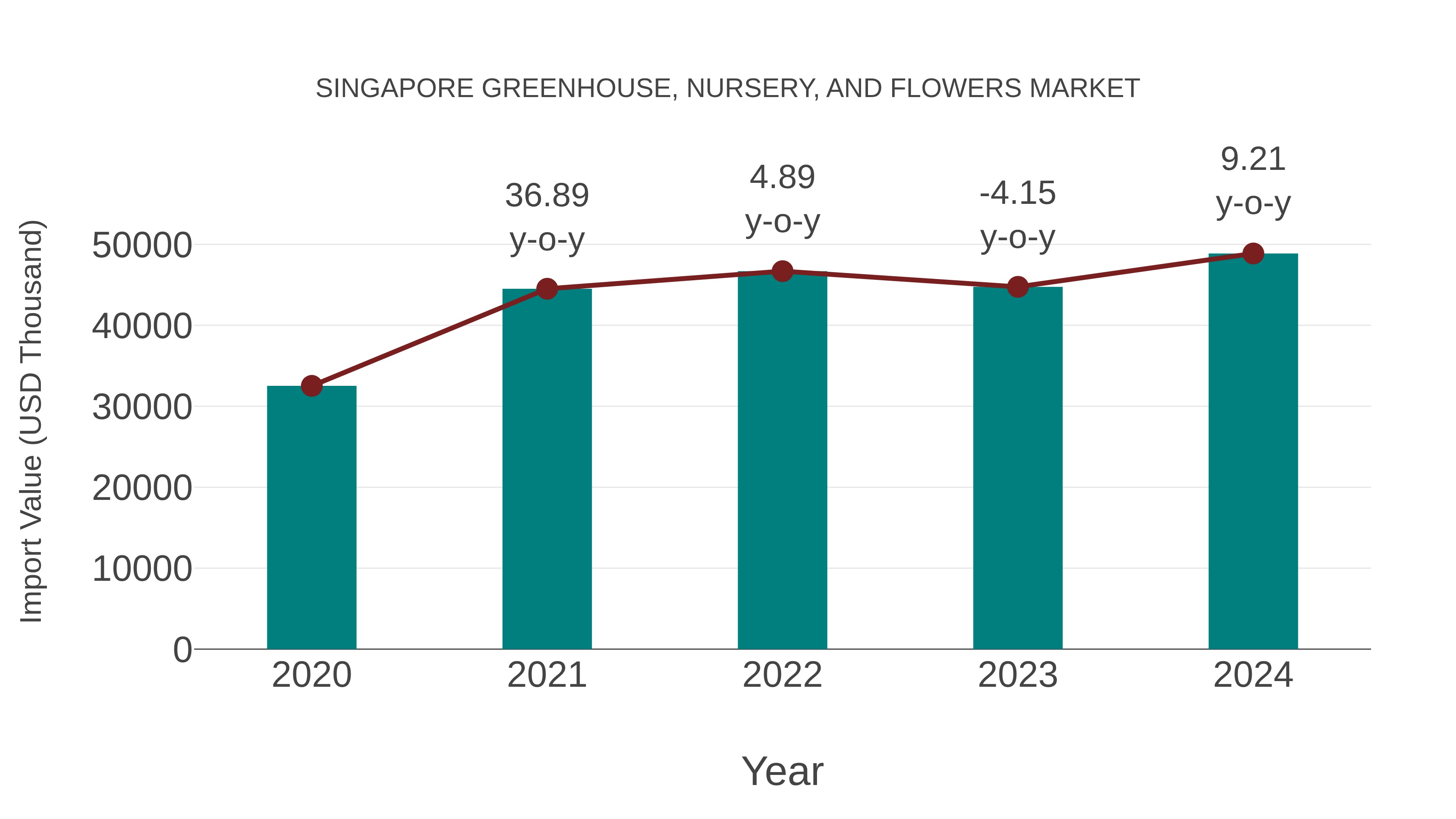
In 2024, Singapore`s import trend for the greenhouse, nursery, and flowers market exhibited a growth rate of 9.21% compared to the previous year. The compound annual growth rate (CAGR) for the period 2020-2024 stood at 10.72%. This import momentum can be attributed to increased consumer demand for a variety of floral products, indicating market stability and sustained interest in horticultural imports during this period.
Singapore Greenhouse Nursery and Flowers Market Synopsis
The greenhouse nursery and flowers market in Singapore cater to the demand for ornamental plants and flowers, both for domestic and commercial use. The country`s landscaping and horticulture sectors rely on nurseries to provide a wide variety of plants for beautification and landscaping projects. The market`s growth is driven by the emphasis on green spaces and aesthetic appeal in Singapore urban environment.
Drivers of the Market
The growth of the Singapore greenhouse nursery and flowers market is influenced by factors such as landscaping, ornamental plants, and floral aesthetics. Greenhouse nurseries produce a wide range of plants, including flowers and ornamental foliage. Growth drivers encompass the demand for diverse and well-maintained plant varieties, innovations in greenhouse management for plant health, and applications in landscaping projects, garden centers, and interior decor. As green spaces and floral beautification thrive, the greenhouse nursery and flowers market are expected to grow, providing essential plants and blooms for aesthetic enhancements.
Challenges of the Market
The greenhouse nursery and flowers market in Singapore confronts challenges associated with floral imports and consumer preferences. Singapore relies heavily on flower imports, making it vulnerable to supply chain disruptions. Additionally, addressing concerns about floral quality, freshness, and adherence to sustainability practices is crucial to meet consumer preferences and environmental goals.
COVID-19 Impact on the Market
The greenhouse nursery and flowers market in Singapore navigated the COVID-19 pandemic with adaptability. While there were disruptions in some supply chains, greenhouse-grown plants and flowers remained popular for landscaping and gardening purposes. Growers and suppliers adapted by offering a variety of ornamental plants and flowers. The pandemic underscored the importance of green spaces and home gardening, influencing market strategies.
Key Players in the Market
Grain farming in Singapore is limited due to space constraints, and the market is primarily dependent on imports. Key players in the grain market include major international grain suppliers and trading companies such as Olam International and Wilmar International.
Key Highlights of the Report:
- Singapore Greenhouse, Nursery, And Flowers Market Outlook
- Market Size of Singapore Greenhouse, Nursery, And Flowers Market, 2025
- Forecast of Singapore Greenhouse, Nursery, And Flowers Market, 2032
- Historical Data and Forecast of Singapore Greenhouse, Nursery, And Flowers Revenues & Volume for the Period 2022-2032F
- Singapore Greenhouse, Nursery, And Flowers Market Trend Evolution
- Singapore Greenhouse, Nursery, And Flowers Market Drivers and Challenges
- Singapore Greenhouse, Nursery, And Flowers Price Trends
- Singapore Greenhouse, Nursery, And Flowers Porter's Five Forces
- Singapore Greenhouse, Nursery, And Flowers Industry Life Cycle
- Historical Data and Forecast of Singapore Greenhouse, Nursery, And Flowers Market Revenues & Volume By Type for the Period 2022-2032F
- Historical Data and Forecast of Singapore Greenhouse, Nursery, And Flowers Market Revenues & Volume By Food Crops Grown Under Cover for the Period 2022-2032F
- Historical Data and Forecast of Singapore Greenhouse, Nursery, And Flowers Market Revenues & Volume By Nursery and Floriculture Production for the Period 2022-2032F
- Historical Data and Forecast of Singapore Greenhouse, Nursery, And Flowers Market Revenues & Volume By End-User for the Period 2022-2032F
- Historical Data and Forecast of Singapore Greenhouse, Nursery, And Flowers Market Revenues & Volume By B2B for the Period 2022-2032F
- Historical Data and Forecast of Singapore Greenhouse, Nursery, And Flowers Market Revenues & Volume By B2C for the Period 2022-2032F
- Singapore Greenhouse, Nursery, And Flowers Import Export Trade Statistics
- Market Opportunity Assessment By Type
- Market Opportunity Assessment By End-User
- Singapore Greenhouse, Nursery, And Flowers Top Companies Market Share
- Singapore Greenhouse, Nursery, And Flowers Competitive Benchmarking By Technical and Operational Parameters
- Singapore Greenhouse, Nursery, And Flowers Company Profiles
- Singapore Greenhouse, Nursery, And Flowers Key Strategic Recommendations






































