Singapore Ladders Market Size, Share & Growth Rate
The Singapore Ladders Market was estimated at USD 765 Million in 2025 and is projected to reach USD 1099 Million by 2032, growing at a CAGR of 5.3% from 2026 to 2032. This growth trajectory is largely driven by the flourishing construction and maintenance sectors within both residential and commercial domains, where the demand for safe and efficient access solutions is paramount. As Singapore continues to evolve its infrastructure, ladders are not merely accessories but critical tools in ensuring safety and productivity in various work environments.
Singapore Ladders Market Year-wise Growth Rate and Key Drivers
This graph highlights how the Singapore Ladders Market has steadily grown over the years, supported by major growth factors.
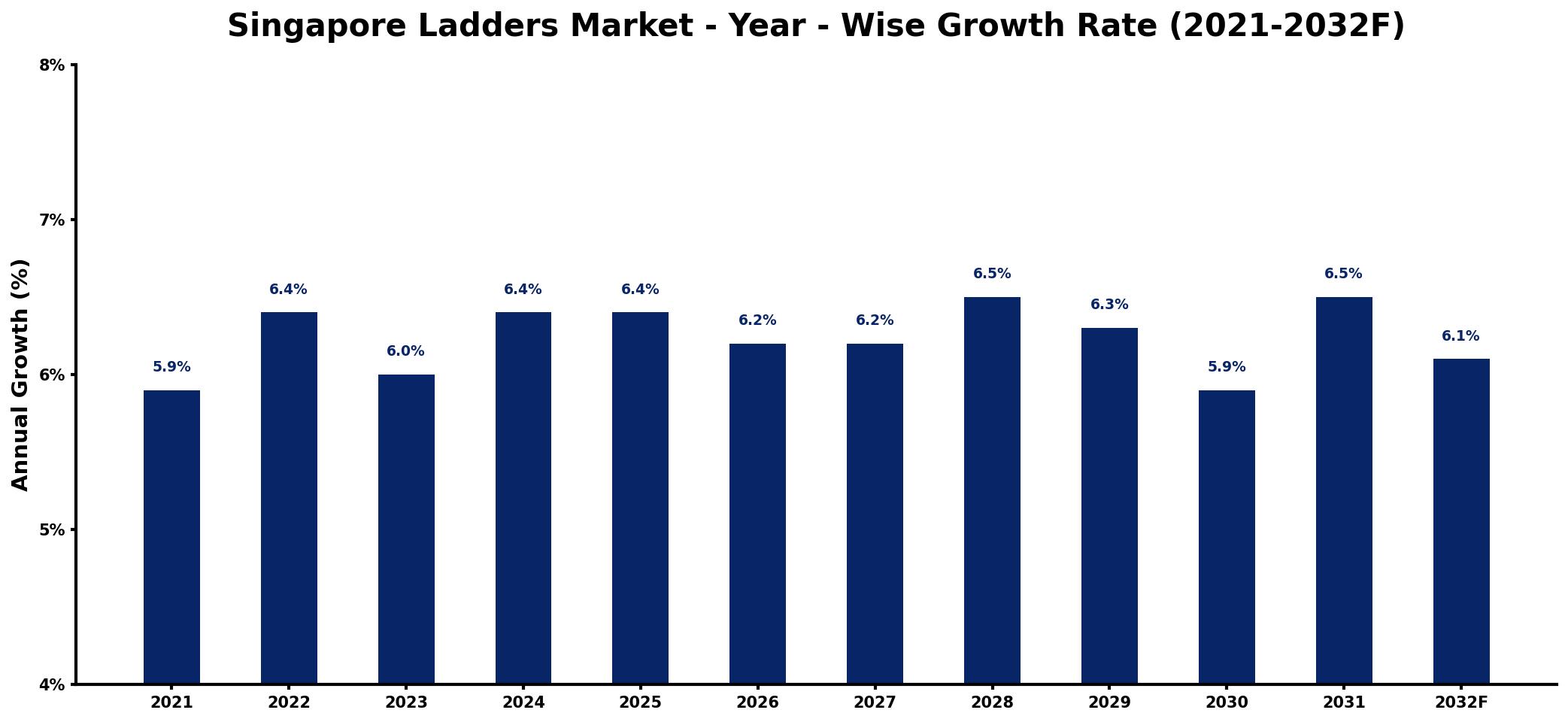
The table below presents the year‑wise growth rates along with the key drivers influencing the market
| Year | Growth Rate | Major Drivers |
| 2021 | 5.9% | Rising construction sector investments |
| 2022 | 6.4% | Increased home renovation projects |
| 2023 | 6.0% | Growth in DIY consumer activities |
| 2024 | 6.4% | Expansion of commercial infrastructure |
| 2025 | 6.4% | Surge in outdoor recreational activities |
| 2026 | 6.2% | Growing demand for safety equipment |
| 2027 | 6.2% | Investment in urban development projects |
| 2028 | 6.5% | Higher adoption of home automation |
| 2029 | 6.3% | Increase in industrial maintenance services |
| 2030 | 5.9% | Rising popularity of sustainable materials |
| 2031 | 6.5% | enhanced product quality standards |
| 2032 | 6.1% | improved raw material availability |
Note: Market size estimations and growth projections presented in this report are based on 6Wresearch's proprietary forecasting methodology, utilizing the latest available industry data, government publications, and primary research inputs.
Singapore Ladders Market Synopsis
The Singapore ladders market showcases a robust landscape, underpinned by increasing activities across multiple sectors such as construction and maintenance. With a growing emphasis on workplace safety, ladders play a vital role in enhancing productivity while enabling safe access to elevated areas. The continued investments in infrastructure development further accentuate the necessity for high-quality ladder solutions.
The market comprises a diverse range of ladder types, designed to meet the specific needs of various industries. As the demand for innovative and safer ladder configurations rises, manufacturers are tasked with continuously improving their product offerings to stay competitive. In a market characterized by evolving safety standards and compliance requirements, the focus on quality and safety is more crucial than ever.
Singapore Ladders Market Key Takeaways
- The market is set for significant growth, largely driven by ongoing construction and maintenance projects.
- Safety regulations and compliance standards are reshaping product offerings and innovations.
- Competition among manufacturers is pushing advancements in ladder safety features.
- COVID-19 impacts have led to shifts in market dynamics, with adaptations towards high-quality ladder solutions.
- The increasing focus on workplace safety is enhancing demand for versatile ladder solutions across industries.
Evaluation of Restraints in Singapore Ladders Market
While the Singapore ladders market shows promising growth, it is not without its challenges. A significant restraint is the stringent safety standards that manufacturers must adhere to, which can lead to increased production costs and complexity. This necessitates continuous investment in research and development to meet compliance requirements, potentially hindering smaller players in the market. Furthermore, the competitive landscape requires differentiation, compelling manufacturers to innovate consistently, which can pose financial and operational strains. As the market evolves, balancing cost-effectiveness with safety and compliance will be pivotal for sustained growth.
Singapore Ladders Market Trends
Several trends are emerging in the Singapore ladders market, notably a shift towards lightweight, durable materials that enhance usability without compromising strength. Manufacturers are increasingly integrating smart technology into ladder designs, allowing for enhanced safety features, such as automatic locking mechanisms and stability sensors. Sustainability is also gaining traction, with companies exploring eco-friendly materials and production processes. As safety standards become more stringent, there is a marked focus on ladders that not only comply but also exceed current safety benchmarks, ensuring peace of mind for users.
Singapore Ladders Market Opportunities
The landscape of the Singapore ladders market presents numerous opportunities for investment and growth. As urban development accelerates, there is a burgeoning need for specialized ladder solutions tailored for unique applications, such as high-rise maintenance and industrial usage. Additionally, the rise in e-commerce and online retail is creating channels for ladder manufacturers to reach a wider audience. Companies that can innovate around safety features and adapt to changing consumer preferences will likely thrive in this dynamic environment, offering tailored solutions that resonate with the evolving needs of the market.
Government Initiatives in the Singapore Ladders Market
The Singapore government has recognized the importance of safety in the workplace, implementing several initiatives aimed at enhancing standards across various industries. Public spending on infrastructure and safety projects directly benefits the ladders market, encouraging manufacturers to align their products with government regulations. Furthermore, various training programs aimed at improving safety practices in construction and maintenance contribute to heightened awareness regarding the importance of quality ladders. These initiatives pave the way for a safer working environment, reinforcing the need for reliable ladder solutions.
Future Insights of the Singapore Ladders Market
Looking ahead to 2026-2032, the Singapore ladders market is poised for robust growth fueled by an expanding economy and persistent investment in infrastructure. As safety and efficiency remain central themes in construction and maintenance, the market will likely see innovations that align with these priorities. The integration of technology into ladder designs is expected to grow, offering enhanced safety features and user experience. Furthermore, as environmental sustainability becomes more crucial, ladders made from eco-friendly materials could carve out a significant niche, reflecting broader global trends while catering to local demands.
Singapore Ladders Market Latest Developments (2025 - 2026)
In recent months, the Singapore ladders market has witnessed significant shifts, with manufacturers focusing on enhancing product safety and durability. The introduction of new ladder designs equipped with advanced safety features has garnered attention among industry professionals. Additionally, there has been a noticeable increase in partnerships between ladder manufacturers and construction firms, aimed at integrating custom solutions into large-scale projects. As health and safety regulations tighten, companies are proactively adapting their offerings to meet these evolving standards, indicating a responsive and progressive market landscape.
Singapore Ladders Market - Key Attractiveness of the Report
- 10 Years of Market Numbers
- Historical Data Starting from 2022 to 2025
- Base Year: 2025
- Forecast Data until 2032
- Key Performance Indicators Impacting the Market
- Major Upcoming Developments and Projects
Key Highlights of the Report:
- Singapore Ladders Market Outlook
- Market Size of Singapore Ladders Market, 2025
- Forecast of Singapore Ladders Market, 2032
- Historical Data and Forecast of Singapore Ladders Revenues & Volume for the Period 2022-2032F
- Singapore Ladders Market Trend Evolution
- Singapore Ladders Market Drivers and Challenges
- Singapore Ladders Price Trends
- Singapore Ladders Porter's Five Forces
- Singapore Ladders Industry Life Cycle
- Historical Data and Forecast of Singapore Ladders Market Revenues & Volume By Application for the Period 2022-2032F
- Historical Data and Forecast of Singapore Ladders Market Revenues & Volume By Industrial for the Period 2022-2032F
- Historical Data and Forecast of Singapore Ladders Market Revenues & Volume By Domestic for the Period 2022-2032F
- Historical Data and Forecast of Singapore Ladders Market Revenues & Volume By Commercial for the Period 2022-2032F
- Singapore Ladders Import Export Trade Statistics
- Market Opportunity Assessment By Application
- Singapore Ladders Top Companies Market Share
- Singapore Ladders Competitive Benchmarking By Technical and Operational Parameters
- Singapore Ladders Company Profiles
- Singapore Ladders Key Strategic Recommendations






































