Singapore Personal computers (PC) Market Summary
The singapore personal computers (pc) market was estimated at USD 1087 Million in 2025 and is projected to reach USD 1570 Million by 2032, growing at a CAGR of 6.5% from 2026 to 2032.
Singapore Personal computers (PC) Market Year-wise Growth Rate and Key Drivers
This graph highlights how the Singapore Personal computers (PC) Market has steadily grown over the past five years, supported by major growth factors.
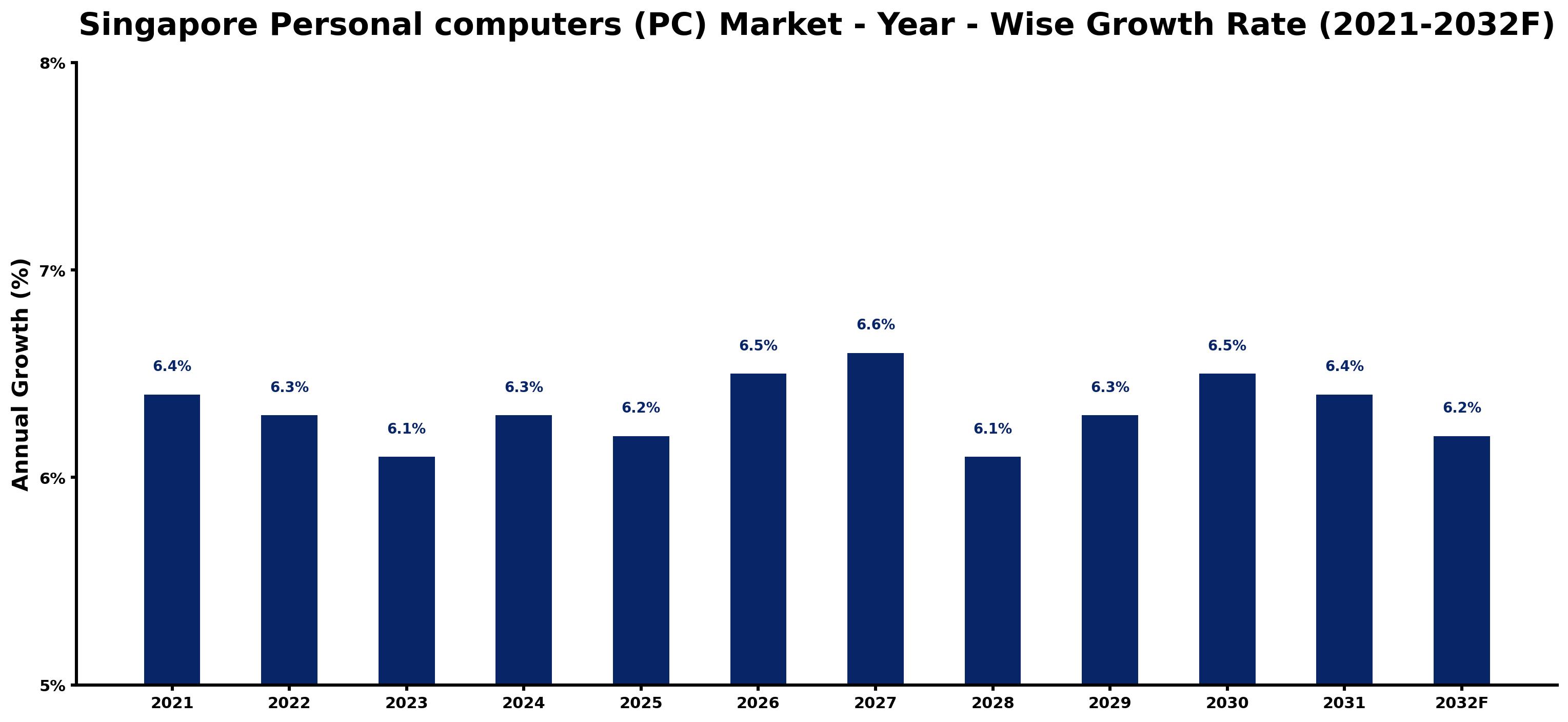
The table below presents the year wise growth rates along with the key drivers influencing the market
| Year | Growth Rate | Major Drivers |
| 2021 | 6.4% | Post-lockdown retail projects highlighted the urgency for upgraded computing solutions. |
| 2022 | 6.3% | Enterprise budgets prioritizing digital transformation spurred significant PC infrastructure investments. |
| 2023 | 6.1% | E-learning initiatives have created sustained demand for affordable personal computing devices. |
| 2024 | 6.3% | Shift towards hybrid work models increased interest in portable and high-performance PCs. |
| 2025 | 6.2% | Emerging tech startups have driven demand for specialized computing solutions in Singapore. |
| 2026 | 6.5% | Local manufacturing incentives encouraged increased production capacities for personal computing devices. |
| 2027 | 6.6% | Sustainability trends prompted consumer interest in energy-efficient and eco-friendly PCs. |
| 2028 | 6.1% | Smart home integration led to higher consumer expectations for compatible personal computing products. |
| 2029 | 6.3% | Advances in gaming technology significantly influenced consumer preferences for high-performance PCs. |
| 2030 | 6.5% | Cloud computing growth necessitated more robust local hardware for optimal performance. |
| 2031 | 6.4% | Continued urbanization in Singapore increased the need for multifunctional personal computing devices. |
| 2032 | 6.2% | Emerging markets for AI applications drove demand for powerful personal computing systems. |
Note - Market size estimations and growth projections presented in this report are based on 6Wresearch's advanced forecasting approach, validated with industry datasets as of June 2026.
Singapore Personal computers (PC) Market Synopsis
The Singapore Personal computers (PC) Market is projected to reach 6.5% and witness significant growth during the forecast period (2026-2032). This growth trajectory is primarily fueled by numerous factors including a heightened consumer inclination towards gaming PCs, an increasing demand for mobility in workstations and laptops, as well as the rapid adoption of cloud computing technologies among enterprises. Additionally, the growing awareness of technological advancements among consumers is also anticipated to play a pivotal role in the market's expansion.
Singapore Personal computers (PC) Market Growth Drivers
Several key drivers are expected to propel the growth of the Singapore Personal computers (PC) Market from 2026 to 2032:
- Consumer Preference for Gaming PCs: A surge in the popularity of gaming culture has led to increased investments in high-performance gaming PCs, positively impacting overall market growth.
- Demand for Portable Computing: The ongoing trend towards remote work has amplified the demand for laptops and portable computing devices, as they offer flexibility and mobility that traditional desktops do not.
- Adoption of Cloud Technologies: Businesses are rapidly embracing cloud computing to enhance operational efficiency and cut hardware costs, thereby driving the sales of personal computers that are compatible with these technologies.
- Rapid Technological Advancements: Innovations such as artificial intelligence integration and enhanced graphics capabilities are attracting consumers who seek the latest technology in their personal computing devices.
- Increasing Digital Engagement: The ongoing digital transformation across sectors in Singapore underscores the importance of personal computers for both home and professional use, further stimulating market growth.
Singapore Personal computers (PC) Market Challenges and Restraints
Despite the promising outlook, the Singapore Personal computers (PC) Market faces certain challenges that could hinder its growth. Key challenges include:
- High Cost of PCs: The premium pricing associated with personal computers can deter budget-conscious consumers, limiting market access for lower-income segments.
- Lack of Technical Support: Insufficient after-sales technical support may lead to consumer hesitation in investing in PCs, especially in a market that increasingly prioritizes user experience and service quality.
- Competition from Alternative Devices: The rising popularity of smartphones and tablets may overshadow traditional PCs, as these devices offer convenience and multifunctionality.
- Economic Uncertainties: Global economic fluctuations could lead to decreased spending on consumer electronics, impacting overall demand for personal computers.
- Environmental Concerns: Growing awareness of environmental issues may prompt consumers to reconsider their purchasing decisions regarding personal computers, particularly those with lower sustainability ratings.
Singapore Personal computers (PC) Market Government Investment and Initiatives
The Singapore government has implemented several initiatives aimed at fostering the growth of the digital economy, which directly supports the development of the personal computers (PC) market:
- Smart Nation Digital Drive: This initiative focuses on harnessing technology to improve living standards and enhance the economy, facilitating the integration of digital tools in everyday life.
- Digital Economy Framework: A strategic approach that encourages businesses to innovate and adopt digital technologies, thus driving the demand for PCs as essential tools for digital transformation.
- Funding and Grants for Tech Startups: The government is providing financial support to technology startups, which indirectly boosts demand for personal computers as these new companies scale and require computing resources.
- Educational Programs: Initiatives aimed at increasing digital literacy among the population encourage consumer investment in personal computers, as individuals seek to upgrade their skills in evolving job markets.
- Infrastructural Developments: Government investments in digital infrastructure enhance connectivity and access, further stimulating the need for personal computing devices across various platforms.
Singapore Personal computers (PC) Market Latest Developments (May 2025 - June 2026)
In the period from May 2025 to June 2026, notable developments within the Singapore Personal computers (PC) Market have emerged as a response to evolving consumer needs:
- Increased Online Sales: As remote work continues to shape consumer behavior, online sales channels have witnessed a significant uptick, leading to greater accessibility of PCs for home users.
- Focus on Sustainability: Manufacturers are increasingly prioritizing sustainable practices in PC production, aligning with consumer preferences for environmentally friendly products.
- Enhanced User Experience: Companies are innovating to improve user experience, introducing PCs with faster processors and better graphics, tailored to gaming and professional use.
- Collaborations with Tech Firms: Partnerships between PC manufacturers and cloud service providers have become common, facilitating more integrated solutions that enhance overall market appeal.
- Investment in R&D: Continued investment in research and development is helping to propel the Singapore PC market forward, fostering advancements in design, functionality, and user satisfaction.
Singapore Personal computers (PC) Market - Key Attractiveness of the Report
- 10 Years of Market Numbers
- Historical Data Starting from 2022 to 2025
- Base Year: 2025
- Forecast Data until 2032
- Key Performance Indicators Impacting the Market
- Major Upcoming Developments and Projects
Key Highlights of the Report:
- Singapore Personal computers (PC) Market Outlook
- Market Size of Singapore Personal computers (PC) Market, 2025
- Forecast of Singapore Personal computers (PC) Market, 2032F
- Historical Data and Forecast of Singapore Personal computers (PC) Revenues & Volume for the Period 2022-2032F
- Singapore Personal computers (PC) Market Trend Evolution
- Singapore Personal computers (PC) Market Drivers and Challenges
- Singapore Personal computers (PC) Price Trends
- Singapore Personal computers (PC) Porter's Five Forces
- Singapore Personal computers (PC) Industry Life Cycle
- Historical Data and Forecast of Singapore Personal computers (PC) Market Revenues & Volume By Product for the Period 2022-2032F
- Historical Data and Forecast of Singapore Personal computers (PC) Market Revenues & Volume By Commercial Desktop for the Period 2022-2032F
- Historical Data and Forecast of Singapore Personal computers (PC) Market Revenues & Volume By Commercial Notebook for the Period 2022-2032F
- Historical Data and Forecast of Singapore Personal computers (PC) Market Revenues & Volume By Consumer Desktop for the Period 2022-2032F
- Historical Data and Forecast of Singapore Personal computers (PC) Market Revenues & Volume By Consumer Notebook and Workstation for the Period 2022-2032F
- Historical Data and Forecast of Singapore Personal computers (PC) Market Revenues & Volume By Distribution Channel for the Period 2022-2032F
- Historical Data and Forecast of Singapore Personal computers (PC) Market Revenues & Volume By Online for the Period 2022-2032F
- Historical Data and Forecast of Singapore Personal computers (PC) Market Revenues & Volume By Offline for the Period 2022-2032F
- Singapore Personal computers (PC) Import Export Trade Statistics
- Market Opportunity Assessment By Product
- Market Opportunity Assessment By Distribution Channel
- Singapore Personal computers (PC) Top Companies Market Share
- Singapore Personal computers (PC) Competitive Benchmarking By Technical and Operational Parameters
- Singapore Personal computers (PC) Company Profiles
- Singapore Personal computers (PC) Key Strategic Recommendations






































