Singapore Refrigeration and Heating Equipment Market Summary
The singapore refrigeration and heating equipment market was estimated at USD 402 Million in 2025 and is projected to reach USD 531 Million by 2032, growing at a CAGR of 5.1% from 2026 to 2032.
Singapore Refrigeration and Heating Equipment Market Year-wise Growth Rate and Key Drivers
This graph highlights how the Singapore Refrigeration and Heating Equipment Market has steadily grown over the past five years, supported by major growth factors.
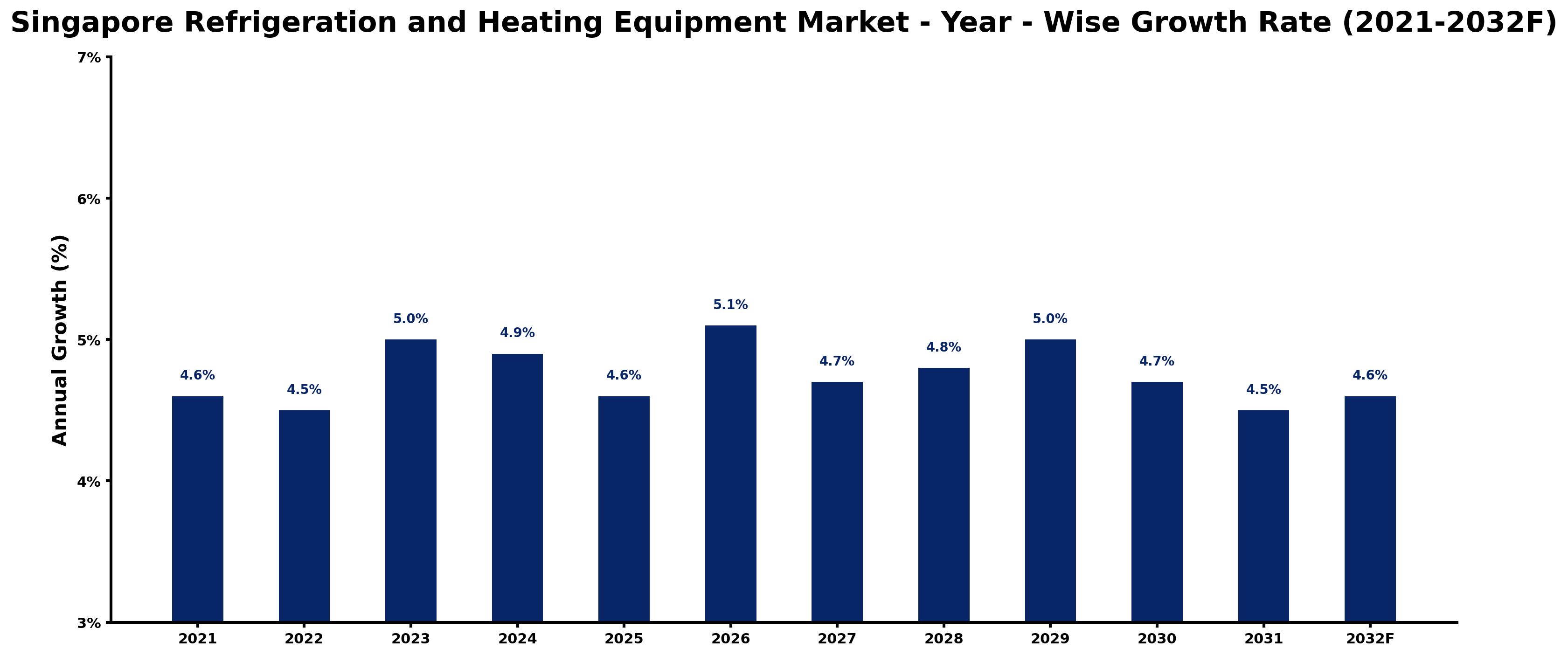
The table below presents the year wise growth rates along with the key drivers influencing the market
| Year | Growth Rate | Major Drivers |
| 2021 | 4.6% | Post-lockdown retail projects sparked demand for commercial cooling and heating systems. |
| 2022 | 4.5% | Environmental concerns led manufacturers to explore more energy-efficient technologies. |
| 2023 | 5.0% | Smart building trends encouraged integration of advanced HVAC control systems. |
| 2024 | 4.9% | Rising construction activity in mixed-use developments increased equipment requirements. |
| 2025 | 4.6% | Consumer interest in sustainable solutions pushed brands to innovate with eco-friendly products. |
| 2026 | 5.1% | Urban population growth translated into heightened demand for residential climate control. |
| 2027 | 4.7% | Technological partnerships emerged, enhancing product offerings with IoT capabilities. |
| 2028 | 4.8% | The hospitality sector's recovery fueled investments in advanced refrigeration solutions. |
| 2029 | 5.0% | Supply chain advancements improved distribution efficiency for refrigeration equipment. |
| 2030 | 4.7% | Local manufacturers gained traction due to reduced lead times and customized services. |
| 2031 | 4.5% | Increased focus on food safety mandated upgraded refrigeration compliance across sectors. |
| 2032 | 4.6% | Diverse industrial applications opened new avenues for heating and cooling technologies. |
Note - Market size estimations and growth projections presented in this report are based on 6Wresearch's advanced forecasting approach, validated with industry datasets as of June 2026.
Singapore Refrigeration and Heating Equipment Market Synopsis
The Singapore Refrigeration and Heating Equipment Market is projected to reach 5.1% and witness significant growth during the forecast period (2026-2032). This growth trajectory is attributed to several factors, including the rising demand for energy-efficient cooling systems and residential air conditioning units, as well as the increasing need for food preservation and storage equipment. The marked expansion of industrial infrastructure within Singapore is anticipated to further fuel this demand. Additionally, government initiatives such as tax rebates on energy-efficient products are expected to bolster sales across the market landscape.
Singapore Refrigeration and Heating Equipment Market Growth Drivers
A multitude of factors are driving the growth of the Singapore Refrigeration and Heating Equipment Market. Chief among these is the escalating demand for energy-efficient systems. As public awareness surrounding environmental protection intensifies, consumers increasingly favor refrigeration and heating equipment that minimizes electricity consumption. Such systems not only provide enhanced performance compared to traditional offerings but also significantly reduce carbon footprints, making them attractive options across various applications. This growing consciousness acts as a catalyst for the market's expansion during the forecast period.
Furthermore, the rise in ambient temperatures, largely attributed to global warming, is contributing to increased demand for air conditioning systems. This trend is particularly evident in the residential sector, where households and office spaces are seeking efficient climate control solutions. The hospitality sector also plays a pivotal role, as businesses strive to provide comfortable environments for guests, indicating a promising revenue potential from these end-user segments.
Singapore Refrigeration and Heating Equipment Market Challenges and Restraints
Despite its growth potential, the Singapore Refrigeration and Heating Equipment Market faces key challenges. Notably, the high costs associated with installation and maintenance present significant barriers for stakeholders. These costs may deter potential customers, limiting the overall development of the market. Furthermore, competition among established players intensifies, as they vie to offer affordable and high-performance alternatives to consumers.
The availability of cheaper options may also pose risks, as consumers may opt for budget-friendly solutions that do not meet energy efficiency standards. This phenomenon could ultimately hinder the desired progression of the market, as businesses strive to maintain profitability against economic pressures. Addressing these challenges will be crucial for stakeholders aiming to secure a competitive edge in the evolving landscape.
Singapore Refrigeration and Heating Equipment Market Investment Opportunities
Investment opportunities within the Singapore Refrigeration and Heating Equipment Market are expanding, particularly in the realm of energy-efficient technologies. The growing consumer preference for sustainable solutions opens avenues for companies that innovate in product development. Investing in smart refrigeration systems that incorporate IoT technology can enhance operational efficiency while meeting environmental standards.
Moreover, the government's ongoing support through incentives for energy-efficient products presents a favorable environment for investors. Engaging in research and development to improve product performance and energy management will likely yield substantial returns as consumers increasingly prioritize efficiency. Collaborations with industrial infrastructure projects and partnerships in the hospitality sector can further amplify investment potential.
Singapore Refrigeration and Heating Equipment Market Government Investment and Initiatives
The Singapore government plays a critical role in nurturing the Refrigeration and Heating Equipment Market through various investment strategies and initiatives. Public spending directed towards infrastructure development is set to enhance the overall market landscape, including expanding the capabilities of refrigeration and heating solutions.
In addition to infrastructure investments, the government is actively promoting energy efficiency through heightened awareness campaigns and fiscal incentives. Tax rebates on energy-efficient products serve as a monetary motivator for consumers to transition towards sustainable options. These initiatives are aimed at not only reducing the environmental impact of refrigeration and heating systems but also positioning Singapore as a leader in sustainable technology.
Singapore Refrigeration and Heating Equipment Market Latest Developments (May 2025 - June 2026)
In the recent period from May 2025 to June 2026, the Singapore Refrigeration and Heating Equipment Market has seen notable developments. Industry stakeholders have begun adjusting their strategies in response to shifting consumer preferences and the global emphasis on energy efficiency. Efforts to innovate and introduce cutting-edge technologies such as smart thermostats and energy management systems have gained traction, reflecting a proactive approach to market demands.
Moreover, the post-COVID-19 recovery has resulted in a renewed focus on enhancing supply chain resilience, as companies strive to mitigate disruptions. The industry has witnessed collaborative efforts among manufacturers, suppliers, and distributors to streamline operations and enhance product offerings. This collaborative approach is expected to bolster growth as normalcy returns to the market.
Singapore Refrigeration and Heating Equipment Market - Key Attractiveness of the Report
- 10 Years of Market Numbers
- Historical Data Starting from 2022 to 2025
- Base Year: 2025
- Forecast Data until 2032
- Key Performance Indicators Impacting the Market
- Major Upcoming Developments and Projects
Key Highlights of the Report:
- Singapore Refrigeration and Heating Equipment Market Outlook
- Market Size of Singapore Refrigeration and Heating Equipment Market, 2025
- Forecast of Singapore Refrigeration and Heating Equipment Market, 2032F
- Historical Data and Forecast of Singapore Refrigeration and Heating Equipment Revenues & Volume for the Period 2022-2032F
- Singapore Refrigeration and Heating Equipment Market Trend Evolution
- Singapore Refrigeration and Heating Equipment Market Drivers and Challenges
- Singapore Refrigeration and Heating Equipment Price Trends
- Singapore Refrigeration and Heating Equipment Porter's Five Forces
- Singapore Refrigeration and Heating Equipment Industry Life Cycle
- Historical Data and Forecast of Singapore Refrigeration and Heating Equipment Market Revenues & Volume By Heating equipments for the Period 2022-2032F
- Historical Data and Forecast of Singapore Refrigeration and Heating Equipment Market Revenues & Volume By Heating Pumps for the Period 2022-2032F
- Historical Data and Forecast of Singapore Refrigeration and Heating Equipment Market Revenues & Volume By Furnaces for the Period 2022-2032F
- Historical Data and Forecast of Singapore Refrigeration and Heating Equipment Market Revenues & Volume By Boilers for the Period 2022-2032F
- Historical Data and Forecast of Singapore Refrigeration and Heating Equipment Market Revenues & Volume By Space heaters for the Period 2022-2032F
- Historical Data and Forecast of Singapore Refrigeration and Heating Equipment Market Revenues & Volume By Unitary heaters for the Period 2022-2032F
- Historical Data and Forecast of Singapore Refrigeration and Heating Equipment Market Revenues & Volume By Others for the Period 2022-2032F
- Historical Data and Forecast of Singapore Refrigeration and Heating Equipment Market Revenues & Volume By Cooling Equipments for the Period 2022-2032F
- Historical Data and Forecast of Singapore Refrigeration and Heating Equipment Market Revenues & Volume By Cooling towers for the Period 2022-2032F
- Historical Data and Forecast of Singapore Refrigeration and Heating Equipment Market Revenues & Volume By Chillers for the Period 2022-2032F
- Historical Data and Forecast of Singapore Refrigeration and Heating Equipment Market Revenues & Volume By Coolers for the Period 2022-2032F
- Historical Data and Forecast of Singapore Refrigeration and Heating Equipment Market Revenues & Volume By Air conditioners for the Period 2022-2032F
- Historical Data and Forecast of Singapore Refrigeration and Heating Equipment Market Revenues & Volume By Others for the Period 2022-2032F
- Historical Data and Forecast of Singapore Refrigeration and Heating Equipment Market Revenues & Volume By General Components for the Period 2022-2032F
- Historical Data and Forecast of Singapore Refrigeration and Heating Equipment Market Revenues & Volume By Condensers for the Period 2022-2032F
- Historical Data and Forecast of Singapore Refrigeration and Heating Equipment Market Revenues & Volume By Compressors for the Period 2022-2032F
- Historical Data and Forecast of Singapore Refrigeration and Heating Equipment Market Revenues & Volume By Radiators for the Period 2022-2032F
- Historical Data and Forecast of Singapore Refrigeration and Heating Equipment Market Revenues & Volume By Sensors for the Period 2022-2032F
- Historical Data and Forecast of Singapore Refrigeration and Heating Equipment Market Revenues & Volume By Transducers for the Period 2022-2032F
- Historical Data and Forecast of Singapore Refrigeration and Heating Equipment Market Revenues & Volume By Others for the Period 2022-2032F
- Historical Data and Forecast of Singapore Refrigeration and Heating Equipment Market Revenues & Volume By End-User Industries for the Period 2022-2032F
- Historical Data and Forecast of Singapore Refrigeration and Heating Equipment Market Revenues & Volume By Residential for the Period 2022-2032F
- Historical Data and Forecast of Singapore Refrigeration and Heating Equipment Market Revenues & Volume By Commercial for the Period 2022-2032F
- Historical Data and Forecast of Singapore Refrigeration and Heating Equipment Market Revenues & Volume By Healthcare Industry for the Period 2022-2032F
- Historical Data and Forecast of Singapore Refrigeration and Heating Equipment Market Revenues & Volume By Educational and government institutions for the Period 2022-2032F
- Historical Data and Forecast of Singapore Refrigeration and Heating Equipment Market Revenues & Volume By Others for the Period 2022-2032F
- Singapore Refrigeration and Heating Equipment Import Export Trade Statistics
- Market Opportunity Assessment By Heating equipments
- Market Opportunity Assessment By Cooling Equipments
- Market Opportunity Assessment By General Components
- Market Opportunity Assessment By End-User Industries
- Singapore Refrigeration and Heating Equipment Top Companies Market Share
- Singapore Refrigeration and Heating Equipment Competitive Benchmarking By Technical and Operational Parameters
- Singapore Refrigeration and Heating Equipment Company Profiles
- Singapore Refrigeration and Heating Equipment Key Strategic Recommendations






































