Singapore Rock Drilling Machine Market Size, Share & Growth Rate
The Singapore Rock Drilling Machine Market was estimated at USD 1318 Million in 2025 and is projected to reach USD 1930 Million by 2032, growing at a CAGR of 5.6% from 2026 to 2032. This robust growth is primarily fueled by Singapore's ambitious infrastructure initiatives and ongoing urban development projects. The increasing demand for efficient excavation and foundational work in urban settings amplifies the necessity for advanced rock drilling machines.
Singapore Rock Drilling Machine Market Year-wise Growth Rate and Key Drivers
This graph highlights how the Singapore Rock Drilling Machine Market has steadily grown over the years, supported by major growth factors.
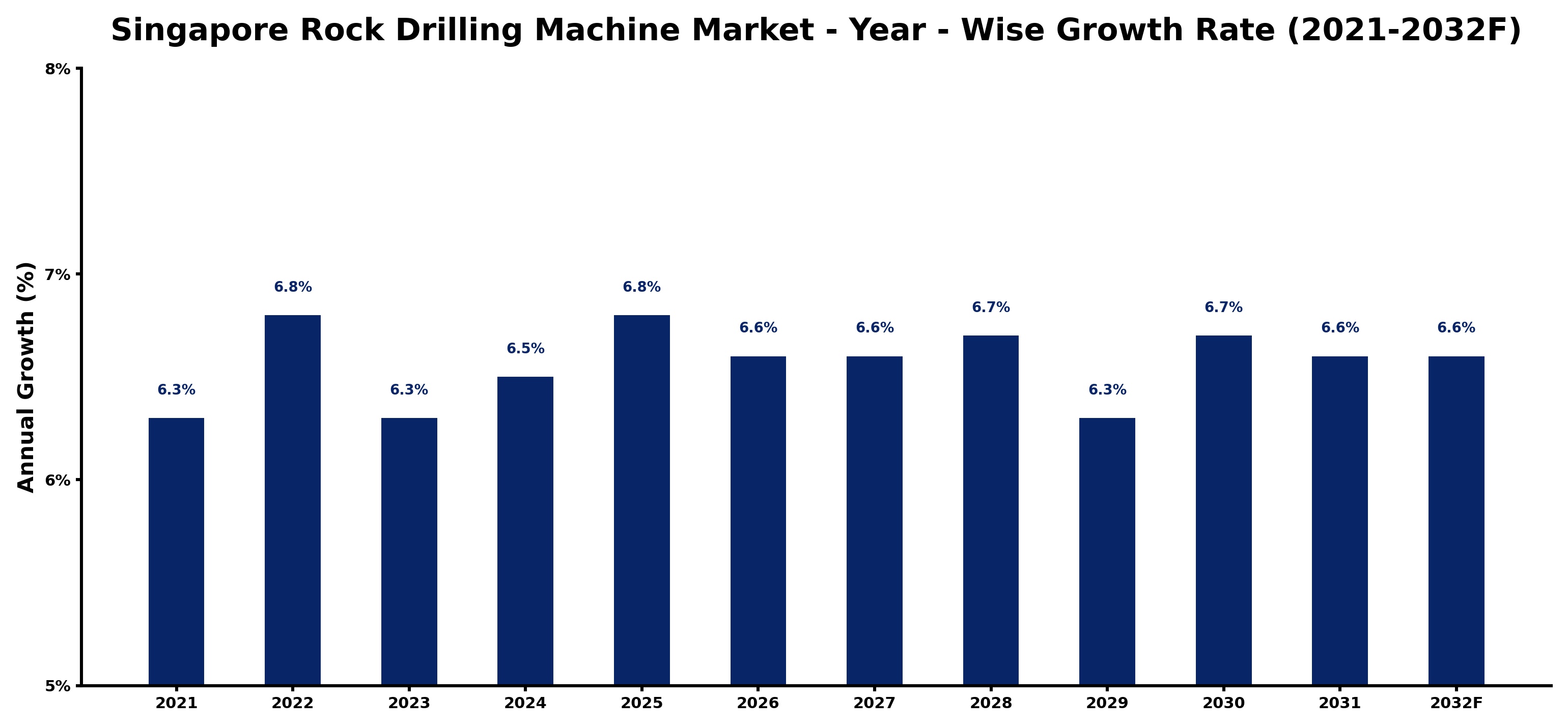
The table below presents the year‑wise growth rates along with the key drivers influencing the market
| Year | Growth Rate | Major Drivers |
| 2021 | 6.3% | Expansion of commercial construction activities |
| 2022 | 6.8% | Rapid growth in telecom and data center sectors |
| 2023 | 6.3% | Rapid growth in telecom and data center sectors |
| 2024 | 6.5% | Expansion of commercial construction activities |
| 2025 | 6.8% | Rapid growth in telecom and data center sectors |
| 2026 | 6.6% | Expansion of transportation and logistics networks |
| 2027 | 6.6% | Expansion of manufacturing activities |
| 2028 | 6.7% | Expansion of transportation and logistics networks |
| 2029 | 6.3% | Increasing industrial automation investments |
| 2030 | 6.7% | Increasing smart city development projects |
| 2031 | 6.6% | Government infrastructure modernization initiatives |
| 2032 | 6.6% | Increasing smart city development projects |
Note - Market size estimations and growth projections presented in this report are based on 6Wresearch's advanced forecasting approach, validated with industry datasets as of June 2026.
Singapore Rock Drilling Machine Market Synopsis
The need for rock drilling machines in Singapore has surged alongside the nation's commitment to enhancing its urban infrastructure. With projects that include extensive underground tunneling and road expansion, these machines are integral to efficient construction practices. Their innovative design features, such as automated and remotely controlled operations, are not only transforming productivity but also ensuring safety on job sites.
As sustainability takes center stage, the market is witnessing a transition towards eco-friendly drilling technologies. This shift reflects a growing awareness among stakeholders regarding environmental impact, prompting manufacturers to invest in research and development to create greener solutions without compromising performance.
Singapore Rock Drilling Machine Market Key Takeaways
- The market is projected to grow steadily due to increasing infrastructure development in Singapore.
- Advanced technological features in drilling machines enhance efficiency and safety in operations.
- Emphasis on sustainability is driving the development of eco-friendly drilling technologies.
- Investment in research and development by market players is critical to meet evolving market demands.
- The market is anticipated to stabilize as the construction and mining sectors recover from the COVID-19 pandemic.
Evaluation of Restraints in Singapore Rock Drilling Machine Market
While the Singapore rock drilling machine market shows promise, it faces certain restraints that may hinder its full potential. The reliance on the construction and mining sectors means that economic fluctuations can lead to unpredictable demand. Moreover, rapid technological advancements necessitate ongoing investment and adaptation from manufacturers, which can be a significant hurdle, particularly for smaller entities. Compliance with stringent safety and environmental regulations also presents ongoing challenges that must be addressed to maintain operational integrity and public trust.
Singapore Rock Drilling Machine Market Trends
Current trends within the Singapore rock drilling machine market indicate a shift towards automation and digitalization. Equipment with smart capabilities is becoming more prevalent, allowing for real-time monitoring and enhanced operational efficiency. Additionally, there is a noticeable increase in demand for hybrid drilling systems that can operate in various environmental conditions, highlighting the versatility expected from modern machinery. The integration of data analytics in managing drilling operations is also emerging as a key trend, empowering operators with insights to optimize their processes.
Singapore Rock Drilling Machine Market Opportunities
Significant growth opportunities exist in the Singapore rock drilling machine market, particularly in the realm of public infrastructure projects. As the government continues to invest in transportation networks and urban development, there will be increased demand for sophisticated drilling technologies capable of handling complex excavation tasks. Furthermore, partnerships between technology firms and machinery manufacturers to develop advanced, eco-friendly drilling solutions present another avenue for growth. Addressing the evolving sustainability requirements will be essential for capturing new business opportunities in this market.
Government Initiatives in the Singapore Rock Drilling Machine Market
The Singaporean government has been proactive in supporting infrastructure development, which directly influences the rock drilling machine market. Public spending initiatives aimed at enhancing urban connectivity and safety have led to the acceleration of projects requiring advanced drilling technology. Programs encouraging sustainable practices in construction and mining further promote investment in eco-friendly drilling solutions. These initiatives not only bolster market growth but also align with Singapore's broader commitment to environmental stewardship and innovation.
Future Insights of the Singapore Rock Drilling Machine Market
Looking ahead to 2026-2032, the Singapore rock drilling machine market is poised for expansion, underpinned by the country's ongoing infrastructure commitments and a renewed focus on sustainable practices. As technological innovations continue to emerge, particularly in automation and digital control, the efficiency and safety of operations are expected to improve significantly. Furthermore, as global trends increasingly favor environmentally responsible practices, the demand for eco-friendly drilling solutions will likely propel the market forward, creating a conducive environment for both established and emerging players.
Singapore Rock Drilling Machine Market Latest Developments (May 2025 - June 2026)
Recent developments in the Singapore rock drilling machine market indicate a strong emphasis on advancing technological capabilities. Manufacturers are launching new models equipped with cutting-edge automation features aimed at improving operational efficiency. Additionally, collaborations between construction companies and tech startups are becoming more common, with a focus on integrating artificial intelligence and machine learning into drilling operations. These trends reflect an industry that is quickly adapting to the demands of modern infrastructure projects.
Singapore Rock Drilling Machine Market - Key Attractiveness of the Report
- 10 Years of Market Numbers
- Historical Data Starting from 2022 to 2025
- Base Year: 2025
- Forecast Data until 2032
- Key Performance Indicators Impacting the Market
- Major Upcoming Developments and Projects
Key Highlights of the Report:
- Singapore Rock Drilling Machine Market Outlook
- Market Size of Singapore Rock Drilling Machine Market, 2025
- Forecast of Singapore Rock Drilling Machine Market, 2032
- Historical Data and Forecast of Singapore Rock Drilling Machine Revenues & Volume for the Period 2022-2032F
- Singapore Rock Drilling Machine Market Trend Evolution
- Singapore Rock Drilling Machine Market Drivers and Challenges
- Singapore Rock Drilling Machine Price Trends
- Singapore Rock Drilling Machine Porter's Five Forces
- Singapore Rock Drilling Machine Industry Life Cycle
- Historical Data and Forecast of Singapore Rock Drilling Machine Market Revenues & Volume By Type for the Period 2022-2032F
- Historical Data and Forecast of Singapore Rock Drilling Machine Market Revenues & Volume By Hydraulic Drills for the Period 2022-2032F
- Historical Data and Forecast of Singapore Rock Drilling Machine Market Revenues & Volume By Electric Drills for the Period 2022-2032F
- Historical Data and Forecast of Singapore Rock Drilling Machine Market Revenues & Volume By Others for the Period 2022-2032F
- Historical Data and Forecast of Singapore Rock Drilling Machine Market Revenues & Volume By Application for the Period 2022-2032F
- Historical Data and Forecast of Singapore Rock Drilling Machine Market Revenues & Volume By Mining Industry for the Period 2022-2032F
- Historical Data and Forecast of Singapore Rock Drilling Machine Market Revenues & Volume By Construction Industry for the Period 2022-2032F
- Historical Data and Forecast of Singapore Rock Drilling Machine Market Revenues & Volume By Others for the Period 2022-2032F
- Singapore Rock Drilling Machine Import Export Trade Statistics
- Market Opportunity Assessment By Type
- Market Opportunity Assessment By Application
- Singapore Rock Drilling Machine Top Companies Market Share
- Singapore Rock Drilling Machine Competitive Benchmarking By Technical and Operational Parameters
- Singapore Rock Drilling Machine Company Profiles
- Singapore Rock Drilling Machine Key Strategic Recommendations






































