Singapore Smart Mirror Market Size, Share & Growth Rate
The Singapore Smart Mirror Market was estimated at USD 992 Million in 2025 and is projected to reach USD 1865 Million by 2032, growing at a CAGR of 9.4% from 2026 to 2032. This substantial growth can be attributed to the increasing demand for innovative home decor solutions and enhanced personal grooming experiences among consumers. Furthermore, the integration of smart home technology and the rise of e-commerce platforms are facilitating greater accessibility and awareness of smart mirrors.
Singapore Smart Mirror Market Year-wise Growth Rate and Key Drivers
This graph highlights how the Singapore Smart Mirror Market has steadily grown over the years, supported by major growth factors.
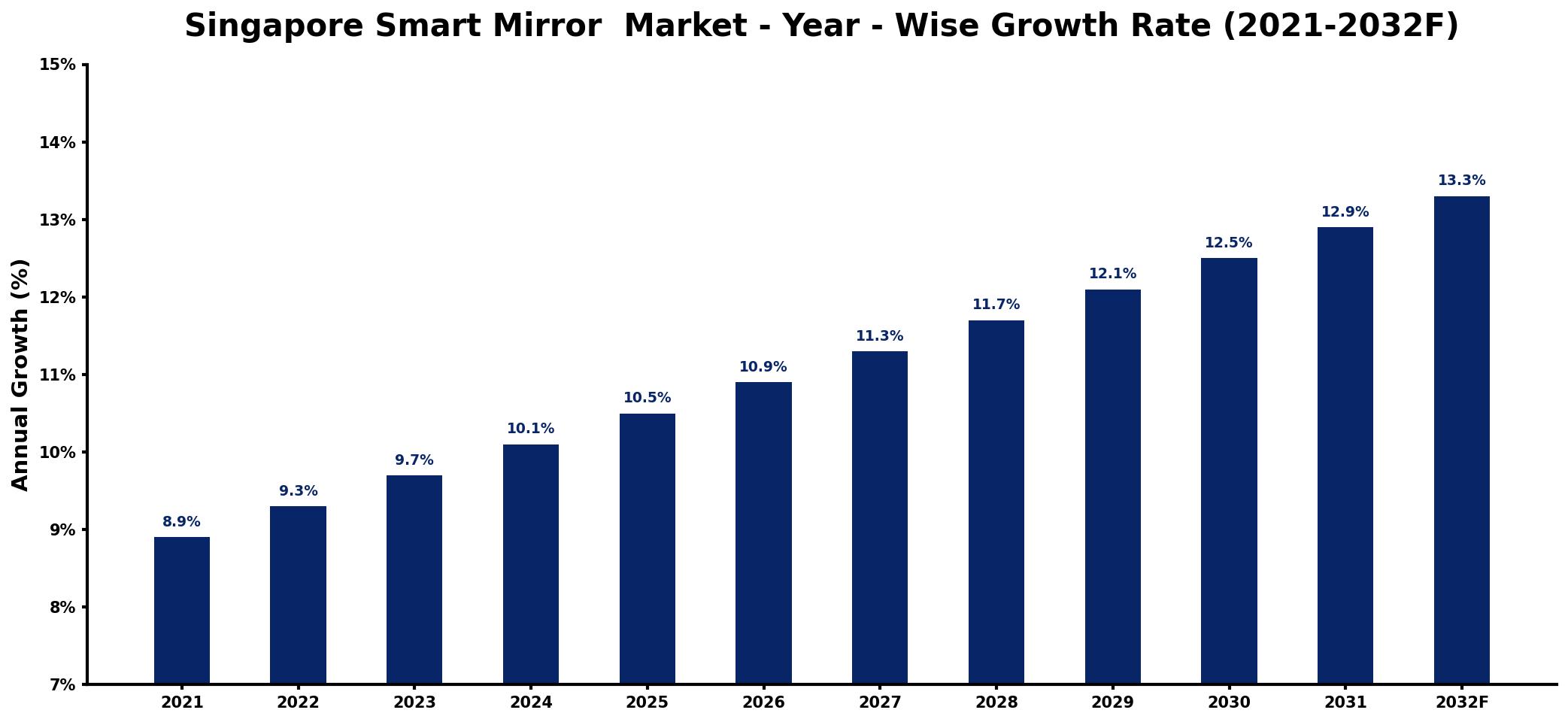
The table below presents the year‑wise growth rates along with the key drivers influencing the market
| Year | Growth Rate | Major Drivers |
| 2021 | 8.9% | increased consumer interest wellness technology |
| 2022 | 9.3% | rise in home automation investments |
| 2023 | 9.7% | growing trend personalization home decor |
| 2024 | 10.1% | expansion connected devices market |
| 2025 | 10.5% | higher disposable income consumers |
| 2026 | 10.9% | advancements in display technology |
| 2027 | 11.3% | influx innovative health applications |
| 2028 | 11.7% | growing urbanization lifestyle changes |
| 2029 | 12.1% | increased focus on sustainability practices |
| 2030 | 12.5% | rising demand luxury home features |
| 2031 | 12.9% | expansion digital health integration |
| 2032 | 13.3% | growth in remote wellness solutions |
Note: Market size estimations and growth projections presented in this report are based on 6Wresearch's proprietary forecasting methodology, utilizing the latest available industry data, government publications, and primary research inputs.
Singapore Smart Mirror Market Synopsis
In Singapore, smart mirrors are becoming a focal point in the intersection of technology and daily living. Consumers are increasingly drawn to these sophisticated devices, which offer more than just a reflective surface—they provide interactive displays, health tracking, and integration with smart home ecosystems. The allure of personalization and convenience is driving both residential and commercial interest in smart mirrors.
As the demand for unique and immersive consumer experiences grows, retailers and hospitality businesses are exploring innovative applications for smart mirrors. These mirrors not only elevate aesthetic appeal but also serve practical purposes, such as providing real-time information and virtual assistance, enhancing the overall user experience.
Singapore Smart Mirror Market Key Takeaways
- The market is witnessing accelerated growth due to a combination of consumer trends favoring high-tech home appliances.
- Smart mirrors are increasingly utilized in diverse settings, including homes, retail shops, and hotel rooms.
- Integration with voice assistance technology is becoming a critical feature in new smart mirror models.
- As the product landscape evolves, manufacturers are focusing on continuous technological advancements to enhance functionalities.
- Increased consumer awareness and education on the benefits of smart mirrors are critical for market penetration.
Evaluation of Restraints in Singapore Smart Mirror Market
The Singapore smart mirror market faces a few pivotal restraints that may hinder its growth trajectory. One of the main challenges is the relatively slow consumer adoption rate, as many potential buyers remain skeptical about the utility and necessity of such products in everyday life. Additionally, the market must address various privacy concerns regarding data collection and security, which could deter customers from embracing smart technologies. Moreover, as the sector is characterized by rapid technological advancements, companies are challenged to keep their offerings updated and relevant, adding pressure to remain competitive.
Singapore Smart Mirror Market Trends
Several trends are shaping the landscape of the Singapore smart mirror market. A growing emphasis on health and wellness is leading to the incorporation of features like skin analysis and health tracking capabilities. Moreover, the integration of augmented reality (AR) technologies is enhancing user engagement, making it possible for customers to try virtual makeup or hairstyles before applying them in real life. Furthermore, the rise of smart home technology continues to encourage consumers to seek products that seamlessly connect with their existing smart devices, promoting an interconnected lifestyle.
Singapore Smart Mirror Market Opportunities
The smart mirror market presents numerous opportunities for growth and innovation. As consumer interest in home automation rises, new market segments within the residential sector are emerging. For instance, smart mirrors can play pivotal roles in home fitness routines, offering guided exercises and performance tracking. Additionally, businesses within the hospitality and retail sectors can benefit from adopting smart mirrors to create engaging customer experiences. The rapid proliferation of e-commerce platforms also opens doors for online sales, allowing manufacturers to reach a broader audience.
Government Initiatives in the Singapore Smart Mirror Market
The Singapore government has been proactive in promoting smart technology adoption across various sectors. Initiatives aimed at enhancing digital transformation, such as funding for research and development in technology-based products, provide a supportive framework for innovation in the smart mirror market. Furthermore, public campaigns encouraging the use of smart devices contribute to elevating consumer awareness about the benefits and functionalities of smart mirrors, fostering an environment conducive to market growth.
Future Insights of the Singapore Smart Mirror Market
As we look ahead to 2026-2032, the Singapore smart mirror market is expected to continue its upward trajectory. Consumer interest in integrated, technologically advanced home products will likely drive continued investments and innovations in this space. Additionally, the potential integration of artificial intelligence (AI) into smart mirrors could enhance personalization, providing users with tailored recommendations and assistance. This evolution will further solidify smart mirrors as essential components in modern homes and businesses.
Singapore Smart Mirror Market Latest Developments (2025 - 2026)
Recent developments in the Singapore smart mirror market reflect a growing focus on technological advancements and user experience enhancements. Companies are increasingly unveiling new models that feature improved connectivity, touchless controls, and enhanced visual displays. Furthermore, collaborations with health and wellness brands are emerging, introducing features that allow users to monitor their health metrics directly from their mirrors. This trend indicates a convergence of lifestyle and technology, propelling the smart mirror sector into a new phase of growth.
Singapore Smart Mirror Market - Key Attractiveness of the Report
- 10 Years of Market Numbers
- Historical Data Starting from 2022 to 2025
- Base Year: 2025
- Forecast Data until 2032
- Key Performance Indicators Impacting the Market
- Major Upcoming Developments and Projects
Key Highlights of the Report:
- Singapore Smart Mirror Market Outlook
- Market Size of Singapore Smart Mirror Market, 2025
- Forecast of Singapore Smart Mirror Market, 2032
- Historical Data and Forecast of Singapore Smart Mirror Revenues & Volume for the Period 2022-2032F
- Singapore Smart Mirror Market Trend Evolution
- Singapore Smart Mirror Market Drivers and Challenges
- Singapore Smart Mirror Price Trends
- Singapore Smart Mirror Porter's Five Forces
- Singapore Smart Mirror Industry Life Cycle
- Historical Data and Forecast of Singapore Smart Mirror Market Revenues & Volume By Component for the Period 2022-2032F
- Historical Data and Forecast of Singapore Smart Mirror Market Revenues & Volume By Hardware for the Period 2022-2032F
- Historical Data and Forecast of Singapore Smart Mirror Market Revenues & Volume By Software for the Period 2022-2032F
- Historical Data and Forecast of Singapore Smart Mirror Market Revenues & Volume By Services for the Period 2022-2032F
- Historical Data and Forecast of Singapore Smart Mirror Market Revenues & Volume By End User for the Period 2022-2032F
- Historical Data and Forecast of Singapore Smart Mirror Market Revenues & Volume By Automotive for the Period 2022-2032F
- Historical Data and Forecast of Singapore Smart Mirror Market Revenues & Volume By Healthcare for the Period 2022-2032F
- Historical Data and Forecast of Singapore Smart Mirror Market Revenues & Volume By Residential for the Period 2022-2032F
- Historical Data and Forecast of Singapore Smart Mirror Market Revenues & Volume By Others for the Period 2022-2032F
- Singapore Smart Mirror Import Export Trade Statistics
- Market Opportunity Assessment By Component
- Market Opportunity Assessment By End User
- Singapore Smart Mirror Top Companies Market Share
- Singapore Smart Mirror Competitive Benchmarking By Technical and Operational Parameters
- Singapore Smart Mirror Company Profiles
- Singapore Smart Mirror Key Strategic Recommendations






































