Slovakia Octopus Market Top 5 Importing Countries and Market Competition (HHI) Analysis
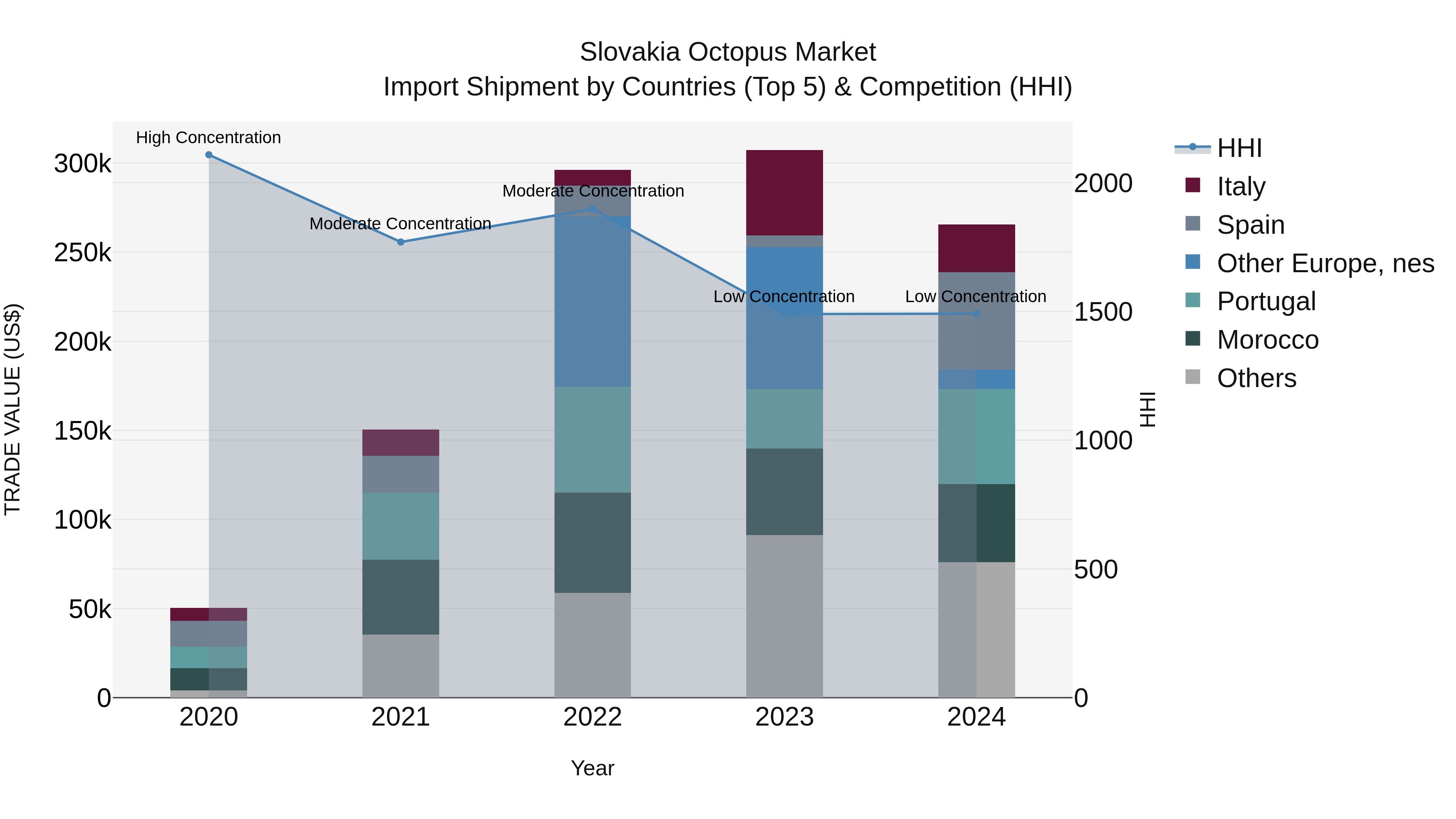
Slovakia`s octopus import Market Top 5 Importing Countries and Market Competition (HHI) Analysis continued to see strong growth in 2024, with Spain, Portugal, Morocco, Hungary, and Italy emerging as top exporting countries. Despite a slight decline in growth rate from 2023 to 2024, the compound annual growth rate (CAGR) for the period of 2020-2024 remained impressive at 51.55%. The Market Top 5 Importing Countries and Market Competition (HHI) Analysis concentration, as measured by the Herfindahl-Hirschman Index (HHI), was at a moderate level in 2024. This data suggests a thriving octopus import Market Top 5 Importing Countries and Market Competition (HHI) Analysis in Slovakia with diverse sources of supply contributing to its growth.
Octopus Market: Slovak Republic vs Top 5 Major Economies in 2027 (Europe)
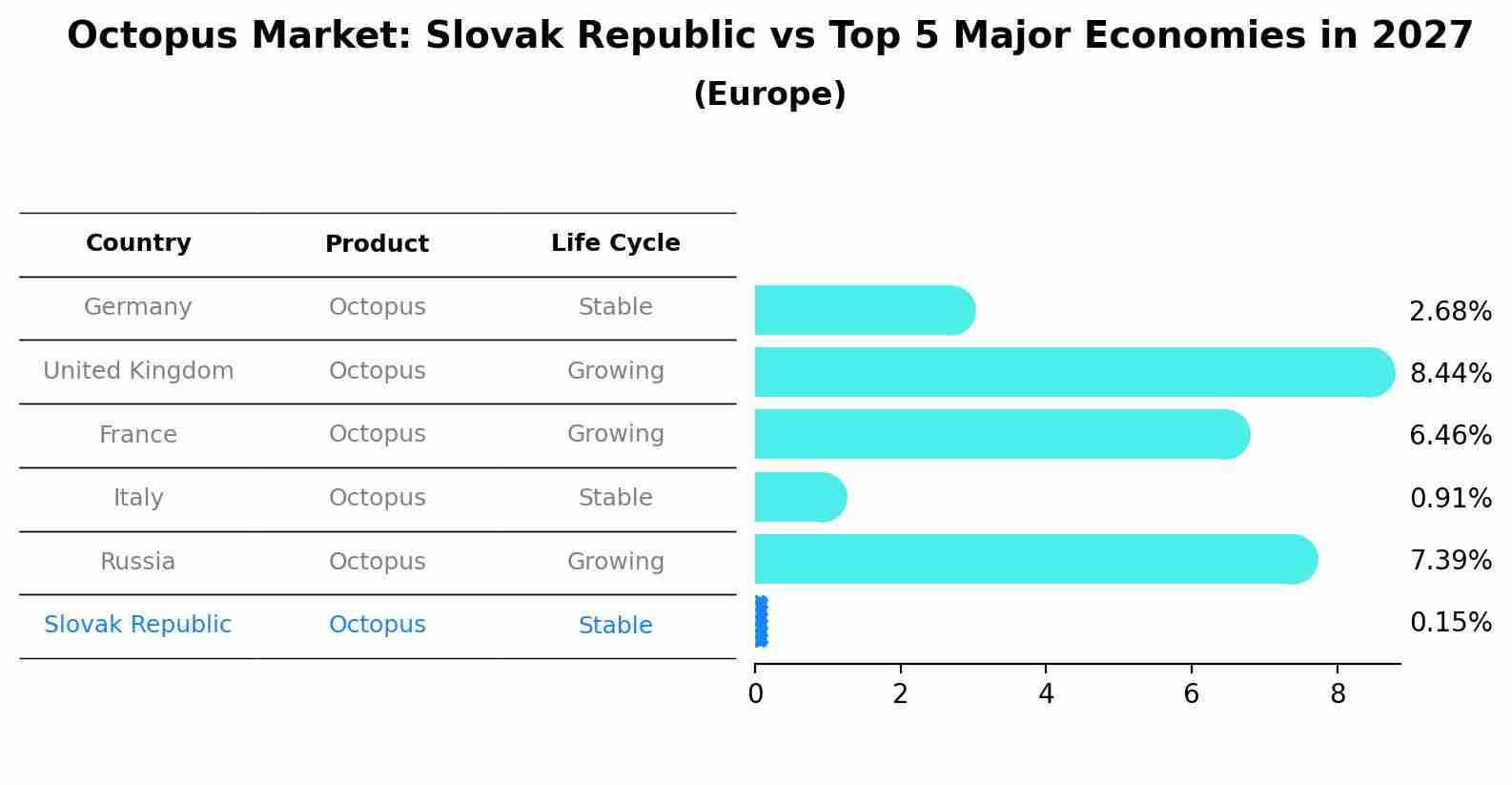
Slovak Republic's Octopus market is anticipated to experience a stable growth rate of 0.15% by 2027, reflecting trends observed in the largest economy Germany, followed by United Kingdom, France, Italy and Russia.
Slovakia Octopus Market Synopsis
The Slovakia Octopus Market is a niche segment within the overall seafood industry, with a growing demand for this unique delicacy. Octopus is popular among consumers in Slovakia due to its tender texture and versatility in various cuisines. The market is primarily driven by the increasing popularity of Mediterranean and Asian cuisines in the country, where octopus is a common ingredient. Restaurants and seafood retailers are key players in the distribution of octopus products, with a focus on quality and freshness to meet consumer preferences. Importation of octopus from other countries also plays a significant role in meeting the demand. Despite being a niche market, the Slovakia Octopus Market is expected to see steady growth as consumer interest in exotic and gourmet foods continues to rise.
Slovakia Octopus Market Trends
The Slovakia octopus market is currently experiencing a growing demand, driven by the rising popularity of seafood dishes and the increasing interest in exotic and gourmet cuisine among consumers. Restaurants and foodservice providers are incorporating octopus dishes into their menus, leading to higher consumption levels. Additionally, the health benefits associated with octopus, such as being low in fat and rich in protein and other nutrients, are also contributing to its popularity. Importantly, sustainability and ethical sourcing practices are becoming important factors influencing purchasing decisions in the Slovakia octopus market, with consumers showing a preference for responsibly sourced and traceable octopus products. Overall, these trends indicate a positive outlook for the Slovakia octopus market, with opportunities for growth and innovation in product offerings and marketing strategies.
Slovakia Octopus Market Challenges
In the Slovakia octopus market, challenges primarily revolve around supply chain logistics and consumer preferences. Due to Slovakia being a landlocked country, importing fresh octopus can be a logistical challenge, leading to issues with quality and availability. Additionally, consumer awareness and acceptance of octopus as a seafood delicacy may be lower compared to more traditional seafood choices, creating a barrier to market growth. Furthermore, fluctuating prices and competition from other seafood products can also impact the demand for octopus in Slovakia. Overall, overcoming these challenges will require strategic partnerships with seafood suppliers, targeted marketing campaigns to educate consumers about the benefits of octopus, and offering competitive pricing to attract and retain customers in the market.
Slovakia Octopus Market Investment Opportunities
The Slovakia Octopus Market presents several investment opportunities for those looking to enter the seafood industry. With increasing demand for exotic and high-quality seafood products, investing in the octopus market in Slovakia can be a lucrative venture. This market offers opportunities for both domestic production and importation to meet the growing consumer interest in octopus dishes. Additionally, advancements in aquaculture technology and sustainable fishing practices provide a favorable environment for investment in the octopus market. Investors can consider opportunities in establishing octopus farms, partnering with local suppliers, or exporting octopus products to other European markets. Overall, the Slovakia Octopus Market offers potential for growth and profitability for investors interested in the seafood industry.
Jordan Agar Market Government Policies
The Slovakia Octopus Market is subject to various government policies aimed at regulating fishing practices, ensuring sustainability, and promoting ethical sourcing. The Slovakian government has implemented strict guidelines on octopus fishing, including quotas and restrictions on certain fishing methods to prevent overfishing and protect the octopus population. Additionally, there are regulations in place to monitor the import and export of octopus products to ensure compliance with international standards and prevent illegal trafficking. The government also encourages transparency in the supply chain, requiring accurate labeling and traceability of octopus products to guarantee their origin and quality. Overall, these policies are designed to promote responsible and sustainable practices within the Slovakia Octopus Market while safeguarding the marine ecosystem and supporting the local fishing industry.
Slovakia Octopus Market Future Outlook
The Slovakia octopus market is expected to experience steady growth in the coming years, driven by increasing consumer interest in seafood varieties and a growing demand for exotic and unique culinary experiences. The market is likely to benefit from the rising popularity of Mediterranean and Asian cuisines, where octopus is a common ingredient. Additionally, improvements in distribution channels and an expanding foodservice industry in Slovakia are anticipated to further boost the market growth. However, challenges such as sourcing sustainable and high-quality octopus, as well as price volatility due to fluctuations in supply, could impact market dynamics. Overall, with the evolving consumer preferences and culinary trends, the Slovakia octopus market is poised for expansion, presenting opportunities for market players to innovate and capitalize on the growing demand.
Key Highlights of the Report:
- Slovakia Octopus Market Outlook
- Market Size of Slovakia Octopus Market, 2024
- Forecast of Slovakia Octopus Market, 2031
- Historical Data and Forecast of Slovakia Octopus Revenues & Volume for the Period 2021 - 2031
- Slovakia Octopus Market Trend Evolution
- Slovakia Octopus Market Drivers and Challenges
- Slovakia Octopus Price Trends
- Slovakia Octopus Porter's Five Forces
- Slovakia Octopus Industry Life Cycle
- Historical Data and Forecast of Slovakia Octopus Market Revenues & Volume By Product Type for the Period 2021 - 2031
- Historical Data and Forecast of Slovakia Octopus Market Revenues & Volume By Fresh for the Period 2021 - 2031
- Historical Data and Forecast of Slovakia Octopus Market Revenues & Volume By Processed for the Period 2021 - 2031
- Historical Data and Forecast of Slovakia Octopus Market Revenues & Volume By Application for the Period 2021 - 2031
- Historical Data and Forecast of Slovakia Octopus Market Revenues & Volume By Commercial for the Period 2021 - 2031
- Historical Data and Forecast of Slovakia Octopus Market Revenues & Volume By Food and Beverage for the Period 2021 - 2031
- Historical Data and Forecast of Slovakia Octopus Market Revenues & Volume By Distribution Channel for the Period 2021 - 2031
- Historical Data and Forecast of Slovakia Octopus Market Revenues & Volume By Direct for the Period 2021 - 2031
- Historical Data and Forecast of Slovakia Octopus Market Revenues & Volume By Indirect for the Period 2021 - 2031
- Slovakia Octopus Import Export Trade Statistics
- Market Opportunity Assessment By Product Type
- Market Opportunity Assessment By Application
- Market Opportunity Assessment By Distribution Channel
- Slovakia Octopus Top Companies Market Share
- Slovakia Octopus Competitive Benchmarking By Technical and Operational Parameters
- Slovakia Octopus Company Profiles
- Slovakia Octopus Key Strategic Recommendations






































