South Africa Lumber Market Size Growth Rate
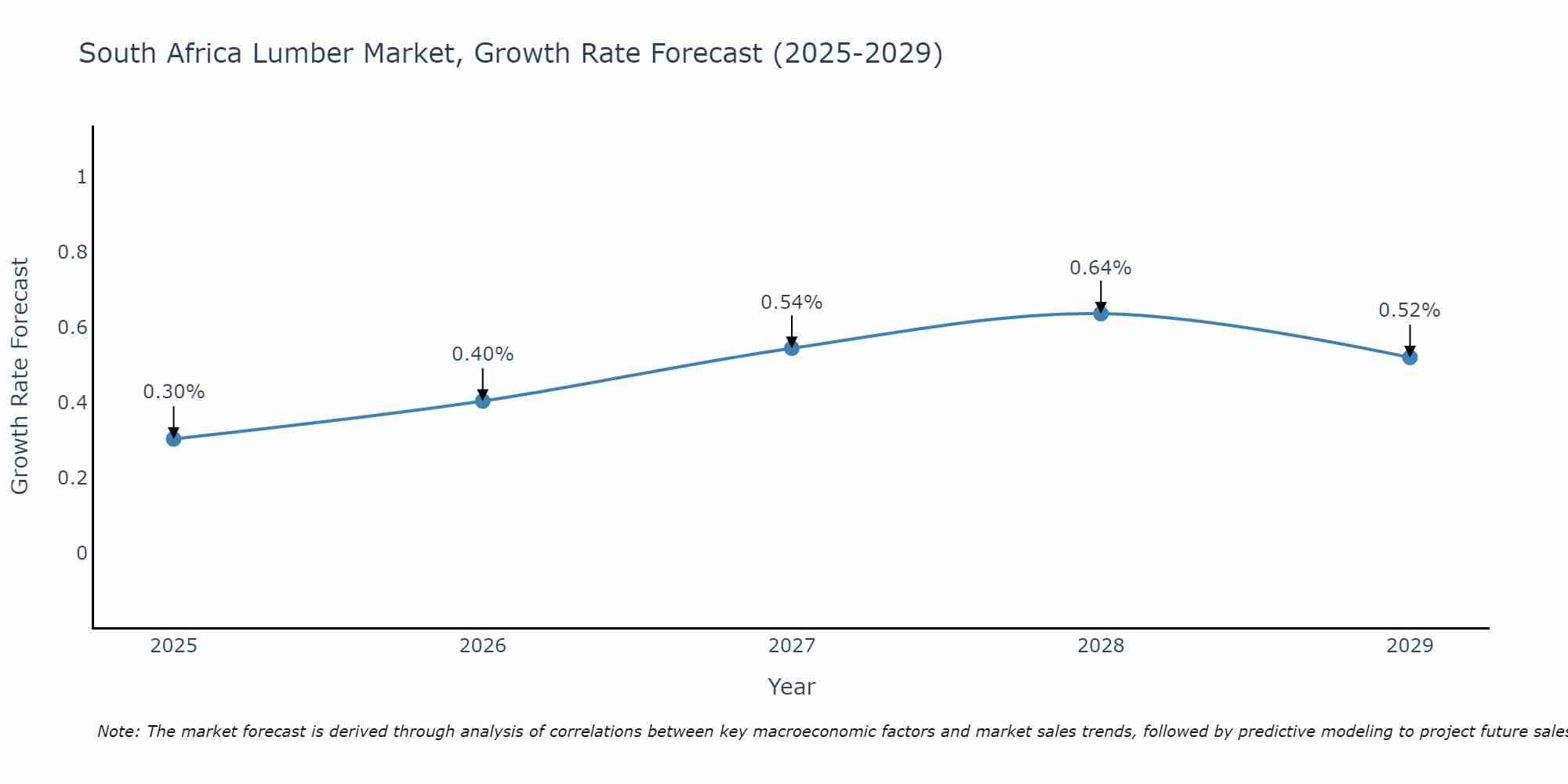
The South Africa Lumber Market is projected to witness mixed growth rate patterns during 2025 to 2029. Starting at 0.30% in 2025, the market peaks at 0.64% in 2028, and settles at 0.52% by 2029.
South Africa Lumber Market Overview
The lumber market in South Africa is witnessing steady growth due to increasing demand from the construction and furniture industries. The country`s rich forestry resources and sustainable practices contribute significantly to the market`s expansion. Government initiatives promoting afforestation and the use of eco-friendly materials further support this growth. However, challenges such as deforestation, illegal logging, and fluctuating raw material prices continue to impact the market dynamics.
Drivers of the market
The South African lumber market is primarily driven by the increasing demand for wood in construction, furniture, and paper industries. The growth in the housing sector, fueled by urbanization and population growth, has led to a surge in demand for timber. Additionally, the adoption of sustainable forestry practices and government policies promoting reforestation have further bolstered the market.
Challenges of the market
The South African lumber market faces significant challenges, including environmental regulations that restrict logging activities to protect natural forests. These regulations, while crucial for sustainability, limit the supply of raw materials, increasing costs for manufacturers. Additionally, the market is impacted by fluctuations in global timber prices and competition from imported lumber, which often has cost advantages. Furthermore, infrastructure constraints, such as inadequate transportation networks, hinder efficient distribution and increase operational costs for local businesses.
Government Policy of the market
The South African government has implemented a series of forestry policies aimed at promoting sustainable management and conservation of forests. These policies include afforestation initiatives, incentives for sustainable logging practices, and stringent regulations to combat illegal logging. Additionally, the government collaborates with international bodies to ensure that the timber industry adheres to global environmental standards.
Key Highlights of the Report:
- South Africa Lumber Market Outlook
- Market Size of South Africa Lumber Market, 2024
- Forecast of South Africa Lumber Market, 2031
- Historical Data and Forecast of South Africa Lumber Revenues & Volume for the Period 2021-2031
- South Africa Lumber Market Trend Evolution
- South Africa Lumber Market Drivers and Challenges
- South Africa Lumber Price Trends
- South Africa Lumber Porter's Five Forces
- South Africa Lumber Industry Life Cycle
- Historical Data and Forecast of South Africa Lumber Market Revenues & Volume By Types for the Period 2021-2031
- Historical Data and Forecast of South Africa Lumber Market Revenues & Volume By Hardwood Lumber for the Period 2021-2031
- Historical Data and Forecast of South Africa Lumber Market Revenues & Volume By Softwood Lumber for the Period 2021-2031
- Historical Data and Forecast of South Africa Lumber Market Revenues & Volume By Application for the Period 2021-2031
- Historical Data and Forecast of South Africa Lumber Market Revenues & Volume By Construction for the Period 2021-2031
- Historical Data and Forecast of South Africa Lumber Market Revenues & Volume By Furniture for the Period 2021-2031
- Historical Data and Forecast of South Africa Lumber Market Revenues & Volume By Flooring for the Period 2021-2031
- Historical Data and Forecast of South Africa Lumber Market Revenues & Volume By Moldings for the Period 2021-2031
- Historical Data and Forecast of South Africa Lumber Market Revenues & Volume By Others for the Period 2021-2031
- South Africa Lumber Import Export Trade Statistics
- Market Opportunity Assessment By Types
- Market Opportunity Assessment By Application
- South Africa Lumber Top Companies Market Share
- South Africa Lumber Competitive Benchmarking By Technical and Operational Parameters
- South Africa Lumber Company Profiles
- South Africa Lumber Key Strategic Recommendations






































