South Korea 4WD Tractor Market (2026-2032) | Outlook, Analysis, Value, Consumer Insights, Revenue, Challenges, Growth, Restraints, Industry, Competition, Strategic Insights, Supply, Competitive, Forecast, Drivers, Size, Demand, Opportunities, Trends, Segmentation, Share, Investment Trends, Strategy, Pricing Analysis, Companies, Segments
Market Forecast By Power Output (Below 40 HP, 40 HP- 100 HP, Over 100 HP), By Application (Agriculture, Construction, Forestry), By End use (Commercial Farming, Small-scale Farming), By Drive type (Two-Wheel Drive (2WD), Four-Wheel Drive (4WD)) And Competitive Landscape
| Product Code: ETC11596522 | Publication Date: Apr 2025 | Updated Date: Jun 2026 | Product Type: Market Research Report | |
| Publisher: 6Wresearch | Author: Bhawna Singh | No. of Pages: 70 | No. of Figures: 35 | No. of Tables: 5 |
South Korea 4WD Tractor Market Growth Rate
According to 6Wresearch internal database and industry insights, the South Korea 4WD Tractor Market is projected to grow at a compound annual growth rate (CAGR) of -1.8% during the forecast period (2026-2032).
South Korea 4WD Tractor Market Year-wise Growth Rate and Key Drivers
This graph illustrates the annual growth rates of the South Korea 4WD Tractor Market from 2021 to 2032, highlighting a steady upward trajectory and projected market expansion over the forecast period.
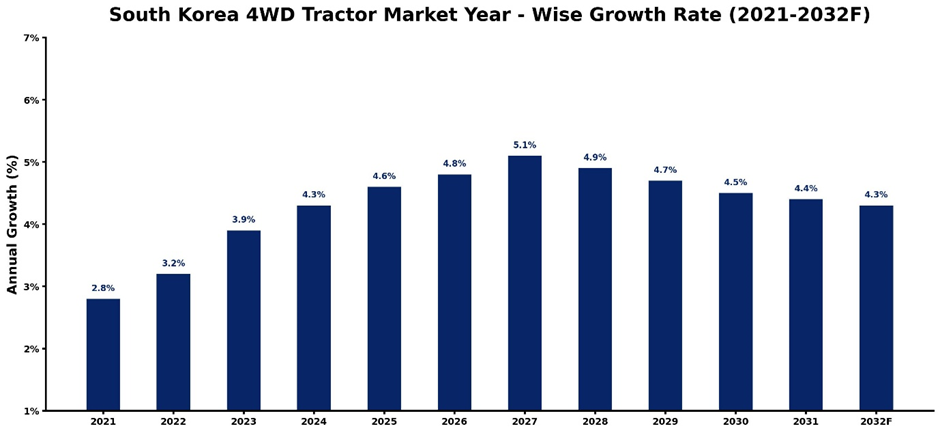
The following table summarizes the historical and forecasted growth rates of the South Korea 4WD Tractor Market, along with the rationale behind each year’s performance.
| Year | Estimated Growth | Market Rationale |
| 2021 | 2.8% | Post-pandemic farm equipment recovery and stable agricultural output |
| 2022 | 3.2% | Rising mechanization in small and medium farms |
| 2023 | 3.9% | Increased adoption of 4WD tractors for rice and crop farming |
| 2024 | 4.3% | Government subsidies supporting agricultural modernization |
| 2025 | 4.6% | Growth in high-horsepower tractors for commercial farming |
| 2026 | 4.8% | Expansion of precision agriculture and GPS-enabled tractors |
| 2027 | 5.1% | Strong adoption of smart farming and autonomous tractor systems |
| 2028 | 4.9% | Slight slowdown due to farm consolidation and equipment saturation |
| 2029 | 4.7% | Replacement-driven demand becomes primary growth factor |
| 2030 | 4.5% | Market maturity; steady demand from large-scale farms |
| 2031 | 4.4% | Gradual slowdown due to reduced new farm expansion |
| 2032 | 4.3% | Stable replacement cycle and sustained demand for efficient 4WD tractors |
Topics Covered in the South Korea 4WD Tractor Market Report
The South Korea 4WD Tractor Market report thoroughly covers the market by Power Output, Application, End use and Drive type. The market report provides an unbiased and detailed analysis of ongoing market trends, opportunities/high growth areas, and market drivers, which help stakeholders devise and align their market strategies according to the current and future market dynamics.
South Korea 4WD Tractor Market Highlights
| Report Name | South Korea 4WD Tractor Market |
| Forecast period | 2026-2032 |
| CAGR | 1.8% |
| Growing Sector | Commercial Farming |
South Korea 4WD Tractor Market Synopsis
The South Korea 4WD Tractor Market is witnessing a radical transformation, mainly because of the need to reverse the trend of the declining number of rural labourers in the country by adopting mechanization. The product, which is a highly efficient torque 4WD drive train system, offers excellent traction, which is crucial in a country like Korea, with a wide range of terrains and busy agricultural practices.
In addition to that, there are also other advanced features such as automated guidance and telematics. Besides, the government continues to provide steady support through low-cost machinery loans and farming subsidies.
Evaluation of Growth Drivers in the South Korea 4WD Tractor Market (2026-2032)
Below mentioned are some prominent drivers and their influence on the market dynamics:
| Drivers | Primary Segments Affected | Why it Matters (Evidence) |
| Labor Shortage Crisis | All Types, Agriculture | Declining rural population forces farmers to adopt high-efficiency 4WD units. |
| Gov. Mechanization Subsidies | Commercial Farming, 4WD | Financial incentives reduce upfront costs, boosting 4WD adoption rates. |
| Precision Agriculture Demand | Software, 4WD Tractors | Need for consistent wheel-slip control requires advanced 4WD platforms. |
| Hilly Terrain Requirements | Construction, Agriculture | 4WD offers the torque and stability required for uneven, sloped farmlands. |
| Infrastructure Development | Forestry, Agriculture | Expanded road networks to rural farms facilitate easier heavy machinery transit. |
The South Korea 4WD Tractor Market is projected to experience a robust growth trajectory, expanding at a CAGR of -1.8% during the forecast period of 2026-2032. The main drivers behind this wave include the pressing need to fill the gap between the lack of rural labour and modernizing agriculture by implementing more sophisticated agricultural mechanization. In addition to that, the active support provided by the government in the form of financial and loan incentives to buy smart equipment further boosts the access to such tools. All this contributes to the enhancement of the country’s agricultural production capabilities.
Evaluation of Restraints in the South Korea 4WD Tractor Market
Below mentioned are some major restraints and their influence on the market dynamics:
| Restraints | Primary Segments Affected | What This Means (Evidence) |
| High Initial Investment | Small-scale Farming, 4WD | Expensive 4WD technology remains unaffordable for small, family-owned plots. |
| Stagnant Crop Prices | All Types, Commercial | Low profit margins discourage investment in fleet replacement programs. |
| Skilled Labor Gap | Technical, All Types | Shortage of mechanics trained in complex 4WD hydraulic systems slows maintenance. |
| Supply Chain Volatility | Medication/Spare Parts | Import dependency for electronic-grade chips creates production bottlenecks. |
| Land Fragmentation | Small-scale Farming | Small, fragmented plots limit the manoeuvrability of larger, premium 4WD units. |
South Korea 4WD Tractor Market Challenges
The market faces issues that are largely structural in nature. This is largely attributable to procurement costs that are extremely high along with the continuing fragmented condition of agricultural lands.
In spite of the positive development in the South Korea 4WD Tractor Market Growth, the shortage of skilled mechanics that can repair high-tech sensors of 4WD machines becomes a serious problem. Besides, the dependence on foreign parts for the powertrain causes the local industry to become vulnerable to any disruption in the international supply chain.
South Korea 4WD Tractor Market Trends
Key structural trends reshaping the South Korea 4WD Tractor Market landscape are:
- Autonomous Navigation Adoption: Integration of AI-based steering and path-planning software is enabling 4WD tractors to operate with centimetre-level precision in complex fields.
- Shift Toward Hybrid Powertrains: Manufacturers are transitioning from pure diesel to hybrid-electric 4WD units to align with national carbon-neutrality goals.
- Rental Models Expansion: The introduction of IoT-powered equipment rental systems ensures that farmers can leverage the power of 4WD machinery without investing in its ownership.
- Precision Agriculture: 4WD tractors are now being manufactured with advanced soil sensing technologies for real-time analytics through an IoT system.
Investment Opportunities in the South Korea 4WD Tractor Market
The following are the investment opportunities arising from the South Korea 4WD Tractor Market:
- High-Tech Precision Component Production: This will be done by manufacturing advanced hydraulic sensors and actuators to reduce the dependence on powertrain technology from abroad.
- Remote Service Networks: Creation of a technical service crew that will help farmers maintain their complicated 4WD tractors in remote regions.
- Smart Farming Software Suite: Making software suites specific to working in conjunction with torque control in 4WD tractors for maximum energy efficiency.
- Used Machinery Certification Programs: Building certified machinery centres for cheap but efficient 4WD tractors for beginners in farming.
Top 5 Leading Players in the South Korea 4WD Tractor Market
Leading manufacturers and technology providers driving the South Korea 4WD Tractor Market include:
1. Daedong Co. (Kioti)
| Field | Details |
|---|---|
| Company Name | Daedong Co. (Kioti) |
| Headquarters | Daegu, South Korea |
| Established Year | 1947 |
| Official Website | Click Here |
Daedong manufactures reliable 4WD tractors designed for diverse agricultural and global farming applications.
2. LS Mtron
| Field | Details |
|---|---|
| Company Name | LS Mtron |
| Headquarters | Anyang-si, South Korea |
| Established Year | 1969 |
| Official Website | Click Here |
LS Mtron produces high-horsepower tractors with advanced 4WD and smart farming technologies.
3. TYM Corporation
| Field | Details |
|---|---|
| Company Name | TYM Corporation |
| Headquarters | Seoul, South Korea |
| Established Year | 1951 |
| Official Website | Click Here |
TYM develops eco-friendly 4WD tractors for commercial and small-scale agricultural use.
4. Kubota Corporation
| Field | Details |
|---|---|
| Company Name | Kubota Corporation |
| Headquarters | Osaka, Japan |
| Established Year | 1890 |
| Official Website | Click Here |
Kubota offers precision 4WD tractors widely used in rice cultivation and small-to-medium farming.
5. John Deere
| Field | Details |
|---|---|
| Company Name | John Deere |
| Headquarters | Moline, USA |
| Established Year | 1837 |
| Official Website | Click Here |
John Deere provides smart 4WD tractors integrated with telematics for precision agriculture.
Government Initiatives Being Implemented in the South Korea 4WD Tractor Market
According to South Korean Government Data, the Ministry of Agriculture, Food and Rural Affairs is actively promoting the "Smart Farming Mechanization Program." This project offers farmers access to cheap loans and subsidies when buying high-end 4WD farming equipment aimed at improving food self-sufficiency up to 55.5% in 2027.
Moreover, the government has set up an online portal for trading of old machines in addition to offering special tax breaks for companies purchasing robotic tractors incorporating artificial intelligence.
Future Insights of the South Korea 4WD Tractor Market
The South Korea 4WD Tractor Industry is expected to witness major growth due to the fast-changing nature of autonomous farming technologies along with the government’s emphasis on developing smart agriculture facilities. High torque engines used in 4WD tractors will solve the problem of manpower along with increasing the efficiency of the land use.
As domestic manufacturers like Daedong and LS Mtron continue to innovate, the market is expected to set a regional benchmark for mechanized, precision-based sustainable farming solutions.
Market Segmentation Analysis
The report offers a comprehensive study of the subsequent market segments and their leading categories:
By Drive Type - Dominated by 4WD, 2WD Set for Niche Applications
According to Bhawna Singh, Assistant Manager, 6Wresearch, 4WD tractors dominated the South Korea 4WD Tractor share with 62.50% in 2025, fuelled by their high requirement of traction in mountainous areas and cultivation. However, conventional 2WD models are gradually becoming irrelevant in the field but may still serve limited purposes on yards in low-cost segments owing to reduced purchasing cost and mechanical complexity.
By Power Output - 40 HP–100 HP Leads, over 100 HP Shows Rapid Expansion
The 40 HP to 100 HP segment accounted for the largest market share of 45.20%, acting as the “utility standard” for varied farming applications. On the other hand, the segment above 100 HP is expected to experience an impressive CAGR of 8.45% up to 2032, driven by increased farm amalgamation leading to large-scale commercial farming practices that require robust traction.
Note: Market size estimations and growth projections presented in this report are based on 6Wresearch’s advanced forecasting approach, validated with industry datasets as of June 2026.
Key Attractiveness of the Report
- 10 Years of Market Numbers.
- Historical Data Starting from 2022 to 2025.
- Base Year: 2025.
- Forecast Data until 2032.
- Key Performance Indicators Impacting the Market.
- Major Upcoming Developments and Projects.
Key Highlights of the Report:
- South Korea 4WD Tractor Market Outlook
- Market Size of South Korea 4WD Tractor Market, 2025
- Forecast of South Korea 4WD Tractor Market, 2032
- Historical Data and Forecast of South Korea 4WD Tractor Revenues & Volume for the Period 2022-2032
- South Korea 4WD Tractor Market Trend Evolution
- South Korea 4WD Tractor Market Drivers and Challenges
- South Korea 4WD Tractor Price Trends
- South Korea 4WD Tractor Porter's Five Forces
- South Korea 4WD Tractor Industry Life Cycle
- Historical Data and Forecast of South Korea 4WD Tractor Market Revenues & Volume By Power Output for the Period 2022-2032
- Historical Data and Forecast of South Korea 4WD Tractor Market Revenues & Volume By Below 40 HP for the Period 2022-2032
- Historical Data and Forecast of South Korea 4WD Tractor Market Revenues & Volume By 40 HP- 100 HP for the Period 2022-2032
- Historical Data and Forecast of South Korea 4WD Tractor Market Revenues & Volume By Over 100 HP for the Period 2022-2032
- Historical Data and Forecast of South Korea 4WD Tractor Market Revenues & Volume By Application for the Period 2022-2032
- Historical Data and Forecast of South Korea 4WD Tractor Market Revenues & Volume By Agriculture for the Period 2022-2032
- Historical Data and Forecast of South Korea 4WD Tractor Market Revenues & Volume By Construction for the Period 2022-2032
- Historical Data and Forecast of South Korea 4WD Tractor Market Revenues & Volume By Forestry for the Period 2022-2032
- Historical Data and Forecast of South Korea 4WD Tractor Market Revenues & Volume By End use for the Period 2022-2032
- Historical Data and Forecast of South Korea 4WD Tractor Market Revenues & Volume By Commercial Farming for the Period 2022-2032
- Historical Data and Forecast of South Korea 4WD Tractor Market Revenues & Volume By Small-scale Farming for the Period 2022-2032
- Historical Data and Forecast of South Korea 4WD Tractor Market Revenues & Volume By Drive type for the Period 2022-2032
- Historical Data and Forecast of South Korea 4WD Tractor Market Revenues & Volume By Two-Wheel Drive (2WD) for the Period 2022-2032
- Historical Data and Forecast of South Korea 4WD Tractor Market Revenues & Volume By Four-Wheel Drive (4WD) for the Period 2022-2032
- South Korea 4WD Tractor Import Export Trade Statistics
- Market Opportunity Assessment By Power Output
- Market Opportunity Assessment By Application
- Market Opportunity Assessment By End use
- Market Opportunity Assessment By Drive type
- South Korea 4WD Tractor Top Companies Market Share
- South Korea 4WD Tractor Competitive Benchmarking By Technical and Operational Parameters
- South Korea 4WD Tractor Company Profiles
- South Korea 4WD Tractor Key Strategic Recommendations
Market Covered
The report offers a comprehensive study of the subsequent market segments:
By Power Output:
- Below 40 HP
- 40 HP – 100 HP
- Over 100 HP
By Application:
- Agriculture
- Construction
- Forestry
By End Use:
- Commercial Farming
- Small-scale Farming
By Drive Type:
- Two-Wheel Drive (2WD)
- Four-Wheel Drive (4WD)
South Korea 4WD Tractor Market (2026-2032): FAQs
The South Korea 4WD Tractor Market is projected to grow at a CAGR of -1.8% between 2026-2032.
Growth is mainly fuelled by the labour shortage in the country along with government subsidies for the latest tractor technology.
Expensive prices at the onset for high-grade 4WD tractor and fragmented rural farmland are the main barriers.
The major companies playing active roles are Daedong Co. (Kioti), LS Mtron, TYM Corporation, Kubota Corporation, and John Deere.
6Wresearch actively monitors the South Korea 4WD Tractor Market and publishes its comprehensive annual report, highlighting emerging trends, growth drivers, revenue analysis, and forecast outlook. Our insights help businesses to make data-backed strategic decisions with ongoing market dynamics. Our analysts track relevent industries related to the South Korea 4WD Tractor Market, allowing our clients with actionable intelligence and reliable forecasts tailored to emerging regional needs.
Yes, we provide customisation as per your requirements. To learn more, feel free to contact us on sales@6wresearch.com
| 1 Executive Summary |
| 2 Introduction |
| 2.1 Key Highlights of the Report |
| 2.2 Report Description |
| 2.3 Market Scope & Segmentation |
| 2.4 Research Methodology |
| 2.5 Assumptions |
| 3 South Korea 4WD Tractor Market Overview |
| 3.1 South Korea Country Macro Economic Indicators |
| 3.2 South Korea 4WD Tractor Market Revenues & Volume, 2022 & 2032F |
| 3.3 South Korea 4WD Tractor Market - Industry Life Cycle |
| 3.4 South Korea 4WD Tractor Market - Porter's Five Forces |
| 3.5 South Korea 4WD Tractor Market Revenues & Volume Share, By Power Output, 2022 & 2032F |
| 3.6 South Korea 4WD Tractor Market Revenues & Volume Share, By Application, 2022 & 2032F |
| 3.7 South Korea 4WD Tractor Market Revenues & Volume Share, By End use, 2022 & 2032F |
| 3.8 South Korea 4WD Tractor Market Revenues & Volume Share, By Drive type, 2022 & 2032F |
| 4 South Korea 4WD Tractor Market Dynamics |
| 4.1 Impact Analysis |
| 4.2 Market Drivers |
| 4.2.1 Growing demand for technologically advanced 4WD tractors in South Korea |
| 4.2.2 Government subsidies and incentives for agricultural mechanization |
| 4.2.3 Increasing adoption of precision farming practices in the country |
| 4.3 Market Restraints |
| 4.3.1 High initial investment cost associated with purchasing 4WD tractors |
| 4.3.2 Limited availability of skilled operators for advanced tractor technologies |
| 4.3.3 Fluctuating fuel prices impacting operating costs for 4WD tractors |
| 5 South Korea 4WD Tractor Market Trends |
| 6 South Korea 4WD Tractor Market, By Types |
| 6.1 South Korea 4WD Tractor Market, By Power Output |
| 6.1.1 Overview and Analysis |
| 6.1.2 South Korea 4WD Tractor Market Revenues & Volume, By Power Output, 2022-2032F |
| 6.1.3 South Korea 4WD Tractor Market Revenues & Volume, By Below 40 HP, 2022-2032F |
| 6.1.4 South Korea 4WD Tractor Market Revenues & Volume, By 40 HP- 100 HP, 2022-2032F |
| 6.1.5 South Korea 4WD Tractor Market Revenues & Volume, By Over 100 HP, 2022-2032F |
| 6.2 South Korea 4WD Tractor Market, By Application |
| 6.2.1 Overview and Analysis |
| 6.2.2 South Korea 4WD Tractor Market Revenues & Volume, By Agriculture, 2022-2032F |
| 6.2.3 South Korea 4WD Tractor Market Revenues & Volume, By Construction, 2022-2032F |
| 6.2.4 South Korea 4WD Tractor Market Revenues & Volume, By Forestry, 2022-2032F |
| 6.3 South Korea 4WD Tractor Market, By End use |
| 6.3.1 Overview and Analysis |
| 6.3.2 South Korea 4WD Tractor Market Revenues & Volume, By Commercial Farming, 2022-2032F |
| 6.3.3 South Korea 4WD Tractor Market Revenues & Volume, By Small-scale Farming, 2022-2032F |
| 6.4 South Korea 4WD Tractor Market, By Drive type |
| 6.4.1 Overview and Analysis |
| 6.4.2 South Korea 4WD Tractor Market Revenues & Volume, By Two-Wheel Drive (2WD), 2022-2032F |
| 6.4.3 South Korea 4WD Tractor Market Revenues & Volume, By Four-Wheel Drive (4WD), 2022-2032F |
| 7 South Korea 4WD Tractor Market Import-Export Trade Statistics |
| 7.1 South Korea 4WD Tractor Market Export to Major Countries |
| 7.2 South Korea 4WD Tractor Market Imports from Major Countries |
| 8 South Korea 4WD Tractor Market Key Performance Indicators |
| 8.1 Average age of 4WD tractors in the South Korean market |
| 8.2 Adoption rate of precision farming technologies among farmers |
| 8.3 Percentage of agricultural land using mechanized farming practices |
| 9 South Korea 4WD Tractor Market - Opportunity Assessment |
| 9.1 South Korea 4WD Tractor Market Opportunity Assessment, By Power Output, 2022 & 2032F |
| 9.2 South Korea 4WD Tractor Market Opportunity Assessment, By Application, 2022 & 2032F |
| 9.3 South Korea 4WD Tractor Market Opportunity Assessment, By End use, 2022 & 2032F |
| 9.4 South Korea 4WD Tractor Market Opportunity Assessment, By Drive type, 2022 & 2032F |
| 10 South Korea 4WD Tractor Market - Competitive Landscape |
| 10.1 South Korea 4WD Tractor Market Revenue Share, By Companies, 2025 |
| 10.2 South Korea 4WD Tractor Market Competitive Benchmarking, By Operating and Technical Parameters |
| 11 Company Profiles |
| 12 Recommendations |
| 13 Disclaimer |
Global Go To Market Strategy - 2030
Export potential enables firms to identify high-growth global markets with greater confidence by combining advanced trade intelligence with a structured quantitative methodology. The framework analyzes emerging demand trends and country-level import patterns while integrating macroeconomic and trade datasets such as GDP and population forecasts, bilateral import–export flows, tariff structures, elasticity differentials between developed and developing economies, geographic distance, and import demand projections. Using weighted trade values from 2020–2024 as the base period to project country-to-country export potential for 2030, these inputs are operationalized through calculated drivers such as gravity model parameters, tariff impact factors, and projected GDP per-capita growth. Through an analysis of hidden potentials, demand hotspots, and market conditions that are most favorable to success, this method enables firms to focus on target countries, maximize returns, and global expansion with data, backed by accuracy.
By factoring in the projected importer demand gap that is currently unmet and could be potential opportunity, it identifies the potential for the Exporter (Country) among 190 countries, against the general trade analysis, which identifies the biggest importer or exporter.
To discover high-growth global markets and optimize your business strategy:
Click Here
Pricing
- Single User License$ 1,995
- Department License$ 2,400
- Site License$ 3,120
- Global License$ 3,795

Leadership Perspectives from Industry Events
Search
Thought Leadership and Analyst Meet





Our Clients








6WResearch In News
- India Export Attractiveness Tracker 2026
- India Air Conditioner Market Set for Strong Rebound in 2026 After Weather-Led Correction and GST-Driven Recovery: 6Wresearch
- ADAS in India: How Automatic Emergency Braking, Blind Spot Detection & Driver Monitoring are Transforming Road Safety
- Doha a strategic location for EV manufacturing hub: IPA Qatar
- Demand for luxury TVs surging in the GCC, says Samsung
- Empowering Growth: The Thriving Journey of Bangladesh’s Cable Industry
Latest Reports
- Nicaragua RPG Gaming Market (2026-2032)
- New Zealand RPG Gaming Market (2026-2032)
- Netherlands RPG Gaming Market (2026-2032)
- Nauru RPG Gaming Market (2026-2032)
- Namibia RPG Gaming Market (2026-2032)
- Mozambique RPG Gaming Market (2026-2032)
- Montenegro RPG Gaming Market (2026-2032)
- Mongolia RPG Gaming Market (2026-2032)
- Monaco RPG Gaming Market (2026-2032)
- Micronesia RPG Gaming Market (2026-2032)
Industry Events and Analyst Meet

EV India Expo 2026

HIMTEX 2026

India Refining Summit 2026

India EV Show 2026

EV tech India Expo 2026
Whitepaper
- Middle East & Africa Commercial Security Market Click here to view more.
- Middle East & Africa Fire Safety Systems & Equipment Market Click here to view more.
- GCC Drone Market Click here to view more.
- Middle East Lighting Fixture Market Click here to view more.
- GCC Physical & Perimeter Security Market Click here to view more.


