South Korea Accumulator Market Growth Rate
According to 6Wresearch internal database and industry insights, the South Korea Accumulator Market is projected to grow at a compound annual growth rate (CAGR) of 5.8% during the forecast period (2026-2032).
South Korea Accumulator Market Year-wise Growth Rate and Key Drivers (2022-2032)
This graph illustrates the annual growth rates of the South Korea Accumulator Market 2022 to 2032, highlighting a steady upward trajectory and projected market expansion over the forecast period.
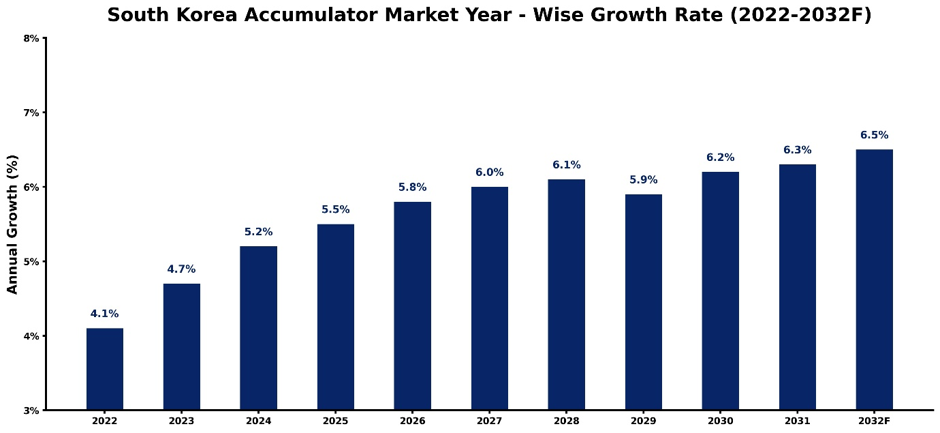 The following table summarizes the historical and forecasted growth rates of the South Korea Accumulator Market, along with the rationale behind each year’s performance.
| Year | Estimated Growth (%) | Market Rationale |
| 2022 | 4.1% | Growth improved due to increased automation adoption in manufacturing plants and rising demand for hydraulic accumulators in heavy-duty equipment applications. |
| 2023 | 4.7% | Expansion supported by increased investments in smart factories, semiconductor equipment manufacturing, and advanced industrial hydraulic systems. |
| 2024 | 5.2% | Demand increased with stronger utilization of accumulators in construction machinery, energy-efficient hydraulic systems, and industrial process equipment. |
| 2025 | 5.5% | Market growth accelerated due to rising replacement demand, modernization of manufacturing facilities, and adoption of high-performance accumulator technologies. |
| 2026 | 5.8% | Growth supported by increasing automation projects, expansion of renewable energy infrastructure, and higher demand from automotive production facilities. |
| 2027 | 6% | Rising investments in industrial robotics, electric mobility manufacturing, and advanced hydraulic systems contribute to stronger accumulator adoption. |
| 2028 | 6.1% | Market maintains momentum due to growing focus on energy-efficient machinery and integration of smart monitoring technologies in hydraulic systems. |
| 2029 | 5.9% | Slight moderation occurs as major industrial sectors reach higher penetration levels, though replacement and maintenance demand remains consistent. |
| 2030 | 6.2% | Growth rebounds with increasing deployment of automated production lines, next-generation construction equipment, and sustainable industrial technologies. |
| 2031 | 6.3% | Expansion continues due to increased demand for customized accumulators and rising investments in high-pressure industrial applications. |
| 2032 | 6.5% | Strong growth projected as South Korea advances toward highly automated manufacturing ecosystems and wider adoption of advanced energy storage components. |
Topics Covered in the South Korea Accumulator Market Report
The South Korea Accumulator Market Report provides a comprehensive analysis based on Type, Application, and Sales Channel. It offers detailed insights into key industry trends, growth drivers, emerging opportunities, competitive developments, and high-growth segments. The report presents an objective assessment of current dynamics and future prospects, enabling stakeholders to make informed business decisions and develop effective strategies aligned with the evolving industry landscape.
South Korea Accumulator Market Highlights
| Report Name | South Korea Accumulator Market |
| Forecast period | 2026–2032 |
| CAGR | 5.8% |
| Growing Sector | Industrial Automation & Hydraulic Equipment |
South Korea Accumulator Market Synopsis
The South Korea Accumulator Market is expected to experience steady growth due to factors such as industrial automation, demand for energy-efficient hydraulic systems, and investments in manufacturing infrastructure. An accumulator is a device that is used to store hydraulic energy based on pressure and maintain pressure in the system. This market is gaining further momentum due to technological advancements in compact and high-pressure accumulator designs, strengthening adoption across multiple industrial applications.
Evaluation of Growth Drivers in the South Korea Accumulator Market (2026-2032)
Below mentioned are some prominent drivers and their influence on the market dynamics:
| Drivers | Primary Segments Affected | Why it Matters (Evidence) |
| Expansion of Smart Manufacturing Facilities | Bladder Accumulators, Industrial Machinery | South Korea’s growing smart factory ecosystem increases demand for efficient hydraulic energy management solutions. |
| Rising Automotive Production Automation | Piston Accumulators, Automobile Industry | Automotive manufacturers increasingly deploy hydraulic systems for precision operations and automated production processes. |
| Renewable Energy Infrastructure Growth | Bladder Accumulators and Applications in Energy | Such hydraulic devices allow regulating pressure in modern energy infrastructure. |
| Growing Need for Construction Equipment | Diaphragm Accumulators and Construction Machinery | The growth of infrastructure and equipment necessitates the use of high-quality hydraulic components. |
| Development in Industrial Robots | Piston Accumulators and the Industry | The applications of robotics imply the need for reliable hydraulic performance. |
South Korea Accumulator Market is expected to grow at a CAGR of 5.8% during the forecast period of 2026-2032. The market development is supported by South Korea’s strong industrial base, where manufacturing contributes nearly 25% of national economic output and continues to encourage investments in automation technologies. Additionally, the country’s machinery sector benefits from increasing industrial robot density, exceeding 1,000 robots per 10,000 manufacturing employees, creating demand for precision hydraulic components. Growing investments in semiconductor facilities, automotive plants, and smart production systems are further supporting the adoption of advanced accumulator solutions across industrial applications.
Evaluation of Restraints in the South Korea Accumulator Market
Below mentioned are some major restraints and their influence on the market dynamics:
| Restraints | Primary Segments Affected | What This Means (Evidence) |
| Costly First-Time Installations | All Types, Industrial Machines | High initial costs associated with advanced accumulator systems restrict the use of such devices by small industrial businesses. |
| Presence of Alternatives to Technology | Bladder & Piston Accumulators, Machines | Presence of electric drive systems and other energy management technologies generates competition. |
| Maintenance Needs | All Types, Industrial Application | Maintenance needs increase the cost of operations for consumers. |
| Industrial Investments Cycles | Automobile, Construction, Production | Cycles of industrial investments may affect purchases of equipment. |
| Technical Proficiency Needs | All Types, Service Providers | Shortage of technical proficiency in hydraulic systems maintenance delays optimization. |
South Korea Accumulator Market Challenges
Although there has been a considerable level of industrial growth, the market is faced with several problems, such as growing competition from other energy management systems, higher levels of maintenance needs, and special technical knowledge. About 75% of the total industrial labor force in South Korea works in technology-intensive industries.
Furthermore, rising raw material costs for steel and precision components can impact manufacturing expenses, while smaller enterprises may experience difficulties in adopting premium accumulator systems due to investment constraints, affecting overall South Korea Accumulator Market Growth.
South Korea Accumulator Market Trends
Major trends shaping the South Korea Accumulator Market are as follows:
- Utilization of Smart Monitoring Technology: Accumulators equipped with sensors and smart monitoring technology to facilitate monitoring of the system pressure and maintenance of the machinery.
- Requirement for Smaller Size of Hydraulic Accumulators: Increasing requirement for small-size hydraulic accumulators which are highly efficient and can save space in automated machinery.
- Electric Vehicles Production: Growing scope for hydraulics accumulators in the manufacturing process of the electric vehicle due to growth in the number of plants for manufacturing of electric vehicles.
- Energy Efficiency in Manufacturing Sector: Companies are focusing on using energy-efficient accumulator technologies.
Investment Opportunities in the South Korea Accumulator Market
Promising investment avenues in the South Korea Accumulator Market are presented below:
- Advanced Hydraulic Component Manufacturing: Investment in domestic production facilities for high-pressure and customized accumulators can reduce dependency on imported components.
- Integrating Smart Factory Equipment: Designing accumulators that are compatible with Industry 4.0 networks presents potential in automated manufacturing operations.
- Automotive Manufacturing: Growth in electric vehicles and batteries presents potential for accumulator manufacturers in producing advanced equipment.
- Maintenance and Service Aftermarkets: Setting up maintenance service for industrial accumulator clients will help in generating continuous income streams.
Top Players in the South Korea Accumulator Market
A detailed compilation of major companies active in the South Korea Accumulator Market is presented below:
1. HYDAC International GmbH
| Company Name | HYDAC International GmbH |
|---|---|
| Established Year | 1963 |
| Headquarters | Sulzbach/Saar, Germany |
| Official Website | Click Here |
HYDAC provides advanced hydraulic accumulator solutions, including bladder and piston types, supporting industrial automation, mobile machinery, and energy-efficient hydraulic applications worldwide.
2. Parker Hannifin Corporation
| Company Name | Parker Hannifin Corporation |
|---|---|
| Established Year | 1917 |
| Headquarters | Cleveland, Ohio, USA |
| Official Website | Click Here |
Parker Hannifin manufactures hydraulic accumulators and motion control solutions designed for automotive, aerospace, industrial machinery, and energy management applications.
3. Bosch Rexroth AG
| Company Name | Bosch Rexroth AG |
|---|---|
| Established Year | 1795 |
| Headquarters | Lohr am Main, Germany |
| Official Website | Click Here |
Bosch Rexroth develops hydraulic accumulator technologies integrated with automation systems, improving machine efficiency, operational stability, and industrial performance.
4. Eaton Corporation plc
| Company Name | Eaton Corporation plc |
|---|---|
| Established Year | 1911 |
| Headquarters | Dublin, Ireland |
| Official Website | Click Here |
Eaton delivers hydraulic accumulator products designed for industrial equipment, mobile machinery, and energy-efficient fluid power management systems.
5. Freudenberg Sealing Technologies
| Company Name | Freudenberg Sealing Technologies |
|---|---|
| Established Year | 1849 |
| Headquarters | Weinheim, Germany |
| Official Website | Click Here |
Freudenberg provides accumulator components and sealing technologies that enhance durability, pressure performance, and reliability across industrial hydraulic systems.
Government Initiatives Being Implemented in the South Korea Accumulator Market
According to South Korea Government Data, several industrial development programs supporting advanced machinery manufacturing, automation, and energy-efficient technologies that indirectly strengthen accumulator adoption. As per the Manufacturing Innovation 3.0 Strategy introduced in 2014, there was an increase in the requirement for precision hydraulic parts due to the development of smart factories by automation, digitization of manufacturing operations, and connected industry technologies. Additionally, Smart Manufacturing Innovation Strategy 2022 has increased government assistance to small and medium manufacturers by promoting the use of intelligent manufacturing machinery and digital monitoring technologies. Furthermore, government’s 2030 National Carbon Neutrality Strategy has increased support for efficient industrial technologies that consume less energy.
Future Insights of the South Korea Accumulator Market
South Korea Accumulator Industry is expected to experience sustained growth as industrial automation, electric vehicle manufacturing, and advanced machinery production continue expanding across the country. As the growing application of smart factories, with more than 30,000 installations due to government initiatives, drives a requirement for dependable hydraulic energy storage systems,
the market is anticipated to be increasingly driven by small-sized sensors-based accumulators that enhance efficiency and maintenance abilities until 2032. Furthermore, South Korea's industry, with its share of around one-fourth of the country's GDP, will continue to offer long-term growth prospects for accumulator vendors in different industries including automotive, construction, and manufacturing.
Market Segmentation Analysis
This report presents a detailed analysis of the market segments along with their leading categories:
By Type – Bladder Accumulator Dominates Market While Piston Accumulator Shows Strong Expansion
According to Ravi Bhandari, Research Head, 6Wresearch, bladder accumulators held about 48.6% of the market share in 2025 owing to their economic efficiency, small size, and application in various machines such as manufacturing equipment, automobiles, and hydraulic power units.
Since they can help in regulating pressure changes and stabilize the systems, they have been favoured in many manufacturing units. On the other hand, the growth rate of piston accumulators is anticipated to reach about 6.4% during 2026-2032 due to their rising demand in high-pressure systems.
By Application – Automobile Industry Leads Market While Oil and Gas Industry Gains Momentum
By application, the automobile industry dominated with nearly 34.2% market share in 2025, driven by the country’s strong automotive manufacturing ecosystem, increasing electric vehicle production, and extensive use of hydraulic systems in assembly lines, stamping operations, and manufacturing equipment. The oil and gas industry is anticipated to grow at a CAGR of approximately 6.1% through 2032 due to rising demand for reliable pressure management systems, offshore equipment modernization, and advanced fluid power solutions used in industrial energy operations.
By Sales Channel – Direct Channel Dominates While Indirect Channel Expands Rapidly
The direct channel accounted for an approximate market share of 61.5% in the South Korea Accumulator Market by 2025 owing to strong associations between the manufacturers and industrial clients who demand custom-made hydraulic systems along with post-sales services.
The large machinery manufacturers and automotive companies tend to favor direct sourcing for proper product integration. The indirect channel, however, is expected to gain a CAGR of roughly 5.9% from 2026 to 2032 with help from increasing distributors, industrial equipment online platforms, and easy access to SMEs.
Note: Market size estimations and growth projections presented in this report are based on 6Wresearch's proprietary forecasting methodology, utilizing the latest available industry data, government publications, and primary research inputs.
Key Attractiveness of the Report
- 10 Years of Market Numbers
- Historical Data Starting from 2022 to 2025
- Base Year: 2025
- Forecast Data until 2032
- Key Performance Indicators Impacting the Market
- Major Upcoming Developments and Projects
Key Highlights of the Report:
- South Korea Accumulator Market Outlook
- Market Size of South Korea Accumulator Market, 2025
- Forecast of South Korea Accumulator Market, 2032
- Historical Data and Forecast of South Korea Accumulator Revenues & Volume for the Period 2022-2032
- South Korea Accumulator Market Trend Evolution
- South Korea Accumulator Market Drivers and Challenges
- South Korea Accumulator Price Trends
- South Korea Accumulator Porter's Five Forces
- South Korea Accumulator Industry Life Cycle
- Historical Data and Forecast of South Korea Accumulator Market Revenues & Volume By Type for the Period 2022-2032
- Historical Data and Forecast of South Korea Accumulator Market Revenues & Volume By Bladder Accumulator for the Period 2022-2032
- Historical Data and Forecast of South Korea Accumulator Market Revenues & Volume By Piston Accumulator for the Period 2022-2032
- Historical Data and Forecast of South Korea Accumulator Market Revenues & Volume By Diaphragm Accumulator for the Period 2022-2032
- Historical Data and Forecast of South Korea Accumulator Market Revenues & Volume By Application for the Period 2022-2032
- Historical Data and Forecast of South Korea Accumulator Market Revenues & Volume By Automobile Industry for the Period 2022-2032
- Historical Data and Forecast of South Korea Accumulator Market Revenues & Volume By Construction and Agricultural for the Period 2022-2032
- Historical Data and Forecast of South Korea Accumulator Market Revenues & Volume By Machinery for the Period 2022-2032
- Historical Data and Forecast of South Korea Accumulator Market Revenues & Volume By Plastics Industry for the Period 2022-2032
- Historical Data and Forecast of South Korea Accumulator Market Revenues & Volume By Marine Industry for the Period 2022-2032
- Historical Data and Forecast of South Korea Accumulator Market Revenues & Volume By Oil and Gas Industry for the Period 2022-2032
- Historical Data and Forecast of South Korea Accumulator Market Revenues & Volume By Sales Channel for the Period 2022-2032
- Historical Data and Forecast of South Korea Accumulator Market Revenues & Volume By Direct Channel for the Period 2022-2032
- Historical Data and Forecast of South Korea Accumulator Market Revenues & Volume By Indirect Channel for the Period 2022-2032
- South Korea Accumulator Import Export Trade Statistics
- Market Opportunity Assessment By Type
- Market Opportunity Assessment By Application
- Market Opportunity Assessment By Sales Channel
- South Korea Accumulator Top Companies Market Share
- South Korea Accumulator Competitive Benchmarking By Technical and Operational Parameters
- South Korea Accumulator Company Profiles
- South Korea Accumulator Key Strategic Recommendations
Market Covered
The report offers a comprehensive study of the subsequent market segments:
By Type
- Bladder Accumulator
- Piston Accumulator
- Diaphragm Accumulator
By Application
- Automobile Industry
- Construction and Agricultural Machinery
- Plastics Industry
- Marine Industry
- Oil and Gas Industry
By Sales Channel
- Direct Channel
- Indirect Channel






































