South Korea Advanced Nanomaterials for Environmental Detection and Remediation Market Growth Rate
According to 6Wresearch internal database and industry insights, the South Korea Advanced Nanomaterials for Environmental Detection and Remediation Market is projected to grow at a compound annual growth rate (CAGR) of 8.89% during the forecast period (2026-2032).
South Korea Advanced Nanomaterials for Environmental Detection and Remediation Market Year-wise Growth Rate and Key Drivers (2022-2032)
This graph illustrates the annual growth rates of the South Korea Advanced Nanomaterials for Environmental Detection and Remediation Market from 2022 to 2032, highlighting a steady upward trajectory and projected market expansion over the forecast period.
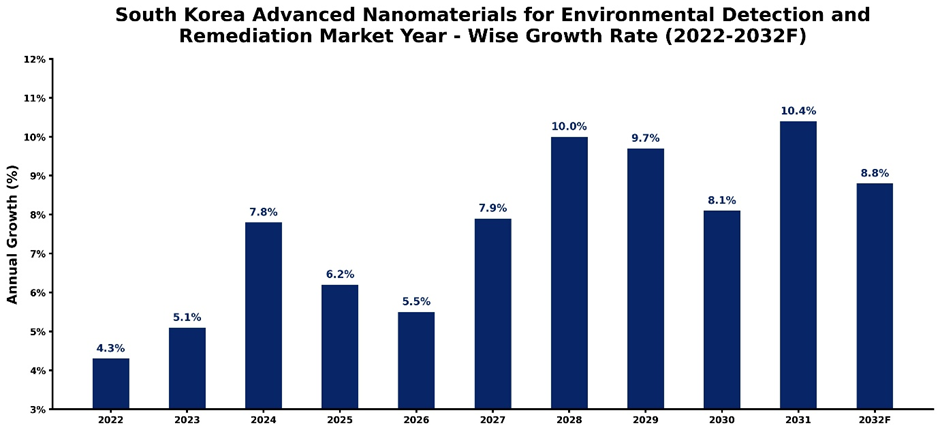
The following table presents the estimated annual growth rates of the market for each year, along with the key factors influencing market performance during the respective period. The values are intended to highlight year-wise drivers rather than provide a direct comparison between individual years.
| Year | Estimated Growth (%) | Market Rationale |
| 2022 | 4.3% | Rising awareness regarding industrial pollution and municipal wastewater treatment initiatives spurred initial adoption. |
| 2023 | 5.1% | Introduction of stringent environmental regulations regarding heavy metal detection catalyzed demand. |
| 2024 | 7.8% | Escalating investments in smart city infrastructure and clean water projects expanded application scope. |
| 2025 | 6.2% | Growing deployment of carbon-based nanomaterials for rapid air quality monitoring supported expansion. |
| 2026 | 5.5% | Technological advancements in magnetic nanoparticles for swift chemical separation drove steady adoption. |
| 2027 | 7.9% | Expansion of the pharmaceutical sector necessitated advanced effluent treatment solutions, boosting sales. |
| 2028 | 10% | Government funding for sustainable agriculture and soil remediation projects fostered widespread usage. |
| 2029 | 9.7% | Integration of IoT with nanosensors for real-time environmental tracking scaled up industrial implementation. |
| 2030 | 8.1% | Large-scale commercialization of silica-based nanomaterials for groundwater purification stimulated the industry. |
| 2031 | 10.4% | Increasing industrialization and the need for eco-friendly waste management solutions maintained consistent momentum. |
| 2032 | 8.8% | Broad adoption of polymer-based nanocomposites across major manufacturing hubs cemented long-term expansion. |
Topics Covered in the South Korea Advanced Nanomaterials for Environmental Detection and Remediation Market Report
The South Korea Advanced Nanomaterials for Environmental Detection and Remediation Market Report provides a comprehensive analysis based on Medium, Type, Application, and End-use Industry. It offers detailed insights into key industry trends, growth drivers, emerging opportunities, competitive developments, and high-growth segments. The report presents an objective assessment of current dynamics and future prospects, enabling stakeholders to make informed business decisions and develop effective strategies aligned with the evolving industry landscape.
South Korea Advanced Nanomaterials for Environmental Detection and Remediation Market Highlights
| Report Name | South Korea Advanced Nanomaterials for Environmental Detection and Remediation Market |
| Forecast period | 2026-2032 |
| CAGR | 8.89% |
| Growing Sector | Waste Water & Industrial Effluent Treatment |
South Korea Advanced Nanomaterials for Environmental Detection and Remediation Market Synopsis
South Korea Advanced Nanomaterials for Environmental Detection and Remediation Market is anticipated to record notable growth due to escalating industrial emissions and a strict ecological regulatory landscape. These nanomaterials are engineered particles, sized between 1 and 100 nanometers, utilized to detect minute pollutants and neutralize hazardous toxins across diverse ecosystems.
At present, about 75% of all proposed industrial waste water facilities make use of advanced nanotechnology detection. The widespread usage shows the dedication of the country to adopt innovative materials science technology for removal of contaminants from the environment without reducing the productivity of industries.
Evaluation of Growth Drivers in the South Korea Advanced Nanomaterials for Environmental Detection and Remediation Market (2026-2032)
Below mentioned are some prominent drivers and their influence on the market dynamics:
| Drivers | Primary Segments Affected | Why it Matters (Evidence) |
| Stricter Environmental Emission Regulations | Water, Air | New compliance mandates force chemical plants to adopt highly sensitive carbon-based nanosensors. |
| Escalating Industrial Effluent Volumes | Waste Water Treatment, Chemicals | Expanding manufacturing hubs generate complex waste, demanding efficient metal-based remediation solutions. |
| Nanosensor Technology Developments | Environmental Monitoring, Air | The integration of Internet of Things with silica nanomaterials allows for precise and timely tracking of pollution. |
| Government Subsidies for Environmental Technologies | Soil and Land Management, Agriculture | Government subsidies for sustainable agriculture lead to quick adoption of polymer-based soil purification technology. |
| Growth in the Need for Drinking Water | Water/Waste Water Treatment | The growing population of cities calls for efficient filtration with nanomaterials to eliminate micro-pollutants. |
South Korea Advanced Nanomaterials for Environmental Detection and Remediation Market is expected to grow at the CAGR of 8.89% during the forecast period of 2026-2032, supported by stringent regulatory compliance and robust industrial demand. The semiconductor and chemical sectors, which account for a massive portion of the national export economy, are mandated to meet strict biochemical oxygen demand and fluoride concentration limits, driving a 40% surge in the adoption of nano-filtration membranes. Additionally, the government’s unprecedented research and development budget for 2026, featuring a substantial 21.6% increase in specific science funding, acts as a massive catalyst. This high investment rate accelerates the manufacturing of magnetic nanoparticles for continuous ecological monitoring.
Evaluation of Restraints in the South Korea Advanced Nanomaterials for Environmental Detection and Remediation Market
Below mentioned are some major restraints and their influence on the market dynamics:
| Restraints | Primary Segments Affected | What This Means (Evidence) |
| High Initial Production Costs | All Types, Environmental Monitoring | Complex manufacturing processes for engineered nanomaterials significantly elevate the final product acquisition prices. |
| Potential Secondary Environmental Toxicity | Soil, Water | Concerns regarding the long-term ecological accumulation of nanoparticles restrict broad deployment in sensitive habitats. |
| Absence of Uniform Regulatory Frameworks | All Categories, Medicines | The ambiguity surrounding the safety testing process for novel nanomaterial categories results in delayed market introduction of products. |
| Difficulties Associated With Scaling Up | Water Treatment, Chemicals | Moving from small-scale synthesis to large-scale production of materials is likely to compromise efficiency and stability. |
| Unique Application Procedures | Air, Soil | The high levels of expertise required for the safe use of nanomaterials poses a problem for rapid application. |
South Korea Advanced Nanomaterials for Environmental Detection and Remediation Market Challenges
South Korea Advanced Nanomaterials for Environmental Detection and Remediation Market growth encounters substantial technical and economic barriers despite its technological prowess. Another key challenge is the uncertainty involved with the secondary toxicity of nanoparticles with about 30% of pilot ventures facing setbacks during the environmental risk assessment process.
In addition, the intricate process involved in the creation of carbon-based and polymeric nanomaterials raises operational expenses by up to 25% at municipal plants. Considering the current inflation rate of 3.1% in the nation, the huge capital investment required for setting up such a system means that about 15% of small-scale industrial plants cannot afford it.
South Korea Advanced Nanomaterials for Environmental Detection and Remediation Market Trends
Notable trends influencing the South Korea advanced nanomaterials for environmental detection and remediation industry are listed below:
- Integration of Bio-Nanocomposites: Manufacturers are increasingly focusing on developing bio-based nanomaterials derived from natural polymers to enhance eco-friendliness. These biodegradable composites ensure that the remediation agents do not leave persistent secondary pollutants in the soil or water post-treatment.
- Magnetic Nanoparticle Application: There has been an increased application of magnetic nanoparticles in the process of heavy metals removal in the waste water from industries. This has made the process easy through the magnetic separation of the particles which takes place externally, thus cutting down the energy needed.
- Nanosensor Network: Use of carbon nanotubes coupled with cloud computing in order to monitor air pollution. These are real-time sensor networks that deliver local data on airborne chemicals in real-time to the municipality during any sudden leakage of industrial chemicals into the air.
Investment Opportunities in the South Korea Advanced Nanomaterials for Environmental Detection and Remediation Market
Attractive investment opportunities within the South Korea advanced nanomaterials for environmental detection and remediation market include the following:
- Smart Water Treatment Facilities: Securing capital to upgrade aging municipal water treatment plants with advanced silica-based nanosiltration membranes. Investments in these municipal projects offer long-term stability and align perfectly with national directives aimed at eliminating microplastics and pharmaceutical residues from public drinking water.
- Start-ups for Nanomaterials Synthesis: Funding nascent technology firms whose purpose is to develop scalable synthesis of carbon-based nanomaterials through a green approach. Energy-efficient and cost-effective nanomaterials synthesis will enable huge gains in terms of market share as industries strive to implement cost-effective solutions in light of chemical disposal laws.
- Agricultural Soil Repair: Developing specific nanomaterials based on polymers that can be used in detecting and eliminating pesticide residues from the soil. Investing in such agricultural technology will be lucrative considering the aggressive incentives by the government to promote sustainable agriculture.
Top Players in the South Korea Advanced Nanomaterials for Environmental Detection and Remediation Market
The following section outlines major companies in the South Korea advanced nanomaterials for environmental detection and remediation market:
1. LG Chem
|
Company Name |
LG Chem |
|---|---|
|
Established Year |
1947 |
|
Headquarters |
Seoul, South Korea |
|
Official Website |
LG Chem engineers advanced polymer-based nanomaterials and filtration membranes heavily utilized for large-scale industrial wastewater purification.
2. Hanwha Solutions
|
Company Name |
Hanwha Solutions |
|---|---|
|
Established Year |
1965 |
|
Headquarters |
Seoul, South Korea |
|
Official Website |
Hanwha Solutions develops innovative carbon-based nanotechnologies and chemical remediation products for complex environmental monitoring and soil management.
3. Kumho Petrochemical
|
Company Name |
Kumho Petrochemical |
|---|---|
|
Established Year |
1970 |
|
Headquarters |
Seoul, South Korea |
|
Official Website |
Kumho Petrochemical manufactures specialized silica and polymer nanomaterials crucial for advanced effluent treatment across domestic chemical industries.
4. Advanced Nano Products Co., Ltd.
|
Company Name |
Advanced Nano Products Co., Ltd. |
|---|---|
|
Established Year |
2000 |
|
Headquarters |
Cheongju, South Korea |
|
Official Website |
Advanced Nano Products manufactures ceramic and metallic nanopowders and structured nanomaterials for electronics, industrial manufacturing, and advanced technology applications.
5. Senko Co., Ltd.
|
Company Name |
Senko Co., Ltd. |
|---|---|
|
Established Year |
1980 |
|
Headquarters |
Seoul, South Korea |
|
Official Website |
Senko develops gas detection instruments and sensor technologies that enable real-time monitoring of hazardous gases, industrial environments, and workplace safety conditions.
Government Initiatives Being Implemented in the South Korea Advanced Nanomaterials for Environmental Detection and Remediation Market
South Korea Advanced Nanomaterials for Environmental Detection and Remediation Market greatly benefits from aggressive legislative frameworks and strategic state funding. In 2025, the Ministry of Environment strictly enforced updated mandates under the Water Environment Conservation Act, requiring high-risk industrial facilities to utilize real-time Tele-Monitoring Systems.
Meanwhile, the government’s policies have been adjusted according to the 2025 OECD guidelines for safe and sustainable design regarding the assessment of toxicity at nanoscale. Moreover, unprecedentedly high expenditure on R&D in the country in 2025, with a 12.9% increase from the previous year, is aimed at funding green technology breakthroughs.
Future Insights of the South Korea Advanced Nanomaterials for Environmental Detection and Remediation Market
The South Korea Advanced Nanomaterials for Environmental Detection and Remediation Industry is positioned to undergo transformative shifts by the year 2032, driven by an urgent need for sustainable ecological restoration. According to future projections, the deployment of smart nanosensors in the national Tele-Monitoring system is expected to increase the efficiency of detecting pollutants in real time by almost 45%. With respect to Net Zero goals, it is expected that there will be a decrease in the toxicity of heavy metals by 60% through the use of nanostructured filters. By 2032, the widespread deployment of these ultra-sensitive materials is expected to optimize municipal wastewater processing efficiency by over 35%.
Market Segmentation Analysis
This report presents a detailed analysis of the market segments along with their leading categories:
By Medium - Water Dominated the Market, Air Set for Rapid Expansion
According to Sumit Sagar, Senior Research Analyst, 6Wresearch, Water accounted for 48.50% of the South Korea Advanced Nanomaterials for Environmental Detection and Remediation Market Share in 2025, primarily owing to massive government investments in municipal water treatment and stringent regulations on industrial wastewater discharge. Meanwhile, the Air segment is anticipated to register the fastest CAGR of 9.20% during 2026–2032, supported by escalating urban air pollution concerns, rising deployment of real-time nanosensor networks across smart cities, and growing public demand for accurate indoor air quality monitoring systems.
By Type - Carbon-based Emerges as the Largest Segment, Polymer-based Records the Fastest Growth
The Carbon-based segment accounted for the maximum market share of 37.40% in the year 2025. The factors driving the growth of this market include exceptional electrical conductivity, large surface area, and widespread application in highly sensitive environmental sensors. On the other hand, the Polymer-based segment is projected to grow at the maximum CAGR of 9.45% during the forecast period, driven by their excellent biocompatibility, tunable chemical properties, lower production costs, and increasing utilization in eco-friendly agricultural soil remediation projects.
By Application - Waste Water & Industrial Effluent Treatment Maintains Market Leadership, Environmental Monitoring Accelerates
Waste Water & Industrial Effluent Treatment dominated the market with an estimated 42.10% market share in 2025, supported by the massive chemical manufacturing base in South Korea and strict national zero-discharge mandates for heavy metals. In contrast, Environmental Monitoring applications are projected to witness the fastest CAGR of 9.60% during 2026–2032, fueled by rapid advancements in IoT-integrated nanosensors, expanding smart city infrastructure, and growing corporate necessity to continuously track and report localized greenhouse gas emissions.
By End-use Industry - Chemicals Command the Market, Pharmaceuticals Gain Momentum
Chemicals constituted a market share of 35.80% in 2025 due to the immense volume of complex, toxic byproducts generated during traditional petrochemical and specialty chemical manufacturing that require advanced nano-remediation. On the other hand, Pharmaceuticals is projected to witness considerable growth of 9.75% during 2026–2032, driven by the escalating demand for highly specialized silica-based filtration systems designed to meticulously remove active pharmaceutical ingredients and endocrine disruptors from both manufacturing effluent and municipal water supplies.
Note: Market size estimations and growth projections presented in this report are based on 6Wresearch's proprietary forecasting methodology, utilizing the latest available industry data, government publications, and primary research inputs.
Key Attractiveness of the Report
- 10 Years of Market Numbers.
- Historical Data Starting from 2022 to 2025.
- Base Year: 2025.
- Forecast Data until 2032.
- Key Performance Indicators Impacting the Market.
- Major Upcoming Developments and Projects.
Key Highlights of the Report:
- South Korea Advanced Nanomaterials for Environmental Detection and Remediation Market Outlook
- Market Size of South Korea Advanced Nanomaterials for Environmental Detection and Remediation Market, 2025
- Forecast of South Korea Advanced Nanomaterials for Environmental Detection and Remediation Market, 2032
- Historical Data and Forecast of South Korea Advanced Nanomaterials for Environmental Detection and Remediation Revenues & Volume for the Period 2022-2032
- South Korea Advanced Nanomaterials for Environmental Detection and Remediation Market Trend Evolution
- South Korea Advanced Nanomaterials for Environmental Detection and Remediation Market Drivers and Challenges
- South Korea Advanced Nanomaterials for Environmental Detection and Remediation Price Trends
- South Korea Advanced Nanomaterials for Environmental Detection and Remediation Porter's Five Forces
- South Korea Advanced Nanomaterials for Environmental Detection and Remediation Industry Life Cycle
- Historical Data and Forecast of South Korea Advanced Nanomaterials for Environmental Detection and Remediation Market Revenues & Volume By Medium for the Period 2022-2032
- Historical Data and Forecast of South Korea Advanced Nanomaterials for Environmental Detection and Remediation Market Revenues & Volume By Air for the Period 2022-2032
- Historical Data and Forecast of South Korea Advanced Nanomaterials for Environmental Detection and Remediation Market Revenues & Volume By Soil for the Period 2022-2032
- Historical Data and Forecast of South Korea Advanced Nanomaterials for Environmental Detection and Remediation Market Revenues & Volume By Water for the Period 2022-2032
- Historical Data and Forecast of South Korea Advanced Nanomaterials for Environmental Detection and Remediation Market Revenues & Volume By Type for the Period 2022-2032
- Historical Data and Forecast of South Korea Advanced Nanomaterials for Environmental Detection and Remediation Market Revenues & Volume By Metal-based for the Period 2022-2032
- Historical Data and Forecast of South Korea Advanced Nanomaterials for Environmental Detection and Remediation Market Revenues & Volume By Carbon-based for the Period 2022-2032
- Historical Data and Forecast of South Korea Advanced Nanomaterials for Environmental Detection and Remediation Market Revenues & Volume By Silica-based for the Period 2022-2032
- Historical Data and Forecast of South Korea Advanced Nanomaterials for Environmental Detection and Remediation Market Revenues & Volume By Polymer-based for the Period 2022-2032
- Historical Data and Forecast of South Korea Advanced Nanomaterials for Environmental Detection and Remediation Market Revenues & Volume By Application for the Period 2022-2032
- Historical Data and Forecast of South Korea Advanced Nanomaterials for Environmental Detection and Remediation Market Revenues & Volume By Waste Water & Industrial Effluent Treatment for the Period 2022-2032
- Historical Data and Forecast of South Korea Advanced Nanomaterials for Environmental Detection and Remediation Market Revenues & Volume By Environmental Monitoring for the Period 2022-2032
- Historical Data and Forecast of South Korea Advanced Nanomaterials for Environmental Detection and Remediation Market Revenues & Volume By Soil & Land Management for the Period 2022-2032
- Historical Data and Forecast of South Korea Advanced Nanomaterials for Environmental Detection and Remediation Market Revenues & Volume By Sustainable Agriculture for the Period 2022-2032
- Historical Data and Forecast of South Korea Advanced Nanomaterials for Environmental Detection and Remediation Market Revenues & Volume By Energy Storage for the Period 2022-2032
- Historical Data and Forecast of South Korea Advanced Nanomaterials for Environmental Detection and Remediation Market Revenues & Volume By Others for the Period 2022-2032
- Historical Data and Forecast of South Korea Advanced Nanomaterials for Environmental Detection and Remediation Market Revenues & Volume By End-use Industry for the Period 2022-2032
- Historical Data and Forecast of South Korea Advanced Nanomaterials for Environmental Detection and Remediation Market Revenues & Volume By Pharmaceuticals for the Period 2022-2032
- Historical Data and Forecast of South Korea Advanced Nanomaterials for Environmental Detection and Remediation Market Revenues & Volume By Chemicals for the Period 2022-2032
- Historical Data and Forecast of South Korea Advanced Nanomaterials for Environmental Detection and Remediation Market Revenues & Volume By Agriculture for the Period 2022-2032
- Historical Data and Forecast of South Korea Advanced Nanomaterials for Environmental Detection and Remediation Market Revenues & Volume By Construction for the Period 2022-2032
- Historical Data and Forecast of South Korea Advanced Nanomaterials for Environmental Detection and Remediation Market Revenues & Volume By Others for the Period 2022-2032
- South Korea Advanced Nanomaterials for Environmental Detection and Remediation Import Export Trade Statistics
- Market Opportunity Assessment By Medium
- Market Opportunity Assessment By Type
- Market Opportunity Assessment By Application
- Market Opportunity Assessment By End-use Industry
- South Korea Advanced Nanomaterials for Environmental Detection and Remediation Top Companies Market Share
- South Korea Advanced Nanomaterials for Environmental Detection and Remediation Competitive Benchmarking By Technical and Operational Parameters
- South Korea Advanced Nanomaterials for Environmental Detection and Remediation Company Profiles
- South Korea Advanced Nanomaterials for Environmental Detection and Remediation Key Strategic Recommendations
Market Covered
The report offers a comprehensive study of the subsequent market segments:
By Medium
- Air
- Soil
- Water
By Type
- Metal-based
- Carbon-based
- Silica-based
- Polymer-based
By Application
- Waste Water & Industrial Effluent Treatment
- Environmental Monitoring
- Soil & Land Management
- Sustainable Agriculture
- Energy Storage
- Others
By End-use Industry
- Pharmaceuticals
- Chemicals
- Agriculture
- Construction
- Others































