South Korea Advertising Services Market Size & Growth Rate
According to 6Wresearch internal database and industry insights, the South Korea Advertising Services Market was valued at USD 13.4 Billion in 2025 and is projected to reach USD 19.84 Billion by 2032, growing at a CAGR of approximately 5.77% during 2026–2032.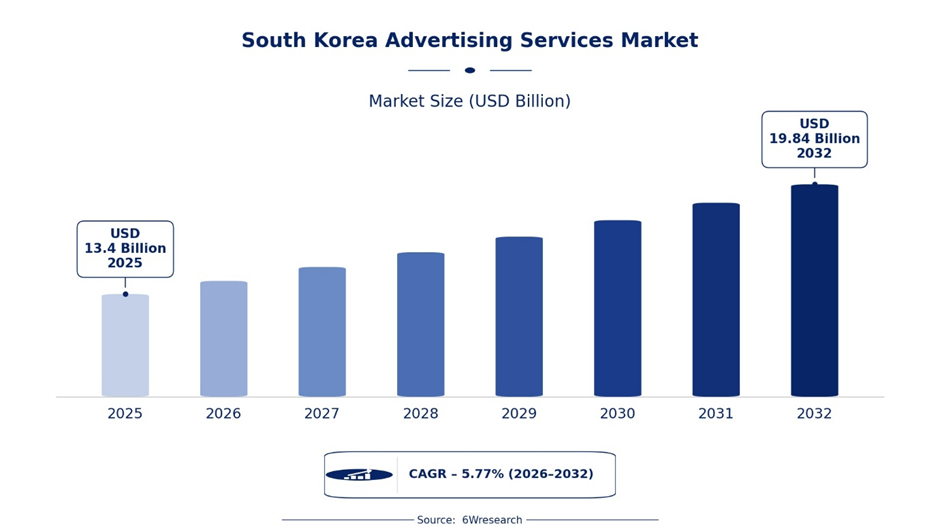
South Korea Advertising Services Market Highlights
|
Report Metric |
Details |
|
Report Name |
South Korea Advertising Services Market |
|
Market Size 2025 |
USD 13.4 Billion |
|
Market Size 2032 |
USD 19.84 Billion |
|
Absolute Growth 2025–2032 |
USD 6.44 Billion |
|
CAGR 2026–2032 |
5.77% |
|
Peak Annual Growth |
7.2% in 2027 |
|
Forecast Period |
2026–2032 |
|
Historical Data |
2022–2025 |
|
Base Year |
2025 |
|
Leading Mode of Service, 2025 |
Digital (62% share) |
|
Leading End-use Industry, 2025 |
Retail (22% share) |
|
Fastest-Growing End-use Industry |
Technology (8.3% CAGR) |
|
Growing Sector |
Digital advertising, led by retail media and connected TV |
|
Key End Users |
Retailers and e-commerce operators, consumer goods manufacturers, banks and insurers, technology and device brands, tourism operators, media owners |
South Korea Advertising Services Market Year-wise Growth Rate and Key Drivers (2022–2032)
This graph illustrates the annual growth rates of the market from 2022 to 2032, highlighting a steady upward trajectory and projected market expansion over the forecast period.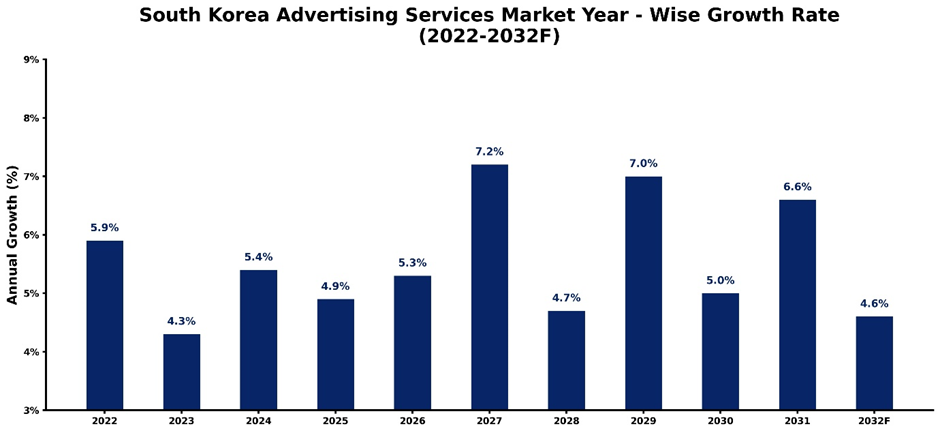 The following table presents the estimated annual growth rate for each year together with the principal factor influencing market performance.
|
Year |
Estimated Annual Growth (%) |
Market Rationale |
|
2022 |
5.9% |
Easing of COVID-19 distancing rules in April 2022 and the FIFA World Cup in Qatar revived advertiser spending. |
|
2023 |
4.3% |
The Bank of Korea raised its base rate to 3.50% in January 2023, constraining advertiser budgets and slowing campaign volumes. |
|
2024 |
5.4% |
The Paris Olympics and the April 2024 general election lifted spending on broadcast and platform campaigns. |
|
2025 |
4.9% |
Political uncertainty after the December 2024 martial law declaration and June 2025 snap election weakened consumer confidence and advertiser budgets. |
|
2026 |
5.3% |
Easing interest rates and recovering household consumption are expected to restore advertiser confidence and release postponed campaign budgets. |
|
2027 |
7.2% |
Mature retail media networks and connected TV measurement standards are expected to channel larger budgets into accountable, performance-linked formats. |
|
2028 |
4.7% |
Population ageing and a shrinking working-age base are expected to temper consumer demand as post-peak spending normalises. |
|
2029 |
7% |
Generative AI production and automated media buying are expected to cut creative costs and widen participation among smaller advertisers. |
|
2030 |
5% |
Rising platform media costs are expected to squeeze advertiser budgets and slow volume growth as pricing power concentrates. |
|
2031 |
6.6% |
Spatial computing and extended-reality devices are expected to open immersive advertising inventory as hardware prices decline and adoption widens. |
|
2032 |
4.6% |
Near-saturated online penetration is expected to normalise growth as incremental audience gains diminish and spending matures. |
Note: Market size estimations and growth projections presented in this report are based on 6Wresearch’s proprietary forecasting methodology, utilizing the latest available industry data, government publications, and primary research inputs.
South Korea Advertising Services Market Synopsis
The South Korea Advertising Services Market is shaped by the convergence of advanced digital infrastructure, mobile-first consumer behaviour, and an increasingly integrated advertising ecosystem. Market offerings span search engine marketing, social media promotions, online video, retail media, television, print, outdoor advertising, and end-to-end services covering creative development, campaign strategy, media planning, and buying. The strong market positions of Naver and Kakao, the growth of Coupang’s e-commerce ecosystem, and the global expansion of Korean beauty, entertainment, electronics, and lifestyle brands are influencing advertising demand and campaign investment patterns. Furthermore, the adoption of AI-enabled content creation, performance analytics, and commerce-linked advertising is opening new avenues for service providers.
Market Dynamics Impact Analysis (2026–2032)
|
Factor |
Type |
Impact |
Primary Segment Affected |
|
High-capacity connectivity and a large online audience |
Driver |
High |
Digital |
|
E-commerce and retail media expansion |
Driver |
High |
Retail |
|
In-store retail media networks |
Opportunity |
Medium |
Retail |
|
Inbound tourism and cross-border cultural marketing |
Opportunity |
Medium |
Travel & Tourism |
|
Tightening privacy enforcement on behavioural targeting |
Restraint |
High |
Digital |
|
Ageing population and low fertility |
Restraint |
Medium |
Consumer Goods |
|
Concentration of media pricing power among platforms |
Challenge |
Medium |
Digital |
|
Shortage of data and AI specialists |
Challenge |
Medium |
Technology |
Evaluation of Drivers in South Korea Advertising Services Market (2026–2032)
Below mentioned are some major drivers and their influence on market dynamics:
|
Drivers |
Primary Segment Affected |
Why It Matters (Evidence) |
|
Large and highly connected online audience |
Digital |
With internet use above 95% of the population, advertisers can reach nearly all consumers through mobile and video channels, which shifts budgets towards measurable online formats and expands inventory for platforms and agencies. |
|
Expansion of e-commerce and retail media |
Retail |
Online shopping transactions exceeded KRW 200 trillion in 2023, giving Coupang, Naver and Kakao rich purchase data that can be sold as sponsored listings, which pulls promotional spending from retailers and brands. |
|
Scale of domestic super-app platforms |
Digital |
KakaoTalk reaches close to 49 million monthly users, almost the entire population, allowing brands to run messaging, commerce and payment-linked campaigns on one channel and increasing demand for platform-based services. |
|
Marketing intensity of global Korean brands |
Technology |
Samsung and Hyundai Motor run continuous global campaigns through captive agencies such as Cheil Worldwide and Innocean, which anchors steady demand for creative, media planning and launch marketing. |
|
Global reach of K-content |
Media & Entertainment |
Netflix committed USD 2.5 billion to Korean content for 2023 to 2027, and the resulting global fan base raises demand for brand integration, product placement and cross-border campaigns. |
The market expansion is being reinforced by South Korea’s highly urbanised population, with approximately 81% of residents living in cities, enabling advertisers to reach large consumer groups through concentrated, high-frequency campaigns. In parallel, rising household incomes are creating greater capacity for discretionary purchases, supporting brand investment across industries. The integration of artificial intelligence into audience analysis, content development and campaign optimisation is also helping businesses reduce customer acquisition costs and improve returns on advertising expenditure. Furthermore, the availability of skilled software engineers and data scientists is strengthening campaign measurement, automation and personalised targeting.
Evaluation of Restraints in South Korea Advertising Services Market
Below mentioned are some major restraints and their influence on market dynamics:
|
Market Restraint |
Primary Segment Affected |
Why It Matters (Evidence) |
|
Tightening privacy enforcement on behavioural targeting |
Digital |
Consent requirements limit data collection, and the Personal Information Protection Commission fined Google and Meta about KRW 100 billion in 2022, which pushes platforms to reduce profiling and lowers targeting precision. |
|
Ageing population and low fertility |
Consumer Goods |
Fertility fell to 0.72 in 2023, shrinking future cohorts of young consumers, which weakens long-run volume growth for mass-market brands and reduces the reach value of youth-oriented advertising. |
|
Structural decline of linear television and print |
Traditional |
Viewers and readers are moving to YouTube, Netflix and mobile news portals, so KBS, MBC, SBS and newspaper publishers lose advertising revenue that their online offerings do not fully replace. |
|
High household debt limiting discretionary demand |
Retail |
Household debt stands close to 90% of GDP, which restricts discretionary consumption and leads retailers and brands to trim promotional budgets when interest rates remain elevated. |
|
Dependence on global platforms for audience reach |
Media & Entertainment |
YouTube is the most used mobile application by total time spent, which directs advertiser budgets towards a foreign platform and reduces revenue available to domestic publishers and broadcasters. |
South Korea Advertising Services Market Challenges
The South Korea Advertising Services Market faces several structural challenges that affect talent availability, campaign efficiency and competitive opportunities. The working-age population has been shrinking since 2019, intensifying competition between agencies and digital platforms for data specialists and increasing recruitment and delivery costs. Additionally, performance advertising inventory is concentrated among Naver, Google and Meta, giving these platforms considerable pricing power and limiting advertisers’ flexibility in budget allocation.
The complications arising from measurement also make it harder to evaluate marketing campaigns, since data is collected independently from closed platform ecosystems, and it becomes impossible to correlate expenditure and sales figures for buyers. The disclosure of paid endorsements introduced in 2020 also means that more time needs to be taken in reviewing marketing campaigns.
Trends in the South Korea Advertising Services Market
Major industry trends in the South Korea Advertising Services Market are summarized below:
- Shift from Search-led to Commerce-led Advertising: Advertisers are moving budgets from portal search and display towards shopping platforms where purchase intent is already visible. Coupang, Naver Shopping and Kakao now sell sponsored listings backed by first-party transaction data, with Coupang serving over 20 million active customers.
- Transition from Linear Television to Streaming and Connected TV: Viewing is migrating from KBS, MBC and SBS broadcasts to YouTube, Netflix and domestic streaming services such as TVING, and Netflix introduced an advertising-supported plan in Korea in November 2022. Advertisers are following audiences into addressable video formats.
- Generative AI Emerging as a Core Creative Production Tool: Agencies and platforms are embedding generative models in copywriting, image production and campaign personalisation. Naver launched its HyperCLOVA X Korean-language model in August 2023, and large agency groups are building in-house AI creative tools.
Investment Opportunities in the South Korea Advertising Services Market
Strategic investment opportunities in the South Korea Advertising Services Market include the following:
- Offline Retail Media Networks: Convenience chains such as GS25 and CU operate well over 15,000 stores each, yet in-store screens and shopper data remain under-monetised. Investors can fund in-store screen networks, shopper-data platforms and campaign measurement tools for these chains.
- Privacy-compliant Measurement and Data Clean Rooms:Stricter consent rules and fragmented reporting across platforms have created demand for neutral measurement. Investors can build data clean rooms, cross-platform attribution and consent-management tools tailored to Korean platforms.
- Creator and Live Commerce Networks:Short-form video and live shopping have turned creators into a primary sales channel on Naver, Kakao and YouTube. Investors can back creator management networks, live-commerce production studios and campaign platforms that match brands with verified creators.
Leading Players in South Korea Advertising Services Market
The following section outlines major companies in the South Korea Advertising Services Market:
1. Cheil Worldwide
| Company Name | Cheil Worldwide |
|---|---|
| Established Year | 1973 |
| Headquarters | Seoul, South Korea |
| Official Website | Click Here |
Cheil Worldwide is an integrated marketing and advertising group providing creative, media, digital and experience services. It plays a central role in the country’s advertising services market through its work for major domestic and global brands.
2. Innocean Worldwide
| Company Name | Innocean Worldwide |
|---|---|
| Established Year | 2005 |
| Headquarters | Seoul, South Korea |
| Official Website | Click Here |
Innocean Worldwide is a full-service advertising agency offering creative, brand, media and performance marketing services. It serves automotive and other corporate clients and holds a prominent position among agencies in South Korea.
3. Naver Corporation
| Company Name | Naver Corporation |
|---|---|
| Established Year | 1999 |
| Headquarters | Seongnam, South Korea |
| Official Website | Click Here |
Naver Corporation operates the country’s leading search portal and commerce ecosystem and sells search, display and shopping advertising to domestic advertisers. It is a primary destination for online advertising budgets in South Korea.
4. Kakao Corporation
| Company Name | Kakao Corporation |
|---|---|
| Established Year | 1995 |
| Headquarters | Jeju, South Korea |
| Official Website | Click Here |
Kakao Corporation operates the KakaoTalk messaging platform and related commerce, content and mobility services, and sells messaging and display advertising to businesses. It is a major platform-based channel for brand and performance campaigns in South Korea.
Government Initiatives in the South Korea Advertising Services Market
The South Korea Advertising Services Market is shaped by digital transformation policies and regulatory measures designed to strengthen advertising infrastructure and accountability. Introduced in 2020, the Korean New Deal allocated KRW 58.2 trillion to its digital pillar through 2025, strengthening the 5G, data and artificial intelligence infrastructure that supports modern advertising operations. Alongside these investments, the Framework Act on Artificial Intelligence, promulgated in January 2025 and effective from January 2026, introduced transparency obligations for AI-generated content, influencing creative development and disclosure practices.
For enforcing these frameworks, there are several bodies responsible for overseeing the compliance as well as operation of the industry. For instance, the Korea Fair Trade Commission has issued new guidelines on recommendation and endorsement advertising in September 2020, where disclosure of payment is necessary. At the same time, Personal Information Protection Commission imposes conditions of consent and penalized Google and Meta with KRW 100 billion in September 2022.
Future Insight of the South Korea Advertising Services Market
The South Korea Advertising Services Market is expected to evolve through advances in connectivity, data utilisation and computing infrastructure. The continued rollout of next-generation networks will create opportunities for immersive and interactive campaigns, while greater collaboration between platforms and brands using first-party data is expected to improve targeting precision and campaign measurement.
In parallel, expanding computing capacity will strengthen domestic data processing and AI model development. National plans targeting 6G commercialisation by 2030 and Naver’s GAK Sejong data centre, designed to host 600,000 servers, illustrate the technological foundations supporting this transition. Additionally, stronger consumer protection and evolving data standards are likely to reinforce trust, encouraging advertisers to adopt emerging formats while maintaining transparency and accountability.
Market Segmentation Analysis
The report offers a comprehensive study of the market across its key segments. The chart below highlights the leading segment by market share in 2025 and the fastest-growing segment by CAGR over 2026–2032, followed by a detailed analysis of each segment.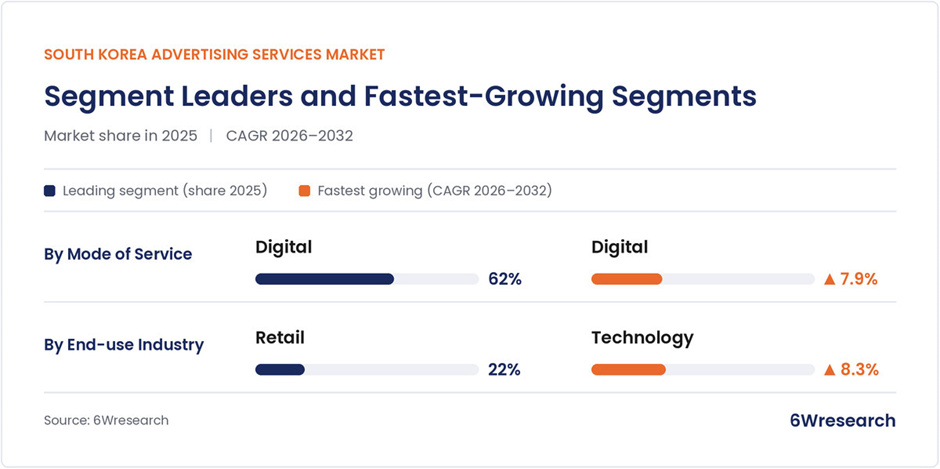
By Mode of Service – Digital Leads and Records the Fastest Growth
According to Sumit Sagar, Senior Research Analyst at 6Wresearch, Digital accounted for a 62% share of the market in 2025, supported by near-universal internet use and the reach of Naver, KakaoTalk and YouTube among advertisers. It is also expected to record the fastest growth at a 7.9% CAGR over 2026–2032, as retail media networks, connected TV and AI-assisted buying move budgets towards measurable online formats.
By End-use Industry – Retail Leads, Technology Expected to Grow Fastest
Retail led the end-use mix in 2025 with a 22% share, as large e-commerce operators and convenience chains directed heavy promotional and retail media spending into advertising. While, technology is projected to expand fastest at an 8.3% CAGR during 2026–2032, driven by recurring device launches from Samsung Electronics and growing marketing by domestic platform and AI service brands.
Key Attractiveness of the Report
- 10 Years of Market Numbers
- Historical Data Starting from 2022 to 2025
- Base Year 2025
- Forecast Data until 2032
- Key Performance Indicators Impacting the Market
- Major Upcoming Developments and Projects
Key Highlights of the Report:
- South Korea Advertising Services Market Outlook
- Market Size of South Korea Advertising Services Market, 2025
- Forecast of South Korea Advertising Services Market, 2032
- Historical Data and Forecast of South Korea Advertising Services Revenues & Volume for the Period 2022-2032
- South Korea Advertising Services Market Trend Evolution
- South Korea Advertising Services Market Drivers and Challenges
- South Korea Advertising Services Price Trends
- South Korea Advertising Services Porter's Five Forces
- South Korea Advertising Services Industry Life Cycle
- Historical Data and Forecast of South Korea Advertising Services Market Revenues & Volume By Mode of Service for the Period 2022-2032
- Historical Data and Forecast of South Korea Advertising Services Market Revenues & Volume By Digital for the Period 2022-2032
- Historical Data and Forecast of South Korea Advertising Services Market Revenues & Volume By Traditional for the Period 2022-2032
- Historical Data and Forecast of South Korea Advertising Services Market Revenues & Volume By End-use Industry for the Period 2022-2032
- Historical Data and Forecast of South Korea Advertising Services Market Revenues & Volume By Retail for the Period 2022-2032
- Historical Data and Forecast of South Korea Advertising Services Market Revenues & Volume By Consumer Goods for the Period 2022-2032
- Historical Data and Forecast of South Korea Advertising Services Market Revenues & Volume By Financial Services for the Period 2022-2032
- Historical Data and Forecast of South Korea Advertising Services Market Revenues & Volume By Energy & Manufacturing for the Period 2022-2032
- Historical Data and Forecast of South Korea Advertising Services Market Revenues & Volume By Technology for the Period 2022-2032
- Historical Data and Forecast of South Korea Advertising Services Market Revenues & Volume By Travel & Tourism for the Period 2022-2032
- Historical Data and Forecast of South Korea Advertising Services Market Revenues & Volume By Media & Entertainment for the Period 2022-2032
- Historical Data and Forecast of South Korea Advertising Services Market Revenues & Volume By Others for the Period 2022-2032
- South Korea Advertising Services Import Export Trade Statistics
- Market Opportunity Assessment By Mode of Service
- Market Opportunity Assessment By End-use Industry
- South Korea Advertising Services Top Companies Market Share
- South Korea Advertising Services Competitive Benchmarking By Technical and Operational Parameters
- South Korea Advertising Services Company Profiles
- South Korea Advertising Services Key Strategic Recommendations
Market Covered
The report offers an extensive study of the following market segments.
By Mode of Service
- Digital
- Traditional
By End-use Industry
- Retail
- Consumer Goods
- Financial Services
- Energy & Manufacturing
- Technology
- Travel & Tourism
- Media & Entertainment
- Others































