South Korea Automotive Wheel Rims Market Size, Share & Growth Rate
The South Korea Automotive Wheel Rims Market was estimated at USD 366 Million in 2025 and is projected to reach USD 513 Million by 2032, growing at a CAGR of 4.9% from 2026 to 2032. This growth trajectory is propelled by increasing vehicle production, a robust demand for personalization in automotive aesthetics, and advancements in wheel rim materials that enhance performance and sustainability.
South Korea Automotive Wheel Rims Market Year-wise Growth Rate and Key Drivers
This graph highlights how the South Korea Automotive Wheel Rims Market has steadily grown over the years, supported by major growth factors.
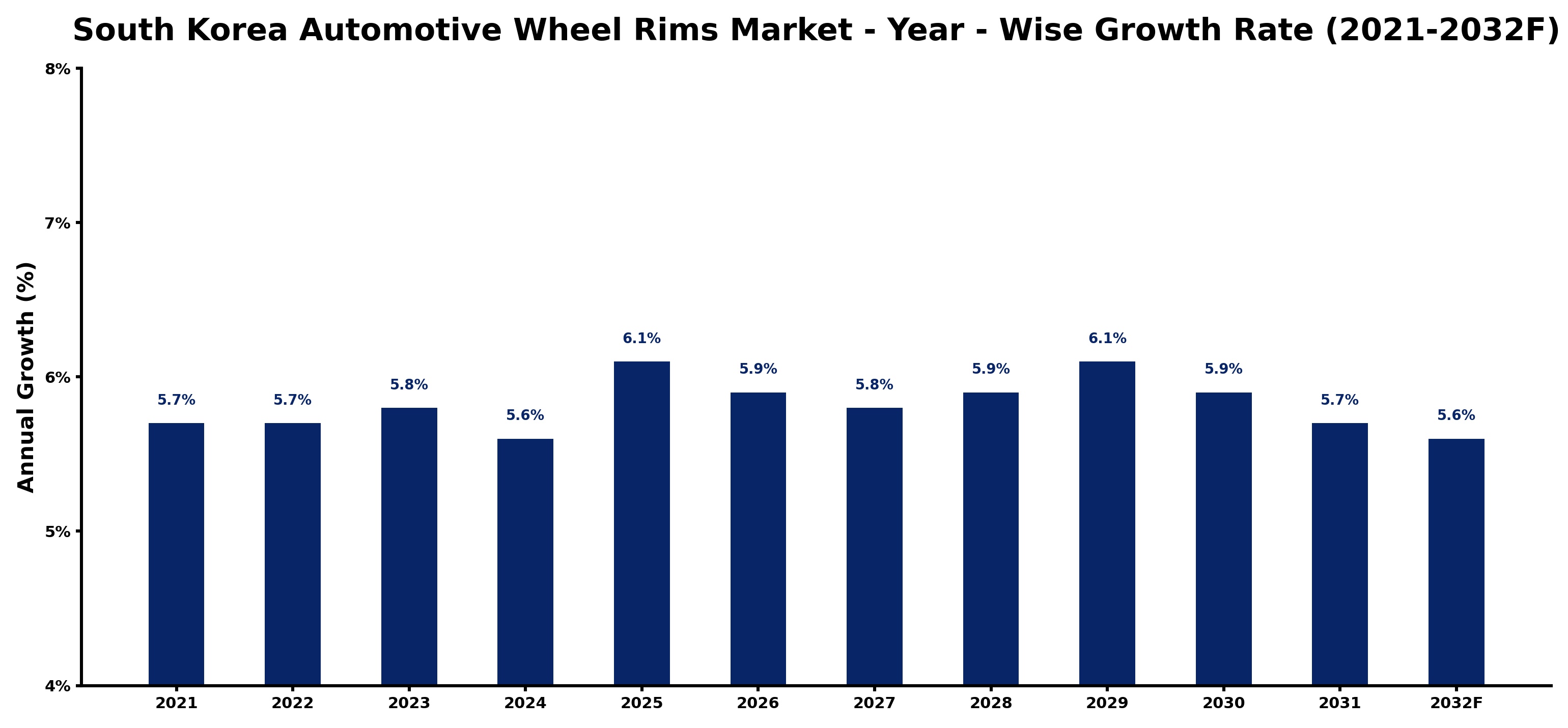
The table below presents the year‑wise growth rates along with the key drivers influencing the market
| Year | Growth Rate | Major Drivers |
| 2021 | 5.7% | Electric vehicle adoption accelerated growth |
| 2022 | 5.7% | Technological advancements enhanced performance |
| 2023 | 5.8% | Sustainability trends drove consumer demand |
| 2024 | 5.6% | Automotive manufacturing expanded production capacity |
| 2025 | 6.1% | Luxury vehicle market strengthened significantly |
| 2026 | 5.9% | Aftermarket customization gained popularity |
| 2027 | 5.8% | Export opportunities increased market reach |
| 2028 | 5.9% | Collaborations with OEMs enhanced innovation |
| 2029 | 6.1% | Rising disposable incomes fueled purchases |
| 2030 | 5.9% | Smart technology integration attracted buyers |
| 2031 | 5.7% | Urbanization boosted vehicle ownership rates |
| 2032 | 5.6% | Government incentives supported industry growth |
Note - Market size estimations and growth projections presented in this report are based on 6Wresearch’s advanced forecasting approach, validated with industry datasets as of June 2026.
South Korea Automotive Wheel Rims Market Synopsis
The dominant force shaping the South Korea Automotive Wheel Rims Market is the rising consumer preference for lightweight and aesthetically pleasing wheel rim designs. This shift is prompting manufacturers to innovate and diversify their product offerings, focusing on unique styles that meet the personalization demands of modern consumers.
Furthermore, the expanding electric vehicle segment has introduced new parameters for wheel rim design, creating a need for specialized solutions that align with the performance criteria unique to EVs. The confluence of these factors is driving a dynamic evolution in the market landscape.
South Korea Automotive Wheel Rims Market Key Takeaways
- The market is experiencing steady growth due to increased vehicle production and consumer demand for customized wheel rims.
- Aluminum alloy rims dominate the market, with growing interest in alternative materials like carbon fiber for high-performance applications.
- Technological advancements in manufacturing processes are reshaping design capabilities and material efficiency.
- Competition is intensifying among both domestic and international players, pushing innovation to the forefront.
- Government regulations are encouraging sustainable practices and safety standards, impacting production strategies.
Evaluation of Restraints in South Korea Automotive Wheel Rims Market
While the South Korea Automotive Wheel Rims Market showcases robust growth potential, it faces significant challenges that could impede its progress. The competition among manufacturers, both local and global, remains fierce, often resulting in price pressures that affect profitability. Furthermore, volatility in raw material prices can disrupt production costs, necessitating agile supply chain management. As consumer preferences continuously shift towards lightweight and durable designs, manufacturers must remain vigilant and adapt promptly to market demands. Additionally, regulations surrounding safety and environmental impacts compel companies to invest in innovative technologies, which can strain resources, particularly for smaller players aiming to remain competitive.
South Korea Automotive Wheel Rims Market Trends
The South Korea Automotive Wheel Rims Market is currently observing several prominent trends. A marked shift towards lightweight materials, particularly aluminum alloys, is taking place as consumers increasingly prioritize performance and fuel efficiency. Additionally, the customization trend continues to gain momentum, with consumers seeking unique and personalized designs that distinguish their vehicles. The rise of electric vehicles is driving demand for specialized wheel rims tailored to the performance characteristics of EVs, paving the way for innovations in material science.
South Korea Automotive Wheel Rims Market Opportunities
Investment opportunities abound in the South Korea Automotive Wheel Rims Market, spurred by the country's robust automotive manufacturing sector. As demand for high-quality, stylish rims continues to rise, there is significant potential for growth in this niche. Companies focusing on advanced technologies and materials, particularly those that enhance sustainability and performance, are poised to capture a larger market share. Additionally, the increasing trend towards electric vehicles provides fertile ground for innovative wheel rim designs that cater to this evolving segment.
Government Initiatives in the South Korea Automotive Wheel Rims Market
The South Korean government has established various policies aimed at fostering innovation and sustainability within the Automotive Wheel Rims Market. These initiatives primarily include the introduction of stringent quality standards and certifications for manufacturers to ensure product safety and performance. Additionally, the government offers incentives for research and development projects focusing on eco-friendly and energy-efficient technologies. Collaboration among industry stakeholders is also encouraged, aimed at enhancing competitiveness and expanding domestic and international market opportunities.
Future Insights of the South Korea Automotive Wheel Rims Market
Looking ahead to 2026-2032, the South Korea Automotive Wheel Rims Market is set to continue its upward trajectory, driven by evolving consumer preferences towards lightweight, durable, and stylish designs. Advancements in manufacturing technology and material science will play a critical role in expanding product offerings. The growing customization trend will further fuel demand, as consumers seek unique aesthetics that complement their vehicles. However, market players must remain adaptive to external factors such as fluctuating raw material prices and changing regulatory landscapes to ensure sustained growth.
South Korea Automotive Wheel Rims Market Latest Developments (May 2025 - June 2026)
Recent developments in the South Korea Automotive Wheel Rims Market highlight a strong focus on technological innovation and sustainability. Companies are increasingly investing in research and development to create lightweight and eco-friendly rim designs, aligned with the growing demand for electric vehicles. Collaborative initiatives between manufacturers and research institutions are also on the rise, aimed at improving production efficiency and product quality. These strategic directions signal a proactive approach to meeting both consumer expectations and regulatory requirements.
South Korea Automotive Wheel Rims Market - Key Attractiveness of the Report
- 10 Years of Market Numbers
- Historical Data Starting from 2022 to 2025
- Base Year: 2025
- Forecast Data until 2032
- Key Performance Indicators Impacting the Market
- Major Upcoming Developments and Projects
Key Highlights of the Report:
- South Korea Automotive Wheel Rims Market Outlook
- Market Size of South Korea Automotive Wheel Rims Market, 2025
- Forecast of South Korea Automotive Wheel Rims Market, 2032
- Historical Data and Forecast of South Korea Automotive Wheel Rims Revenues & Volume for the Period 2022-2032F
- South Korea Automotive Wheel Rims Market Trend Evolution
- South Korea Automotive Wheel Rims Market Drivers and Challenges
- South Korea Automotive Wheel Rims Price Trends
- South Korea Automotive Wheel Rims Porter's Five Forces
- South Korea Automotive Wheel Rims Industry Life Cycle
- Historical Data and Forecast of South Korea Automotive Wheel Rims Market Revenues & Volume By Material Type for the Period 2022-2032F
- Historical Data and Forecast of South Korea Automotive Wheel Rims Market Revenues & Volume By Alloy for the Period 2022-2032F
- Historical Data and Forecast of South Korea Automotive Wheel Rims Market Revenues & Volume By Steel for the Period 2022-2032F
- Historical Data and Forecast of South Korea Automotive Wheel Rims Market Revenues & Volume By Carbon Fiber for the Period 2022-2032F
- Historical Data and Forecast of South Korea Automotive Wheel Rims Market Revenues & Volume By Sales Channel for the Period 2022-2032F
- Historical Data and Forecast of South Korea Automotive Wheel Rims Market Revenues & Volume By OEM for the Period 2022-2032F
- Historical Data and Forecast of South Korea Automotive Wheel Rims Market Revenues & Volume By Aftermarket for the Period 2022-2032F
- Historical Data and Forecast of South Korea Automotive Wheel Rims Market Revenues & Volume By Vehicle Type for the Period 2022-2032F
- Historical Data and Forecast of South Korea Automotive Wheel Rims Market Revenues & Volume By Passenger Cars for the Period 2022-2032F
- Historical Data and Forecast of South Korea Automotive Wheel Rims Market Revenues & Volume By Commercial Vehicles for the Period 2022-2032F
- South Korea Automotive Wheel Rims Import Export Trade Statistics
- Market Opportunity Assessment By Material Type
- Market Opportunity Assessment By Sales Channel
- Market Opportunity Assessment By Vehicle Type
- South Korea Automotive Wheel Rims Top Companies Market Share
- South Korea Automotive Wheel Rims Competitive Benchmarking By Technical and Operational Parameters
- South Korea Automotive Wheel Rims Company Profiles
- South Korea Automotive Wheel Rims Key Strategic Recommendations






































