South Korea High Performance Computing as a Service Market Size & Growth Rate (2026-2032)
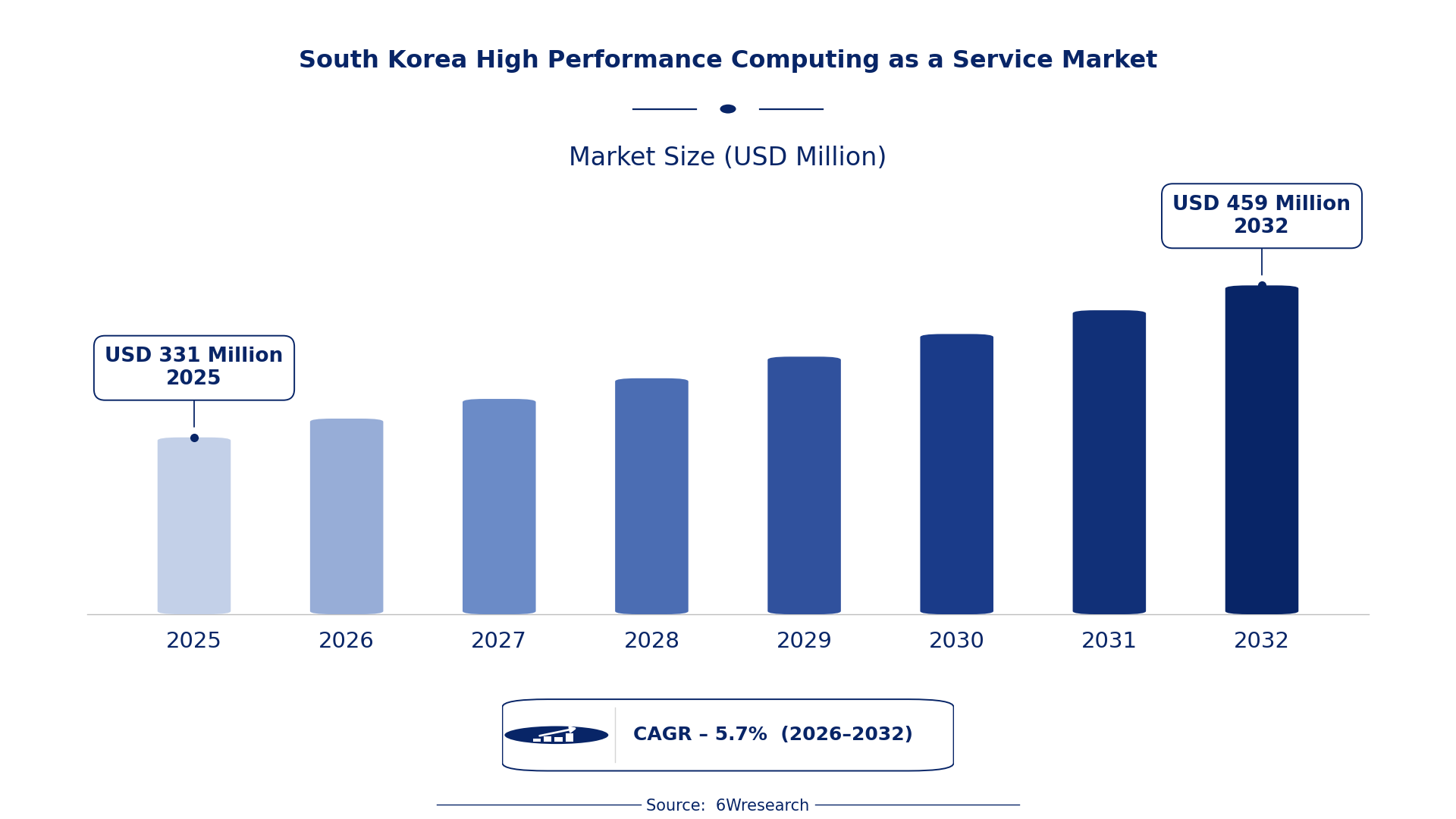
The South Korea High Performance Computing as a Service Market was estimated at USD 331 Million in 2025 and is projected to reach USD 459 Million by 2032, growing at a CAGR of 5.7% from 2026 to 2032.
South Korea High Performance Computing as a Service Market Synopsis
The South Korea High Performance Computing as a Service market is increasingly recognized as a vital enabler for innovation across various sectors. Healthcare, finance, and automotive industries are harnessing HPCaaS to streamline complex data analysis, making decisions faster and more efficiently than ever before.
Organizations are transitioning from traditional computing methods to cloud-based HPC solutions, which offer scalability and cost-effectiveness. This shift not only optimizes resource allocation but also enhances the capabilities of research and development efforts across multiple disciplines.
South Korea High Performance Computing as a Service Market Year-wise Growth Rate and Key Drivers
This graph illustrates the annual growth rates of the South Korea High Performance Computing as a Service Market from 2021 to 2032, highlighting a steady upward trajectory and projected expansion over the forecast period.
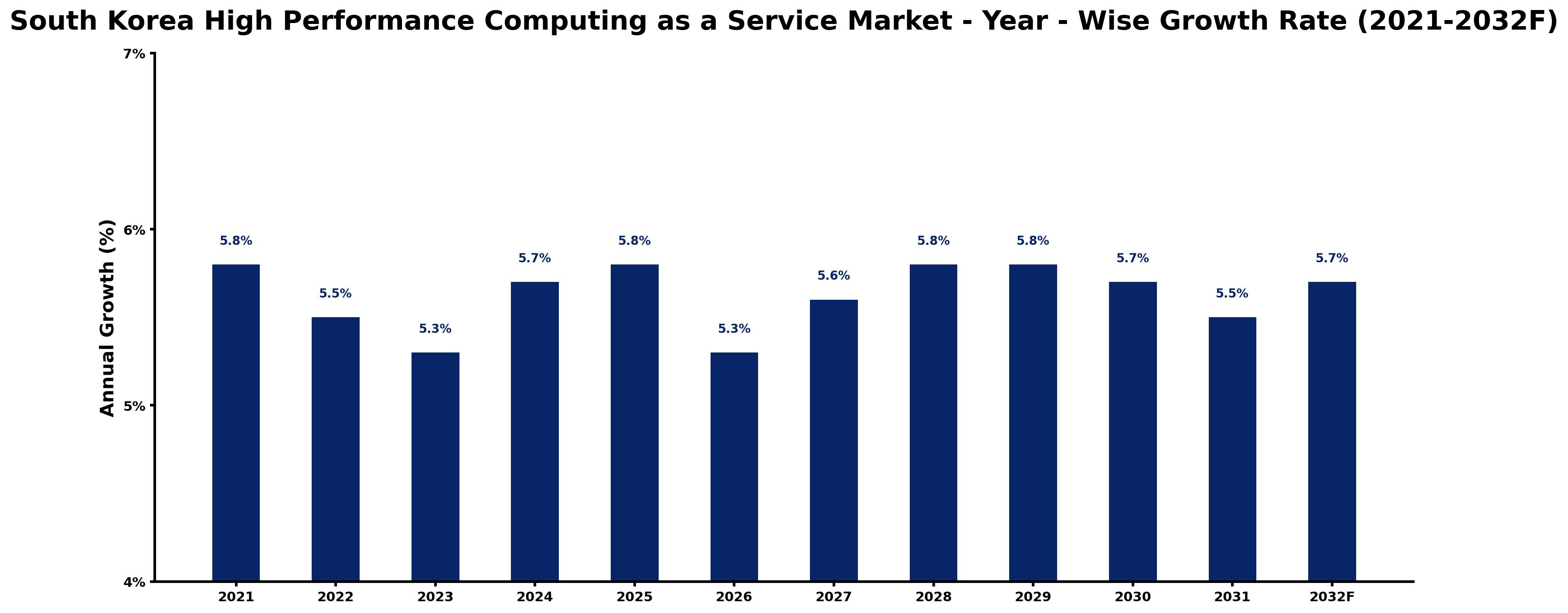
The table below presents the year‑wise growth rates along with the key drivers influencing the market
| Year | Growth Rate | Major Drivers |
| 2021 | 5.8% | Rising government investment in AI-driven research projects |
| 2022 | 5.5% | Launch of KETEP's HPC initiative for energy efficiency |
| 2023 | 5.3% | Increased demand for data analytics in biotechnology sector |
| 2024 | 5.7% | National push for cloud computing in smart factories |
| 2025 | 5.8% | High-growth in semiconductor design requiring HPC resources |
| 2026 | 5.3% | Industry 4.0 initiatives boosting manufacturing simulation needs |
| 2027 | 5.6% | Health sector's expansion fueling bioinformatics HPC requirements |
| 2028 | 5.8% | Government incentives for HPC adoption in education sector |
| 2029 | 5.8% | Supportive policies for startups utilizing HPC technologies |
| 2030 | 5.7% | Aging population drives demand for healthcare technology innovations |
| 2031 | 5.5% | Focus on cybersecurity solutions requiring advanced computing power |
| 2032 | 5.7% | Emergence of quantum computing projects demanding HPC services |
Note: Market size estimations and growth projections presented in this report are based on 6Wresearch's proprietary forecasting methodology, utilizing the latest available industry data, government publications, and primary research inputs.
South Korea High Performance Computing as a Service Market Key Takeaways
Below are some of the specific key takeaways from the market, including:
- The demand for HPCaaS is driven by the growing need for advanced data analytics and simulation capabilities.
- Healthcare and finance sectors are leading adopters of HPCaaS solutions, leveraging high-speed computing for critical applications.
- The government's push for digital transformation is significantly influencing the adoption of HPCaaS in South Korea.
- Challenges such as data security and awareness still hinder broader adoption among potential users.
- Cloud-based HPC solutions are becoming increasingly popular due to their scalability and cost-effectiveness.
Evaluation of Restraints in South Korea High Performance Computing as a Service Market
Despite the promising growth of the South Korea HPCaaS market, several factors are holding it back. A major challenge is the lack of understanding among potential users regarding the full capabilities and advantages of HPCaaS offerings. This limited awareness often leads to hesitation in adoption.
Data security and privacy concerns also loom large, with organizations wary of entrusting sensitive information to third-party providers. Additionally, the scarcity of skilled professionals who can effectively utilize HPCaaS solutions hampers market progress, particularly among smaller organizations that may lack the necessary budget for investment.
South Korea High Performance Computing as a Service Market Trends
The South Korea HPCaaS market is witnessing several notable trends. The integration of artificial intelligence and machine learning into HPCaaS solutions is gaining traction, as these technologies demand high-performance computing capabilities for their effective implementation. Hybrid HPCaaS models, which combine on-premise and cloud resources, are also emerging as a viable option for organizations seeking flexibility.
Additionally, the increasing trend of digital transformation across industries is pushing organizations to adopt HPCaaS to stay competitive. Customization of HPC solutions to cater to specific industry needs is another growing trend, reflecting a shift towards more tailored services.
South Korea High Performance Computing as a Service Market Opportunities
Opportunities for growth in the South Korea HPCaaS market are abundant. There is significant potential for developing specialized HPC solutions that meet the unique requirements of different sectors, such as automotive engineering and biopharmaceutical research. Strategic partnerships between HPCaaS providers and local enterprises can further enhance technological capabilities and broaden service offerings.
Investments in infrastructure to support the increasing demand for high-performance computing services will be crucial. As organizations continue to push for innovation, the HPCaaS market is positioned to attract investment and expand rapidly in the coming years.
Government Initiatives in the South Korea High Performance Computing as a Service Market
The South Korean government is actively fostering the development of the HPCaaS market through various initiatives aimed at enhancing competitiveness and innovation. By promoting digital transformation in key industries, the government is setting the stage for increased adoption of HPC technologies, which is critical for maintaining a competitive edge in the global market.
- A national digital infrastructure upgrade programme launched recently focuses on enhancing computing capabilities in healthcare and finance sectors.
- Ongoing funding initiatives from the Ministry of Science and ICT are aimed at supporting R&D in high-performance computing technologies.
- Tax incentives for companies investing in HPCaaS capabilities have been introduced to stimulate market growth.
- Current partnerships between government bodies and industry leaders are aimed at promoting the adoption of HPC solutions across various sectors.
- A planned initiative expected to begin in 2026 will expand HPC infrastructure access in rural areas, promoting equality in technological advancement.
Future Insights of the South Korea High Performance Computing as a Service Market
Looking ahead to 2026-2032, the South Korea HPCaaS market is set for substantial growth driven by the increasing demand for advanced computing solutions. The convergence of AI and big data analytics is likely to further accelerate the need for high-performance computing, making HPCaaS indispensable for organizations aiming to enhance their operational efficiency.
As digital transformation continues to be a government priority, the market will benefit from increased investments in infrastructure and research. This supportive environment will create a fertile ground for the growth of innovative HPCaaS solutions tailored to meet the evolving demands of various industries.
South Korea High Performance Computing as a Service Market Latest Developments
In the past year, the South Korea HPCaaS market has seen noteworthy developments as companies adapt to the changing technological landscape. The push for high-performance computing has led to various partnerships and initiatives aimed at enhancing service offerings and expanding market reach.
- A new cloud-based HPC service was launched in Q1 2025, designed specifically for the healthcare sector, enabling faster data processing for research purposes.
- Currently ongoing is a project that began in late 2024 focused on integrating AI capabilities into existing HPCaaS platforms, aimed at improving efficiency.
- A major technology vendor is expected to launch an upgraded HPCaaS platform in early 2026, featuring enhanced security measures and user-friendly interfaces.
- Ongoing partnerships with educational institutions are aimed at training the next generation of HPC specialists, initiated in mid-2025.
- A planned initiative to develop a national HPC training program for industry professionals is set to begin by late 2025, addressing the skills gap in the market.
South Korea High Performance Computing as a Service Market - Key Attractiveness of the Report
- 10 Years of Market Numbers
- Historical Data Starting from 2022 to 2025
- Base Year: 2025
- Forecast Data until 2032
- Key Performance Indicators Impacting the Market
- Major Upcoming Developments and Projects
Key Highlights of the Report:
- South Korea High Performance Computing as a Service Market Outlook
- Market Size of South Korea High Performance Computing as a Service Market, 2025
- Forecast of South Korea High Performance Computing as a Service Market, 2032
- Historical Data and Forecast of South Korea High Performance Computing as a Service Revenues & Volume for the Period 2022-2032F
- South Korea High Performance Computing as a Service Market Trend Evolution
- South Korea High Performance Computing as a Service Market Drivers and Challenges
- South Korea High Performance Computing as a Service Price Trends
- South Korea High Performance Computing as a Service Porter's Five Forces
- South Korea High Performance Computing as a Service Industry Life Cycle
- Historical Data and Forecast of South Korea High Performance Computing as a Service Market Revenues & Volume By Verticals for the Period 2022-2032F
- Historical Data and Forecast of South Korea High Performance Computing as a Service Market Revenues & Volume By BFSI for the Period 2022-2032F
- Historical Data and Forecast of South Korea High Performance Computing as a Service Market Revenues & Volume By Healthcare for the Period 2022-2032F
- Historical Data and Forecast of South Korea High Performance Computing as a Service Market Revenues & Volume By Life Sciences for the Period 2022-2032F
- Historical Data and Forecast of South Korea High Performance Computing as a Service Market Revenues & Volume By Manufacturing for the Period 2022-2032F
- Historical Data and Forecast of South Korea High Performance Computing as a Service Market Revenues & Volume By Deployment Type for the Period 2022-2032F
- Historical Data and Forecast of South Korea High Performance Computing as a Service Market Revenues & Volume By Colocation for the Period 2022-2032F
- Historical Data and Forecast of South Korea High Performance Computing as a Service Market Revenues & Volume By Hosted Private Cloud for the Period 2022-2032F
- Historical Data and Forecast of South Korea High Performance Computing as a Service Market Revenues & Volume By Public Cloud for the Period 2022-2032F
- Historical Data and Forecast of South Korea High Performance Computing as a Service Market Revenues & Volume By Component for the Period 2022-2032F
- Historical Data and Forecast of South Korea High Performance Computing as a Service Market Revenues & Volume By Software for the Period 2022-2032F
- Historical Data and Forecast of South Korea High Performance Computing as a Service Market Revenues & Volume By Services for the Period 2022-2032F
- South Korea High Performance Computing as a Service Import Export Trade Statistics
- Market Opportunity Assessment By Verticals
- Market Opportunity Assessment By Deployment Type
- Market Opportunity Assessment By Component
- South Korea High Performance Computing as a Service Top Companies Market Share
- South Korea High Performance Computing as a Service Competitive Benchmarking By Technical and Operational Parameters
- South Korea High Performance Computing as a Service Company Profiles
- South Korea High Performance Computing as a Service Key Strategic Recommendations






































