South Korea Hospital Equipment And Supplies Market Size, Share & Growth Rate
The South Korea Hospital Equipment And Supplies Market was estimated at USD 228 Million in 2025 and is projected to reach USD 321 Million by 2032, growing at a CAGR of 5.0% from 2026 to 2032. This trajectory reflects the critical role that advanced medical technologies and equipment play in the ever-evolving healthcare landscape of South Korea. Factors such as an aging population, increased prevalence of chronic diseases, and ongoing healthcare reforms are significantly fueling this growth, leading to a heightened demand for innovative medical devices and diagnostic equipment.
South Korea Hospital Equipment And Supplies Market Year-wise Growth Rate and Key Drivers
This graph highlights how the South Korea Hospital Equipment And Supplies Market has steadily grown over the years, supported by major growth factors.
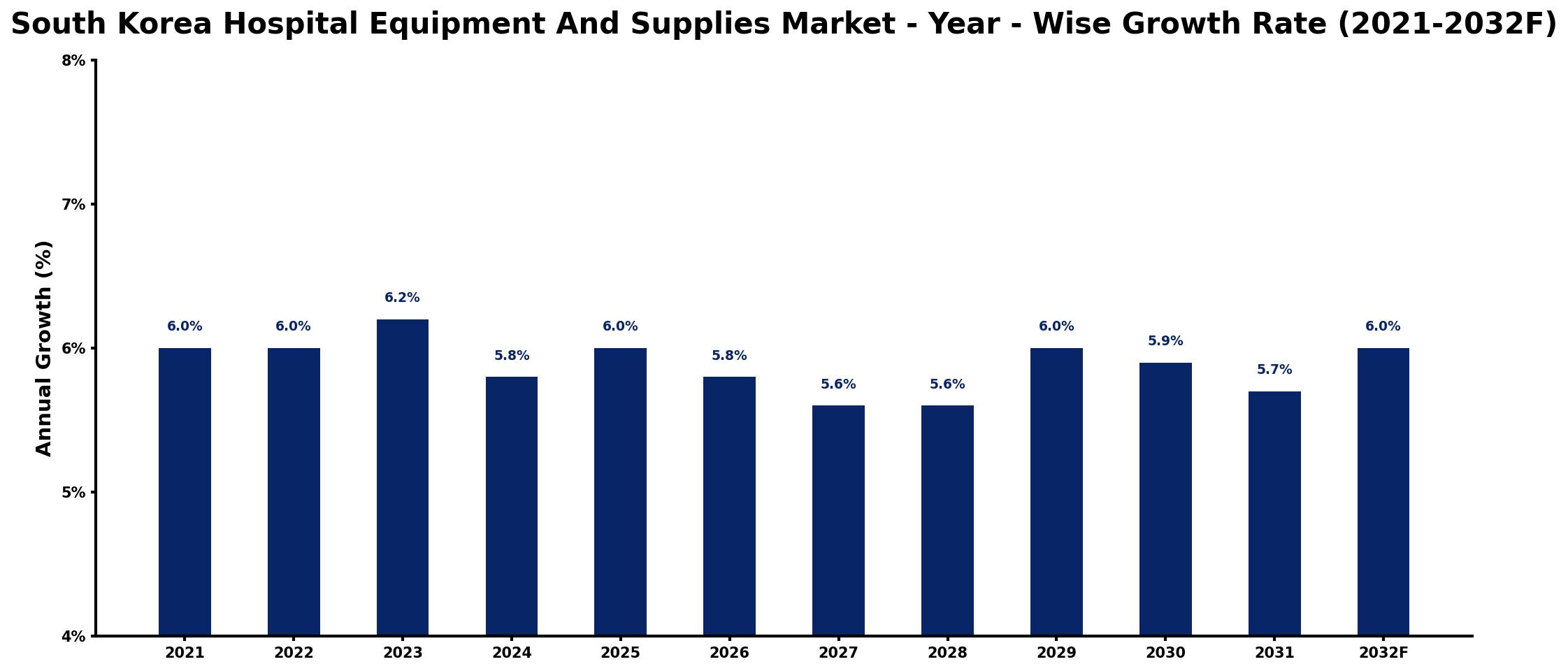
The table below presents the year‑wise growth rates along with the key drivers influencing the market
| Year | Growth Rate | Major Drivers |
| 2021 | 6.0% | Rising healthcare infrastructure investments |
| 2022 | 6.0% | Increased patient care demand |
| 2023 | 6.2% | Technological advancements in healthcare |
| 2024 | 5.8% | Growing aging population needs |
| 2025 | 6.0% | Expansion of telemedicine services |
| 2026 | 5.8% | Strengthened focus on preventive care |
| 2027 | 5.6% | Emerging market opportunities identified |
| 2028 | 5.6% | Surge in chronic disease management |
| 2029 | 6.0% | Enhanced regulatory support initiatives |
| 2030 | 5.9% | Innovations in health data analytics |
| 2031 | 5.7% | Collaboration between public private sectors |
| 2032 | 6.0% | Rising global health awareness campaigns |
Note: Market size estimations and growth projections presented in this report are based on 6Wresearch's proprietary forecasting methodology, utilizing the latest available industry data, government publications, and primary research inputs.
South Korea Hospital Equipment And Supplies Market Synopsis
The South Korea Hospital Equipment And Supplies Market is witnessing robust growth driven by increased healthcare expenditures and a shift towards advanced medical technologies. Hospitals are now more focused on acquiring high-quality imaging systems, surgical instruments, and patient monitoring devices, crucial for enhancing patient care and operational efficiency.
Technological advancements in medical equipment continue to revolutionize treatment capabilities, improving outcomes for patients across various healthcare settings. Furthermore, ongoing government investment in healthcare infrastructure is facilitating the adoption of state-of-the-art medical supplies, thereby ensuring that the hospital equipment market remains vibrant and competitive.
South Korea Hospital Equipment And Supplies Market Key Takeaways
- Growing healthcare demands driven by an aging population are propelling the need for innovative hospital equipment.
- Technological advancements are reshaping the landscape of medical devices, enhancing operational efficiency and patient care.
- Government policies supporting investment in healthcare infrastructure are creating a favorable environment for market growth.
- Consistent healthcare budget increases reflect commitment to improving hospital equipment and supply standards.
- Regulatory compliance remains vital in ensuring the quality and safety of medical devices in the competitive market.
Evaluation of Restraints in South Korea Hospital Equipment And Supplies Market
While the South Korea Hospital Equipment And Supplies Market is positioned for growth, it faces certain constraints that could limit its potential. Budgetary constraints in the healthcare sector can delay the procurement of new technologies, as hospitals prioritize essential upgrades over advanced equipment. Additionally, rapid technological advancements lead to obsolescence; devices quickly become outdated, necessitating continuous investment. These dynamics require a careful balance between innovation and fiscal management, as hospitals navigate regulatory requirements that dictate both procurement processes and the lifecycle management of medical devices.
South Korea Hospital Equipment And Supplies Market Trends
Emerging trends in the South Korea Hospital Equipment And Supplies Market are characterized by a shift towards digital health solutions and telemedicine, catalyzed by the COVID-19 pandemic. Hospitals increasingly integrate smart devices and cloud-based solutions, enhancing patient monitoring and data management. There is also a growing emphasis on sustainability within hospital supplies, with manufacturers prioritizing eco-friendly materials and practices. Lastly, the rise in demand for minimally invasive surgical instruments aligns with a global trend towards improved patient outcomes and reduced recovery times.
South Korea Hospital Equipment And Supplies Market Opportunities
Opportunities abound in the South Korea Hospital Equipment And Supplies Market, particularly for companies that can innovate in the realm of digital health technologies. As hospitals aim to enhance patient care efficiency, there is a notable demand for advanced telehealth solutions and patient management software. Additionally, growing interest in precision medicine opens avenues for diagnostic equipment that supports personalized treatment plans. Public funding for R&D initiatives offers further prospects for developing cutting-edge medical devices that meet the evolving needs of healthcare providers.
Government Initiatives in the South Korea Hospital Equipment And Supplies Market
The South Korean government is actively promoting the hospital equipment and supplies market through various initiatives aimed at improving healthcare quality. Regulations ensure that medical equipment meets stringent safety and efficacy standards, while public funds are allocated to support hospitals investing in advanced technologies. Moreover, the government backs research and development programs, encouraging innovations that can lead to enhanced patient care and operational excellence in healthcare facilities across the nation.
Future Insights of the South Korea Hospital Equipment And Supplies Market
Looking ahead from 2026 to 2032, the South Korea Hospital Equipment And Supplies Market is poised for substantial growth driven by a confluence of factors. The aging population and rising incidences of chronic diseases will continue to escalate demand for advanced medical solutions. With ongoing government support and a focus on technological innovation, the market is likely to witness increased investment in hospital infrastructure. Additionally, as healthcare providers adopt more integrated approaches, the emphasis on seamless interoperability among devices will further drive advancements in the sector.
South Korea Hospital Equipment And Supplies Market Latest Developments (2025 - 2026)
Recent developments in the South Korea Hospital Equipment And Supplies Market reflect a concerted push towards integrating cutting-edge technologies into healthcare settings. Hospitals are increasingly adopting digital solutions for patient monitoring and health management, aligning with global healthcare trends. Furthermore, collaborations between healthcare institutions and tech companies are fostering innovations in medical devices, enabling better patient care. As the market progresses, the focus on sustainability and eco-friendly practices is becoming an essential consideration for manufacturers and healthcare providers alike.
South Korea Hospital Equipment And Supplies Market - Key Attractiveness of the Report
- 10 Years of Market Numbers
- Historical Data Starting from 2022 to 2025
- Base Year: 2025
- Forecast Data until 2032
- Key Performance Indicators Impacting the Market
- Major Upcoming Developments and Projects
Key Highlights of the Report:
- South Korea Hospital Equipment And Supplies Market Outlook
- Market Size of South Korea Hospital Equipment And Supplies Market, 2025
- Forecast of South Korea Hospital Equipment And Supplies Market, 2032
- Historical Data and Forecast of South Korea Hospital Equipment And Supplies Revenues & Volume for the Period 2022-2032F
- South Korea Hospital Equipment And Supplies Market Trend Evolution
- South Korea Hospital Equipment And Supplies Market Drivers and Challenges
- South Korea Hospital Equipment And Supplies Price Trends
- South Korea Hospital Equipment And Supplies Porter's Five Forces
- South Korea Hospital Equipment And Supplies Industry Life Cycle
- Historical Data and Forecast of South Korea Hospital Equipment And Supplies Market Revenues & Volume By Product for the Period 2022-2032F
- Historical Data and Forecast of South Korea Hospital Equipment And Supplies Market Revenues & Volume By Sterilization And Disinfectant Equipment for the Period 2022-2032F
- Historical Data and Forecast of South Korea Hospital Equipment And Supplies Market Revenues & Volume By Disposable Hospital Supplies Patient Examination Devices for the Period 2022-2032F
- Historical Data and Forecast of South Korea Hospital Equipment And Supplies Market Revenues & Volume By Syringes And Needles for the Period 2022-2032F
- Historical Data and Forecast of South Korea Hospital Equipment And Supplies Market Revenues & Volume By Application for the Period 2022-2032F
- Historical Data and Forecast of South Korea Hospital Equipment And Supplies Market Revenues & Volume By OEMs for the Period 2022-2032F
- Historical Data and Forecast of South Korea Hospital Equipment And Supplies Market Revenues & Volume By Aftermarket for the Period 2022-2032F
- South Korea Hospital Equipment And Supplies Import Export Trade Statistics
- Market Opportunity Assessment By Product
- Market Opportunity Assessment By Application
- South Korea Hospital Equipment And Supplies Top Companies Market Share
- South Korea Hospital Equipment And Supplies Competitive Benchmarking By Technical and Operational Parameters
- South Korea Hospital Equipment And Supplies Company Profiles
- South Korea Hospital Equipment And Supplies Key Strategic Recommendations






































