South Korea Insurance Telematics Market Size & Growth Rate (2026-2032)
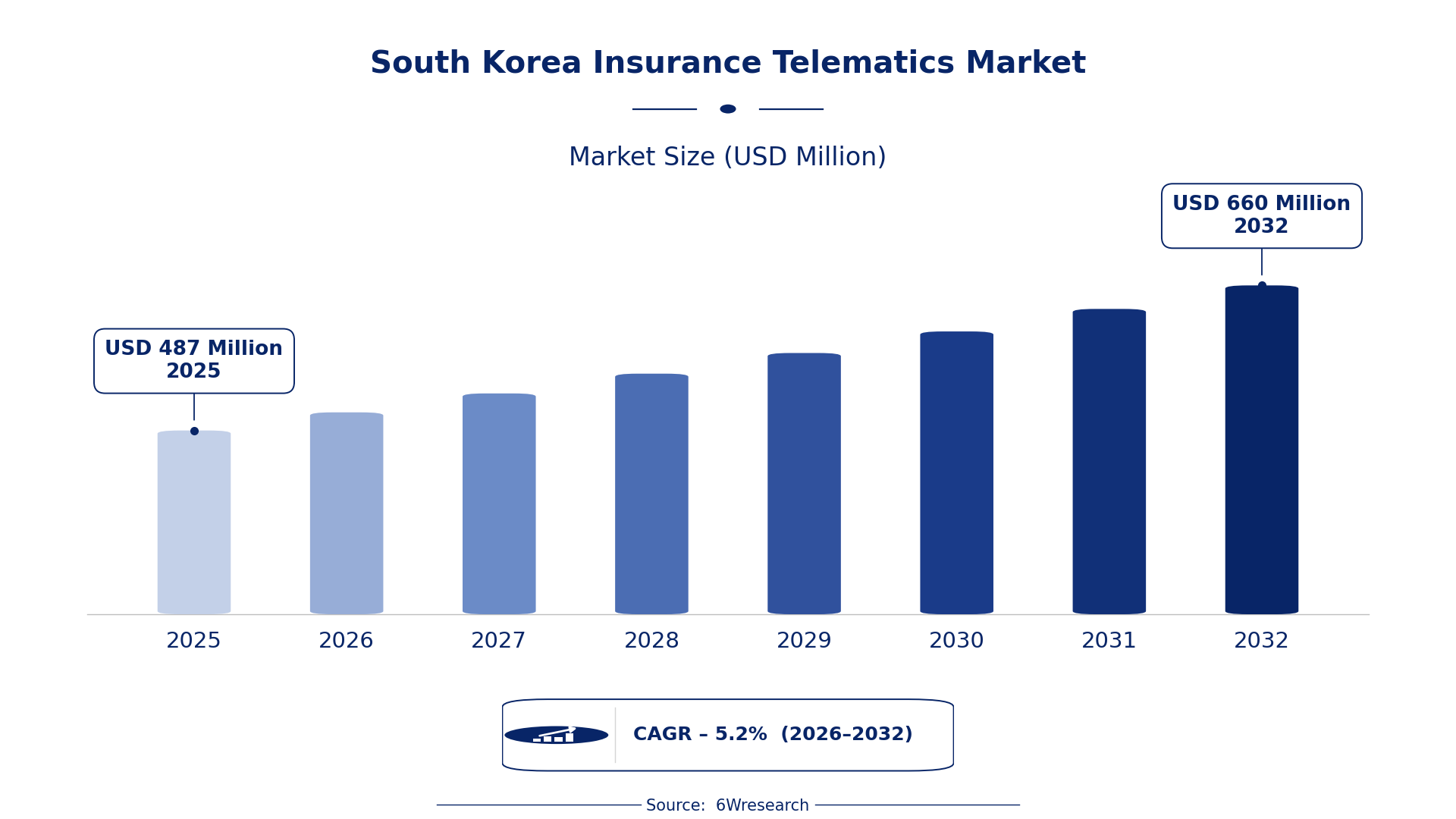
The South Korea Insurance Telematics Market was estimated at USD 487 Million in 2025 and is projected to reach USD 660 Million by 2032, growing at a CAGR of 5.2% from 2026 to 2032.
South Korea Insurance Telematics Market Synopsis
The South Korea Insurance Telematics Market is witnessing a significant surge as telematics technology becomes increasingly integrated into automotive insurance. This growth is not merely a trend; it reflects a profound shift towards data-driven decision-making in the insurance sector, where understanding driver behavior is paramount.
Looking ahead, the market is expected to evolve as innovations in telematics pave the way for more personalized insurance products. As consumer demand for tailored solutions grows, insurers that harness this technology effectively will likely gain a competitive edge. The future is not just about collecting data; it’s about using it wisely.
South Korea Insurance Telematics Market Year-wise Growth Rate and Key Drivers
This graph illustrates the annual growth rates of the South Korea Insurance Telematics Market from 2021 to 2032, highlighting a steady upward trajectory and projected expansion over the forecast period.
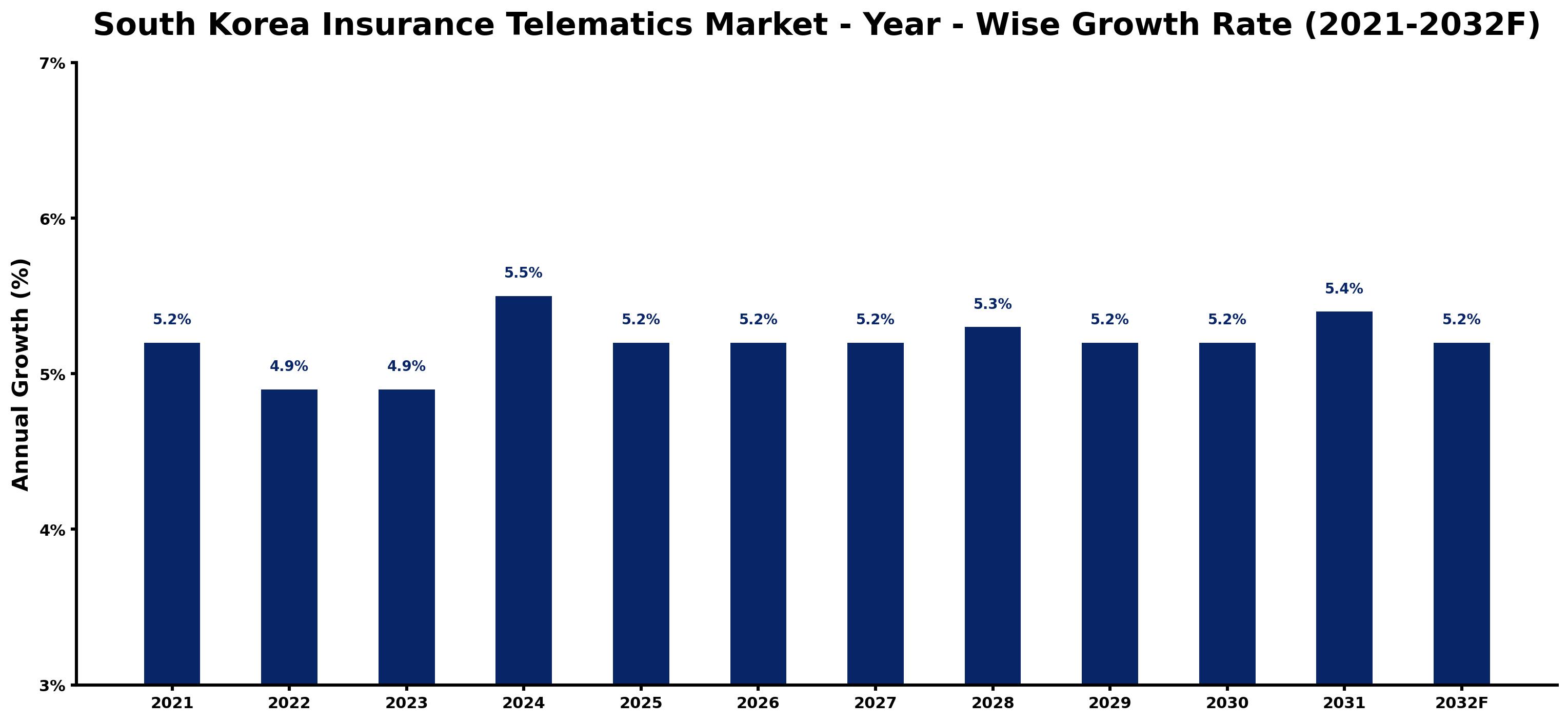
The table below presents the year‑wise growth rates along with the key drivers influencing the market
| Year | Growth Rate | Major Drivers |
| 2021 | 5.2% | Increased smartphone penetration boosts telematics adoption. |
| 2022 | 4.9% | Government promotes safe driving through insurance discounts. |
| 2023 | 4.9% | Emergence of AI technology enhances risk assessment capabilities. |
| 2024 | 5.5% | Regulatory support for usage-based insurance models. |
| 2025 | 5.2% | Rising popularity of connected vehicles drives telematics growth. |
| 2026 | 5.2% | Insurance firms integrate telematics into personalized policy offerings. |
| 2027 | 5.2% | Consumer demand for lower premiums encourages telematics use. |
| 2028 | 5.3% | Insurance companies leverage big data analytics for telematics. |
| 2029 | 5.2% | National campaigns focus on road safety via telematics. |
| 2030 | 5.2% | Telematics technology aligns with South Korea's Smart City initiative. |
| 2031 | 5.4% | Increased awareness of driver behavior impacts insurance rates. |
| 2032 | 5.2% | Partnerships between insurers and tech firms fuel innovation. |
Note: Market size estimations and growth projections presented in this report are based on 6Wresearch's proprietary forecasting methodology, utilizing the latest available industry data, government publications, and primary research inputs.
South Korea Insurance Telematics Market Key Takeaways
Below are some of the specific key takeaways from the market, including:
- The integration of telematics technology is reshaping insurance pricing models.
- Consumer interest in usage-based insurance is on the rise, reflecting changing attitudes towards risk.
- Government policies are increasingly supportive of telematics adoption, enhancing market growth potential.
- Advancements in data analytics are enabling insurers to improve risk assessment and customer engagement.
- Collaborations between technology providers and insurers are fostering innovation in product offerings.
Evaluation of Restraints in South Korea Insurance Telematics Market
Despite its promising trajectory, the South Korea Insurance Telematics Market faces certain constraints that could impede its full potential. One of the foremost challenges is the rapid pace of technological advancement. Insurers must continually invest in cutting-edge telematics devices and data analytics capabilities to stay relevant. Compliance with stringent privacy regulations also presents hurdles, as consumer trust is paramount in this data-driven environment. Additionally, integrating these advanced technologies into existing systems requires not just financial investment but also strategic partnerships, which can be complex and time-consuming.
South Korea Insurance Telematics Market Trends
Several trends are emerging that will significantly shape the South Korea Insurance Telematics Market. One key trend is the increasing adoption of connected vehicles, which provide a wealth of data that insurers can utilize for more accurate risk assessments. Personalized insurance products are gaining traction, driven by consumer demand for solutions tailored to their specific driving behaviors. on top of that, the push for enhanced road safety through telematics technology is becoming a priority, reflecting a broader societal commitment to reducing accidents and improving driver behavior.
South Korea Insurance Telematics Market Opportunities
Opportunities abound within the South Korea Insurance Telematics Market, particularly as insurers seek innovative solutions to attract and retain customers. The expanding market for usage-based insurance represents a prime area for growth, as more consumers recognize the potential savings linked to safer driving. Additionally, partnerships between insurers and technology firms can lead to the development of new products and services that enhance customer engagement. Investing in R&D initiatives focused on telematics innovation will also be crucial, as will efforts to improve data analytics capabilities to harness insights that drive competitive advantage.
Government Initiatives in the South Korea Insurance Telematics Market
Government policies are playing a vital role in shaping the South Korea Insurance Telematics Market, reflecting a commitment to road safety and insurance customization. Regulatory frameworks are being established to ensure ethical use of telematics data while safeguarding driver privacy. Public-sector initiatives are fostering collaboration between insurers and technology providers, enhancing innovation within the sector. These efforts highlight the government's recognition of the importance of telematics in improving both insurance affordability and road safety.
- A national initiative launched in 2023 aimed at enhancing telematics infrastructure across urban areas, improving data accessibility for insurers.
- Currently ongoing is a regulatory framework that mandates transparency in the use of telematics data for insurance pricing, enhancing consumer trust.
- Upcoming plans include a public-private partnership expected to roll out advanced vehicle tracking systems by 2026, aiming to improve risk assessment methodologies.
- Recent legislation introduced in 2024 focuses on providing financial incentives for insurers adopting telematics technology to promote safer driving behaviors.
- An ongoing research program aimed at developing innovative telematics solutions, involving collaborations with telecom providers and data analytics firms.
Future Insights of the South Korea Insurance Telematics Market
As we look toward the 2026-2032 horizon, the South Korea Insurance Telematics Market is positioned for substantial growth. The increasing penetration of connected vehicles will likely enhance data collection capabilities, enabling insurers to refine their risk models further. Additionally, as consumer expectations shift towards personalized services, insurers that leverage telematics data effectively will enjoy a competitive advantage. The combination of regulatory support and technological advancement suggests a vibrant future for this market.
South Korea Insurance Telematics Market Latest Developments
Recent activity in the South Korea Insurance Telematics Market reflects a growing momentum towards innovation and consumer engagement. Insurers are actively investing in new technologies to improve their offerings and enhance customer satisfaction. The trend towards usage-based insurance is gaining traction, driven by heightened consumer awareness and demand for personalized insurance products.
- A technology vendor successfully launched an advanced telematics device in early 2023, significantly enhancing data accuracy for insurers.
- An ongoing partnership between leading insurance firms and data analytics companies aims to develop predictive models that improve risk assessment, initiated in mid-2023.
- A planned rollout expected to begin in early 2026 will introduce a new mobile app aimed at increasing consumer engagement with usage-based insurance.
- A major insurer announced its initiative to upgrade existing telematics systems to improve data processing capabilities, which began in late 2024 and is anticipated to be completed by mid-2025.
- A recent pilot program focusing on telematics data integration within traditional insurance frameworks has shown promising results, currently in its testing phase.
South Korea Insurance Telematics Market - Key Attractiveness of the Report
- 10 Years of Market Numbers
- Historical Data Starting from 2022 to 2025
- Base Year: 2025
- Forecast Data until 2032
- Key Performance Indicators Impacting the Market
- Major Upcoming Developments and Projects
Government policies focus on enhancing road safety and supporting insurance premium customization. Recent regulations ensure ethical use of telematics data and driver privacy protection while promoting R&D initiatives in insurance telematics.
Key Highlights of the Report:
- South Korea Insurance Telematics Market Outlook
- Market Size of South Korea Insurance Telematics Market, 2025
- Forecast of South Korea Insurance Telematics Market, 2032
- Historical Data and Forecast of South Korea Insurance Telematics Revenues & Volume for the Period 2022-2032F
- South Korea Insurance Telematics Market Trend Evolution
- South Korea Insurance Telematics Market Drivers and Challenges
- South Korea Insurance Telematics Price Trends
- South Korea Insurance Telematics Porter's Five Forces
- South Korea Insurance Telematics Industry Life Cycle
- Historical Data and Forecast of South Korea Insurance Telematics Market Revenues & Volume By End User for the Period 2022-2032F
- Historical Data and Forecast of South Korea Insurance Telematics Market Revenues & Volume By Small for the Period 2022-2032F
- Historical Data and Forecast of South Korea Insurance Telematics Market Revenues & Volume By Medium Enterprises for the Period 2022-2032F
- Historical Data and Forecast of South Korea Insurance Telematics Market Revenues & Volume By Large Enterprises for the Period 2022-2032F
- Historical Data and Forecast of South Korea Insurance Telematics Market Revenues & Volume By Deployment Type for the Period 2022-2032F
- Historical Data and Forecast of South Korea Insurance Telematics Market Revenues & Volume By Cloud for the Period 2022-2032F
- Historical Data and Forecast of South Korea Insurance Telematics Market Revenues & Volume By On-Premises for the Period 2022-2032F
- Historical Data and Forecast of South Korea Insurance Telematics Market Revenues & Volume By Organization Size for the Period 2022-2032F
- Historical Data and Forecast of South Korea Insurance Telematics Market Revenues & Volume By Small and Medium Enterprises (SMEs) for the Period 2022-2032F
- Historical Data and Forecast of South Korea Insurance Telematics Market Revenues & Volume By Large Enterprises for the Period 2022-2032F
- South Korea Insurance Telematics Import Export Trade Statistics
- Market Opportunity Assessment By End User
- Market Opportunity Assessment By Deployment Type
- Market Opportunity Assessment By Organization Size
- South Korea Insurance Telematics Top Companies Market Share
- South Korea Insurance Telematics Competitive Benchmarking By Technical and Operational Parameters
- South Korea Insurance Telematics Company Profiles
- South Korea Insurance Telematics Key Strategic Recommendations






































