South Korea Metal Fabrication Market Size, Share & Growth Rate
The South Korea Metal Fabrication Market was estimated at USD 1317 Million in 2025 and is projected to reach USD 1911 Million by 2032, growing at a CAGR of 5.5% from 2026 to 2032. This upward trajectory is primarily driven by increasing investments in the construction and manufacturing sectors, where demand for precision-engineered metal components is paramount. Additionally, the automotive and aerospace industries continue to fuel the need for advanced metal fabrication services, fostering a competitive landscape in South Korea.
South Korea Metal Fabrication Market Year-wise Growth Rate and Key Drivers
This graph highlights how the South Korea Metal Fabrication Market has steadily grown over the years, supported by major growth factors.
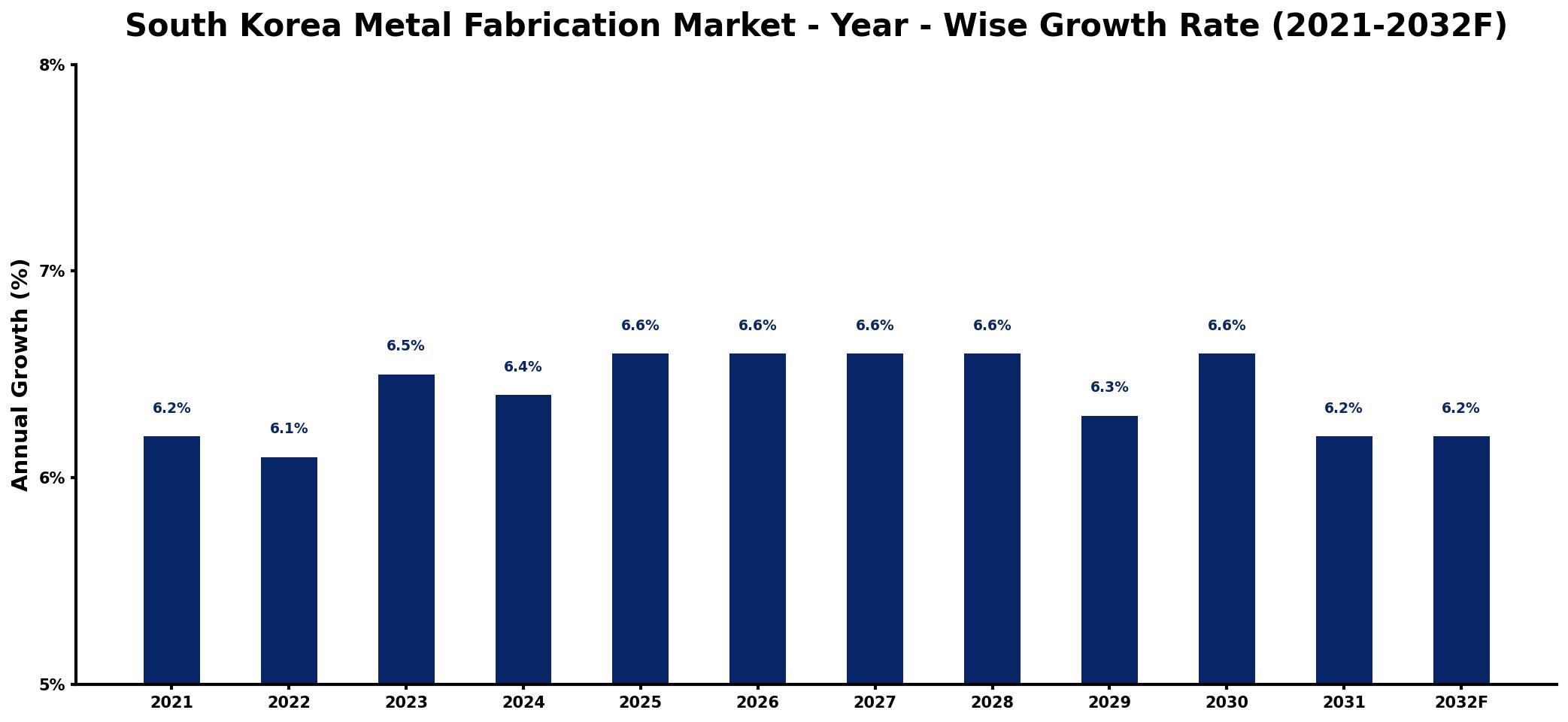
The table below presents the year‑wise growth rates along with the key drivers influencing the market
| Year | Growth Rate | Major Drivers |
| 2021 | 6.2% | Rising demand from construction sector |
| 2022 | 6.1% | Increased investment in infrastructure projects |
| 2023 | 6.5% | Expansion of automotive manufacturing facilities |
| 2024 | 6.4% | Growth in renewable energy installations |
| 2025 | 6.6% | Technological advancements in automation |
| 2026 | 6.6% | Surge in aerospace industry projects |
| 2027 | 6.6% | Boost in consumer electronics production |
| 2028 | 6.6% | increased overall sector activity |
| 2029 | 6.3% | Increase in defense sector spending |
| 2030 | 6.6% | expanding manufacturing base activity |
| 2031 | 6.2% | increased production capacity utilization |
| 2032 | 6.2% | Rising focus on sustainability initiatives |
Note: Market size estimations and growth projections presented in this report are based on 6Wresearch's proprietary forecasting methodology, utilizing the latest available industry data, government publications, and primary research inputs.
South Korea Metal Fabrication Market Synopsis
Currently, the most significant force shaping the South Korea Metal Fabrication Market is the rapid expansion of the construction industry. This sector not only drives demand for structural components but also necessitates innovation in metal fabrication technologies to meet stringent quality standards and design specifications.
Moreover, the automotive sector is undergoing a transformation with the increasing shift toward electric vehicles, compelling fabricators to adapt their offerings. This trend requires custom solutions that align with the evolving requirements of manufacturers, thereby promoting growth in the metal fabrication landscape.
South Korea Metal Fabrication Market Key Takeaways
- The market is poised for substantial growth due to escalating demand from the automotive and aerospace sectors.
- Technological advancements are essential for meeting customer needs for customized and high-quality products.
- Government support through policy initiatives enhances competitiveness and promotes innovation in metal fabrication.
- Industry players are focusing on optimizing production processes to mitigate lead times and improve efficiency.
- Investment in skilled labor and advanced technologies remains critical for market resilience and adaptability.
Evaluation of Restraints in South Korea Metal Fabrication Market
Despite the optimistic outlook for the South Korea Metal Fabrication Market, several real constraints could hinder progress. The industry's capacity to optimize production processes and reduce lead times is frequently challenged by a shortage of skilled labor. Moreover, fluctuations in raw material prices can impact profitability and operational planning. Addressing these limitations will require strategic investments in both human resources and advanced fabrication technologies to maintain competitive advantage.
South Korea Metal Fabrication Market Trends
A notable trend shaping the South Korea Metal Fabrication Market is the increasing adoption of automation and robotics in fabrication processes. This shift not only enhances productivity but also contributes to precision in manufacturing. Furthermore, sustainability is becoming a critical focus, with companies looking to minimize waste and implement eco-friendly practices in their operations.
Another emerging trend is the collaboration between fabricators and technology developers, fostering innovations that cater to specific industry needs, particularly in sectors such as aerospace and automotive. This collaboration is essential for keeping pace with technological advancements and consumer demands.
South Korea Metal Fabrication Market Opportunities
Opportunities for growth in the South Korea Metal Fabrication Market are abundant. The ongoing urbanization and infrastructure projects present a significant demand for custom metal components. Additionally, the surge in renewable energy projects, such as wind and solar energy, opens new avenues for metal fabrication services tailored to these industries. Companies that innovate and expand their service offerings to cater to these sectors can anticipate substantial growth and profitability.
Government Initiatives in the South Korea Metal Fabrication Market
The South Korean government actively promotes the metal fabrication market through various policy initiatives aimed at fostering industrial growth and technological advancement. Regulatory frameworks are in place to ensure product quality and safety, alongside standards governing fabrication processes and material properties. Moreover, incentives for research and development in metal fabrication technologies encourage innovation and are instrumental in enhancing the competitiveness of domestic manufacturers in global markets.
Future Insights of the South Korea Metal Fabrication Market
Looking ahead to the period from 2026 to 2032, the South Korea Metal Fabrication Market is expected to witness sustained growth driven by ongoing technological advancements and an increased focus on sustainability. As the construction and automotive sectors evolve, fabricators will need to adapt rapidly to changing demands. The integration of smart technologies and automated solutions will become increasingly important, positioning companies to harness efficiencies and respond to the needs of a dynamic market.
South Korea Metal Fabrication Market Latest Developments (2025 - 2026)
Recent industry developments indicate a growing shift toward digitalization within the South Korea metal fabrication market. Companies are increasingly leveraging data analytics and machine learning to optimize their operations and enhance product quality. Additionally, partnerships between academic institutions and industry stakeholders are on the rise, aiming to advance research in metal fabrication technologies and improve overall productivity.
South Korea Metal Fabrication Market - Key Attractiveness of the Report
- 10 Years of Market Numbers
- Historical Data Starting from 2022 to 2025
- Base Year: 2025
- Forecast Data until 2032
- Key Performance Indicators Impacting the Market
- Major Upcoming Developments and Projects
Key Highlights of the Report:
- South Korea Metal Fabrication Market Outlook
- Market Size of South Korea Metal Fabrication Market, 2025
- Forecast of South Korea Metal Fabrication Market, 2032
- Historical Data and Forecast of South Korea Metal Fabrication Revenues & Volume for the Period 2022-2032F
- South Korea Metal Fabrication Market Trend Evolution
- South Korea Metal Fabrication Market Drivers and Challenges
- South Korea Metal Fabrication Price Trends
- South Korea Metal Fabrication Porter's Five Forces
- South Korea Metal Fabrication Industry Life Cycle
- Historical Data and Forecast of South Korea Metal Fabrication Market Revenues & Volume By End-user Industry for the Period 2022-2032F
- Historical Data and Forecast of South Korea Metal Fabrication Market Revenues & Volume By Manufacturing for the Period 2022-2032F
- Historical Data and Forecast of South Korea Metal Fabrication Market Revenues & Volume By Power and Utilities for the Period 2022-2032F
- Historical Data and Forecast of South Korea Metal Fabrication Market Revenues & Volume By Construction for the Period 2022-2032F
- Historical Data and Forecast of South Korea Metal Fabrication Market Revenues & Volume By Oil and Gas for the Period 2022-2032F
- Historical Data and Forecast of South Korea Metal Fabrication Market Revenues & Volume By Other End-user Industries for the Period 2022-2032F
- Historical Data and Forecast of South Korea Metal Fabrication Market Revenues & Volume By Metal Folding for the Period 2022-2032F
- Historical Data and Forecast of South Korea Metal Fabrication Market Revenues & Volume By Product category for the Period 2022-2032F
- Historical Data and Forecast of South Korea Metal Fabrication Market Revenues & Volume By Structural steel fabrication for the Period 2022-2032F
- Historical Data and Forecast of South Korea Metal Fabrication Market Revenues & Volume By Process Equipment Fabrication for the Period 2022-2032F
- South Korea Metal Fabrication Import Export Trade Statistics
- Market Opportunity Assessment By End-user Industry
- Market Opportunity Assessment By Product category
- South Korea Metal Fabrication Top Companies Market Share
- South Korea Metal Fabrication Competitive Benchmarking By Technical and Operational Parameters
- South Korea Metal Fabrication Company Profiles
- South Korea Metal Fabrication Key Strategic Recommendations






































