South Korea Windows Market Summary
The south korea windows market was estimated at USD 1436 Million in 2025 and is projected to reach USD 2091 Million by 2032, growing at a CAGR of 6.6% from 2026 to 2032.
South Korea Windows Market Year-wise Growth Rate and Key Drivers
This graph highlights how the South Korea Windows Market has steadily grown over the past five years, supported by major growth factors.
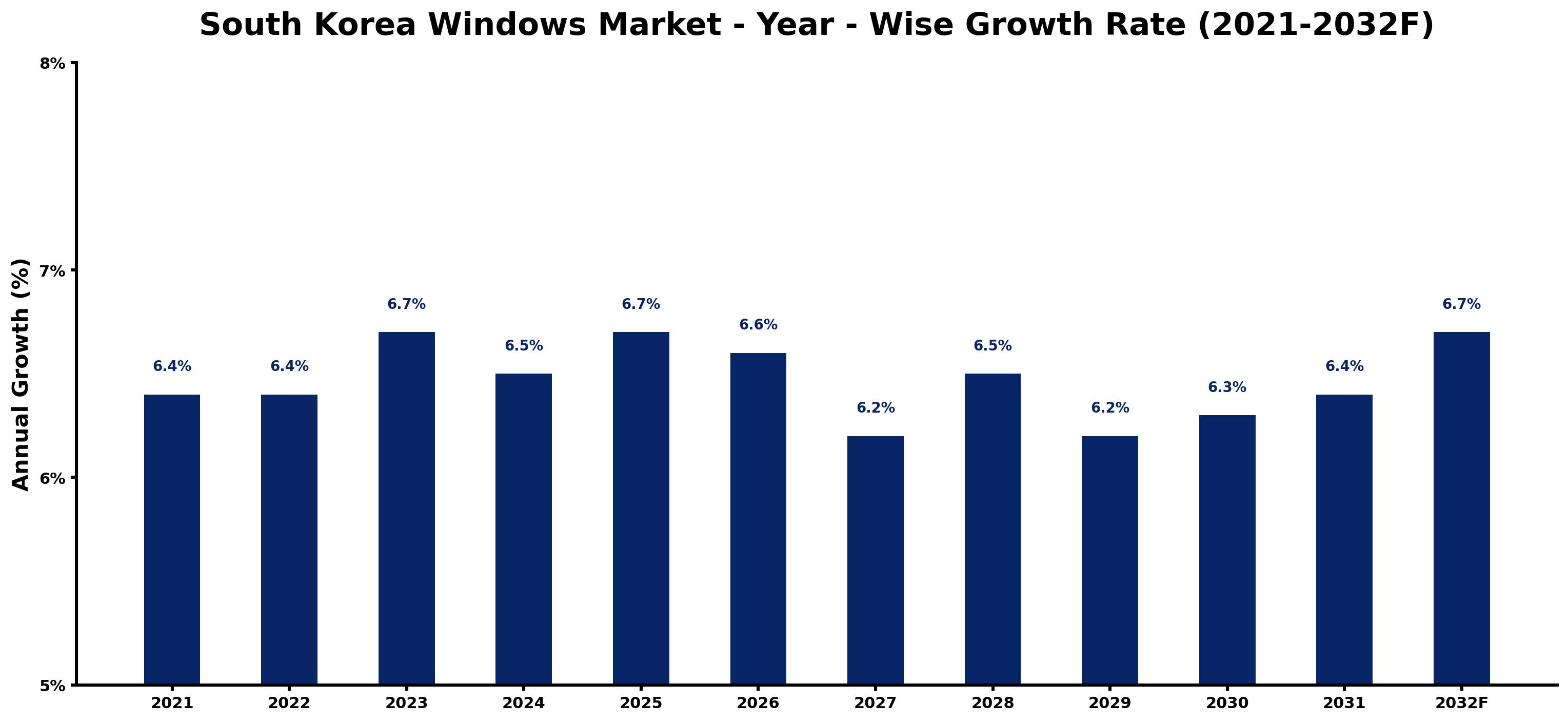
The table below presents the year wise growth rates along with the key drivers influencing the market
| Year | Growth Rate | Major Drivers |
| 2021 | 6.4% | Post-pandemic recovery spurs a resurgence in residential construction projects across South Korea. |
| 2022 | 6.4% | Technological innovations in energy efficiency transform consumer preferences for windows today. |
| 2023 | 6.7% | Sustainable building materials gain traction, influencing design choices in urban developments. |
| 2024 | 6.5% | The integration of smart home technology reshapes how consumers interact with windows. |
| 2025 | 6.7% | A competitive landscape emerges as local manufacturers invest in advanced window solutions. |
| 2026 | 6.6% | Increasing urban density prompts demand for larger windows in compact living spaces. |
| 2027 | 6.2% | Architectural trends favor large glass facades, driving up demand for specialized installations. |
| 2028 | 6.5% | Climate resilience becomes a priority, affecting window specifications for new constructions. |
| 2029 | 6.2% | Consumer awareness grows, leading to higher expectations for energy-efficient product performance. |
| 2030 | 6.3% | Emerging trends in modular construction highlight the need for adaptable window designs. |
| 2031 | 6.4% | Collaboration between tech firms and builders facilitates innovative window product developments. |
| 2032 | 6.7% | Market consolidation occurs as key players merge, shaping future competitive dynamics. |
Note - Market size estimations and growth projections presented in this report are based on 6Wresearch's advanced forecasting approach, validated with industry datasets as of June 2026.
South Korea Windows Market Synopsis
The South Korea Windows Market is projected to reach 6.6% and witness significant growth during the forecast period (2026-2032). This growth is largely attributed to the increasing demand for energy-efficient windows driven by the construction sector. Innovative window technologies, like double and triple glazing, low-emissivity (Low-E) coatings, and smart glass, are becoming increasingly prominent within the South Korean market. Furthermore, the variety of materials, including aluminum, uPVC, and wood, allows for diverse applications, catering to distinct consumer preferences.
South Korea Windows Market Growth Drivers
The growth of the South Korea Windows Market is being propelled by several critical factors:
- The booming construction sector, characterized by a surge in both residential and commercial projects, necessitates the incorporation of high-performance windows.
- Advancements in window technology have resulted in solutions that not only enhance aesthetic appeal but also significantly improve energy efficiency.
- Environmental regulations are increasingly imposing stringent standards for energy efficiency, prompting builders and architects to opt for advanced window solutions.
- A growing consumer awareness surrounding sustainability leads to a heightened demand for windows that contribute to lower energy bills and reduced carbon footprints.
- The integration of smart technologies in window designs is facilitating even greater energy savings and convenience, appealing to tech-savvy consumers.
South Korea Windows Market Trends and Opportunities
The South Korea Windows Market is witnessing notable trends that present various opportunities for growth:
- Increased adoption of smart glass technology, which adjusts its tint based on sunlight exposure, offers potential for reducing energy consumption.
- The trend towards minimalist design in architecture aligns with the demand for sleek and unobtrusive window solutions, enhancing the aesthetic value of buildings.
- Growing investment in retrofitting existing buildings with energy-efficient windows opens a lucrative market for manufacturers.
- Collaborations between technology firms and window manufacturers are anticipated to yield innovative products that merge functionality with enhanced user experience.
- As urban areas expand, the need for high-performance windows in new developments continues to increase, supplementing market demand.
South Korea Windows Market Challenges and Restraints
Despite its strong growth trajectory, the South Korea Windows Market faces several challenges:
- Technological advancements require continuous investment, which may strain the resources of smaller manufacturers.
- Environmental sustainability concerns necessitate a shift towards recycled materials, which can complicate production processes.
- Market players must navigate the complex landscape of regulatory compliance to meet both local and international standards.
- Consumer preferences are evolving rapidly, requiring manufacturers to be agile and responsive to changing market demands.
- Price competition among manufacturers can lead to margin pressures, necessitating differentiation through quality and innovation.
South Korea Windows Market Government Investment and Initiatives
To foster growth within the South Korea Windows Market, the government has launched several initiatives aimed at promoting energy-efficient solutions:
- The South Korean government offers incentives for both homeowners and businesses who invest in energy-efficient window replacements, thereby encouraging market growth.
- Regulations on product labeling and certification help inform consumers about the energy performance of windows, ensuring informed purchasing decisions.
- Public awareness campaigns have been initiated to highlight the advantages of energy-efficient windows in terms of lowering utility costs and environmental impact.
- Collaborative efforts with industry stakeholders are ongoing to address technical barriers that impede the adoption of advanced window technologies.
- Funding for research and development in window technologies is being allocated to drive innovation and improve the competitiveness of domestic manufacturers.
South Korea Windows Market Latest Developments (May 2025 - June 2026)
Over the period from May 2025 to June 2026, the South Korea Windows Market has seen several key developments:
- Emerging innovations in energy-efficient window technologies, particularly in the area of smart window solutions, have attracted notable interest from both the construction and architectural sectors.
- The governmental initiatives to promote sustainable building practices have gained momentum, prompting increased collaboration among industry stakeholders.
- Diverse consumer preferences have led manufacturers to explore and introduce customized solutions that cater to unique architectural styles and energy efficiency needs.
- Increased consumer education efforts about the long-term benefits of energy-efficient windows have resulted in a more knowledgeable market base.
- Continued investment in research and development has yielded advanced materials, enhancing the thermal performance and durability of windows.
South Korea Windows Market - Key Attractiveness of the Report
- 10 Years of Market Numbers
- Historical Data Starting from 2022 to 2025
- Base Year: 2025
- Forecast Data until 2032
- Key Performance Indicators Impacting the Market
- Major Upcoming Developments and Projects
Key Highlights of the Report:
- South Korea Windows Market Outlook
- Market Size of South Korea Windows Market, 2025
- Forecast of South Korea Windows Market, 2032
- Historical Data and Forecast of South Korea Windows Revenues & Volume for the Period 2022-2032F
- South Korea Windows Market Trend Evolution
- South Korea Windows Market Drivers and Challenges
- South Korea Windows Price Trends
- South Korea Windows Porter's Five Forces
- South Korea Windows Industry Life Cycle
- Historical Data and Forecast of South Korea Windows Market Revenues & Volume By Material for the Period 2022-2032F
- Historical Data and Forecast of South Korea Windows Market Revenues & Volume By uPVC for the Period 2022-2032F
- Historical Data and Forecast of South Korea Windows Market Revenues & Volume By Wood for the Period 2022-2032F
- Historical Data and Forecast of South Korea Windows Market Revenues & Volume By Metal for the Period 2022-2032F
- Historical Data and Forecast of South Korea Windows Market Revenues & Volume By Others for the Period 2022-2032F
- Historical Data and Forecast of South Korea Windows Market Revenues & Volume By Application for the Period 2022-2032F
- Historical Data and Forecast of South Korea Windows Market Revenues & Volume By Residential for the Period 2022-2032F
- Historical Data and Forecast of South Korea Windows Market Revenues & Volume By Commercial for the Period 2022-2032F
- South Korea Windows Import Export Trade Statistics
- Market Opportunity Assessment By Material
- Market Opportunity Assessment By Application
- South Korea Windows Top Companies Market Share
- South Korea Windows Competitive Benchmarking By Technical and Operational Parameters
- South Korea Windows Company Profiles
- South Korea Windows Key Strategic Recommendations






































