Sri Lanka Apiculture Market Size, Share & Growth Rate
The Sri Lanka Apiculture Market was estimated at USD 1097 Million in 2025 and is projected to reach USD 1581 Million by 2032, growing at a CAGR of 5.4% from 2026 to 2032. This upward trajectory is being propelled by a burgeoning consumer interest in health and wellness, leading to an increased demand for natural honey and bee products. The supportive role of the government in promoting sustainable apiculture practices further enhances the markets growth potential.
Sri Lanka Apiculture Market Year-wise Growth Rate and Key Drivers
This graph highlights how the Sri Lanka Apiculture Market has steadily grown over the years, supported by major growth factors.
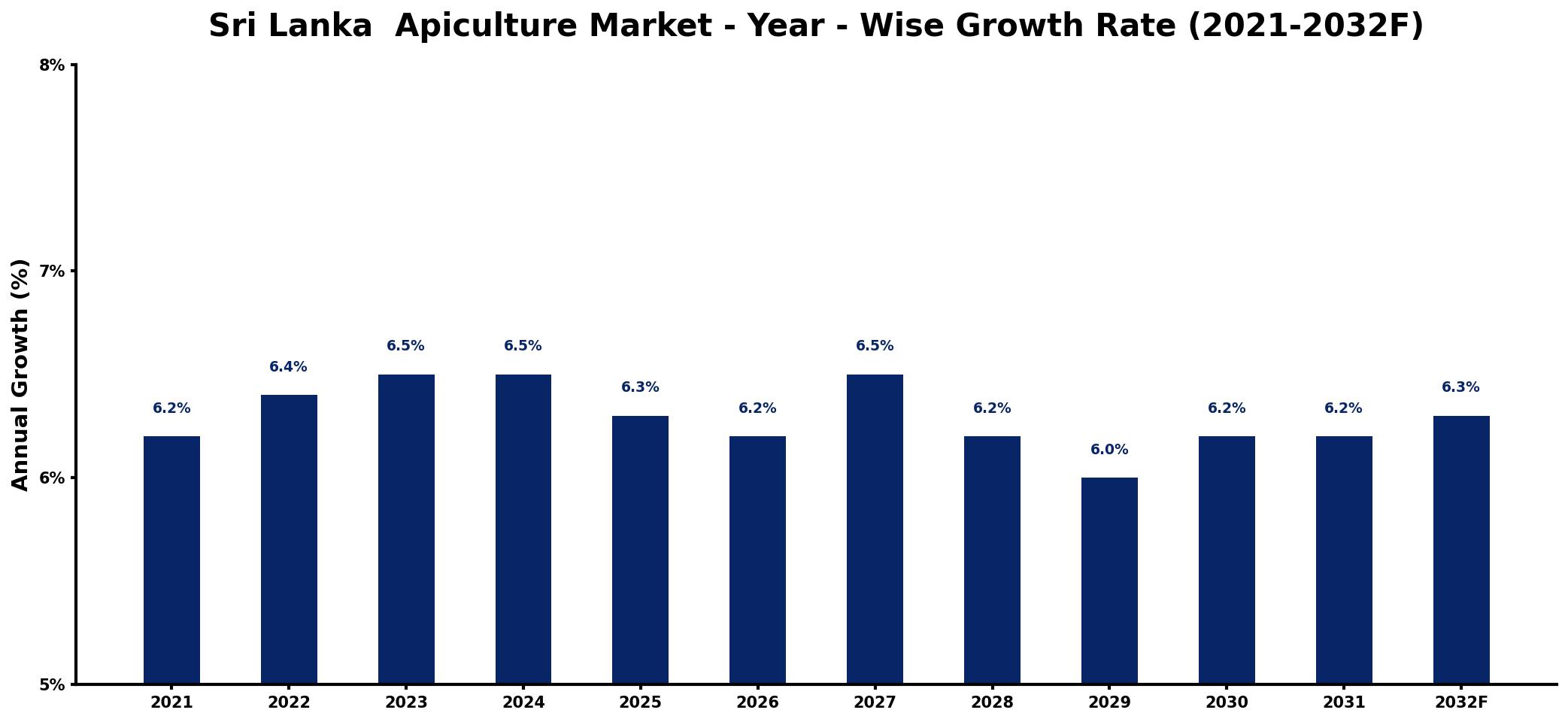
The table below presents the year‑wise growth rates along with the key drivers influencing the market
| Year | Growth Rate | Major Drivers |
| 2021 | 6.2% | Increased consumer health awareness |
| 2022 | 6.4% | Rising demand for organic products |
| 2023 | 6.5% | Expansion of local bee farms |
| 2024 | 6.5% | Growth in natural sweetener market |
| 2025 | 6.3% | Surge in eco-tourism initiatives |
| 2026 | 6.2% | Investment in agricultural technology |
| 2027 | 6.5% | Higher exports of honey products |
| 2028 | 6.2% | Increased research on pollinators |
| 2029 | 6.0% | enhanced product quality standards |
| 2030 | 6.2% | Emergence of urban beekeeping trends |
| 2031 | 6.2% | Government support for local producers |
| 2032 | 6.3% | Rising popularity of wellness products |
Note: Market size estimations and growth projections presented in this report are based on 6Wresearch's proprietary forecasting methodology, utilizing the latest available industry data, government publications, and primary research inputs.
Sri Lanka Apiculture Market Synopsis
A significant force driving the Sri Lanka Apiculture Market is the rising consumer awareness surrounding the health benefits of honey and bee products. This awareness encourages both traditional and commercial beekeepers to adapt their practices to meet increasing quality expectations.
Additionally, the countrys favorable climatic conditions and rich biodiversity create a supportive environment for beekeeping. These attributes help in the production of a wide variety of high-quality honey, making Sri Lanka a potential hub for apiculture innovation and exports.
Sri Lanka Apiculture Market Key Takeaways
- Increasing consumer preference for organic and natural products is driving growth in the market.
- The governments training and financial support initiatives are enhancing beekeeping productivity and sustainability.
- There is an emerging focus on quality certification to meet international export standards.
- Investment in modern technologies and practices can significantly uplift honey production levels.
- Tourism initiatives related to beekeeping offer additional revenue streams for the industry.
Evaluation of Restraints in Sri Lanka Apiculture Market
While the Sri Lanka Apiculture Market is poised for growth, it faces several constraints. Limited access to modern beekeeping technology and practices often results in lower productivity levels. Additionally, adverse weather patterns and natural disasters can have detrimental impacts on honey production and bee colonies. The lack of awareness among farmers regarding the economic benefits of beekeeping also acts as a barrier to broader market development. Moreover, pesticide usage in agriculture poses significant threats to bee populations, complicating the landscape for honey production. Addressing these issues through comprehensive education and sustainable practices is vital for unlocking the market's true potential.
Sri Lanka Apiculture Market Trends
Current trends in the Sri Lanka Apiculture Market reveal a shift towards organic honey production, spurred by consumer health consciousness. Theres a notable increase in demand for sustainably sourced products, prompting beekeepers to adopt modern technologies to enhance honey production and quality. Furthermore, the focus on quality control and adherence to international certification standards is increasingly becoming a priority, facilitating greater export opportunities for Sri Lankan honey.
Sri Lanka Apiculture Market Opportunities
The Sri Lanka Apiculture Market is ripe with investment opportunities, especially in the realm of modernizing beekeeping operations. As local and international demand for honey and its by-products escalates, investors can find lucrative avenues in developing value-added products like beeswax, royal jelly, and propolis. Moreover, eco-tourism centered around beekeeping practices holds significant potential to attract visitors, thereby providing additional revenue streams for local communities. Capitalizing on these opportunities can lead to substantial economic growth within the apiculture sector.
Government Initiatives in the Sri Lanka Apiculture Market
The Sri Lankan government has introduced multiple initiatives aimed at bolstering the apiculture market. These policies include providing training and technical support to local beekeepers, promoting beekeeping as a sustainable livelihood option. Financial assistance, along with subsidies, are available to help beekeepers invest in essential equipment and infrastructure. Additionally, regulatory frameworks are being established to ensure the quality and safety of honey products while also controlling diseases affecting bee populations. Collectively, these government efforts are designed to stimulate industry growth and improve the livelihoods of those engaged in apiculture.
Future Insights of the Sri Lanka Apiculture Market
Looking ahead to 2026-2032, the Sri Lanka Apiculture Market is projected to continue its positive growth trajectory. Factors driving this growth include an increasing awareness of honeys health benefits, rising disposable incomes, and a global trend towards organic products. Government initiatives to further support beekeepers will likely play a pivotal role in enhancing honey production. However, challenges such as climate change impacts on bee health and competition from imported honey will need to be navigated effectively. Overall, the market is set for substantial expansion, presenting numerous opportunities for both local and international stakeholders.
Sri Lanka Apiculture Market Latest Developments (2025 - 2026)
Recent developments in the Sri Lanka Apiculture Market indicate a push towards greater quality assurance and standardization within honey production. Innovative beekeeping practices are gaining traction, with more beekeepers exploring advanced technologies to optimize yields. Additionally, partnerships between governmental and non-governmental organizations have emerged to enhance training programs for aspiring beekeepers. Such initiatives are expected to lay a stronger foundation for the industry's growth, positioning Sri Lanka as a competitive player in the global honey market.
Sri Lanka Apiculture Market - Key Attractiveness of the Report
- 10 Years of Market Numbers
- Historical Data Starting from 2022 to 2025
- Base Year: 2025
- Forecast Data until 2032
- Key Performance Indicators Impacting the Market
- Major Upcoming Developments and Projects
Key Highlights of the Report:
- Sri Lanka Apiculture Market Outlook
- Market Size of Sri Lanka Apiculture Market, 2025
- Forecast of Sri Lanka Apiculture Market, 2032
- Historical Data and Forecast of Sri Lanka Apiculture Revenues & Volume for the Period 2022-2032F
- Sri Lanka Apiculture Market Trend Evolution
- Sri Lanka Apiculture Market Drivers and Challenges
- Sri Lanka Apiculture Price Trends
- Sri Lanka Apiculture Porter's Five Forces
- Sri Lanka Apiculture Industry Life Cycle
- Historical Data and Forecast of Sri Lanka Apiculture Market Revenues & Volume By Product Type for the Period 2022-2032F
- Historical Data and Forecast of Sri Lanka Apiculture Market Revenues & Volume By Honey for the Period 2022-2032F
- Historical Data and Forecast of Sri Lanka Apiculture Market Revenues & Volume By Beeswax for the Period 2022-2032F
- Historical Data and Forecast of Sri Lanka Apiculture Market Revenues & Volume By Live-bees for the Period 2022-2032F
- Historical Data and Forecast of Sri Lanka Apiculture Market Revenues & Volume By Others for the Period 2022-2032F
- Historical Data and Forecast of Sri Lanka Apiculture Market Revenues & Volume By Application for the Period 2022-2032F
- Historical Data and Forecast of Sri Lanka Apiculture Market Revenues & Volume By Medical for the Period 2022-2032F
- Historical Data and Forecast of Sri Lanka Apiculture Market Revenues & Volume By Food Beverages for the Period 2022-2032F
- Historical Data and Forecast of Sri Lanka Apiculture Market Revenues & Volume By Cosmetics for the Period 2022-2032F
- Historical Data and Forecast of Sri Lanka Apiculture Market Revenues & Volume By Others for the Period 2022-2032F
- Sri Lanka Apiculture Import Export Trade Statistics
- Market Opportunity Assessment By Product Type
- Market Opportunity Assessment By Application
- Sri Lanka Apiculture Top Companies Market Share
- Sri Lanka Apiculture Competitive Benchmarking By Technical and Operational Parameters
- Sri Lanka Apiculture Company Profiles
- Sri Lanka Apiculture Key Strategic Recommendations






































