Sri Lanka Publishing Market Summary
The sri lanka publishing market was estimated at USD 230 Million in 2025 and is projected to reach USD 316 Million by 2032, growing at a CAGR of 5.4% from 2026 to 2032.
Sri Lanka Publishing Market Year-wise Growth Rate and Key Drivers
This graph highlights how the Sri Lanka Publishing Market has steadily grown over the past five years, supported by major growth factors.
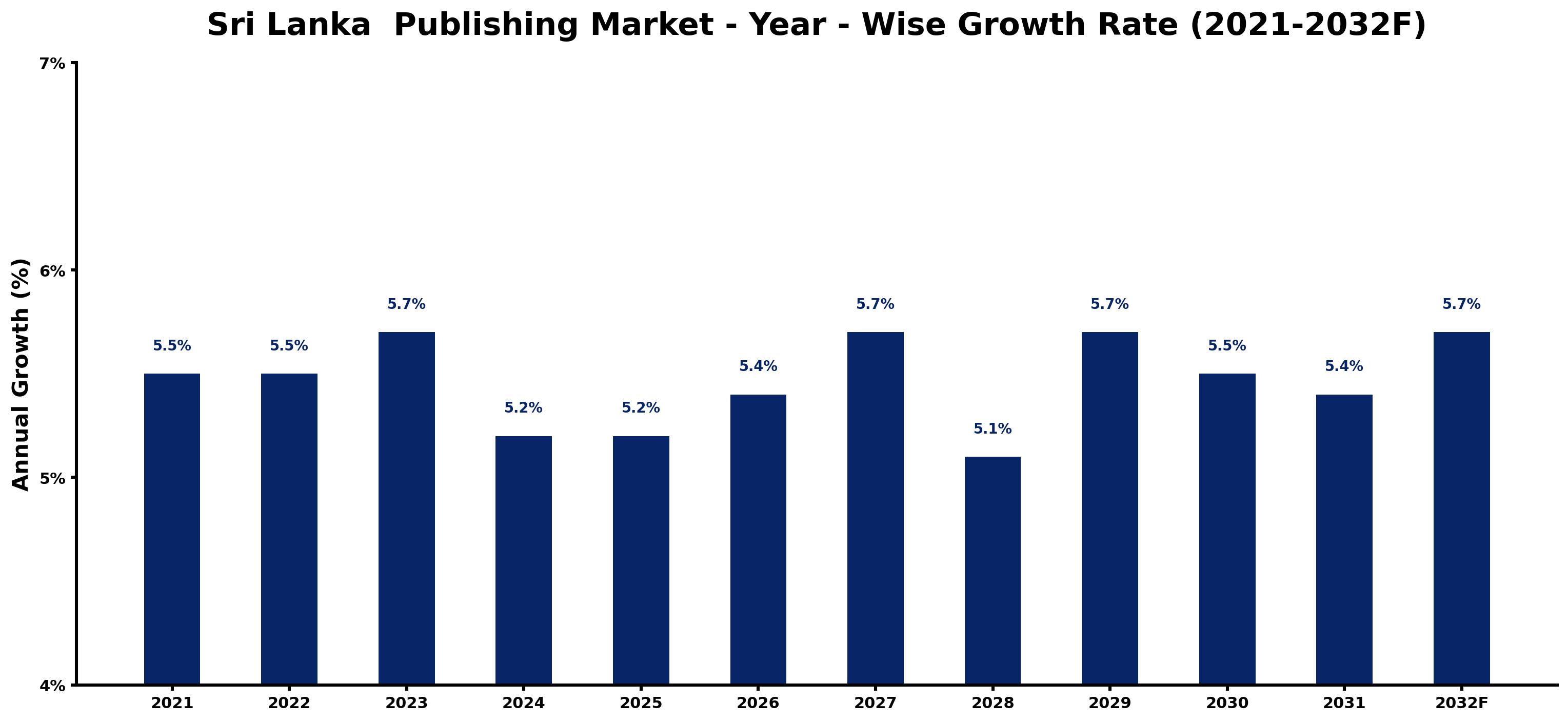
The table below presents the year wise growth rates along with the key drivers influencing the market
| Year | Growth Rate | Major Drivers |
| 2021 | 5.5% | Digital transformation in publishing began reshaping consumer engagement and content delivery. |
| 2022 | 5.5% | Emerging local authors gained traction, leading to increased sales of indigenous literature. |
| 2023 | 5.7% | Educational reforms prompted a surge in demand for academic and educational publishing materials. |
| 2024 | 5.2% | E-books and audiobooks gained popularity; platforms expanded access across urban and rural areas. |
| 2025 | 5.2% | Social media platforms became essential for marketing, boosting visibility for new publications. |
| 2026 | 5.4% | Collaborations with local bookstores fostered community support for independent publishers. |
| 2027 | 5.7% | Cultural heritage projects sparked interest in localized content, merging tradition with modern storytelling. |
| 2028 | 5.1% | Corporate sponsorship for literary events increased, enhancing the publishing landscape significantly. |
| 2029 | 5.7% | Translation services grew, allowing international titles to penetrate the Sri Lankan market effectively. |
| 2030 | 5.5% | Subscription models attracted younger audiences, reflecting shifting consumer preferences in reading. |
| 2031 | 5.4% | Sustainability trends pushed publishers toward eco-friendly materials and practices, attracting a conscious consumer base. |
| 2032 | 5.7% | Digital literacy initiatives expanded readership, laying a foundation for future publishing innovations. |
Note - Market size estimations and growth projections presented in this report are based on 6Wresearch's advanced forecasting approach, validated with industry datasets as of June 2026.
Sri Lanka Publishing Market Synopsis
The Sri Lanka Publishing Market is projected to reach 5.4% and witness significant growth during the forecast period (2026-2032). This growth trajectory is largely driven by several factors, including the increasing penetration of the Internet and supportive governmental initiatives aimed at enhancing digital literacy throughout the educational sector. Programs such as Invest Sri Lanka and the Digital Roadmap 2026-2032 represent vital efforts to promote the integration of technology in education, which is expected to drive demand within the publishing market.
Sri Lanka Publishing Market Growth Drivers
The dynamics of the Sri Lanka Publishing Market are being positively influenced by a combination of factors that provide a robust foundation for growth. Key drivers include:
- The rise in Internet usage, allowing easy access to a wide array of digital content and e-books.
- An increase in student enrollment in higher education institutions, leading to a greater demand for educational materials.
- Government initiatives aimed at fostering digital literacy and integrating technology into educational practices.
- The growing understanding and enforcement of copyright laws, thereby boosting publisher confidence and increasing digital sales.
- The implementation of technological innovations such as cloud computing and data analytics, enabling publishing houses to enhance their operational efficiencies.
Sri Lanka Publishing Market Trends and Opportunities
As the Sri Lanka Publishing Market evolves, several trends are emerging that signal opportunities for growth and innovation. These trends include:
- The increasing shift towards digital forms of content distribution, particularly e-books and online learning resources.
- Greater collaboration between educational institutions and publishing companies to develop localized content tailored to the Sri Lankan curriculum.
- Enhanced focus on mobile-friendly publishing solutions to cater to the growing number of mobile Internet users.
- The application of artificial intelligence in content creation and personalized learning experiences.
- A rising interest in audiobooks and other audio formats, expanding the overall market landscape.
Sri Lanka Publishing Market Challenges and Restraints
Despite its growth potential, the Sri Lanka Publishing Market faces several challenges that could restrain its advancement. Key challenges include:
- The digital divide in rural areas, where access to the Internet and digital resources remains limited.
- Resistance to change among traditional publishers adapting to the rapidly changing digital landscape.
- Concerns regarding the security of digital content and the potential for piracy.
- Financial constraints faced by educational institutions in acquiring up-to-date educational materials.
- The need for continuous investment in technology to stay competitive in an evolving publishing environment.
Sri Lanka Publishing Market Government Investment and Initiatives
The Sri Lankan government is actively supporting the publishing market through various investments and initiatives. Programs focused on enhancing digital literacy are pivotal, particularly in an educational context. The Digital Roadmap 2026-2032 sets forth a strategic plan to promote technology integration across schools and universities, fostering a more robust educational ecosystem. This includes investments in infrastructure that support digital learning, as well as incentives for companies that contribute to the development of educational resources. Furthermore, the government is working to increase awareness of copyright laws, which encourages publishers and authors to innovate and participate in the digital marketplace.
Sri Lanka Publishing Market Latest Developments (May 2025 - June 2026)
Recent developments in the Sri Lanka Publishing Market reflect a significant transition towards digital formats. Between May 2025 and June 2026, there has been a marked increase in collaboration between educational institutions and publishing houses to produce localized and contextually relevant content. The focus on mobile and audio formats has gained traction, positioning publishers to address the preferences of a tech-savvy audience. Government initiatives continue to gain momentum, enhancing infrastructure and promoting digital literacy programs, which are essential for equipping students with necessary skills. As publishers navigate these changes, a notable investment in technology and innovation is becoming essential for sustaining competitiveness and meeting evolving consumer demands.
Sri Lanka Publishing Market - Key Attractiveness of the Report
- 10 Years of Market Numbers
- Historical Data Starting from 2022 to 2025
- Base Year: 2025
- Forecast Data until 2032
- Key Performance Indicators Impacting the Market
- Major Upcoming Developments and Projects
Key Highlights of the Report:
- Sri Lanka Publishing Market Outlook
- Market Size of Sri Lanka Publishing Market, 2025
- Forecast of Sri Lanka Publishing Market, 2032F
- Historical Data and Forecast of Sri Lanka Publishing Revenues & Volume for the Period 2022-2032F
- Sri Lanka Publishing Market Trend Evolution
- Sri Lanka Publishing Market Drivers and Challenges
- Sri Lanka Publishing Price Trends
- Sri Lanka Publishing Porter's Five Forces
- Sri Lanka Publishing Industry Life Cycle
- Historical Data and Forecast of Sri Lanka Publishing Market Revenues & Volume By Types for the Period 2022-2032F
- Historical Data and Forecast of Sri Lanka Publishing Market Revenues & Volume By Newspaper for the Period 2022-2032F
- Historical Data and Forecast of Sri Lanka Publishing Market Revenues & Volume By Journals for the Period 2022-2032F
- Historical Data and Forecast of Sri Lanka Publishing Market Revenues & Volume By Catalogues for the Period 2022-2032F
- Historical Data and Forecast of Sri Lanka Publishing Market Revenues & Volume By Magazine for the Period 2022-2032F
- Historical Data and Forecast of Sri Lanka Publishing Market Revenues & Volume By Books for the Period 2022-2032F
- Historical Data and Forecast of Sri Lanka Publishing Market Revenues & Volume By E-Books for the Period 2022-2032F
- Historical Data and Forecast of Sri Lanka Publishing Market Revenues & Volume By Platform for the Period 2022-2032F
- Historical Data and Forecast of Sri Lanka Publishing Market Revenues & Volume By Digital? for the Period 2022-2032F
- Historical Data and Forecast of Sri Lanka Publishing Market Revenues & Volume By Paper for the Period 2022-2032F
- Sri Lanka Publishing Import Export Trade Statistics
- Market Opportunity Assessment By Types
- Market Opportunity Assessment By Platform
- Sri Lanka Publishing Top Companies Market Share
- Sri Lanka Publishing Competitive Benchmarking By Technical and Operational Parameters
- Sri Lanka Publishing Company Profiles
- Sri Lanka Publishing Key Strategic Recommendations






































