Sri Lanka Smartphone Market Summary
The sri lanka smartphone market was estimated at USD 982 Million in 2025 and is projected to reach USD 1807 Million by 2032, growing at a CAGR of 10.5% from 2026 to 2032.
Sri Lanka Smartphone Market Year-wise Growth Rate and Key Drivers
This graph highlights how the Sri Lanka Smartphone Market has steadily grown over the past five years, supported by major growth factors.
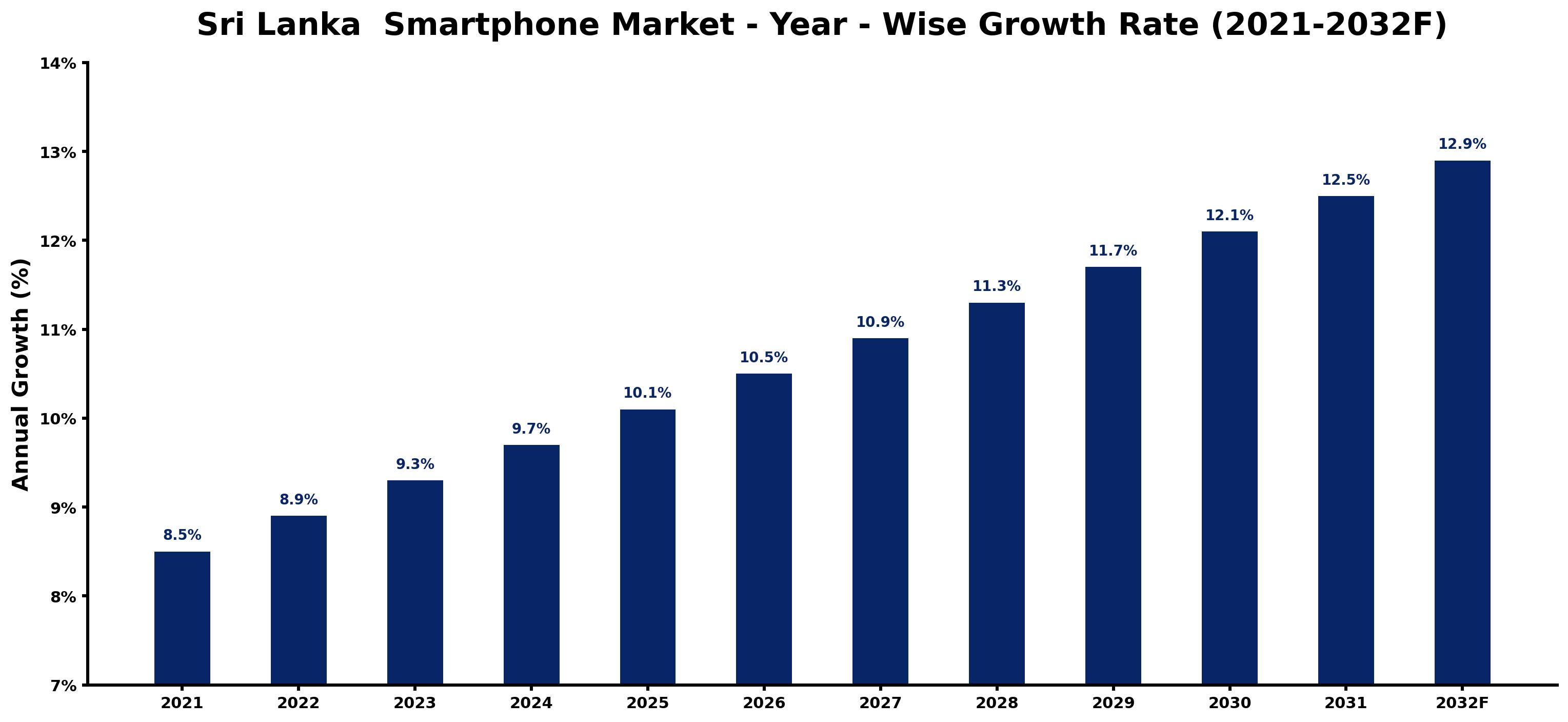
The table below presents the year wise growth rates along with the key drivers influencing the market
| Year | Growth Rate | Major Drivers |
| 2021 | 8.5% | Consumer interest in affordable smartphones has surged due to increased digital engagement. |
| 2022 | 8.9% | Local manufacturers began producing cost-effective devices to meet changing market preferences. |
| 2023 | 9.3% | Telecom operators introduced competitive data plans, enhancing smartphone usage across demographics. |
| 2024 | 9.7% | Smartphone brands introduced localized features, catering to culturally specific user needs. |
| 2025 | 10.1% | Emerging trends in mobile payments prompted users to upgrade their devices for security. |
| 2026 | 10.5% | Innovative marketing strategies targeted younger audiences, boosting smartphone penetration significantly. |
| 2027 | 10.9% | Urbanization trends in Sri Lanka increased demand for smartphones among city dwellers. |
| 2028 | 11.3% | The introduction of 5G networks expanded smartphone capabilities, attracting tech-savvy consumers. |
| 2029 | 11.7% | Sustainability initiatives led to a rise in eco-friendly smartphone manufacturing in the region. |
| 2030 | 12.1% | Partnerships with educational institutions promoted digital learning, increasing smartphone necessity among students. |
| 2031 | 12.5% | Smartphone repair services improved, encouraging users to upgrade rather than abandon devices. |
| 2032 | 12.9% | Competitive pricing strategies led to a saturation of affordable smartphones in the market. |
Note - Market size estimations and growth projections presented in this report are based on 6Wresearch's advanced forecasting approach, validated with industry datasets as of June 2026.
Sri Lanka Smartphone Market Synopsis
The Sri Lanka Smartphone Market is projected to reach 10.5% and witness significant growth during the forecast period (2026-2032). This expansion is primarily fueled by increasing disposable income among consumers, prompting a higher demand for smartphones equipped with advanced features and specifications. As vendors respond to this growing demand by diversifying their product portfolios, the market is becoming more segmented, catering to budget, mid-range, and high-end device consumers.
Sri Lanka Smartphone Market Growth Drivers
Several factors are propelling the Sri Lanka smartphone market forward. Firstly, the rise in disposable income has empowered consumers to invest in devices that offer enhanced functionality. Secondly, smartphone manufacturers are innovating rapidly, pushing technological advancements that meet evolving consumer needs. Thirdly, the expansion of telecom infrastructure and competitive pricing strategies, particularly in mobile data plans, have significantly boosted smartphone accessibility and internet usage across various demographics. Additionally, global trends such as social media engagement and e-commerce have driven smartphone adoption as users seek reliable devices to support their online activities. Lastly, the increasing presence of online sales channels is facilitating easier access to smartphones for a broader audience.
Sri Lanka Smartphone Market Challenges and Restraints
Despite the promising growth prospects, the Sri Lanka smartphone market faces notable challenges. Weak GDP growth, compounded by currency depreciation, has led to higher import costs for electronics, which may hinder market expansion. Additionally, fluctuating economic conditions can impact consumer purchasing power, creating uncertainty in demand. Furthermore, the smartphone market must contend with significant competition and price wars, which could pressure profit margins for manufacturers. Lastly, the rapid pace of technological change means that companies must continuously innovate to keep up; failure to do so could result in losing market share.
Sri Lanka Smartphone Market Trends and Opportunities
Current trends in the Sri Lanka smartphone market indicate a shift towards devices that integrate advanced features such as artificial intelligence and enhanced camera technology. These specifications are increasingly influencing consumer choices, particularly among younger demographics. There is also a noticeable shift towards sustainable and eco-friendly devices, as environmental concerns influence purchasing decisions. Opportunities abound for vendors who can market smartphones with superior battery life, durability, and energy efficiency. Additionally, the ongoing expansion of 5G networks is expected to create new avenues for mobile applications and services, further driving demand in the coming years.
Sri Lanka Smartphone Market Government Investment and Initiatives
The Sri Lankan government is active in fostering growth within the ICT sector, including the smartphone market. Various initiatives have been launched to enhance the digital landscape through investments in digital infrastructure and education. The government is also encouraging local manufacturing to reduce reliance on imports, which could optimize costs for consumers and businesses alike. Incentives for SMEs and startups focused on technology and innovation are being introduced to stimulate the development of local solutions. This strategic commitment aims to place Sri Lanka as a competitive player in the global ICT market, offering a supportive environment for stakeholders in the smartphone space.
Sri Lanka Smartphone Market Latest Developments (May 2025 - June 2026)
During the period from May 2025 to June 2026, the Sri Lanka smartphone market has witnessed several significant developments. Vendors have intensified their efforts to introduce affordable yet feature-rich devices, accommodating a broader consumer base amidst economic challenges. Additionally, advancements in mobile technology have led to the introduction of devices with enhanced camera systems and robust processing capabilities. Telecom providers have continued to roll out competitive data plans, which has further incentivized consumers to upgrade their devices. Moreover, the growing popularity of e-commerce platforms has prompted more digital marketing strategies, allowing brands to connect with consumers effectively. Collaborative initiatives between the government and private sector have also emerged, aimed at improving telecommunications infrastructure and accessibility.
Sri Lanka Smartphone Market - Key Attractiveness of the Report
- 10 Years of Market Numbers
- Historical Data Starting from 2022 to 2025
- Base Year: 2025
- Forecast Data until 2032
- Key Performance Indicators Impacting the Market
- Major Upcoming Developments and Projects
Key Highlights of the Report:
- Sri Lanka Smartphone Market Outlook
- Market Size of Sri Lanka Smartphone Market, 2025
- Forecast of Sri Lanka Smartphone Market, 2032F
- Historical Data and Forecast of Sri Lanka Smartphone Revenues & Volume for the Period 2022-2032F
- Sri Lanka Smartphone Market Trend Evolution
- Sri Lanka Smartphone Market Drivers and Challenges
- Sri Lanka Smartphone Price Trends
- Sri Lanka Smartphone Porter's Five Forces
- Sri Lanka Smartphone Industry Life Cycle
- Historical Data and Forecast of Sri Lanka Smartphone Market Revenues & Volume By Product Type for the Period 2022-2032F
- Historical Data and Forecast of Sri Lanka Smartphone Market Revenues & Volume By Android for the Period 2022-2032F
- Historical Data and Forecast of Sri Lanka Smartphone Market Revenues & Volume By iOS for the Period 2022-2032F
- Historical Data and Forecast of Sri Lanka Smartphone Market Revenues & Volume By Windows for the Period 2022-2032F
- Historical Data and Forecast of Sri Lanka Smartphone Market Revenues & Volume By Blackberry Operating System for the Period 2022-2032F
- Historical Data and Forecast of Sri Lanka Smartphone Market Revenues & Volume By Other for the Period 2022-2032F
- Historical Data and Forecast of Sri Lanka Smartphone Market Revenues & Volume By Distribution Channel for the Period 2022-2032F
- Historical Data and Forecast of Sri Lanka Smartphone Market Revenues & Volume By OEM for the Period 2022-2032F
- Historical Data and Forecast of Sri Lanka Smartphone Market Revenues & Volume By Retailer for the Period 2022-2032F
- Historical Data and Forecast of Sri Lanka Smartphone Market Revenues & Volume By e-Commerce for the Period 2022-2032F
- Sri Lanka Smartphone Import Export Trade Statistics
- Market Opportunity Assessment By Product Type
- Market Opportunity Assessment By Distribution Channel
- Sri Lanka Smartphone Top Companies Market Share
- Sri Lanka Smartphone Competitive Benchmarking By Technical and Operational Parameters
- Sri Lanka Smartphone Company Profiles
- Sri Lanka Smartphone Key Strategic Recommendations






































