Taiwan 3D Food Printing Market Growth Rate
According to 6Wresearch internal databases and industry insights, the Taiwan 3D Food Printing Market is projected to grow at a steady compound annual growth rate (CAGR) of 6.7% during the forecast period 2026–2032.
Taiwan 3D Food Printing Market Year-wise Growth Rate and Key Drivers (2022-2032)
This graph illustrates the annual growth rates of the Taiwan 3D Food Printing Market from 2022 to 2032, highlighting a steady upward trajectory and projected market expansion over the forecast period.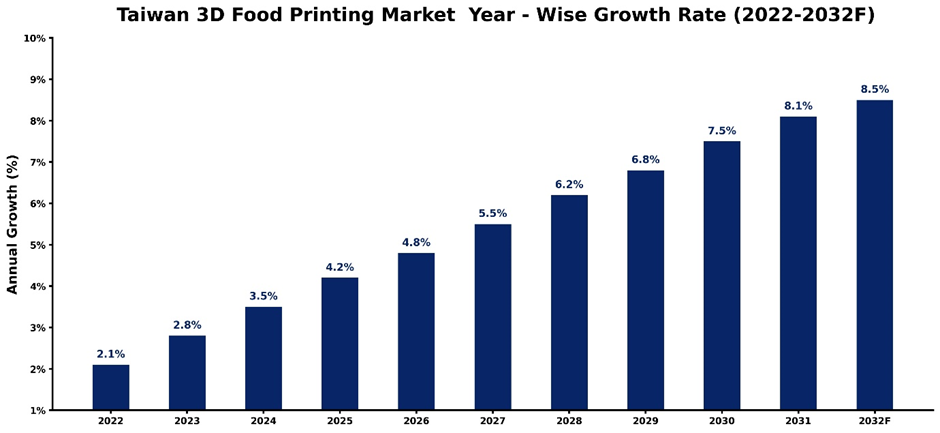
The following table summarizes the historical and forecasted growth rates of Taiwan 3D Food Printing Market, along with the rationale behind each year’s performance.
| Year | Estimated Growth (%) | Market Rationale |
| 2022 | 2.1% | Initial academic research and lab-scale prototyping. |
| 2023 | 2.8% | Increased interest in personalized nutrition and aesthetics. |
| 2024 | 3.5% | Rise in food-tech startups exploring 'food customization'. |
| 2025 | 4.2% | Adoption of 3D printing for texture-modified foods in elderly care. |
| 2026 | 4.8% | Integration of 3D printing in niche culinary/high-end hospitality. |
| 2027 | 5.5% | Scaling of supply chains for printable, shelf-stable food pastes. |
| 2028 | 6.2% | Expansion into retail health-food markets for personalized diets. |
| 2029 | 6.8% | Regulatory frameworks for novel printed food ingredients. |
| 2030 | 7.5% | Mass production of home-use consumer-grade food printers. |
| 2031 | 8.1% | Broad adoption in hospital and commercial kitchen settings. |
| 2032 | 8.5% | Fully integrated sustainable and waste-reduction food cycles. |
Topics Covered in the Taiwan 3D Food Printing Market Report
The Taiwan 3D Food Printing Market report covers the market by vertical and technique. The report provides a detailed analysis of ongoing market trends, along with key market drivers that will help stakeholders align strategies based on current and future market dynamics.
Taiwan 3D Food Printing Market Highlights
| Report Name | Taiwan 3D Food Printing Market |
| Forecast period | 2026-2032 |
| CAGR | 6.7% |
| Growing Sector | Commercial sector |
Taiwan 3D Food Printing Market Synopsis
The Taiwan 3D Food Printing Market is poised for significant structural evolution during the forecast period. The primary drivers for market growth include the rising demand foe individualized nutrition, particularly for the elderly, the push toward sustainable food production through waste reduction, and rapid innovation in material science for food-grade inks. The market size will be expanded by government’s commitment to "smart agriculture" and high-tech food manufacturing, combined with a growing hospitality sector seeking aesthetic and culinary differentiation.
Evaluation of Growth Drivers in Taiwan 3D Food Printing Market (2026–2032)
Below are some major drivers and their influence on the market dynamics:
| Drivers | Primary Segment Affected | Why It Matters (Evidence) |
| Aging Population (Dysphagia Care) | Elderly Care / Clinical Nutrition | High demand for texture-modified, nutrient-dense, and safe-to-swallow foods. |
| Personalized Nutrition | Wellness & Healthcare | Precision control over macro/micronutrients tailored to individual metabolic needs. |
| Sustainable Food Cycles | Food Manufacturing / Retail | Utilization of upcycled ingredients and on-demand production will reduce waste. |
| Digital Gastronomy | Hospitality & Premium Dining | Enhances visual presentation and allows for complex structural designs. |
| Smart Kitchen Integration | Consumer/Commercial Equipment | Shift toward autonomous, digitally-controlled kitchen environments. |
The Taiwan 3D Food Printing Market Share is projected to grow with a CAGR of 6.7% during 2026–2032. The key reasons pushing market expansion are rising need for texture-modified meals in the aging population and transition from traditional manual preparation to high-precision digital food manufacturing. Taiwan’s population aged 65 and above is expected to exceed 20% of the total population by 2025, increasing demand for texture-modified and personalized nutrition solutions.
Evaluation of Restraints in Taiwan 3D Food Printing Market
Below are some major restraints and their influence on the market dynamics:
| Restraints | Primary Segment Affected | What This Means (Evidence) |
| High Initial Costs | Small-to-Mid Sized Cafes/Restaurants | Significant capital needed for printer hardware and specialized food-grade materials. |
| Limited Material Portfolio | Manufacturers | Lack of standardized, shelf-stable, and printable food-grade "inks." |
| Strict Food Safety Norms | Regulatory/Compliance Bodies | Rigorous TFDA approval processes for novel "printed" food manufacturing. |
| Slow Throughput Speed | Mass Production/Industrial Units | Current extrusion-based printing remains slower than traditional mass-production moulds. |
| Consumer Skepticism | General Public | "Food neophobia" regarding the taste and texture of printed synthetic alternatives. |
Taiwan 3D Food Printing Market Challenges
The market faces several hurdles, including high computational requirements for complex 3D food modelling and the need for significant R&D in post-processing stages (baking, frying, and sterilization) that preserve the integrity of printed structures. Industry surveys indicate that more than 60% of food technology companies identify skilled workforce availability as a major barrier to scale the advanced food manufacturing technologies. Regulatory ambiguity regarding labeling for printed foods can delay deployment.
Taiwan 3D Food Printing Market Trends
Significant trends driving the Taiwan 3D food printing market are presented below:
- AI-Driven Recipe Optimization: Machine learning algorithms supports in calibrating ingredient ratios, improve texture, structure, and individualized nutrition delivery.
- Hybrid Manufacturing: Expansion of high-quality artistic presentation can be achieved by inclusion of additive layer deposition with traditional culinary techniques.
- Focus on Dysphagia Solutions: Increase in intake rates and quality for elderly care patients by improved printing IDDSI-compliant and visually appealing meals.
- Eco-Friendly Ingredients: Implementing circular economy goals and reducing waste by utilizing plant-based proteins, algae-based materials, and repurposed food scraps.
Investment Opportunities in Taiwan 3D Food Printing Market
Emerging investment opportunities in the Taiwan 3D food printing market include the following:
- Equipment-as-a-Service (EaaS): Adoption within hospitals and restaurants enhanced due to minimized initial hardware costs, by developing scalable subscription models.
- Proprietary Bio-Ink Development: Investment opportunities present in local startups that make stable, nutrient-dense, and highly printable food-grade material formulations for commercial.
- Digital Recipe Marketplaces: Funding required in developing secure platforms for chefs to design, share, and monetize proprietary files, results in creating additional earning method.
- Smart Clinical Kitchens: Manufacturing integrated hardware-software infrastructure, that is highly valuable for large-scale medical facilities, will enable precision-controlled nutrient management.
Top Leading Players in Taiwan 3D Food Printing Market
The following is a comprehensive list of key companies operating in the Taiwan 3D food printing market:
1. XYZprinting
| Company Name | XYZprinting |
|---|---|
| Established Year | 2013 |
| Headquarters | Taipei, Taiwan |
| Official Website | Click Here |
XYZprinting, a subsidiary of New Kinpo Group, specializes in accessible desktop 3D printing hardware, including consumer-friendly 3D chocolate and dough printing solutions.
2. Natural Machines
| Company Name | Natural Machines |
|---|---|
| Established Year | 2012 |
| Headquarters | Barcelona, Spain |
| Official Website | Click Here |
Innovators of the IoT-based Foodini printer, which is widely utilized for professional and commercial savory and sweet culinary customization.
3. byFlow
| Company Name | byFlow |
|---|---|
| Established Year | 2015 |
| Headquarters | Eindhoven, Netherlands |
| Official Website | Click Here |
Their flagship Focus 3D printer, a portable multi-material extrusion system designed for culinary, industrial, and creative design applications.
4. Formfty
| Company Name | Formfty |
|---|---|
| Established Year | 2018 |
| Headquarters | Taipei, Taiwan |
| Official Website | Click Here |
Serving as a primary distributor and service partner for advanced additive manufacturing equipment, providing specialized support for local 3D practitioners.
5. 3DMART
| Company Name | 3DMART |
|---|---|
| Established Year | 2014 |
| Headquarters | New Taipei City, Taiwan |
| Official Website | Click Here |
A premier regional distributor of state-of-the-art 3D printing hardware, scanners, and comprehensive educational resources for the additive manufacturing industry.
Government Initiatives being implemented in the Taiwan 3D Food Printing Market
According to the Taiwan’s government data, the market is actively promoted through strategic investments in smart agriculture and high-tech food manufacturing. The Ministry of Economic Affairs (MOEA) and the Food Industry R&D institute (FIRDI) implemented programs, that focus on integrating AI-driven processing and sustainable circular economy technologies. The Taiwan 3D Food Printing Market size will be expanded by promoting "climate-smart" production and providing R&D grants for low-carbon supply chains, also the government aims to modernize the local food industry.
Future Insights of the in Taiwan 3D Food Printing Market
The future of the market is defined by a shift toward highly personalized, data-driven nutrition. For managing dysphagia in Taiwan’s aging population, artificial intelligence is integrating with additive manufacturing, leads to evolving the industry from niche culinary applications to essential healthcare infrastructure. The Taiwan 3D Food Printing Market revenue will be enhanced by adoption of circular food systems, which upcycle agricultural waste into high-quality printing "inks". By 2032, these innovations will move beyond laboratory settings, establishing autonomous, smart-kitchen ecosystems.
Market Segmentation Analysis
This report presents a detailed analysis of the market segments along with their leading categories:
By Vertical - Commercial Led the Market and Set for Rapid Growth
According to Ravi Bhandari, Senior Research Analyst, 6Wresearch, by vertical, in 2025, the Commercial dominated the Taiwan 3D food printing market, by capturing 51% of the market share, driven by adaption of 3D printing in the hospitality and high-end culinary. Also, during 2026-2032, the Commercial will maintain its dominance with a CAGR of 25%, fueled by the integration of autonomous and AI-driven smart kitchens.
By Technique - Extrusion-Based Printing Dominated the Market and Set for Rapid Expansion
By Technique, in 2025, the Extrusion-Based Printing technique led the Taiwan 3D food printing market, capturing 60% of the market share, due to its exceptional versatility in processing common food materials such as chocolate and plant-protein pastes. And by 2032, Extrusion-Based Printing will keep on leading with a CAGR of 24%, sustained by its ongoing adaptation for high-precision and automated smart-kitchen systems.
Note: Market size estimations and growth projections presented in this report are based on 6Wresearch's proprietary forecasting methodology, utilizing the latest available industry data, government publications, and primary research inputs.
Key Attractiveness of the Report:
- 10 Years of Market Numbers
- Historical Data Starting from 2022 to 2025
- Base Year: 2025
- Forecast Data until 2032
- Key Performance Indicators Impacting the Market
- Major Upcoming Developments and Projects
Key Highlights of the Report:
Taiwan 3D Food Printing Market Outlook
- Market Size of Taiwan 3D Food Printing Market, 2025
- Forecast of Taiwan 3D Food Printing Market, 2032
- Historical Data and Forecast of Taiwan 3D Food Printing Revenues & Volume for the Period 2022-2032
- Taiwan 3D Food Printing Market Trend Evolution
- Taiwan 3D Food Printing Market Drivers and Challenges
- Taiwan 3D Food Printing Price Trends
- Taiwan 3D Food Printing Porter`s Five Forces
- Taiwan 3D Food Printing Industry Life Cycle
- Historical Data and Forecast of Taiwan 3D Food Printing Market Revenues & Volume By Vertical for the Period 2022-2032
- Historical Data and Forecast of Taiwan 3D Food Printing Market Revenues & Volume By Government for the Period 2022-2032
- Historical Data and Forecast of Taiwan 3D Food Printing Market Revenues & Volume By Commercial for the Period 2022-2032
- Historical Data and Forecast of Taiwan 3D Food Printing Market Revenues & Volume By Residential for the Period 2022-2032
- Historical Data and Forecast of Taiwan 3D Food Printing Market Revenues & Volume By Technique for the Period 2022-2032
- Historical Data and Forecast of Taiwan 3D Food Printing Market Revenues & Volume By Extrusion Based Printing for the Period 2022-2032
- Historical Data and Forecast of Taiwan 3D Food Printing Market Revenues & Volume By Selective Laser Sintering for the Period 2022-2032
- Historical Data and Forecast of Taiwan 3D Food Printing Market Revenues & Volume By Binder Jetting for the Period 2022-2032
- Historical Data and Forecast of Taiwan 3D Food Printing Market Revenues & Volume By Inkjet Printing for the Period 2022-2032
- Taiwan 3D Food Printing Import Export Trade Statistics
- Market Opportunity Assessment By Vertical
- Market Opportunity Assessment By Technique
- Taiwan 3D Food Printing Top Companies Market Share
- Taiwan 3D Food Printing Competitive Benchmarking By Technical and Operational Parameters
- Taiwan 3D Food Printing Company Profiles
- Taiwan 3D Food Printing Key Strategic Recommendations
Market Covered
The report offers an extensive study of the following market segments:
By Vertical
- Government
- Commercial
- Residential
By Technique
- Extrusion-Based Printing
- Selective Laser Sintering (SLS)
- Binder Jetting
- Inkjet Printing






































