Taiwan Threat Detection AI Market Size & Growth Rate
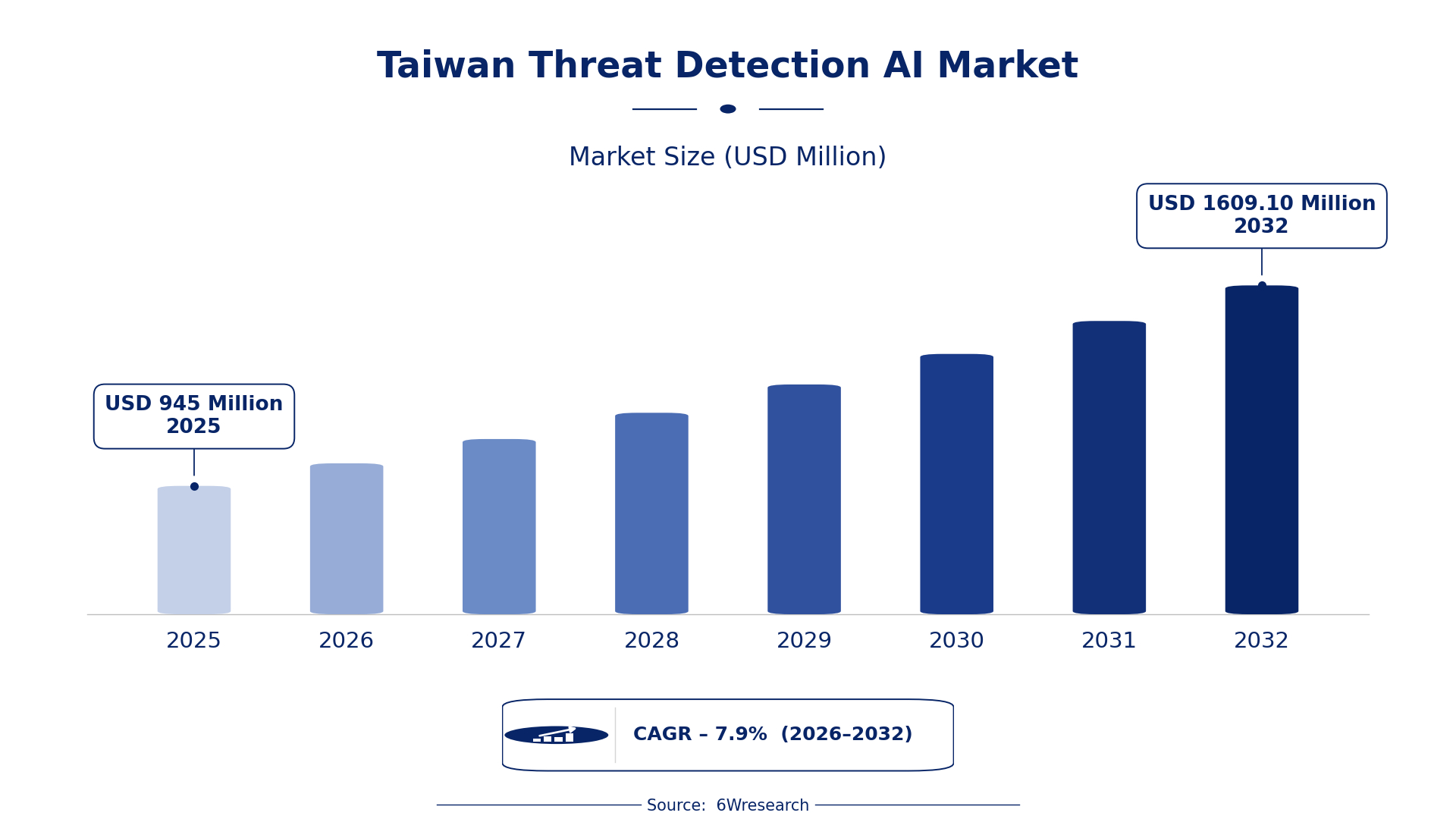
According to 6Wresearch internal database and industry insights, the Taiwan Threat Detection AI Market was valued at USD 945.0 million in 2025 and is projected to reach USD 1,609.10 million by 2032, growing at a CAGR of approximately 7.9% during 2026–2032.
Taiwan Threat Detection AI Market Highlights
| Report Metric | Details |
| Report Name | Taiwan Threat Detection AI Market |
| Market Size 2025 | USD 945.0 million |
| Market Size 2032 | USD 1,609.10 million |
| Absolute Growth 2025–2032 | USD 664.10 million |
| CAGR 2026–2032 | 7.9% |
| Peak Annual Growth | 9.1% in 2027 |
| Forecast Period | 2026–2032 |
| Historical Data | 2022–2025 |
| Base Year | 2025 |
| Leading Detection Type, 2025 | Malware Detection (52% share) |
| Leading AI Technique Used, 2025 | Machine Learning (41% share) |
| Leading Deployment Mode, 2025 | Cloud-Based (43% share) |
| Leading End User, 2025 | Enterprises (41% share) |
| Fastest-Growing Detection Type | Phishing Threats (9.6% CAGR) |
| Fastest-Growing AI Technique Used | Anomaly Detection AI (10.5% CAGR) |
| Fastest-Growing End User | Fintech Companies (9.0% CAGR) |
| Growing Sector | Fintech |
| Key End Users | IT Security Teams, Enterprises, Fintech Companies, Government Agencies |
Taiwan Threat Detection AI Market Year-wise Growth Rate and Key Drivers (2022–2032)
This graph illustrates the annual growth rates of the market from 2022 to 2032, highlighting a steady upward trajectory and projected market expansion over the forecast period.
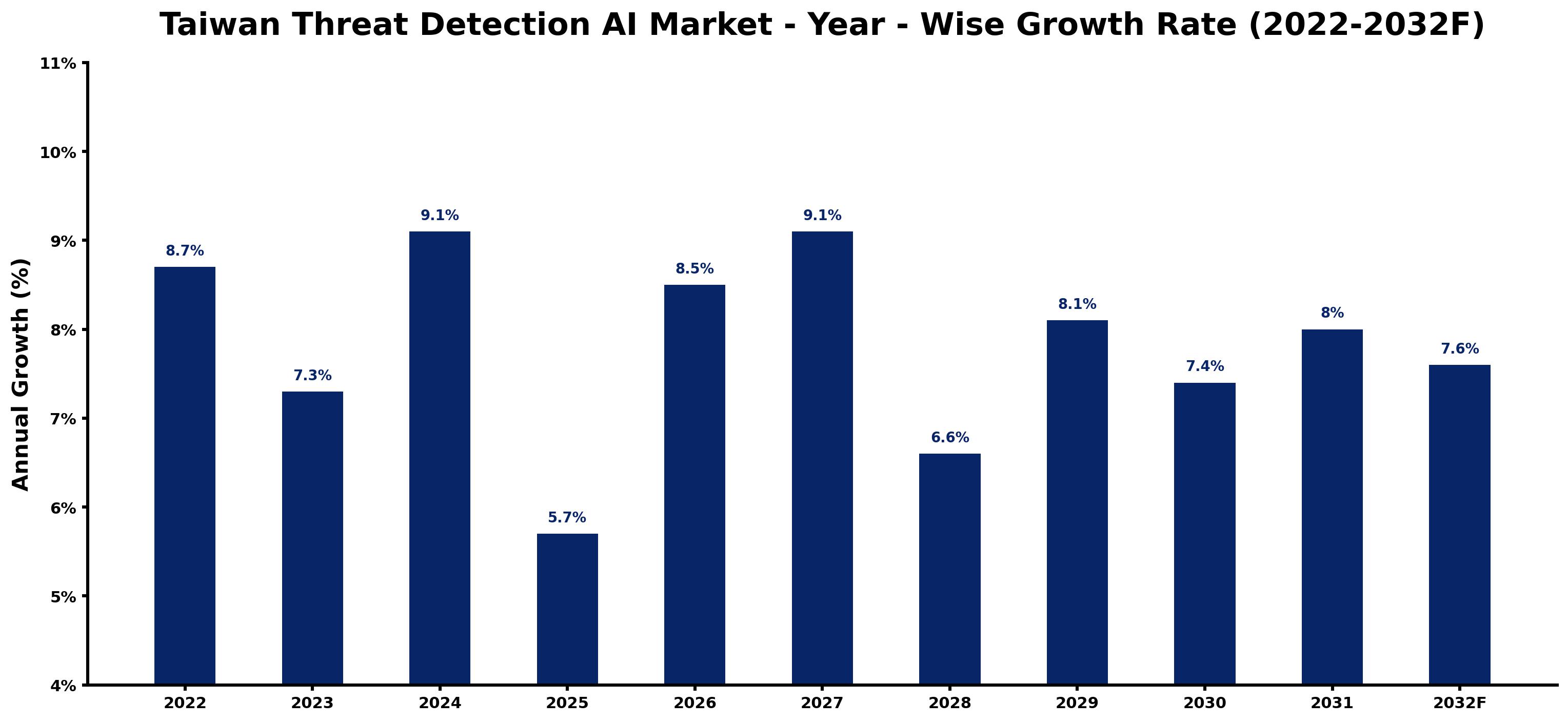
Year by year, the estimates below pair each growth rate with the development that shaped it.
| Year | Estimated Annual Growth (%) | Market Rationale |
| 2022 | 8.7 | The market experienced strong demand from IT security teams focusing on cybersecurity measures. |
| 2023 | 7.3 | Growth slowed as enterprises adjusted their cybersecurity budgets amid economic uncertainties. |
| 2024 | 9.1 | Demand surged as Taiwan's fintech sector expanded, driving investments in threat detection solutions. |
| 2025 | 5.7 | Growth slowed due to increased competition among providers in the cybersecurity market. |
| 2026 | 8.5 | A rise in cyber threats prompted enterprises to invest more in advanced detection technologies. |
| 2027 | 9.1 | The market peaked as government initiatives boosted funding for cybersecurity advancements. |
| 2028 | 6.6 | Growth slowed as the Cyber Security Management Act of 2023 began to shape the market. |
| 2029 | 8.1 | Demand increased as businesses sought to improve their cybersecurity posture against evolving threats. |
| 2030 | 7.4 | Growth slowed as the market matured, with established players dominating the sector. |
| 2031 | 8.0 | Demand rose again as regulatory requirements for cybersecurity tightened across sectors. |
| 2032 | 7.6 | Growth slowed as the market continued to stabilise, with a focus on compliance. |
Note: Market size estimations and growth projections presented in this report are based on 6Wresearch's proprietary forecasting methodology, utilizing the latest available industry data, government publications, and primary research inputs.
Taiwan Threat Detection AI Market Synopsis
Threat Detection AI in Taiwan encompasses technologies designed to identify and mitigate cyber threats through algorithms and machine learning. This technology safeguards sensitive data, prevents unauthorised access, and fortifies cybersecurity measures. The Taiwan Threat Detection AI Market is growing due to rising cyber threats and increasing demand from sectors such as IT security and finance. With over 300 fintech companies seeking advanced solutions, the market is expected to experience substantial growth in the coming years. The Cyber Security Management Act, launched in 2023, further propels this growth by establishing new digital security standards.
Market Dynamics Impact Analysis (2026–2032)
| Factor | Type | Impact | Primary Segment Affected |
| Growing demand from IT security teams for advanced threat detection solutions. | Driver | High | Malware Detection |
| Increased investment in cybersecurity by fintech companies due to rising threats. | Driver | High | Fintech Companies |
| The need for compliance with new cybersecurity regulations creates opportunities for suppliers. | Opportunity | High | Enterprises |
| The Smart City initiative in Taipei drives demand for integrated cybersecurity solutions. | Opportunity | Medium | Government Agencies |
| Limited awareness among SMEs about the importance of threat detection solutions. | Restraint | Medium | Enterprises |
| High initial costs of implementing advanced threat detection systems can deter adoption. | Restraint | High | Fintech Companies |
| Competition among providers can lead to pricing pressures affecting profitability. | Challenge | High | Malware Detection |
| Rapid technological changes require constant updates, increasing operational costs. | Challenge | Medium | Enterprises |
Evaluation of Drivers in Taiwan Threat Detection AI Market (2026–2032)
The table below links each growth driver to the segment it affects and the evidence for it.
| Drivers | Primary Segment Affected | Why It Matters (Evidence) |
| Increased cyber threats drive demand for effective malware detection solutions. | Malware Detection | Taiwan has seen a 30% increase in cyber threats, prompting IT security teams to invest in advanced technologies. |
| Growing fintech sector requires advanced threat detection to safeguard sensitive data. | Fintech Companies | With over 300 fintech companies in Taiwan, the need for cybersecurity measures is critical. |
| Government initiatives boost funding for cybersecurity advancements. | Enterprises | The Ministry of Economic Affairs allocated $50 million for AI and cybersecurity advancements in 2022. |
| Rising regulatory requirements for cybersecurity compliance stimulate demand. | Government Agencies | The Cyber Security Management Act of 2023 mandates enhanced threat detection capabilities for organizations. |
| Increased awareness of cyber risks among businesses boosts demand for solutions. | IT Security Teams | As cyber threats rise, organizations are prioritizing investments in threat detection technologies. |
The Threat Detection AI market in Taiwan is expanding as demand from enterprises, fintech companies, and government agencies rises. In 2023, Taiwan experienced a 30% increase in cyber threats, prompting organizations to invest in advanced detection solutions. The Ministry of Economic Affairs allocated $50 million for AI and cybersecurity advancements, strengthening local capabilities. Regulatory requirements, such as the Cyber Security Management Act, mandate organizations to adopt advanced threat detection measures. This growing awareness and regulatory support are driving further investments in the sector.
Evaluation of Restraints in Taiwan Threat Detection AI Market
The table below lists the restraints and the evidence behind each.
| Market Restraint | Primary Segment Affected | Why It Matters (Evidence) |
| Limited awareness among SMEs about the importance of threat detection solutions. | Enterprises | Many small and medium enterprises in Taiwan lack understanding of the risks, leading to low adoption rates. |
| High initial costs of implementing advanced threat detection systems can deter adoption. | Fintech Companies | The financial burden of advanced systems may prevent smaller fintech firms from investing in necessary technologies. |
| Increased competition may force providers to lower prices, impacting their profit margins. | Malware Detection | Competition among providers can lead to pricing pressures affecting profitability. |
| Rapid technological changes require constant updates, increasing operational costs. | Enterprises | Organizations must frequently invest in updates to keep pace with evolving threats, straining budgets. |
| Lack of skilled professionals in cybersecurity hampers market growth. | Fintech Companies | The shortage of qualified personnel can delay the implementation of necessary threat detection systems. |
Taiwan Threat Detection AI Market Challenges
Buyers in the Threat Detection AI market in Taiwan encounter high implementation costs, often exceeding $100 million for comprehensive cybersecurity solutions, which limits access for smaller enterprises. Regulatory changes, such as the Cyber Security Management Act, impose strict compliance standards that can delay project approvals, complicating entry for suppliers eager to launch their products. A lack of skilled professionals in AI and cybersecurity hampers local firms' ability to innovate, leading to extended product development timelines. Heightened competition from international companies forces local suppliers to lower prices, which can result in diminished quality of their offerings.
Trends in the Taiwan Threat Detection AI Market
Buyers and suppliers in the Taiwan Threat Detection AI Market are adjusting to the following trends.
- Shift from On-Premise to Cloud-Based Solutions: Enterprises are increasingly adopting cloud-based threat detection solutions for scalability and flexibility. The Cloud Security Alliance Taiwan Chapter promotes best practices for cloud security, supporting this shift. In 2023, over 43% of deployments were cloud-based.
- Emergence of Anomaly Detection AI: Anomaly Detection AI is gaining traction as organizations seek to improve threat identification accuracy. With a projected CAGR of 10.5% from 2026 to 2032, this technique is becoming essential for effective cybersecurity. The rise in cyber threats is driving this trend.
- Increased Focus on Regulatory Compliance: As regulatory requirements tighten, enterprises are prioritizing compliance with cybersecurity standards. The Cyber Security Management Act of 2023 mandates enhanced detection capabilities, influencing investment decisions across sectors. This trend is expected to shape the market significantly.
- Integration of Behavioral Analytics: Organizations are adopting behavioral analytics to improve threat detection capabilities. This technique analyzes user behavior patterns, helping to identify potential threats. The growing demand for comprehensive cybersecurity solutions is driving its adoption.
Investment Opportunities in the Taiwan Threat Detection AI Market
Several openings in the Taiwan Threat Detection AI Market merit attention from investors.
- Demand from Fintech Companies: Fintech companies are increasingly in search of advanced threat detection solutions to safeguard sensitive data. With over 300 firms in Taiwan, the market offers opportunities for suppliers. Collaborating with local partners can facilitate market entry.
- Investment in Smart City Initiatives: The Taipei City Government's Smart City programme aims to enhance cybersecurity measures. With substantial funding allocated, there is an opportunity to provide integrated threat detection solutions. Local partnerships can effectively navigate this initiative.
- Expansion of AI in Cybersecurity: The Digital Economy Development Plan seeks to promote AI adoption across various sectors. This presents an opportunity to invest in AI-driven threat detection technologies. Engaging with government agencies can provide access to funding and support.
- Rising Cybersecurity Awareness Among Enterprises: As awareness of cyber threats grows, enterprises are actively seeking effective detection solutions. This increasing interest creates opportunities for suppliers to offer tailored products. Building relationships with IT security teams can strengthen market presence.
Government Initiatives in the Taiwan Threat Detection AI Market
In 2023, the Cyber Security Management Act was enacted by the Ministry of Digital Affairs to enhance national cybersecurity measures, focusing on threat detection and response capabilities. This law requires organisations to adopt advanced detection technologies to protect sensitive information. The National Development Council's 2022 initiative promotes AI adoption in various sectors, including cybersecurity, to improve detection capabilities. The Cybersecurity Action Plan approved in 2020 aimed to strengthen the resilience of critical infrastructure against cyber threats, with an emphasis on detection and response. These measures collectively enhance the cybersecurity framework in Taiwan.
The National Cyber Security Center oversees threat detection initiatives in Taiwan, collaborating with local firms for threat intelligence sharing. The agency supports various programmes aimed at improving cybersecurity posture across sectors. The Ministry of Economic Affairs funds AI development through initiatives that support threat detection technologies. The Cybersecurity and Infrastructure Security Agency collaborates with local entities to facilitate knowledge sharing and improve overall cybersecurity measures.
Future Insight of the Taiwan Threat Detection AI Market
The Threat Detection AI market in Taiwan will undergo notable changes by 2032, influenced by several important factors. Initiatives from the National Cyber Security Center will strengthen collaboration between public and private sectors, promoting innovation. Support from the Ministry of Economic Affairs will facilitate the development of tailored solutions for users. With a government investment of $100 million in cybersecurity enhancements, suppliers are likely to pursue advanced technologies and strategic partnerships to meet the growing need for robust security measures.
Market Segmentation Analysis
The report offers a comprehensive study of the following market segments and their leading categories in the market.
By Detection Type – Malware Detection Dominated, Phishing Threats Expected to Grow Fastest
According to Vasudha, AM at 6Wresearch, Malware Detection took a 52% share of detection type in 2025, more than any other category. Malware Detection holds the largest share in Taiwan's Threat Detection AI Market as it is crucial for identifying and neutralising malicious software attacks, which are prevalent in various sectors. The 30% increase in cyber threats last year has made malware detection a top priority for organisations seeking to protect their assets. The quickest growth will come from Phishing Threats, forecast to expand at a CAGR of 9.6% between 2026 and 2032. Phishing Threats is witnessing rapid growth due to the urgent need for solutions that can effectively detect fraudulent attempts to steal sensitive information. The rising awareness of cyber risks among businesses has intensified the demand for efficient phishing detection measures, driving this segment's expansion. Suppliers should enhance their malware detection capabilities while investing in phishing threat solutions to align with evolving market demands.
By AI Technique Used – Machine Learning Dominated, Anomaly Detection AI Expected to Grow Fastest
In 2025, Machine Learning led the ai technique used split with a 41% share. Machine Learning dominates the market because it significantly enhances threat detection accuracy through thorough data analysis. Its extensive application across various sectors underscores its vital role in addressing the complexities of emerging cyber threats. Anomaly Detection AI is set to record the highest CAGR in this split, 10.5% over 2026–2032. Anomaly Detection AI is rapidly gaining traction as it effectively identifies deviations from normal behaviour, which is essential for timely threat identification. The increasing sophistication of cyber threats necessitates this detection method, further propelling growth in this segment. Suppliers need to focus on developing machine learning capabilities while expanding their offerings in anomaly detection to remain competitive.
By Deployment Mode – Cloud-Based Dominated and Is Expected to Record the Fastest Growth
The largest deployment mode category in 2025 was Cloud-Based, with a 43% share of total revenue. Cloud-Based deployment leads the market as it offers scalable and flexible threat detection solutions tailored to diverse user requirements. This mode is particularly appealing to organisations seeking cost-effective and efficient cybersecurity measures in a dynamic environment. The same category is also set to grow fastest, at a CAGR of 10.2% during 2026–2032. Cloud-Based deployment is also the fastest-growing mode, as its scalability and accessibility perfectly align with the increasing demand for robust cybersecurity solutions. As more businesses transition to cloud environments, this trend will likely strengthen, solidifying its market position. Suppliers must concentrate on cloud-based solutions to capture the growing demand and ensure their relevance in the market.
By End User – Enterprises Dominated, Fintech Companies Expected to Grow Fastest
With a 41% revenue share in 2025, Enterprises was the largest end user category. Enterprises account for the largest share in the Threat Detection AI Market as large organisations require comprehensive cybersecurity solutions to protect their extensive networks and sensitive data. The rising prevalence of cyber threats compels these entities to invest significantly in advanced detection technologies. Fintech Companies are projected to grow fastest, at a CAGR of 9.0% during 2026–2032. Fintech Companies represent the fastest-growing end user segment due to their urgent need for robust threat detection solutions to safeguard sensitive financial data. With over 300 fintech companies in Taiwan, the pressing demand for enhanced security measures is driving rapid adoption in this sector. This suggests that suppliers should tailor their offerings to meet the specific needs of fintech companies while continuing to support enterprise clients.
Key Attractiveness of the Report
- 10 Years of Market Numbers
- Historical Data Starting from 2022 to 2025
- Base Year 2025
- Forecast Data until 2032
- Key Performance Indicators Impacting the Market
- Major Upcoming Developments and Projects
Key Highlights of the Report:
- Taiwan Threat Detection AI Market Outlook
- Market Size of Taiwan Threat Detection AI Market, 2025
- Forecast of Taiwan Threat Detection AI Market, 2032
- Historical Data and Forecast of Taiwan Threat Detection AI Revenues & Volume for the Period 2022 - 2032F
- Taiwan Threat Detection AI Market Trend Evolution
- Taiwan Threat Detection AI Market Drivers and Challenges
- Taiwan Threat Detection AI Price Trends
- Taiwan Threat Detection AI Porter's Five Forces
- Taiwan Threat Detection AI Industry Life Cycle
- Historical Data and Forecast of Taiwan Threat Detection AI Market Revenues & Volume By Detection Type for the Period 2022 - 2032F
- Historical Data and Forecast of Taiwan Threat Detection AI Market Revenues & Volume By Malware Detection for the Period 2022 - 2032F
- Historical Data and Forecast of Taiwan Threat Detection AI Market Revenues & Volume By Intrusion Detection for the Period 2022 - 2032F
- Historical Data and Forecast of Taiwan Threat Detection AI Market Revenues & Volume By Phishing Threats for the Period 2022 - 2032F
- Historical Data and Forecast of Taiwan Threat Detection AI Market Revenues & Volume By Insider Threats for the Period 2022 - 2032F
- Historical Data and Forecast of Taiwan Threat Detection AI Market Revenues & Volume By AI Technique Used for the Period 2022 - 2032F
- Historical Data and Forecast of Taiwan Threat Detection AI Market Revenues & Volume By Machine Learning for the Period 2022 - 2032F
- Historical Data and Forecast of Taiwan Threat Detection AI Market Revenues & Volume By Anomaly Detection AI for the Period 2022 - 2032F
- Historical Data and Forecast of Taiwan Threat Detection AI Market Revenues & Volume By NLP + Classification for the Period 2022 - 2032F
- Historical Data and Forecast of Taiwan Threat Detection AI Market Revenues & Volume By Behavioral Analytics for the Period 2022 - 2032F
- Historical Data and Forecast of Taiwan Threat Detection AI Market Revenues & Volume By Deployment Mode for the Period 2022 - 2032F
- Historical Data and Forecast of Taiwan Threat Detection AI Market Revenues & Volume By Cloud-Based for the Period 2022 - 2032F
- Historical Data and Forecast of Taiwan Threat Detection AI Market Revenues & Volume By On-Premise for the Period 2022 - 2032F
- Historical Data and Forecast of Taiwan Threat Detection AI Market Revenues & Volume By Email Systems for the Period 2022 - 2032F
- Historical Data and Forecast of Taiwan Threat Detection AI Market Revenues & Volume By Hybrid for the Period 2022 - 2032F
- Historical Data and Forecast of Taiwan Threat Detection AI Market Revenues & Volume By End User for the Period 2022 - 2032F
- Historical Data and Forecast of Taiwan Threat Detection AI Market Revenues & Volume By IT Security Teams for the Period 2022 - 2032F
- Historical Data and Forecast of Taiwan Threat Detection AI Market Revenues & Volume By Enterprises for the Period 2022 - 2032F
- Historical Data and Forecast of Taiwan Threat Detection AI Market Revenues & Volume By Fintech Companies for the Period 2022 - 2032F
- Historical Data and Forecast of Taiwan Threat Detection AI Market Revenues & Volume By Government Agencies for the Period 2022 - 2032F
- Taiwan Threat Detection AI Import Export Trade Statistics
- Market Opportunity Assessment By Detection Type
- Market Opportunity Assessment By AI Technique Used
- Market Opportunity Assessment By Deployment Mode
- Market Opportunity Assessment By End User
- Taiwan Threat Detection AI Top Companies Market Share
- Taiwan Threat Detection AI Competitive Benchmarking By Technical and Operational Parameters
- Taiwan Threat Detection AI Company Profiles
- Taiwan Threat Detection AI Key Strategic Recommendations
Market Covered
This report examines the market across the segments below.
By Detection Type
- Malware Detection
- Intrusion Detection
- Phishing Threats
- Insider Threats
By AI Technique Used
- Machine Learning
- Anomaly Detection AI
- NLP + Classification
- Behavioral Analytics
By Deployment Mode
- Cloud-Based
- On-Premise
- Email Systems
- Hybrid
By End User
- IT Security Teams
- Enterprises
- Fintech Companies
- Government Agencies































