Taiwan Ultrasound AI Market Size & Growth Rate
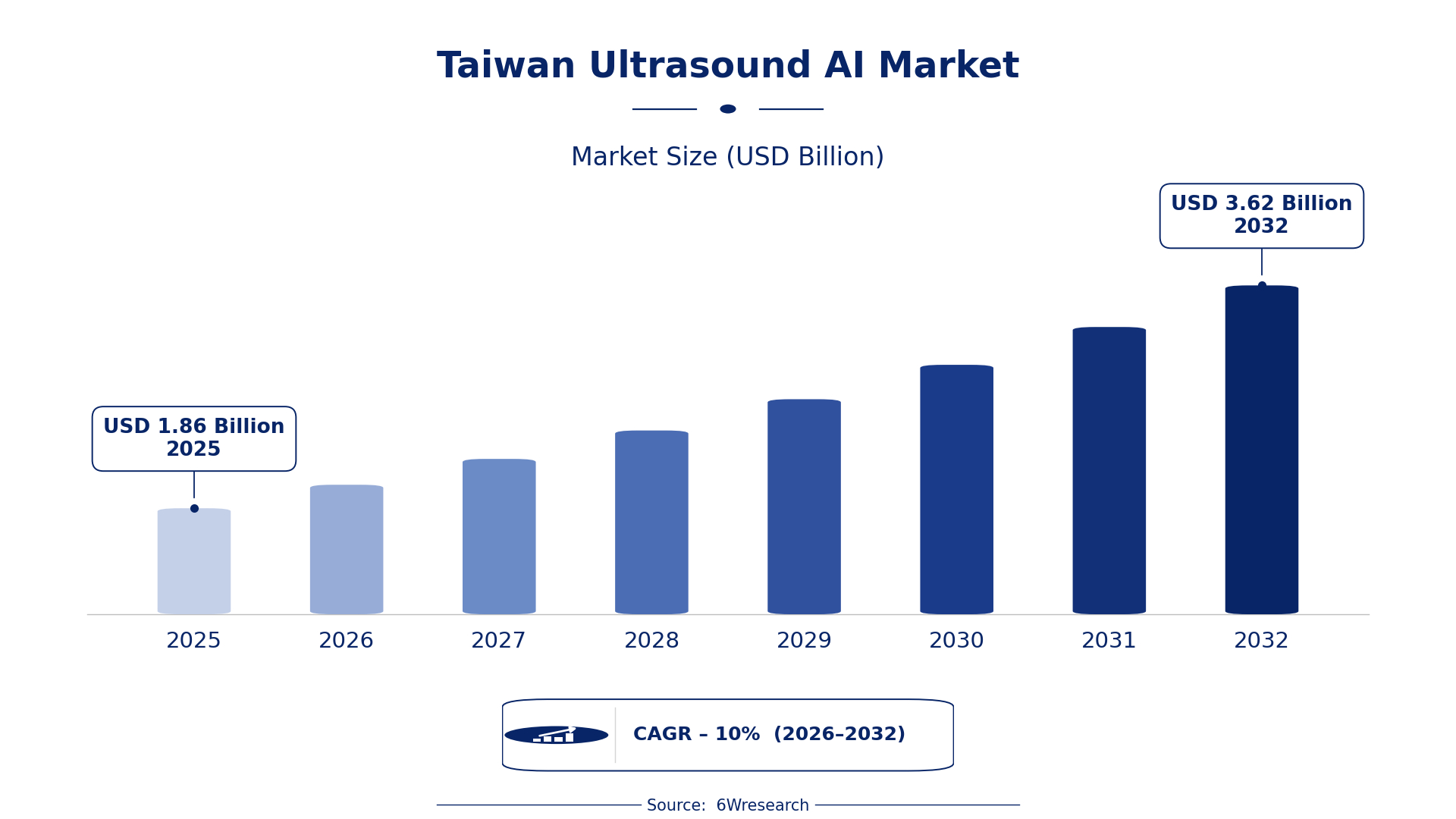
According to 6Wresearch internal database and industry insights, the Taiwan Ultrasound AI Market was valued at USD 1.86 billion in 2025 and is projected to reach USD 3.62 billion by 2032, growing at a CAGR of approximately 10% during 2026–2032.
Taiwan Ultrasound AI Market Highlights
| Report Metric | Details |
| Report Name | Taiwan Ultrasound AI Market |
| Market Size 2025 | USD 1.86 billion |
| Market Size 2032 | USD 3.62 billion |
| Absolute Growth 2025–2032 | USD 1.76 billion |
| CAGR 2026–2032 | 10% |
| Peak Annual Growth | 12.0% in 2032 |
| Forecast Period | 2026–2032 |
| Historical Data | 2022–2025 |
| Base Year | 2025 |
| Leading AI Feature, 2025 | Anomaly Detection (38% share) |
| Leading Application Area, 2025 | General Diagnostics (41% share) |
| Leading Deployment Mode, 2025 | On-Premise (46% share) |
| Leading End User, 2025 | Hospitals (45% share) |
| Fastest-Growing AI Feature | Decision Support (11.2% CAGR) |
| Fastest-Growing Application Area | Cardiology (11.3% CAGR) |
| Fastest-Growing Deployment Mode | Cloud-Based (12.3% CAGR) |
| Fastest-Growing End User | AI Health Startups (11.9% CAGR) |
| Growing Sector | Healthcare |
| Key End Users | Hospitals, Clinics, Diagnostic Labs, AI Health Startups |
Taiwan Ultrasound AI Market Year-wise Growth Rate and Key Drivers (2022–2032)
This graph illustrates the annual growth rates of the market from 2022 to 2032, highlighting a steady upward trajectory and projected market expansion over the forecast period.
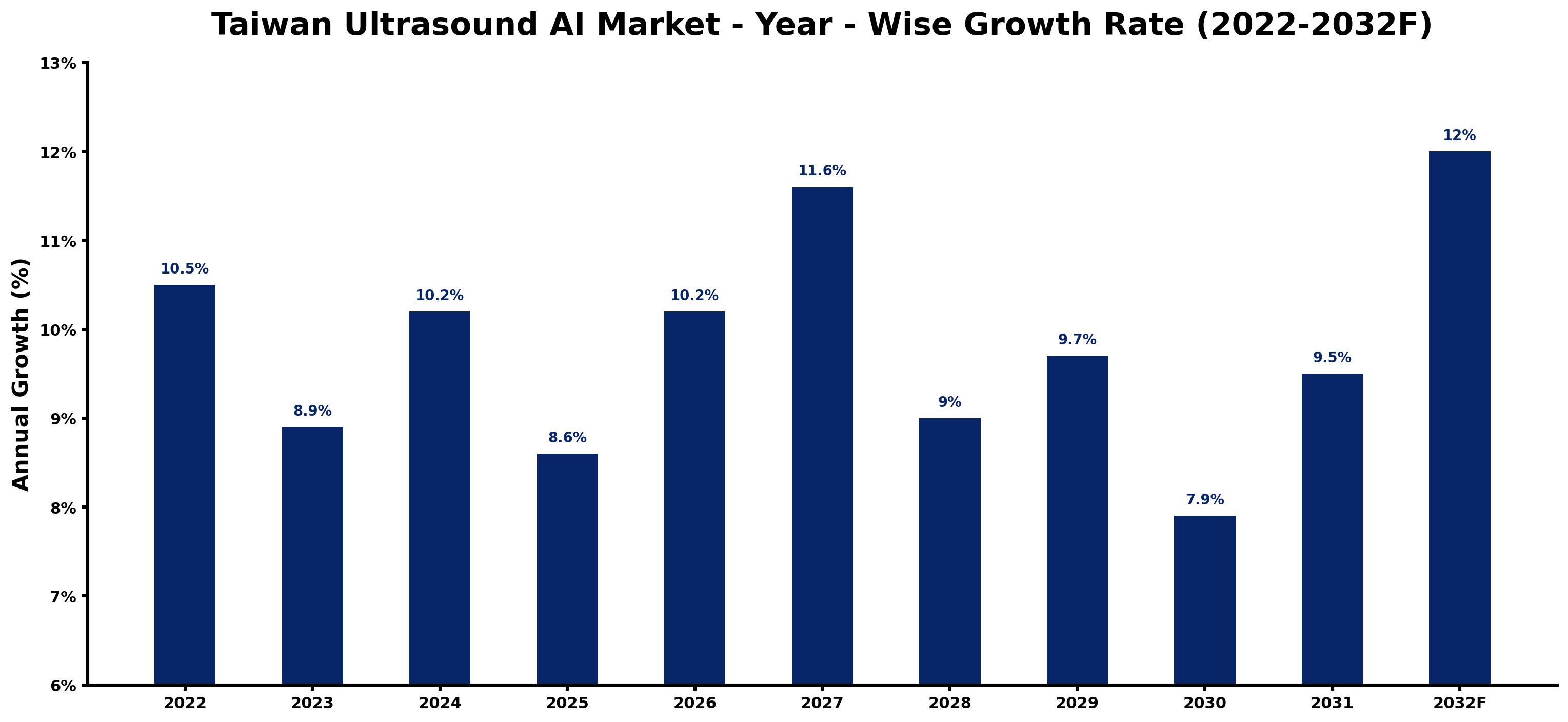
Below, each year's estimated growth is shown next to the factor that most influenced it.
| Year | Estimated Annual Growth (%) | Market Rationale |
| 2022 | 10.5 | The market experienced strong growth due to increased demand for advanced diagnostic services. |
| 2023 | 8.9 | Growth slowed as hospitals adjusted to new technologies and budget constraints. |
| 2024 | 10.2 | Demand picked up as healthcare facilities expanded their ultrasound capabilities. |
| 2025 | 8.6 | Growth slowed again as market saturation began to influence new purchases. |
| 2026 | 10.2 | An increase in AI integration initiatives from the AI Health Development Program boosted demand for ultrasound AI solutions. |
| 2027 | 11.6 | Healthcare providers adopted more AI technologies, improving diagnostic accuracy through better decision support. |
| 2028 | 9.0 | Growth slowed as hospitals focused on optimising existing systems and integrating new technologies. |
| 2029 | 9.7 | Demand rose as healthcare facilities sought to improve patient outcomes with AI-driven anomaly detection. |
| 2030 | 7.9 | Growth slowed due to the market reaching a more mature phase with established technologies. |
| 2031 | 9.5 | An increase in healthcare expenditure led to renewed investment in ultrasound AI systems across hospitals. |
| 2032 | 12.0 | The market peaked as hospitals fully embraced AI technologies for diagnostics, driven by the Smart Healthcare Industry Development Plan. |
Note: Market size estimations and growth projections presented in this report are based on 6Wresearch's proprietary forecasting methodology, utilizing the latest available industry data, government publications, and primary research inputs.
Taiwan Ultrasound AI Market Synopsis
The Ultrasound AI Market in Taiwan encompasses the incorporation of artificial intelligence technologies into ultrasound imaging systems. This advancement enhances diagnostic capabilities through machine learning algorithms that analyse ultrasound images, leading to improved accuracy in medical diagnostics. The market is expanding due to increasing demand from hospitals and clinics, bolstered by government initiatives such as the AI Health Development Program. With over 500 hospitals and a population of 23.5 million, Taiwan's healthcare sector is progressively adopting advanced technologies to improve patient care and outcomes.
Market Dynamics Impact Analysis (2026–2032)
| Factor | Type | Impact | Primary Segment Affected |
| Increasing adoption of AI technologies in healthcare | Driver | High | Anomaly Detection |
| Growing number of ultrasound examinations conducted annually | Driver | High | General Diagnostics |
| Investment in AI healthcare initiatives | Opportunity | High | Hospitals |
| Expansion of diagnostic facilities and clinics | Opportunity | Medium | Clinics |
| Regulatory hurdles in AI medical device approvals | Restraint | High | Anomaly Detection |
| High costs associated with advanced ultrasound AI systems | Restraint | Medium | Anomaly Detection |
| Ultrasound AI Market in Taiwan faces challenges from regulatory complexities | Challenge | High | Anomaly Detection |
| Limited awareness among smaller clinics about AI benefits | Challenge | Medium | Clinics |
Evaluation of Drivers in Taiwan Ultrasound AI Market (2026–2032)
The factors lifting demand, and the evidence behind each, are summarised below.
| Drivers | Primary Segment Affected | Why It Matters (Evidence) |
| Integration of AI technologies improves diagnostic accuracy | Anomaly Detection | This leads to increased purchases by hospitals seeking better patient outcomes. |
| Rising number of ultrasound examinations per hospital | General Diagnostics | With around 1,000 examinations annually, hospitals are investing in advanced systems. |
| Government support through funding programs for AI in healthcare | Hospitals | The AI Health Development Program allocates NT$ 500 million, encouraging technology adoption. |
| Growing healthcare expenditure in Taiwan | Clinics | With approximately NT$ 3 trillion spent in 2022, clinics are upgrading their technologies. |
| Increased focus on patient outcomes and efficiency | Cardiology | Departments are adopting AI technologies for improved monitoring and assessments. |
Market growth in Taiwan for Ultrasound AI rests on rising end-use demand from healthcare facilities, coupled with a strong supply response from technology providers. The average number of ultrasound examinations per hospital is around 1,000 annually, driving hospitals to invest in advanced AI systems. Taiwan's healthcare expenditure reached approximately NT$ 3 trillion in 2022, enabling clinics to upgrade their diagnostic capabilities. As hospitals seek to improve patient outcomes, the integration of AI technologies becomes increasingly essential, leading to higher demand for ultrasound AI solutions.
Evaluation of Restraints in Taiwan Ultrasound AI Market
The key brakes on demand, and where they bite hardest, are shown below.
| Market Restraint | Primary Segment Affected | Why It Matters (Evidence) |
| Regulatory complexities in obtaining approvals for AI medical devices | Anomaly Detection | Taiwan's FDA regulations can delay the introduction of new technologies, impacting market growth. |
| High costs associated with advanced ultrasound AI systems | Clinics | The financial burden can limit smaller clinics from adopting advanced technologies. |
| Limited awareness of AI benefits among smaller healthcare providers | Clinics | This results in slower adoption rates for ultrasound AI technologies in outpatient settings. |
| Challenges in integrating AI with existing healthcare systems | Hospitals | Hospitals face difficulties in upgrading their infrastructure to accommodate new technologies. |
| Concerns over data privacy and security in AI applications | Anomaly Detection | Healthcare providers must navigate complex regulations, which can hinder technology adoption. |
Taiwan Ultrasound AI Market Challenges
The Taiwan Ultrasound AI market encounters fierce competition from established imaging technologies, which hampers the adoption of AI solutions. Hospitals and clinics are often reluctant to invest in AI systems due to initial costs that frequently exceed NT$ 10 million, limiting their budgets for new technologies. Regulatory challenges also complicate the situation; obtaining ISO 13485 certification can delay product launches by up to six months, affecting suppliers' ability to meet market demands. Supply chain disruptions arise from reliance on imported components, causing delays in system availability for healthcare providers and ultimately impacting patient care.
Trends in the Taiwan Ultrasound AI Market
Buyers and suppliers in the Taiwan Ultrasound AI Market are adjusting to the following trends.
- Shift Towards AI-Driven Diagnostics: Since 2021, Taiwan has seen a shift towards AI-driven diagnostics in healthcare. The AI Health Development Program has allocated NT$ 500 million to improve AI integration, resulting in increased adoption rates across hospitals.
- Transition from Traditional to AI-Driven Imaging: The move from traditional imaging methods to AI-driven ultrasound systems is evident in Taiwan's hospitals. With an average of 1,000 examinations per hospital, the demand for improved diagnostic accuracy is driving this change.
- Expansion of AI Technologies in Cardiology: In 2023, cardiology departments in Taiwan are increasingly adopting AI technologies for better patient outcomes. This trend is highlighted by a 20% increase in AI integration initiatives by 2025.
- Growth of Cloud-Based Deployment Models: The rise of cloud-based deployment models for ultrasound AI systems began in 2026. This shift allows for improved data management and accessibility, with a projected CAGR of 12.3% in this segment.
Investment Opportunities in the Taiwan Ultrasound AI Market
The following opportunities in the Taiwan Ultrasound AI Market pair current demand with a clear way in.
- Increasing Investment in Healthcare Technology: With Taiwan's healthcare expenditure at approximately NT$ 3 trillion in 2022, there is a strong opportunity to invest in advanced ultrasound AI systems. Hospitals are the primary buyers, seeking to improve diagnostic capabilities.
- Expansion of Diagnostic Facilities: Now is an opportune time to supply ultrasound AI technologies as Taiwan expands its healthcare facilities. The growing number of clinics presents a strong market for advanced diagnostic solutions.
- Partnerships for AI Integration: Establishing joint ventures with local healthcare providers can facilitate entry into the ultrasound AI market. Collaborating with hospitals can help navigate regulatory challenges and improve technology adoption.
- Focus on AI Health Startups: The emergence of AI health startups in Taiwan offers a unique investment opportunity. With a projected growth rate of 11.9%, these startups are looking for innovative solutions to improve their offerings.
Government Initiatives in the Taiwan Ultrasound AI Market
The "Smart Healthcare Industry Development Plan" introduced in 2023 by the Ministry of Economic Affairs aims to encourage innovation in AI healthcare technologies. This plan targets a 20% increase in AI adoption by 2025, providing a solid framework for technology integration. It builds on previous efforts like the "AI Health Development Program" launched in 2021, which allocated NT$ 500 million to integrate AI into healthcare systems, ensuring a supportive environment for technology adoption.
In 2022, the Ministry of Health and Welfare initiated the "Digital Health Action Plan" to improve digital health infrastructure, including AI applications in diagnostics. This plan is backed by the Taiwan FDA, which has updated its regulatory framework for AI medical devices, streamlining approval processes to encourage innovation. The FDA's efforts ensure that new technologies meet safety and efficacy standards, facilitating smoother market entry for ultrasound AI systems.
Future Insight of the Taiwan Ultrasound AI Market
The Taiwan Ultrasound AI market is set to advance by 2032, driven by the "Digital Health Action Plan" and the "Smart Healthcare Industry Development Plan" that promote technology adoption. Healthcare expenditure is expected to increase to NT$ 4 trillion, supporting investments in advanced diagnostic technologies. The AI Health Development Program will encourage innovation in ultrasound applications, enhancing patient outcomes across healthcare settings. As AI integration becomes standard practice, buyers will benefit from improved diagnostic accuracy and more efficient workflows.
Market Segmentation Analysis
The report offers a comprehensive study of the following market segments and their leading categories in the market.
By AI Feature – Anomaly Detection Dominated, Decision Support Expected to Grow Fastest
According to Bhawna Singh, Assistant Manager at 6Wresearch, Anomaly Detection took a 38% share of ai feature in 2025, more than any other category. Anomaly detection commands the largest share in Taiwan's Ultrasound AI market due to its critical role in identifying potential health issues in ultrasound images. This capability is essential for hospitals, which conduct around 1,000 ultrasound examinations annually, ensuring a steady demand for this feature. Over 2026–2032, Decision Support is expected to post the fastest growth, at a CAGR of 11.2%. The decision support feature is experiencing rapid growth as it assists clinicians in making informed decisions, a necessity in Taiwan's complex healthcare environment. As the intricacies of cases increase, the demand for decision support will likely surge, reinforcing anomaly detection's lead. This means suppliers should focus on enhancing decision support functionalities to meet the evolving needs of healthcare providers.
By Application Area – General Diagnostics Dominated, Cardiology Expected to Grow Fastest
In 2025, General Diagnostics led the application area split with a 41% share. General diagnostics captures the largest share of the market as it is widely used for various medical assessments across Taiwan's healthcare facilities. This broad applicability ensures a consistent demand for ultrasound AI technologies in hospitals and clinics alike. The quickest growth will come from Cardiology, forecast to expand at a CAGR of 11.3% between 2026 and 2032. Cardiology is the fastest-growing application area, driven by the critical need for advanced cardiac assessments and monitoring. The increasing adoption of AI technologies in cardiology departments highlights the urgency for improved diagnostic tools. Buyers in the cardiology sector should consider investing in advanced ultrasound AI technologies to improve patient outcomes.
By Deployment Mode – On-Premise Dominated, Cloud-Based Expected to Grow Fastest
The largest deployment mode category in 2025 was On-Premise, with a 46% share of total revenue. On-premise deployment leads the market share as it is commonly used in hospitals for immediate access to ultrasound AI technologies. This mode allows healthcare providers to manage their data securely while ensuring quick response times during diagnostics. Cloud-Based is set to record the highest CAGR in this split, 12.3% over 2026–2032. Cloud-based deployment is growing rapidly due to its ability to facilitate data storage and accessibility, appealing to healthcare providers looking for flexible solutions. As more facilities adopt digital health strategies, cloud solutions will become increasingly popular. Suppliers should develop cloud-based solutions to cater to the evolving preferences of healthcare providers seeking flexibility.
By End User – Hospitals Dominated, AI Health Startups Expected to Grow Fastest
Hospitals accounted for a 45% market share by end user in 2025. Hospitals dominate the market share as the primary users of ultrasound AI technology, utilising it to improve diagnostic accuracy. With over 500 hospitals in Taiwan, their collective demand significantly drives the growth of this market segment. AI Health Startups are projected to grow fastest, at a CAGR of 11.9% during 2026–2032. AI health startups are emerging as the fastest-growing end user segment, concentrating on developing innovative applications for ultrasound AI. Their agility in adopting and implementing new technologies positions them for considerable future expansion. This indicates that suppliers should explore partnerships with AI health startups to capitalise on new opportunities in the ultrasound AI market.
Key Attractiveness of the Report
- 10 Years of Market Numbers
- Historical Data Starting from 2022 to 2025
- Base Year 2025
- Forecast Data until 2032
- Key Performance Indicators Impacting the Market
- Major Upcoming Developments and Projects
Key Highlights of the Report:
- Taiwan Ultrasound AI Market Outlook
- Market Size of Taiwan Ultrasound AI Market, 2025
- Forecast of Taiwan Ultrasound AI Market, 2032
- Historical Data and Forecast of Taiwan Ultrasound AI Revenues & Volume for the Period 2022 - 2032F
- Taiwan Ultrasound AI Market Trend Evolution
- Taiwan Ultrasound AI Market Drivers and Challenges
- Taiwan Ultrasound AI Price Trends
- Taiwan Ultrasound AI Porter's Five Forces
- Taiwan Ultrasound AI Industry Life Cycle
- Historical Data and Forecast of Taiwan Ultrasound AI Market Revenues & Volume By AI Feature for the Period 2022 - 2032F
- Historical Data and Forecast of Taiwan Ultrasound AI Market Revenues & Volume By Image Enhancement for the Period 2022 - 2032F
- Historical Data and Forecast of Taiwan Ultrasound AI Market Revenues & Volume By Anomaly Detection for the Period 2022 - 2032F
- Historical Data and Forecast of Taiwan Ultrasound AI Market Revenues & Volume By Workflow Automation for the Period 2022 - 2032F
- Historical Data and Forecast of Taiwan Ultrasound AI Market Revenues & Volume By Decision Support for the Period 2022 - 2032F
- Historical Data and Forecast of Taiwan Ultrasound AI Market Revenues & Volume By Application Area for the Period 2022 - 2032F
- Historical Data and Forecast of Taiwan Ultrasound AI Market Revenues & Volume By General Diagnostics for the Period 2022 - 2032F
- Historical Data and Forecast of Taiwan Ultrasound AI Market Revenues & Volume By OB/GYN for the Period 2022 - 2032F
- Historical Data and Forecast of Taiwan Ultrasound AI Market Revenues & Volume By Cardiology for the Period 2022 - 2032F
- Historical Data and Forecast of Taiwan Ultrasound AI Market Revenues & Volume By Musculoskeletal for the Period 2022 - 2032F
- Historical Data and Forecast of Taiwan Ultrasound AI Market Revenues & Volume By Deployment Mode for the Period 2022 - 2032F
- Historical Data and Forecast of Taiwan Ultrasound AI Market Revenues & Volume By Cloud-Based for the Period 2022 - 2032F
- Historical Data and Forecast of Taiwan Ultrasound AI Market Revenues & Volume By On-Premise for the Period 2022 - 2032F
- Historical Data and Forecast of Taiwan Ultrasound AI Market Revenues & Volume By SaaS Platform for the Period 2022 - 2032F
- Historical Data and Forecast of Taiwan Ultrasound AI Market Revenues & Volume By Embedded Systems for the Period 2022 - 2032F
- Historical Data and Forecast of Taiwan Ultrasound AI Market Revenues & Volume By End User for the Period 2022 - 2032F
- Historical Data and Forecast of Taiwan Ultrasound AI Market Revenues & Volume By Hospitals for the Period 2022 - 2032F
- Historical Data and Forecast of Taiwan Ultrasound AI Market Revenues & Volume By Diagnostic Labs for the Period 2022 - 2032F
- Historical Data and Forecast of Taiwan Ultrasound AI Market Revenues & Volume By Clinics for the Period 2022 - 2032F
- Historical Data and Forecast of Taiwan Ultrasound AI Market Revenues & Volume By AI Health Startups for the Period 2022 - 2032F
- Taiwan Ultrasound AI Import Export Trade Statistics
- Market Opportunity Assessment By AI Feature
- Market Opportunity Assessment By Application Area
- Market Opportunity Assessment By Deployment Mode
- Market Opportunity Assessment By End User
- Taiwan Ultrasound AI Top Companies Market Share
- Taiwan Ultrasound AI Competitive Benchmarking By Technical and Operational Parameters
- Taiwan Ultrasound AI Company Profiles
- Taiwan Ultrasound AI Key Strategic Recommendations
Market Covered
Segments analysed in this report are listed below.
By AI Feature
- Image Enhancement
- Anomaly Detection
- Workflow Automation
- Decision Support
By Application Area
- General Diagnostics
- OB/GYN
- Cardiology
- Musculoskeletal
By Deployment Mode
- Cloud-Based
- On-Premise
- SaaS Platform
- Embedded Systems
By End User
- Hospitals
- Diagnostic Labs
- Clinics
- AI Health Startups































