Tajikistan Lithium Hydroxide Market Size, Share & Growth Rate
The Tajikistan Lithium Hydroxide Market was estimated at USD 250 Million in 2025 and is projected to reach USD 352 Million by 2032, growing at a CAGR of 5.0% from 2026 to 2032. This growth trajectory is significantly influenced by the increasing global demand for lithium-ion batteries across various sectors such as electric vehicles, consumer electronics, and renewable energy storage solutions. The rich lithium reserves in Tajikistan, coupled with favorable mining policies, are further solidifying the country's position as a pivotal player in the global lithium supply chain.
Tajikistan Lithium Hydroxide Market Year-wise Growth Rate and Key Drivers
This graph highlights how the Tajikistan Lithium Hydroxide Market has steadily grown over the years, supported by major growth factors.
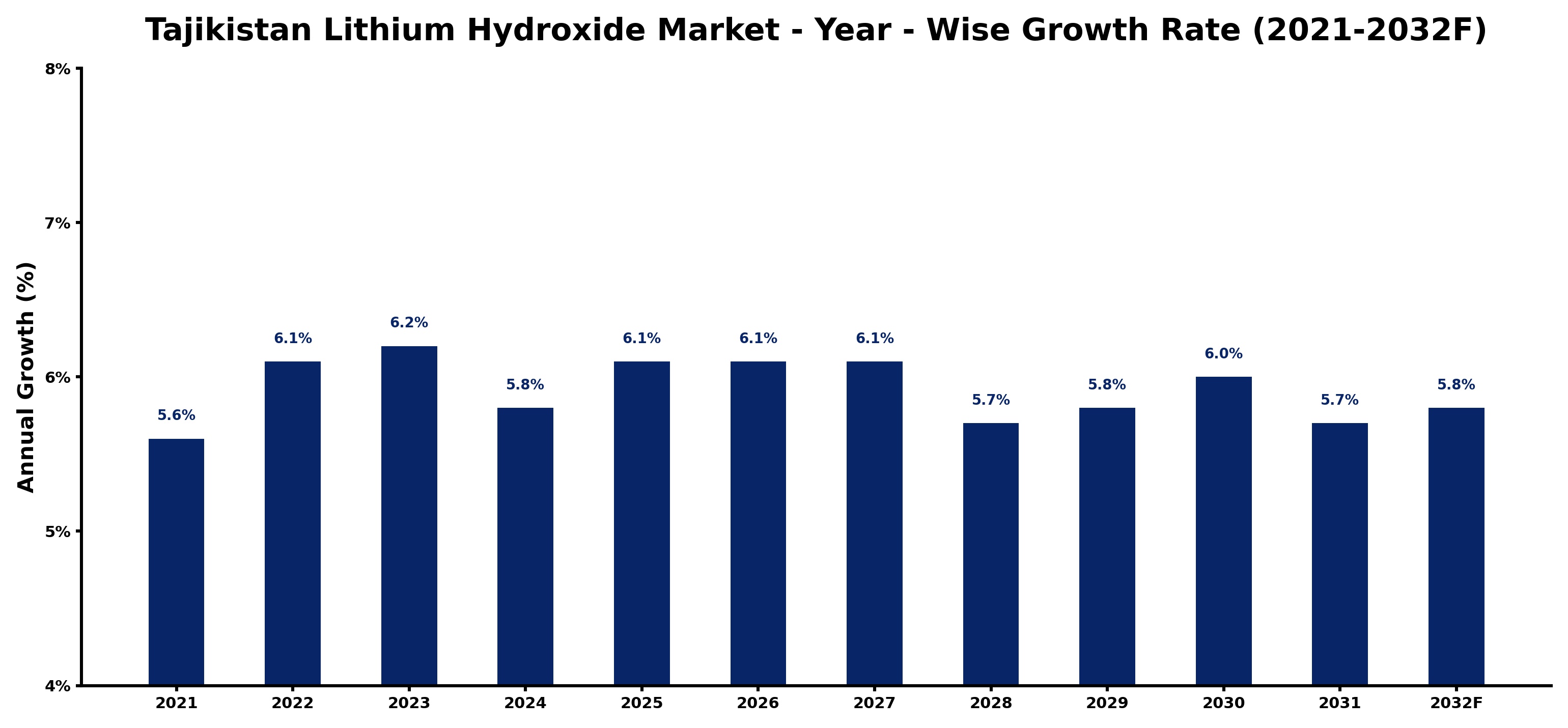
The table below presents the year‑wise growth rates along with the key drivers influencing the market
| Year | Growth Rate | Major Drivers |
| 2021 | 5.6% | Rising electric vehicle demand |
| 2022 | 6.1% | Battery production capacity increased |
| 2023 | 6.2% | Investment in mining infrastructure |
| 2024 | 5.8% | Technological advancements in extraction |
| 2025 | 6.1% | Global sustainability initiatives expanded |
| 2026 | 6.1% | Partnerships with automotive manufacturers |
| 2027 | 6.1% | Government incentives for production |
| 2028 | 5.7% | Increased lithium-ion battery usage |
| 2029 | 5.8% | Expansion of renewable energy projects |
| 2030 | 6.0% | Growing consumer awareness of EVs |
| 2031 | 5.7% | Strategic trade agreements enhanced supply |
| 2032 | 5.8% | Research and development funding increased |
Note - Market size estimations and growth projections presented in this report are based on 6Wresearch's advanced forecasting approach, validated with industry datasets as of June 2026.
Tajikistan Lithium Hydroxide Market Synopsis
The most compelling force shaping the Tajikistan Lithium Hydroxide Market today is the surging demand for electric vehicles (EVs). As the world pivots towards cleaner energy, the need for efficient battery technology has never been greater, positioning Tajikistan's abundant lithium resources as a vital asset. With significant investments in lithium extraction and processing, the market is aligning itself to cater to this booming demand.
Moreover, the government's supportive policies and initiatives have set the stage for a favorable investment climate. The emphasis on sustainability and environmentally friendly mining practices are essential elements driving the market forward. As more stakeholders enter the market, the competition is likely to intensify, accelerating technological advancements and capacity expansions.
Tajikistan Lithium Hydroxide Market Key Takeaways
- The Tajikistan Lithium Hydroxide Market is poised for substantial growth, driven primarily by the electric vehicle sector.
- Government incentives and policies are enhancing the investment landscape for lithium extraction and processing.
- Technological advancements in battery manufacturing are likely to open new avenues for market expansion.
- The growing emphasis on sustainable practices is shaping the industry's operational framework.
- Tajikistan's strategic location provides a critical logistical advantage for exporting lithium hydroxide to key global markets.
Evaluation of Restraints in Tajikistan Lithium Hydroxide Market
Despite the promising growth prospects, the Tajikistan Lithium Hydroxide Market faces several constraints that could impede progress. Limited infrastructure in mining and processing areas contributes to higher production costs, making it challenging to compete with established players globally. Additionally, the lack of advanced technological expertise and insufficient investment in research and development hinder the sector's potential. Political instability and regulatory uncertainties further exacerbate these challenges, posing risks that could deter foreign investment and slow market development.
Tajikistan Lithium Hydroxide Market Trends
Current trends in the Tajikistan Lithium Hydroxide Market indicate a strong shift towards innovation in extraction technologies, aimed at improving efficiency and reducing environmental impact. As major industries increasingly adopt lithium-ion batteries, there is a concerted effort to streamline supply chains and enhance the sustainability of operations. Furthermore, growing partnerships with international entities are facilitating technology transfers that bolster local capabilities and production efficiency, fostering a more competitive market landscape.
Tajikistan Lithium Hydroxide Market Opportunities
Significant investment opportunities exist within the Tajikistan Lithium Hydroxide Market due to the country's vast lithium reserves and the burgeoning demand for lithium products in electric vehicles and renewable energy sectors. By capitalizing on its favorable geological conditions and competitive production costs, investors can establish a strong foothold in this growing market. Additionally, Tajikistan's inclusion in China's Belt and Road Initiative offers strategic advantages for export, creating pathways to lucrative markets in Asia and beyond.
Government Initiatives in the Tajikistan Lithium Hydroxide Market
The Tajik government has rolled out various initiatives aimed at bolstering the lithium hydroxide market. These include the provision of tax incentives and subsidies to attract both domestic and foreign investments in lithium extraction and processing sectors. Additionally, there is a concentrated effort to enhance regulatory frameworks and infrastructure, aimed at facilitating smoother operations for mining activities. Partnerships with international organizations are also being explored to leverage global expertise and foster technological advancements within the industry.
Future Insights of the Tajikistan Lithium Hydroxide Market
Looking ahead to 2026-2032, the Tajikistan Lithium Hydroxide Market appears poised for significant expansion, largely propelled by the increasing global appetite for lithium-ion batteries. As the electric vehicle sector continues its upward trajectory, Tajikistan's capacity for lithium extraction and production will be critical. The government's commitment to improving infrastructure, alongside ongoing investments in technology, is expected to further enhance market competitiveness. However, the landscape will also require navigation of geopolitical challenges and technological shifts that may emerge within the global lithium industry.
Tajikistan Lithium Hydroxide Market Latest Developments (May 2025 - June 2026)
Recent developments in the Tajikistan Lithium Hydroxide Market indicate a marked increase in foreign interest, with several partnerships being formed to expedite technological advancements in extraction and processing. Government initiatives aimed at improving infrastructure have also begun to yield positive results, facilitating more efficient operations. Additionally, companies are actively exploring sustainable mining practices, aligning their operations with global environmental standards and responding to increasing consumer demand for eco-friendly products.
Tajikistan Lithium Hydroxide Market - Key Attractiveness of the Report
- 10 Years of Market Numbers
- Historical Data Starting from 2022 to 2025
- Base Year: 2025
- Forecast Data until 2032
- Key Performance Indicators Impacting the Market
- Major Upcoming Developments and Projects
Key Highlights of the Report:
- Tajikistan Lithium Hydroxide Market Outlook
- Market Size of Tajikistan Lithium Hydroxide Market, 2025
- Forecast of Tajikistan Lithium Hydroxide Market, 2032
- Historical Data and Forecast of Tajikistan Lithium Hydroxide Revenues & Volume for the Period 2022-2032F
- Tajikistan Lithium Hydroxide Market Trend Evolution
- Tajikistan Lithium Hydroxide Market Drivers and Challenges
- Tajikistan Lithium Hydroxide Price Trends
- Tajikistan Lithium Hydroxide Porter's Five Forces
- Tajikistan Lithium Hydroxide Industry Life Cycle
- Historical Data and Forecast of Tajikistan Lithium Hydroxide Market Revenues & Volume By Application for the Period 2022-2032F
- Historical Data and Forecast of Tajikistan Lithium Hydroxide Market Revenues & Volume By Batteries for the Period 2022-2032F
- Historical Data and Forecast of Tajikistan Lithium Hydroxide Market Revenues & Volume By Lubricating Greases for the Period 2022-2032F
- Historical Data and Forecast of Tajikistan Lithium Hydroxide Market Revenues & Volume By Purification for the Period 2022-2032F
- Historical Data and Forecast of Tajikistan Lithium Hydroxide Market Revenues & Volume By Others for the Period 2022-2032F
- Tajikistan Lithium Hydroxide Import Export Trade Statistics
- Market Opportunity Assessment By Application
- Tajikistan Lithium Hydroxide Top Companies Market Share
- Tajikistan Lithium Hydroxide Competitive Benchmarking By Technical and Operational Parameters
- Tajikistan Lithium Hydroxide Company Profiles
- Tajikistan Lithium Hydroxide Key Strategic Recommendations






































