Tanzania Apiculture Market Size, Share & Growth Rate
The Tanzania Apiculture Market was estimated at USD 466 Million in 2025 and is projected to reach USD 625 Million by 2032, growing at a CAGR of 4.3% from 2026 to 2032. This growth trajectory is largely fueled by an increasing global demand for honey and related bee products, driven by the rising health consciousness among consumers. Additionally, the country's favorable climate and rich biodiversity are perfect for sustainable beekeeping practices, enhancing both the quality and quantity of honey production.
Tanzania Apiculture Market Year-wise Growth Rate and Key Drivers
This graph highlights how the Tanzania Apiculture Market has steadily grown over the years, supported by major growth factors.
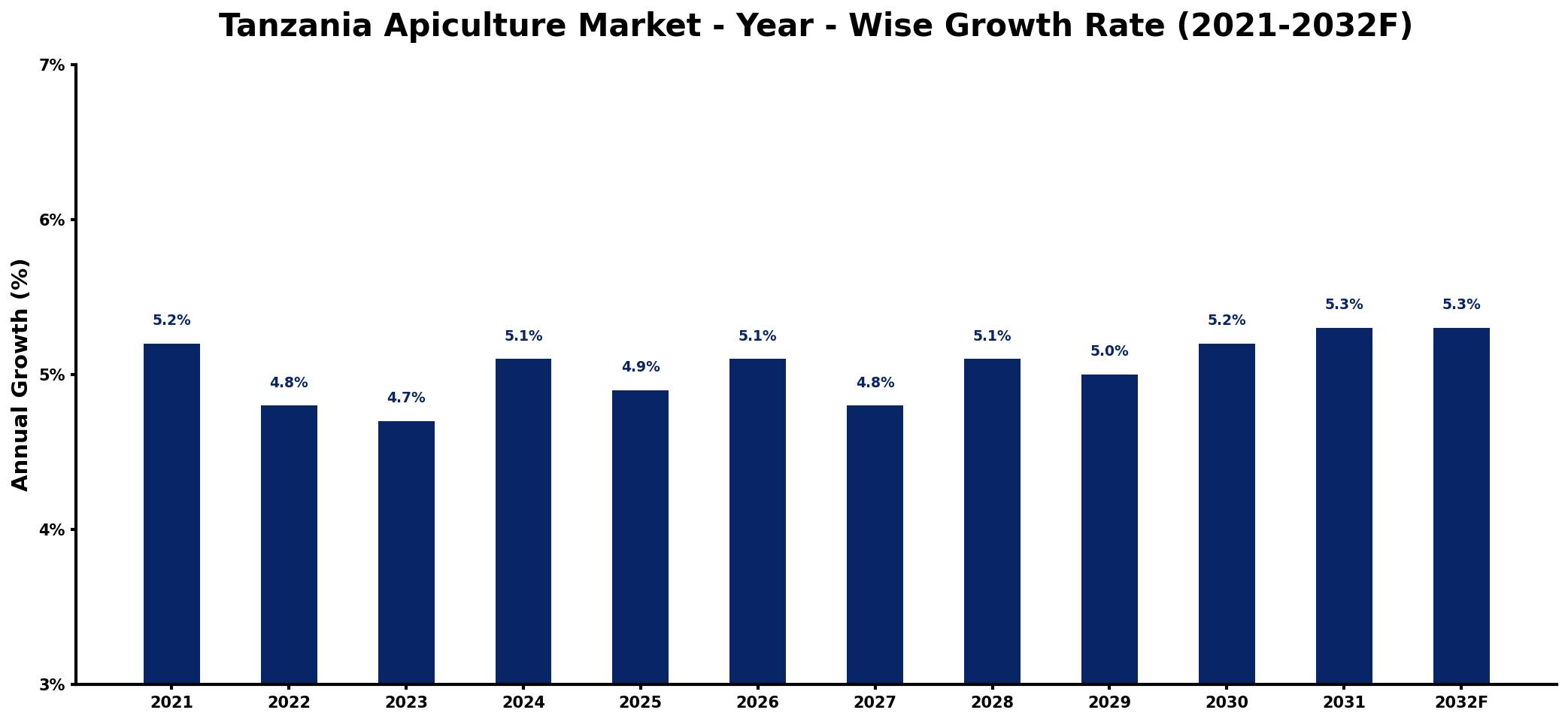
The table below presents the year‑wise growth rates along with the key drivers influencing the market
| Year | Growth Rate | Major Drivers |
| 2021 | 5.2% | Rising consumer health awareness |
| 2022 | 4.8% | Increased organic farming practices |
| 2023 | 4.7% | Growing demand for natural sweeteners |
| 2024 | 5.1% | Expansion of export markets |
| 2025 | 4.9% | Investment in local production facilities |
| 2026 | 5.1% | Surge in eco-tourism initiatives |
| 2027 | 4.8% | Enhanced agricultural training programs |
| 2028 | 5.1% | Collaboration with local cooperatives |
| 2029 | 5.0% | Innovations in sustainable farming |
| 2030 | 5.2% | Strengthened supply chain networks |
| 2031 | 5.3% | Emergence of niche market segments |
| 2032 | 5.3% | Advancements in research and development |
Note: Market size estimations and growth projections presented in this report are based on 6Wresearch's proprietary forecasting methodology, utilizing the latest available industry data, government publications, and primary research inputs.
Tanzania Apiculture Market Synopsis
Tanzania stands out in the apiculture landscape, with a wealth of natural resources that support a thriving beekeeping industry. Small-scale farmers play a pivotal role, cultivating honey production through traditional methods, which are increasingly complemented by modern practices to boost yield.
Despite the challenges of infrastructure and climate change, the government and various organizations are pushing initiatives that underscore the importance of beekeeping as a sustainable livelihood. This supportive ecosystem is gradually transforming the sector, making it an attractive area for investment and innovation.
Tanzania Apiculture Market Key Takeaways
- The market is witnessing a shift towards sustainable and organic honey production, catering to eco-conscious consumers.
- Small-scale beekeepers are increasingly adopting modern technologies to enhance production efficiency.
- There is a growing interest in value-added products such as honey-based cosmetics and medicinal offerings.
- Government policies are promoting beekeeping as a viable economic activity, helping to improve livelihoods across rural areas.
- Awareness of honey's health benefits is driving demand, both locally and internationally.
Evaluation of Restraints in Tanzania Apiculture Market
Several key challenges continue to hamper the growth of the Tanzania apiculture market. Limited access to modern beekeeping equipment and insufficient training for beekeepers restrict productivity and quality improvements. Furthermore, the lack of adequate infrastructure hinders effective market access, while climate change poses ongoing threats to both bee health and honey yield. Additionally, the presence of pests and diseases continues to undermine colony strength, resulting in inconsistent quality and supply chain issues. Addressing these restraints will be critical for unlocking the sectors full potential.
Tanzania Apiculture Market Trends
A notable trend in the Tanzania apiculture market is the increasing consumer preference for sustainably sourced products. The demand for organic honey is on the rise, driving beekeepers to adopt environmentally friendly practices. Moreover, the innovation of value-added honey products, such as infused honeys and wellness-focused items, reflects a shift toward more diverse product offerings. These trends are further encouraged by improved branding and packaging strategies aimed at enhancing market competitiveness.
Tanzania Apiculture Market Opportunities
The Tanzania apiculture market presents substantial investment opportunities, particularly in the realms of advanced beekeeping technology and training initiatives for local producers. As global demand for natural bee products continues to grow, investors can tap into the expanding consumer base. Beyond honey production, avenues exist in the processing of by-products such as beeswax, propolis, and royal jelly, each with applications in various industries, including food, cosmetics, and healthcare.
Government Initiatives in the Tanzania Apiculture Market
The Tanzanian government has put forth a range of policies aimed at bolstering the apiculture sector. The National Beekeeping Policy of 2002 is a cornerstone of these efforts, focusing on sustainable practices and improving the livelihoods of beekeepers. Furthermore, initiatives like the establishment of the Tanzania Beekeepers Association facilitate training and provide technical support to enhance production capabilities. Regulatory measures are also in place to ensure the safety and quality of honey products, underscoring the governments commitment to developing this vital industry.
Future Insights of the Tanzania Apiculture Market
Looking ahead to 2026-2032, the Tanzania apiculture market is expected to flourish, fueled by rising consumer awareness about the nutritional and health benefits of honey and bee products. As organic and ethically sourced products gain traction, Tanzanian honey is likely to capture a larger share of both domestic and international markets. Continued government support and improved access to modern beekeeping techniques will help elevate production standards, making this sector increasingly attractive for new entrants and investors alike.
Tanzania Apiculture Market Latest Developments (2025 - 2026)
In recent months, the Tanzanian apiculture industry has seen a surge in training programs aimed at enhancing the skills of local beekeepers. Various organizations are collaborating with the government to introduce modern beekeeping practices, ensuring that farmers can optimize their honey production. Additionally, there have been notable advancements in market access initiatives, making it easier for small-scale beekeepers to reach consumers both locally and internationally.
Tanzania Apiculture Market - Key Attractiveness of the Report
- 10 Years of Market Numbers
- Historical Data Starting from 2022 to 2025
- Base Year: 2025
- Forecast Data until 2032
- Key Performance Indicators Impacting the Market
- Major Upcoming Developments and Projects
Key Highlights of the Report:
- Tanzania Apiculture Market Outlook
- Market Size of Tanzania Apiculture Market, 2025
- Forecast of Tanzania Apiculture Market, 2032
- Historical Data and Forecast of Tanzania Apiculture Revenues & Volume for the Period 2022-2032F
- Tanzania Apiculture Market Trend Evolution
- Tanzania Apiculture Market Drivers and Challenges
- Tanzania Apiculture Price Trends
- Tanzania Apiculture Porter's Five Forces
- Tanzania Apiculture Industry Life Cycle
- Historical Data and Forecast of Tanzania Apiculture Market Revenues & Volume By Product Type for the Period 2022-2032F
- Historical Data and Forecast of Tanzania Apiculture Market Revenues & Volume By Honey for the Period 2022-2032F
- Historical Data and Forecast of Tanzania Apiculture Market Revenues & Volume By Beeswax for the Period 2022-2032F
- Historical Data and Forecast of Tanzania Apiculture Market Revenues & Volume By Live-bees for the Period 2022-2032F
- Historical Data and Forecast of Tanzania Apiculture Market Revenues & Volume By Others for the Period 2022-2032F
- Historical Data and Forecast of Tanzania Apiculture Market Revenues & Volume By Application for the Period 2022-2032F
- Historical Data and Forecast of Tanzania Apiculture Market Revenues & Volume By Medical for the Period 2022-2032F
- Historical Data and Forecast of Tanzania Apiculture Market Revenues & Volume By Food Beverages for the Period 2022-2032F
- Historical Data and Forecast of Tanzania Apiculture Market Revenues & Volume By Cosmetics for the Period 2022-2032F
- Historical Data and Forecast of Tanzania Apiculture Market Revenues & Volume By Others for the Period 2022-2032F
- Tanzania Apiculture Import Export Trade Statistics
- Market Opportunity Assessment By Product Type
- Market Opportunity Assessment By Application
- Tanzania Apiculture Top Companies Market Share
- Tanzania Apiculture Competitive Benchmarking By Technical and Operational Parameters
- Tanzania Apiculture Company Profiles
- Tanzania Apiculture Key Strategic Recommendations






































