Tanzania Robotic Vacuum Cleaner Market Size, Share & Growth Rate
The Tanzania Robotic Vacuum Cleaner Market was estimated at USD 163 Million in 2025 and is projected to reach USD 219 Million by 2032, growing at a CAGR of 4.3% from 2026 to 2032. This growth trajectory is largely fueled by increasing urbanization and a rising standard of living among consumers. As more households in urban centers adopt smart home technologies, the demand for robotic vacuum cleaners is set to accelerate, reflecting a shift towards convenience and efficiency in daily chores.
Tanzania Robotic Vacuum Cleaner Market Year-wise Growth Rate and Key Drivers
This graph highlights how the Tanzania Robotic Vacuum Cleaner Market has steadily grown over the years, supported by major growth factors.
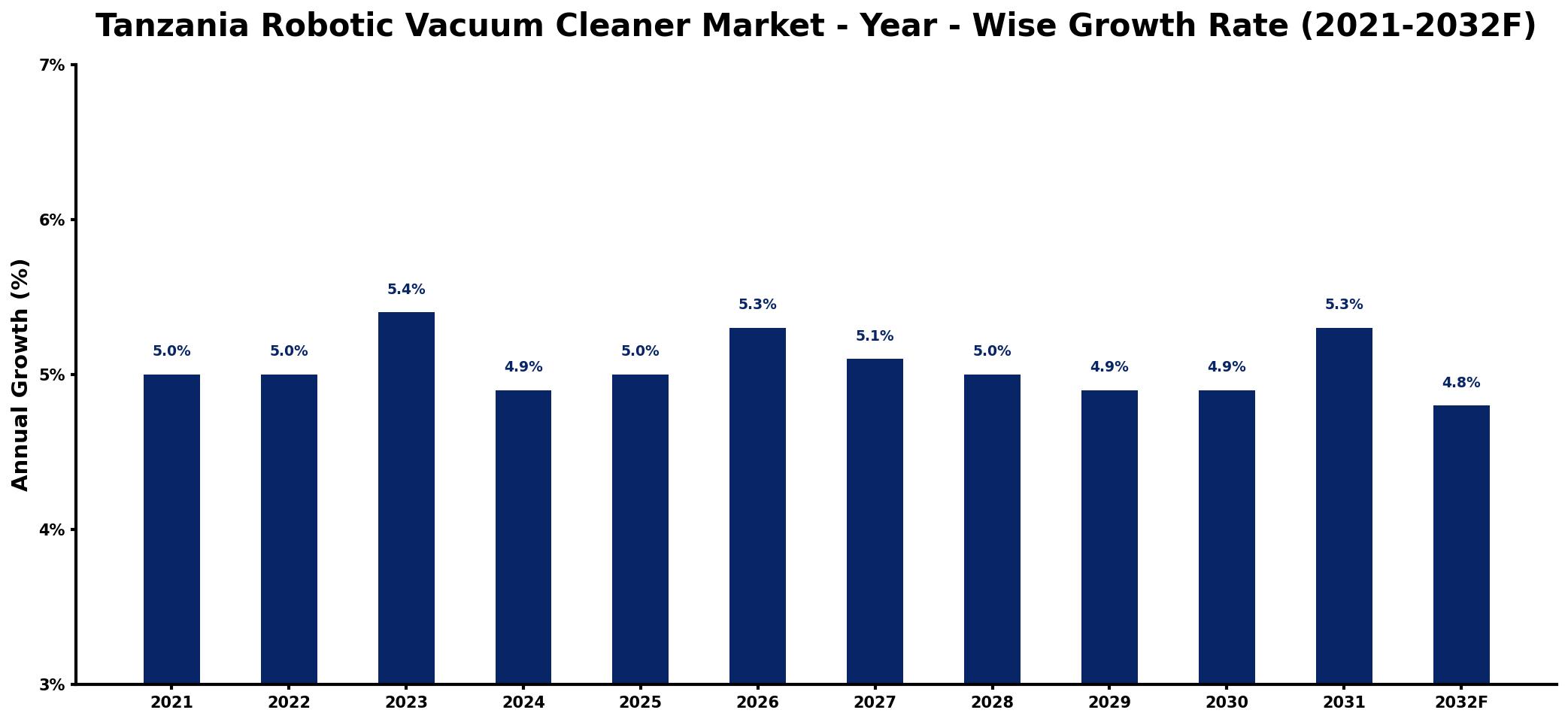
The table below presents the year‑wise growth rates along with the key drivers influencing the market
| Year | Growth Rate | Major Drivers |
| 2021 | 5.0% | Rising consumer electronics demand |
| 2022 | 5.0% | Increased smart home investments |
| 2023 | 5.4% | Growth in urban living spaces |
| 2024 | 4.9% | Expansion of online retail channels |
| 2025 | 5.0% | Improved consumer awareness initiatives |
| 2026 | 5.3% | Technological advancements in automation |
| 2027 | 5.1% | Surge in disposable income levels |
| 2028 | 5.0% | Growing focus on energy efficiency |
| 2029 | 4.9% | Increased availability of financing options |
| 2030 | 4.9% | growing automotive sector requirements |
| 2031 | 5.3% | Rising environmental sustainability trends |
| 2032 | 4.8% | Enhanced product performance expectations |
Note: Market size estimations and growth projections presented in this report are based on 6Wresearch's proprietary forecasting methodology, utilizing the latest available industry data, government publications, and primary research inputs.
Tanzania Robotic Vacuum Cleaner Market Synopsis
Recent momentum in the Tanzania Robotic Vacuum Cleaner Market reveals a dynamic shift toward automation in home cleaning solutions. Although still in its infancy relative to global standards, the market exhibits significant potential for expansion as consumer awareness grows.
Looking ahead, the market is poised for further growth, driven by technological advancements and increasing disposable incomes. With urban lifestyles becoming more fast-paced, the inclination toward automated cleaning solutions will only intensify, making this an opportune moment for both local and international brands to establish a foothold.
Tanzania Robotic Vacuum Cleaner Market Key Takeaways
- The market is experiencing robust growth propelled by urbanization and rising disposable incomes.
- Innovations such as voice control and mapping technology are enhancing consumer interest and product functionality.
- Consumer awareness and education on the benefits of robotic vacuum cleaners remain critical for market expansion.
- Challenges such as high import costs and limited local manufacturing could hinder faster adoption.
- Investment opportunities are ripe for companies willing to navigate the complexities of the Tanzanian market.
Evaluation of Restraints in Tanzania Robotic Vacuum Cleaner Market
Despite the promising prospects, several factors restrain the growth of the Tanzania Robotic Vacuum Cleaner Market. Limited consumer awareness regarding the advantages of robotic vacuum cleaners hampers market penetration. Additionally, the perceived high costs compared to traditional cleaning devices deter price-sensitive consumers. Infrastructure issues, such as inconsistent electricity supply in certain regions, further limit usability. The market's dependency on imports also leads to heightened costs and potential supply disruptions, complicating the path to broader adoption.
Tanzania Robotic Vacuum Cleaner Market Trends
Current trends indicate a growing consumer preference for smart home devices that offer ease and efficiency. Robotic vacuum cleaners are becoming more affordable and feature-rich, with many models now incorporating advanced technologies like app integration and intelligent navigation systems. Moreover, the increasing focus on cleanliness, especially post-pandemic, is further driving demand.
Another notable trend is the competitive landscape, with both domestic and international brands innovating to cater to diverse consumer needs. This competition is likely to lead to even more tailored solutions as companies aim to stand out in a burgeoning market.
Tanzania Robotic Vacuum Cleaner Market Opportunities
The Tanzania Robotic Vacuum Cleaner Market presents a wealth of investment opportunities. As urbanization continues to rise and disposable incomes expand, the demand for convenient household solutions will grow. Companies can capitalize on this trend by focusing on product innovation, such as eco-friendly models and devices tailored to local cleaning habits. Moreover, as government initiatives aimed at promoting technological advancement take shape, the market environment will become increasingly favorable for new entrants and existing players alike.
Government Initiatives in the Tanzania Robotic Vacuum Cleaner Market
While there are no specific policies governing the robotic vacuum cleaner sector, general consumer protection laws are in place to ensure product safety and adequate information dissemination. The Tanzania Bureau of Standards (TBS) also influences import regulations, affecting the availability of robotic vacuum cleaners. Additionally, broader government initiatives aimed at fostering technological growth could indirectly facilitate market acceptance and expansion.
Future Insights of the Tanzania Robotic Vacuum Cleaner Market
Looking towards 2026 and beyond, the Tanzania Robotic Vacuum Cleaner Market is set for significant evolution. Increased consumer acceptance of smart home technologies, coupled with rising incomes, will likely continue driving market growth. As manufacturers invest in product enhancements such as better navigation systems and improved user interfaces, the efficiency and affordability of these devices will increase, further attracting a wider consumer base. Overall, the future looks promising for this market, with ample opportunities for innovation and customer engagement.
Tanzania Robotic Vacuum Cleaner Market Latest Developments (2025 - 2026)
In the latest developments, the market has seen a surge in product launches featuring cutting-edge technologies, including enhanced mapping and navigation capabilities. Consumer education programs are increasingly being implemented to raise awareness about the benefits of robotic cleaning devices. Additionally, partnerships between local retailers and international brands are emerging to streamline distribution and enhance accessibility for consumers.
Tanzania Robotic Vacuum Cleaner Market - Key Attractiveness of the Report
- 10 Years of Market Numbers
- Historical Data Starting from 2022 to 2025
- Base Year: 2025
- Forecast Data until 2032
- Key Performance Indicators Impacting the Market
- Major Upcoming Developments and Projects
Key Highlights of the Report:
- Tanzania Robotic Vacuum Cleaner Market Outlook
- Market Size of Tanzania Robotic Vacuum Cleaner Market, 2025
- Forecast of Tanzania Robotic Vacuum Cleaner Market, 2032
- Historical Data and Forecast of Tanzania Robotic Vacuum Cleaner Revenues & Volume for the Period 2022-2032F
- Tanzania Robotic Vacuum Cleaner Market Trend Evolution
- Tanzania Robotic Vacuum Cleaner Market Drivers and Challenges
- Tanzania Robotic Vacuum Cleaner Price Trends
- Tanzania Robotic Vacuum Cleaner Porter's Five Forces
- Tanzania Robotic Vacuum Cleaner Industry Life Cycle
- Historical Data and Forecast of Tanzania Robotic Vacuum Cleaner Market Revenues & Volume By Type for the Period 2022-2032F
- Historical Data and Forecast of Tanzania Robotic Vacuum Cleaner Market Revenues & Volume By Floor Vacuum Cleaner for the Period 2022-2032F
- Historical Data and Forecast of Tanzania Robotic Vacuum Cleaner Market Revenues & Volume By Window Vacuum Cleaner for the Period 2022-2032F
- Historical Data and Forecast of Tanzania Robotic Vacuum Cleaner Market Revenues & Volume By Pool Vacuum Cleaner for the Period 2022-2032F
- Historical Data and Forecast of Tanzania Robotic Vacuum Cleaner Market Revenues & Volume By Application for the Period 2022-2032F
- Historical Data and Forecast of Tanzania Robotic Vacuum Cleaner Market Revenues & Volume By Household for the Period 2022-2032F
- Historical Data and Forecast of Tanzania Robotic Vacuum Cleaner Market Revenues & Volume By Commercial for the Period 2022-2032F
- Historical Data and Forecast of Tanzania Robotic Vacuum Cleaner Market Revenues & Volume By Operation Mode for the Period 2022-2032F
- Historical Data and Forecast of Tanzania Robotic Vacuum Cleaner Market Revenues & Volume By Self-Drive for the Period 2022-2032F
- Historical Data and Forecast of Tanzania Robotic Vacuum Cleaner Market Revenues & Volume By Remote Control for the Period 2022-2032F
- Historical Data and Forecast of Tanzania Robotic Vacuum Cleaner Market Revenues & Volume By Distribution Channel for the Period 2022-2032F
- Historical Data and Forecast of Tanzania Robotic Vacuum Cleaner Market Revenues & Volume By Online for the Period 2022-2032F
- Historical Data and Forecast of Tanzania Robotic Vacuum Cleaner Market Revenues & Volume By Offline for the Period 2022-2032F
- Historical Data and Forecast of Tanzania Robotic Vacuum Cleaner Market Revenues & Volume By Price for the Period 2022-2032F
- Historical Data and Forecast of Tanzania Robotic Vacuum Cleaner Market Revenues & Volume By Below USD 150 for the Period 2022-2032F
- Historical Data and Forecast of Tanzania Robotic Vacuum Cleaner Market Revenues & Volume By USD 150 - 300 for the Period 2022-2032F
- Historical Data and Forecast of Tanzania Robotic Vacuum Cleaner Market Revenues & Volume By USD 300 - 500 for the Period 2022-2032F
- Historical Data and Forecast of Tanzania Robotic Vacuum Cleaner Market Revenues & Volume By Above USD 500 for the Period 2022-2032F
- Tanzania Robotic Vacuum Cleaner Import Export Trade Statistics
- Market Opportunity Assessment By Type
- Market Opportunity Assessment By Application
- Market Opportunity Assessment By Operation Mode
- Market Opportunity Assessment By Distribution Channel
- Market Opportunity Assessment By Price
- Tanzania Robotic Vacuum Cleaner Top Companies Market Share
- Tanzania Robotic Vacuum Cleaner Competitive Benchmarking By Technical and Operational Parameters
- Tanzania Robotic Vacuum Cleaner Company Profiles
- Tanzania Robotic Vacuum Cleaner Key Strategic Recommendations






































