Tartaric acid Market: Tanzania vs Top 5 Major Economies in 2027 (Africa)
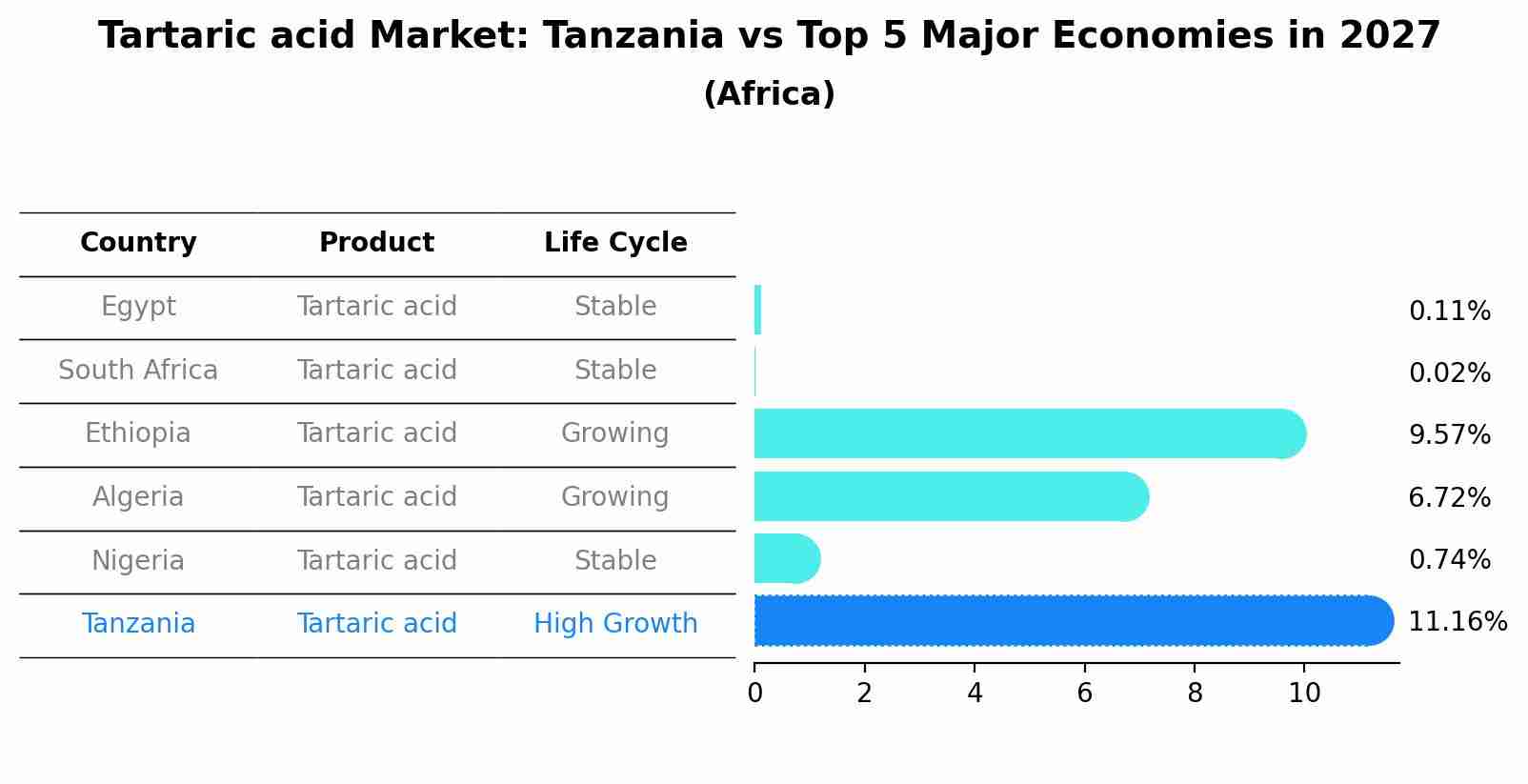
In the Africa region, the Tartaric acid market in Tanzania is projected to expand at a high growth rate of 11.16% by 2027. The largest economy is Egypt, followed by South Africa, Ethiopia, Algeria and Nigeria.
Tanzania Tartaric acid Market Overview
The Tanzania tartaric acid market is experiencing steady growth driven by the increasing demand from various industries such as food and beverage, pharmaceuticals, and cosmetics. Tartaric acid is primarily used as an acidulant in food and beverage products, as a stabilizer in pharmaceuticals, and as a component in skincare products. The market is also benefiting from the growing trend of clean label products and natural ingredients in the food and beverage industry. Key players in the Tanzania tartaric acid market include both domestic manufacturers and international suppliers. Factors such as the expanding food and beverage industry, rising disposable income, and shifting consumer preferences towards healthier products are expected to further propel the growth of the tartaric acid market in Tanzania in the coming years.
Tanzania Tartaric acid Market Trends
In the Tanzania Tartaric acid market, there is a growing trend towards the use of natural and organic sources for tartaric acid production, in line with the global shift towards sustainable and environmentally friendly practices. Consumers are increasingly seeking products that are free from synthetic chemicals and additives. Additionally, there is a rising demand for tartaric acid in the food and beverage industry due to its various applications as a food additive and flavor enhancer. The pharmaceutical and cosmetic industries are also driving the demand for tartaric acid, particularly for its use in skincare products and medications. With the increasing awareness of the health benefits of tartaric acid, such as its antioxidant properties, the market is expected to witness steady growth in the coming years.
Tanzania Tartaric acid Market Challenges
In the Tanzania Tartaric acid market, some of the key challenges faced include limited awareness and understanding of the product among consumers and businesses, which can hinder its adoption and demand. Additionally, the market may face fluctuations in raw material availability and pricing, as tartaric acid is primarily derived from grapes and other fruits. Infrastructure and logistical challenges for distribution and transportation within Tanzania can also impact the market`s growth potential. Furthermore, competition from alternative food additives and preservatives may pose a threat to the market share of tartaric acid. Addressing these challenges will require efforts to educate consumers and businesses about the benefits of tartaric acid, ensure a stable supply chain, improve infrastructure, and differentiate the product from substitutes in the market.
Tanzania Tartaric acid Market Investment Opportunities
The Tanzania tartaric acid market presents promising investment opportunities due to the growing demand for this key ingredient in various industries such as food and beverage, pharmaceuticals, and cosmetics. With the increasing focus on natural and organic products, tartaric acid, derived from grapes, is gaining popularity as a safe and versatile ingredient. Investing in the Tanzania tartaric acid market allows for leveraging the country`s abundant grape production, favorable climate for grape cultivation, and potential cost advantages. Furthermore, the rising trend of clean label products and the expanding export market provide a conducive environment for investment in the Tanzania tartaric acid market, offering long-term growth prospects for investors looking to capitalize on the demand for this essential organic acid.
Tanzania Tartaric acid Market Government Policy
The Tanzanian government does not have specific policies targeting the tartaric acid market. However, the country has general regulatory frameworks governing the manufacturing and export of chemicals, which would also encompass tartaric acid production. Tanzania`s regulatory bodies, such as the Tanzania Food and Drugs Authority (TFDA) and the Tanzania Bureau of Standards (TBS), ensure product quality and compliance with international standards. Additionally, the government promotes investment in the manufacturing sector through incentives and support programs, which could indirectly benefit tartaric acid producers. Overall, while there are no direct policies focused on the tartaric acid market, the existing regulatory environment and government support for the manufacturing sector provide a conducive business environment for tartaric acid producers in Tanzania.
Tanzania Tartaric acid Market Future Outlook
The Tanzania Tartaric acid market is expected to experience steady growth in the coming years due to the increasing demand for the product in various industries such as food and beverage, pharmaceuticals, and cosmetics. Factors such as the rising disposable income, changing consumer preferences towards natural and organic products, and the growing use of Tartaric acid as a stabilizer and acidulant in food and beverage products will drive market growth. Additionally, the expanding pharmaceutical and cosmetic industries in Tanzania will further contribute to the increasing demand for Tartaric acid. However, challenges such as fluctuating raw material prices and competition from substitute products may hinder market growth. Overall, with the right strategies in place, the Tanzania Tartaric acid market is poised for a positive outlook in the future.
Key Highlights of the Report:
- Tanzania Tartaric acid Market Outlook
- Market Size of Tanzania Tartaric acid Market, 2021
- Forecast of Tanzania Tartaric acid Market, 2031
- Historical Data and Forecast of Tanzania Tartaric acid Revenues & Volume for the Period 2021 - 2031
- Tanzania Tartaric acid Market Trend Evolution
- Tanzania Tartaric acid Market Drivers and Challenges
- Tanzania Tartaric acid Price Trends
- Tanzania Tartaric acid Porter's Five Forces
- Tanzania Tartaric acid Industry Life Cycle
- Historical Data and Forecast of Tanzania Tartaric acid Market Revenues & Volume By Source for the Period 2021 - 2031
- Historical Data and Forecast of Tanzania Tartaric acid Market Revenues & Volume By Grapes & sun-dried raisins for the Period 2021 - 2031
- Historical Data and Forecast of Tanzania Tartaric acid Market Revenues & Volume By Maleic anhydride for the Period 2021 - 2031
- Historical Data and Forecast of Tanzania Tartaric acid Market Revenues & Volume By Others for the Period 2021 - 2031
- Historical Data and Forecast of Tanzania Tartaric acid Market Revenues & Volume By Application for the Period 2021 - 2031
- Historical Data and Forecast of Tanzania Tartaric acid Market Revenues & Volume By Food & beverages for the Period 2021 - 2031
- Historical Data and Forecast of Tanzania Tartaric acid Market Revenues & Volume By Pharmaceuticals for the Period 2021 - 2031
- Historical Data and Forecast of Tanzania Tartaric acid Market Revenues & Volume By Cosmetics & personal care products for the Period 2021 - 2031
- Historical Data and Forecast of Tanzania Tartaric acid Market Revenues & Volume By Others for the Period 2021 - 2031
- Historical Data and Forecast of Tanzania Tartaric acid Market Revenues & Volume By Type for the Period 2021 - 2031
- Historical Data and Forecast of Tanzania Tartaric acid Market Revenues & Volume By Naturals for the Period 2021 - 2031
- Historical Data and Forecast of Tanzania Tartaric acid Market Revenues & Volume By Synthetic for the Period 2021 - 2031
- Tanzania Tartaric acid Import Export Trade Statistics
- Market Opportunity Assessment By Source
- Market Opportunity Assessment By Application
- Market Opportunity Assessment By Type
- Tanzania Tartaric acid Top Companies Market Share
- Tanzania Tartaric acid Competitive Benchmarking By Technical and Operational Parameters
- Tanzania Tartaric acid Company Profiles
- Tanzania Tartaric acid Key Strategic Recommendations






































