Tanzania Wine Coolers Market: Top 5 Importing Countries and Market Competition (HHI) Analysis
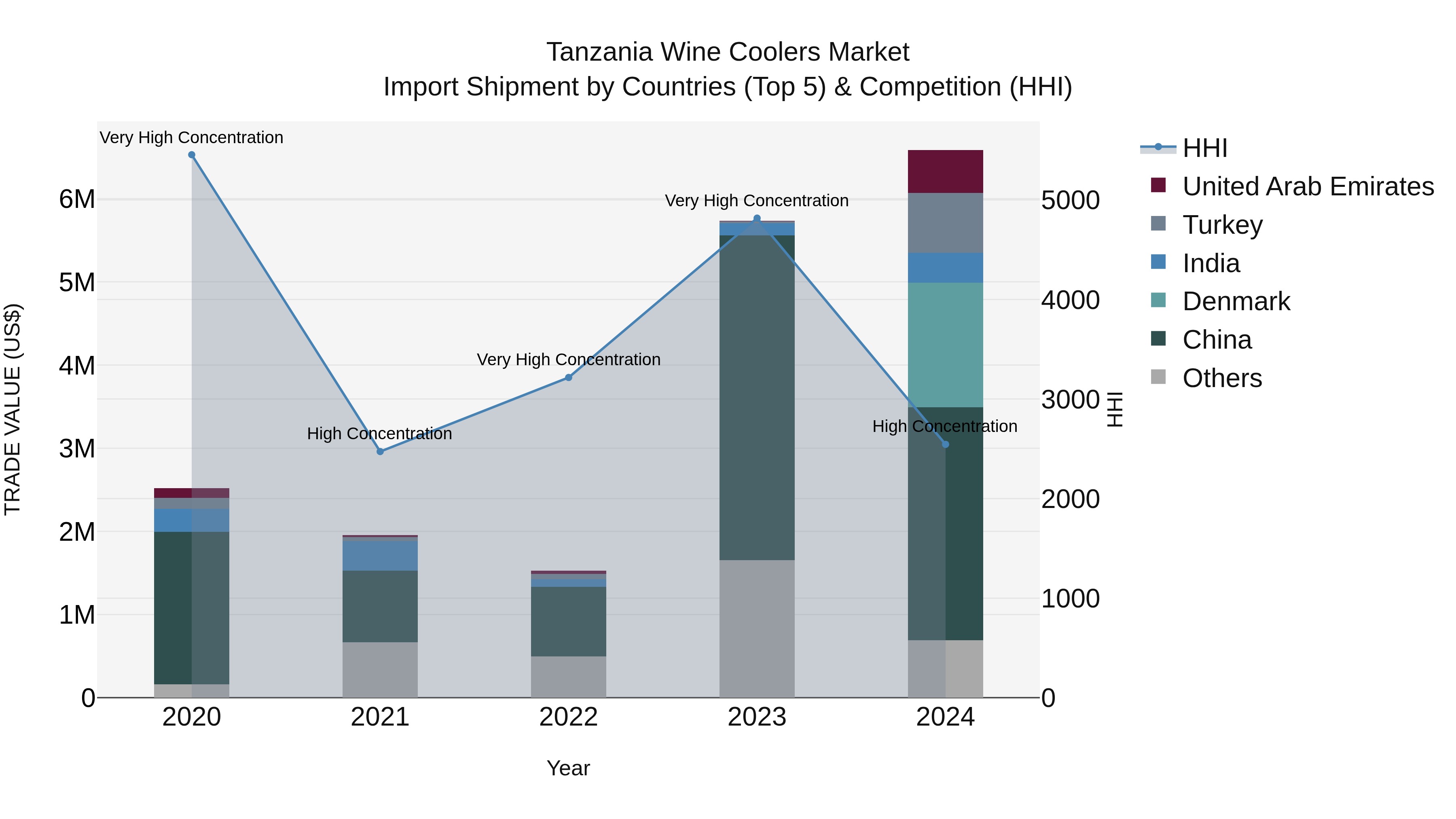
The wine cooler import market in Tanzania showed continued growth in 2024, with top exporting countries being China, Denmark, Turkey, United Arab Emirates, and India. The market concentration remained high, indicating a competitive landscape. The high CAGR of 27.17% from 2020 to 2024 reflects strong demand for wine coolers in Tanzania. The growth rate of 14.86% from 2023 to 2024 demonstrates a sustained upward trajectory in import shipments. Overall, the Tanzanian wine cooler market appears dynamic and promising for both domestic consumers and international suppliers.
Key Highlights of the Report:
- Tanzania Wine Coolers Market Outlook
- Market Size of Tanzania Wine Coolers Market, 2025
- Forecast of Tanzania Wine Coolers Market, 2032
- Historical Data and Forecast of Tanzania Wine Coolers Revenues & Volume for the Period 2022 - 2032
- Tanzania Wine Coolers Market Trend Evolution
- Tanzania Wine Coolers Market Drivers and Challenges
- Tanzania Wine Coolers Price Trends
- Tanzania Wine Coolers Porter's Five Forces
- Tanzania Wine Coolers Industry Life Cycle
- Historical Data and Forecast of Tanzania Wine Coolers Market Revenues & Volume By Type for the Period 2022 - 2032
- Historical Data and Forecast of Tanzania Wine Coolers Market Revenues & Volume By Free Standing for the Period 2022 - 2032
- Historical Data and Forecast of Tanzania Wine Coolers Market Revenues & Volume By Counter-top for the Period 2022 - 2032
- Historical Data and Forecast of Tanzania Wine Coolers Market Revenues & Volume By Built-in for the Period 2022 - 2032
- Historical Data and Forecast of Tanzania Wine Coolers Market Revenues & Volume By Technology for the Period 2022 - 2032
- Historical Data and Forecast of Tanzania Wine Coolers Market Revenues & Volume By Compressor Based for the Period 2022 - 2032
- Historical Data and Forecast of Tanzania Wine Coolers Market Revenues & Volume By Thermoelectric Based for the Period 2022 - 2032
- Historical Data and Forecast of Tanzania Wine Coolers Market Revenues & Volume By Distribution Channel for the Period 2022 - 2032
- Historical Data and Forecast of Tanzania Wine Coolers Market Revenues & Volume By Online for the Period 2022 - 2032
- Historical Data and Forecast of Tanzania Wine Coolers Market Revenues & Volume By Offline for the Period 2022 - 2032
- Tanzania Wine Coolers Import Export Trade Statistics
- Market Opportunity Assessment By Type
- Market Opportunity Assessment By Technology
- Market Opportunity Assessment By Distribution Channel
- Tanzania Wine Coolers Top Companies Market Share
- Tanzania Wine Coolers Competitive Benchmarking By Technical and Operational Parameters
- Tanzania Wine Coolers Company Profiles
- Tanzania Wine Coolers Key Strategic Recommendations






































