Thailand Advanced Nanomaterials for Environmental Detection and Remediation Market Size & Growth Rate
According to 6Wresearch internal database and industry insights, the Thailand Advanced Nanomaterials for Environmental Detection and Remediation Market was valued at USD 20.5 million in 2025 and is projected to reach USD 39.44 million by 2032, growing at a CAGR of approximately 9.8% during 2026–2032.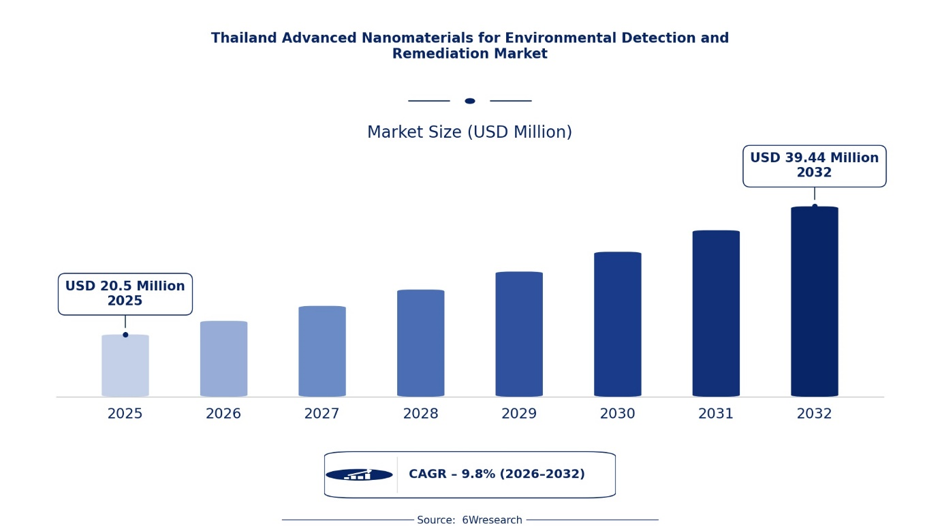
Thailand Advanced Nanomaterials for Environmental Detection and Remediation Market Highlights
| Report Metric | Details |
| Report Name | Thailand Advanced Nanomaterials for Environmental Detection and Remediation Market |
| Market Size 2025 | USD 20.5 million |
| Market Size 2032 | USD 39.44 million |
| Absolute Growth 2025–2032 | USD 18.94 million |
| CAGR 2026–2032 | 9.8% |
| Peak Annual Growth | 11.6% in 2029 |
| Forecast Period | 2026–2032 |
| Historical Data | 2022–2025 |
| Base Year | 2025 |
| Leading Medium, 2025 | Water (62% share) |
| Leading Type, 2025 | Metal-based (46% share) |
| Leading Application, 2025 | Waste Water & Industrial Effluent Treatment (38% share) |
| Leading End-use Industry, 2025 | Chemicals (31% share) |
| Fastest-Growing Medium | Air (11.4% CAGR) |
| Fastest-Growing Type | Carbon-based (11.2% CAGR) |
| Fastest-Growing Application | Energy Storage (12.6% CAGR) |
| Fastest-Growing End-use Industry | Pharmaceuticals (11.7% CAGR) |
| Growing Sector | Energy Storage and Environmental Monitoring |
| Key End Users | Industrial effluent dischargers, municipal utilities, pollution control authorities, research institutes, agricultural producers and battery manufacturers |
Thailand Advanced Nanomaterials for Environmental Detection and Remediation Market Year-wise Growth Rate and Key Drivers (2022–2032)
This graph illustrates the annual growth rates of the Thailand Advanced Nanomaterials for Environmental Detection and Remediation Market from 2022 to 2032, highlighting gradual market development in the historical period and stronger expansion during the forecast period.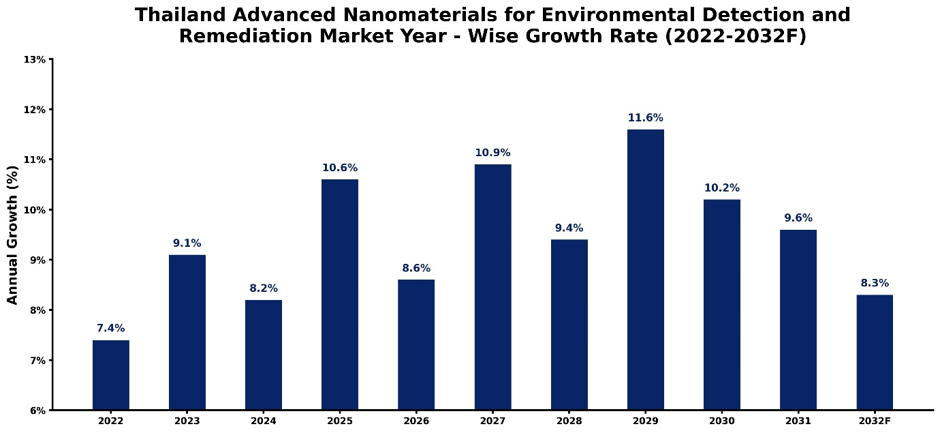
The following table presents the estimated annual growth rates of the market for each year, along with the key factors influencing market performance during the respective period.
| Year | Estimated Annual Growth (%) | Market Rationale |
| 2022 | 7.4% | Reopening of factories and laboratories after pandemic restrictions restarted deferred environmental monitoring and effluent treatment projects across Thai industrial estates. |
| 2023 | 9.1% | The November 2022 update to Thailand’s national climate pledge raised industrial interest in advanced remediation and monitoring materials. |
| 2024 | 8.2% | Weak manufacturing output and cautious capital spending slowed the award of new industrial wastewater upgrade projects during 2024. |
| 2025 | 10.6% | Severe PM2.5 episodes in Bangkok and northern provinces in early 2025 raised demand for air-quality sensing and filtration materials. |
| 2026 | 8.6% | Normalisation after the haze-driven surge of 2025 is expected to temper emergency procurement and return spending to planned project cycles. |
| 2027 | 10.9% | Enforcement of tighter effluent and air emission standards is expected to lift uptake of detection and treatment materials in factories. |
| 2028 | 9.4% | Completion of first-phase treatment upgrades is expected to moderate new project awards as buyers digest installed capacity. |
| 2029 | 11.6% | Commercial scale-up of domestically produced nanomaterials from national research facilities is expected to lower unit costs and widen adoption. |
| 2030 | 10.2% | Price competition from imported carbon and metal-oxide products is expected to narrow supplier margins and slow value growth. |
| 2031 | 9.6% | Saturation among large industrial buyers is expected to shift growth toward smaller enterprises, where adoption proceeds more slowly. |
| 2032 | 8.3% | Growth is expected to stabilise as core remediation applications mature and replacement demand outweighs first-time installations. |
Note: Market size estimations and growth projections presented in this report are based on 6Wresearch's proprietary forecasting methodology, utilizing the latest available industry data, government publications, and primary research inputs.
Thailand Advanced Nanomaterials for Environmental Detection and Remediation Market Synopsis
The Thailand Advanced Nanomaterials for Environmental Detection and Remediation Market comprises metal-based, carbon-based, silica-based and polymer-based nanomaterials used to sense, capture and degrade pollutants in air, soil and water, including sensors, adsorbents, catalysts and filtration membranes. Growth is supported by industrial effluent control in the Eastern Economic Corridor, recurring PM2.5 episodes in northern provinces, expanding university research programmes in nanotechnology, and the BCG Economy Model’s sustainability focus. However, dependence on imported precursors and the cost premium over conventional treatment media continue to limit wider adoption.
Market Dynamics Impact Analysis (2026–2032)
| Factor | Type | Impact | Primary Segment Affected |
| Industrial effluent compliance in eastern industrial estates | Driver | High | Water |
| Recurring PM2.5 episodes and tighter air standards | Driver | High | Air |
| Local production and scale-up of agro-residue carbon materials | Opportunity | High | Carbon-based |
| Nanomaterial demand from battery and electric vehicle supply chains | Opportunity | Medium | Energy Storage |
| Dependence on imported precursors and instruments | Restraint | High | Metal-based |
| Cost premium over conventional treatment methods | Restraint | Medium | Silica-based |
| Limited enforcement capacity among small industrial dischargers | Challenge | Medium | Waste Water & Industrial Effluent Treatment |
| Integration with legacy monitoring networks | Challenge | Medium | Environmental Monitoring |
Evaluation of Drivers in Thailand Advanced Nanomaterials for Environmental Detection and Remediation Market (2026–2032)
Below mentioned are some major drivers and their influence on market dynamics.
| Drivers | Primary Segment Affected | Why It Matters (Evidence) |
| Industrial effluent compliance in the Eastern Economic Corridor | Water | Petrochemical, electronics and automotive plants generate complex effluent that conventional media treat inefficiently, hence operators adopt adsorbent and catalytic nanomaterials. |
| Recurring PM2.5 pollution | Air | Annual haze creates repeat demand for nano-enabled sensors and filtration media. The national 24-hour PM2.5 standard of 37.5 micrograms per cubic metre, in force since 2023, raises the number of exceedance days that trigger action. |
| National research capacity in nanotechnology | Carbon-based | Research institutes and leading universities develop locally produced sensors and adsorbents, which shortens commercialisation time and reduces reliance on imported grades. |
| Zero-emission vehicle and battery push | Energy Storage | Electric vehicle and battery assembly requires conductive carbon and metal-oxide nanomaterials for electrodes. Thailand’s 30@30 policy targets zero-emission vehicles at 30% of vehicle production by 2030. |
| Intensive agricultural production | Sustainable Agriculture | Large cultivated areas and heavy fertiliser use create demand for soil remediation and nano-enabled agricultural inputs. |
Demand is underpinned by Thailand’s strong manufacturing base, which includes one of Southeast Asia’s largest automotive and electronics clusters and supports recurring spending on plant upgrades. Rising corporate sustainability reporting among listed companies is increasing procurement of measurable pollution-control technologies, while growing foreign direct investment in advanced manufacturing brings international environmental standards into local plants. Thailand’s tourism economy, which welcomed roughly 35 million visitors in 2024, also raises expectations for visible environmental quality, supporting private spending on pollution control.
Evaluation of Restraints in Thailand Advanced Nanomaterials for Environmental Detection and Remediation Market
Below mentioned are some major restraints and their influence on market dynamics.
| Market Restraint | Primary Segment Affected | Why It Matters (Evidence) |
| Dependence on imported precursors and instruments | Metal-based | High-purity metal salts and characterisation equipment are largely sourced abroad, which exposes buyers to currency changes and long lead times. |
| Cost premium over incumbent treatment methods | Silica-based | Coagulation, activated carbon, and chlorination remain the established treatment routes, and nanomaterial media carry a higher upfront price. |
| Absence of nanomaterial-specific standards | Polymer-based | Thailand has no dedicated regulation for release of engineered nanomaterials into effluent or soil, therefore buyers lack approved test methods. |
| Pilot-to-commercial scale-up gap | Carbon-based | Most research output stays at gram to kilogram scale as pilot lines and financing are scarce. Commercial supply for large treatment contracts is therefore limited. |
| Conservative public procurement | Waste Water & Industrial Effluent Treatment | Municipal utilities and agencies buy under the Public Procurement and Supplies Administration Act of 2017, whose price-based tendering rules favour established products over novel materials. |
Thailand Advanced Nanomaterials for Environmental Detection and Remediation Market Challenges
Thailand has more than 3 million SMEs, many discharging effluent without dedicated treatment, thus limited enforcement capacity slows the pace at which advanced materials reach end users. Haze concentrates sensor and filtration demand into a four-month January to April window, straining supplier inventories. Applied nanotechnology specialists are concentrated in a few institutions, which makes industrial recruitment difficult. Imported precursors are priced in US dollars, and the baht traded between roughly 33 and 37 per dollar, complicating budgeting. Integration with the Pollution Control Department’s legacy reference-grade station network also remains technically demanding.
Trends in the Thailand Advanced Nanomaterials for Environmental Detection and Remediation Market
Below mentioned are some of the trends shaping the Thailand Advanced Nanomaterials for Environmental Detection and Remediation Market growth.
- Shift from Seasonal Haze Response to Continuous Air-Quality Sensing: Thailand is moving away from emergency measures taken during the dry-season haze towards year-round monitoring, with municipalities and industrial estates adding low-cost sensor nodes beside the Pollution Control Department’s fixed stations. Suppliers of nano-enabled gas and particulate sensors gain recurring demand, while buyers increasingly require calibrated, locally serviceable devices.
- Increasing Shift Towards Locally Developed Nanomaterials: Country is promoting domestically developed adsorbents, silica carriers, and sensor coatings to reduce import dependence, which creates opportunities for local manufacturers and research collaborations.
- Growing Research Focus on Engineered Carbon Nanomaterials: Thai researchers are exploring graphene, carbon nanotubes, and functionalised carbon for advanced water treatment and pollution detection, which helps fuel the demand for cost-effective, high-performance nanomaterials.
Investment Opportunities in the Thailand Advanced Nanomaterials for Environmental Detection and Remediation Market
Some of the investment opportunities in the Thailand Advanced Nanomaterials for Environmental Detection and Remediation Market are mentioned below.
- Nano-Enabled Air Quality Sensors: Recurring haze keeps municipal and industrial demand for monitoring high. Investors can assemble and calibrate metal-oxide and carbon-based gas and particulate sensors in the greater Bangkok region, working with university spin-offs for technology access.
- Agro-Residue Carbon Adsorbent Production: Rice husk, sugarcane bagasse and cassava residues are abundant and often burnt in the open, which adds to seasonal haze. Investors can set up pyrolysis and activation capacity in central and northeastern provinces through joint ventures with sugar and rice millers, supplying adsorbents for industrial effluent polishing and soil amendment.
- Nanomaterials for Battery and Energy Storage Supply Chains: Increasing electric vehicle and battery assembly creates demand for conductive carbon and metal-oxide cathode additives. Investors can add specialty materials capacity close to battery plants and partnering with cell manufacturers for material qualification before scaling output.
Government Initiatives in the Thailand Advanced Nanomaterials for Environmental Detection and Remediation Market
Thailand’s Bio-Circular-Green Economy Model, endorsed as a national agenda in 2021, places pollution reduction and resource efficiency at the centre of development planning. The country has pledged carbon neutrality by 2050 and net-zero greenhouse gas emissions by 2065, and its updated Nationally Determined Contribution targets a 30 per cent emissions reduction by 2030. The Enhancement and Conservation of National Environmental Quality Act of 1992 remains the core statute governing effluent and emission standards.
The National Nanotechnology Center, established in 2003 under the National Science and Technology Development Agency, develops nanomaterials and sensors for environmental use at Thailand Science Park. The Pollution Control Department operates the national air-quality monitoring network and enforces PM2.5 standards, which were tightened to 37.5 micrograms per cubic metre in 2023. The Board of Investment and the Eastern Economic Corridor Office provide incentives for environmental and advanced-materials projects across three eastern provinces.
Future Insight of the Thailand Advanced Nanomaterials for Environmental Detection and Remediation Market
The Thailand Advanced Nanomaterials for Environmental Detection and Remediation Market is expected to witness steady growth, on account of rising air and water pollution concerns, stricter environmental regulations, and increasing investments in sustainable industrial practices. Growing demand for real-time air-quality monitoring, advanced wastewater treatment, and industrial emission control will create opportunities for nanomaterials such as graphene, carbon nanotubes, nanosilica, and engineered adsorbents. Additionally, the adoption of low-cost nanosensors, the development of locally produced nanomaterials, and the growing focus on resource recovery and water reuse are expected to strengthen demand across industrial, municipal, and environmental management applications.
Market Segmentation Analysis
The report offers a comprehensive study of the market across its key segments. The chart below highlights the leading segment by market share in 2025 and the fastest-growing segment by CAGR over 2026–2032, followed by a detailed analysis of each segment.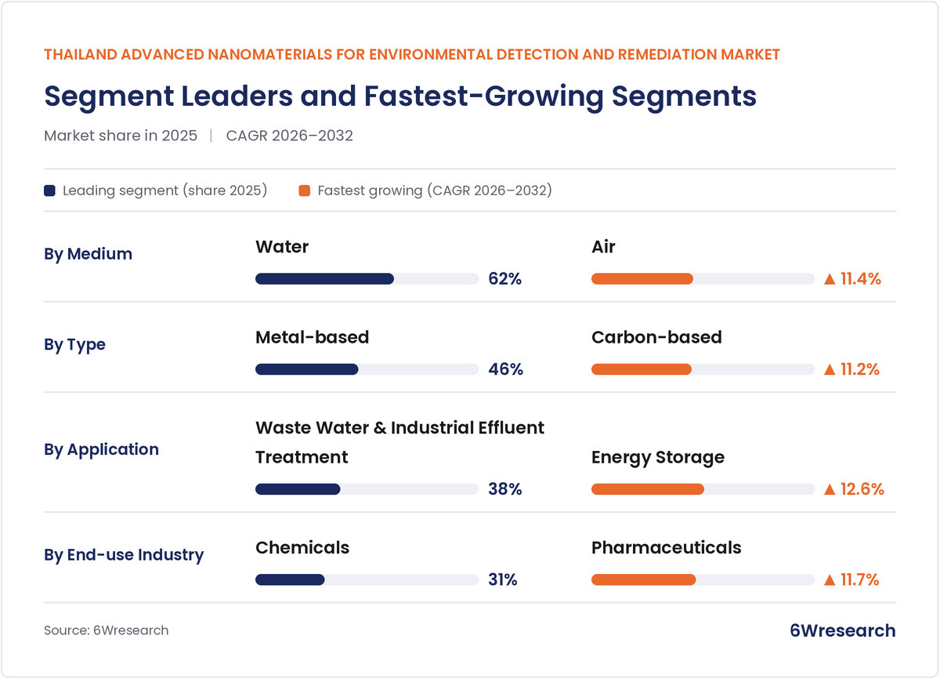
By Medium – Water Led, Air Expected to Grow Fastest
According to Sumit Sagar, Senior Research Analyst at 6Wresearch, water accounted for the largest share of 62% in 2025, supported by the heavy effluent load from Thailand’s eastern petrochemical and manufacturing clusters and the dependence of industry on river basins. Air is expected to record the fastest CAGR of 11.4% during 2026–2032, driven by recurring PM2.5 episodes in Bangkok and northern provinces that are raising demand for sensing and filtration materials.
By Type – Metal-based Led, Carbon-based Expected to Grow Fastest
Metal-based nanomaterials held the largest share of 46% in 2025, as silver, titanium dioxide, zinc oxide and iron-based particles are well established in disinfection, photocatalysis and heavy-metal removal across Thai industrial plants. Carbon-based materials are projected to grow at the fastest CAGR of 11.2% during 2026–2032, helped by growing research on graphene and carbon nanotubes at Thai institutes and by their strong adsorption capacity.
By Application – Waste Water & Industrial Effluent Treatment Led, Energy Storage Expected to Grow Fastest
Waste Water & Industrial Effluent Treatment contributed 38% of revenues in 2025, as factories in Rayong, Chonburi and Samut Prakan must meet discharge limits set under national environmental law. Energy Storage is anticipated to expand at the fastest CAGR of 12.6% through 2026–2032, supported by the country’s growing electric vehicle and battery manufacturing activity, which requires carbon and metal-oxide nanomaterials.
By End-use Industry – Chemicals Led, Pharmaceuticals Expected to Grow Fastest
Chemicals held 31% of demand in 2025 on the back of the Map Ta Phut petrochemical complex, whose effluent and emission control needs create steady purchases of treatment and monitoring materials. Pharmaceuticals, with a projected CAGR of 11.7% during 2026–2032, will advance fastest as Thailand’s medical and pharmaceutical manufacturing base raises its requirements for high-purity water and contamination control.
Key Attractiveness of the Report
- 10 Years of Market Numbers
- Historical Data Starting from 2022 to 2025
- Base Year 2025
- Forecast Data until 2032
- Key Performance Indicators Impacting the Market
- Major Upcoming Developments and Projects
Key Highlights of the Report:
- Thailand Advanced Nanomaterials for Environmental Detection and Remediation Market Outlook
- Market Size of Thailand Advanced Nanomaterials for Environmental Detection and Remediation Market, 2025
- Forecast of Thailand Advanced Nanomaterials for Environmental Detection and Remediation Market, 2032
- Historical Data and Forecast of Thailand Advanced Nanomaterials for Environmental Detection and Remediation Revenues & Volume for the Period 2022-2032
- Thailand Advanced Nanomaterials for Environmental Detection and Remediation Market Trend Evolution
- Thailand Advanced Nanomaterials for Environmental Detection and Remediation Market Drivers and Challenges
- Thailand Advanced Nanomaterials for Environmental Detection and Remediation Price Trends
- Thailand Advanced Nanomaterials for Environmental Detection and Remediation Porter's Five Forces
- Thailand Advanced Nanomaterials for Environmental Detection and Remediation Industry Life Cycle
- Historical Data and Forecast of Thailand Advanced Nanomaterials for Environmental Detection and Remediation Market Revenues & Volume By Medium for the Period 2022-2032
- Historical Data and Forecast of Thailand Advanced Nanomaterials for Environmental Detection and Remediation Market Revenues & Volume By Air for the Period 2022-2032
- Historical Data and Forecast of Thailand Advanced Nanomaterials for Environmental Detection and Remediation Market Revenues & Volume By Soil for the Period 2022-2032
- Historical Data and Forecast of Thailand Advanced Nanomaterials for Environmental Detection and Remediation Market Revenues & Volume By Water for the Period 2022-2032
- Historical Data and Forecast of Thailand Advanced Nanomaterials for Environmental Detection and Remediation Market Revenues & Volume By Type for the Period 2022-2032
- Historical Data and Forecast of Thailand Advanced Nanomaterials for Environmental Detection and Remediation Market Revenues & Volume By Metal-based for the Period 2022-2032
- Historical Data and Forecast of Thailand Advanced Nanomaterials for Environmental Detection and Remediation Market Revenues & Volume By Carbon-based for the Period 2022-2032
- Historical Data and Forecast of Thailand Advanced Nanomaterials for Environmental Detection and Remediation Market Revenues & Volume By Silica-based for the Period 2022-2032
- Historical Data and Forecast of Thailand Advanced Nanomaterials for Environmental Detection and Remediation Market Revenues & Volume By Polymer-based for the Period 2022-2032
- Historical Data and Forecast of Thailand Advanced Nanomaterials for Environmental Detection and Remediation Market Revenues & Volume By Application for the Period 2022-2032
- Historical Data and Forecast of Thailand Advanced Nanomaterials for Environmental Detection and Remediation Market Revenues & Volume By Waste Water & Industrial Effluent Treatment for the Period 2022-2032
- Historical Data and Forecast of Thailand Advanced Nanomaterials for Environmental Detection and Remediation Market Revenues & Volume By Environmental Monitoring for the Period 2022-2032
- Historical Data and Forecast of Thailand Advanced Nanomaterials for Environmental Detection and Remediation Market Revenues & Volume By Soil & Land Management for the Period 2022-2032
- Historical Data and Forecast of Thailand Advanced Nanomaterials for Environmental Detection and Remediation Market Revenues & Volume By Sustainable Agriculture for the Period 2022-2032
- Historical Data and Forecast of Thailand Advanced Nanomaterials for Environmental Detection and Remediation Market Revenues & Volume By Energy Storage for the Period 2022-2032
- Historical Data and Forecast of Thailand Advanced Nanomaterials for Environmental Detection and Remediation Market Revenues & Volume By Others for the Period 2022-2032
- Historical Data and Forecast of Thailand Advanced Nanomaterials for Environmental Detection and Remediation Market Revenues & Volume By End-use Industry for the Period 2022-2032
- Historical Data and Forecast of Thailand Advanced Nanomaterials for Environmental Detection and Remediation Market Revenues & Volume By Pharmaceuticals for the Period 2022-2032
- Historical Data and Forecast of Thailand Advanced Nanomaterials for Environmental Detection and Remediation Market Revenues & Volume By Chemicals for the Period 2022-2032
- Historical Data and Forecast of Thailand Advanced Nanomaterials for Environmental Detection and Remediation Market Revenues & Volume By Agriculture for the Period 2022-2032
- Historical Data and Forecast of Thailand Advanced Nanomaterials for Environmental Detection and Remediation Market Revenues & Volume By Construction for the Period 2022-2032
- Historical Data and Forecast of Thailand Advanced Nanomaterials for Environmental Detection and Remediation Market Revenues & Volume By Others for the Period 2022-2032
- Thailand Advanced Nanomaterials for Environmental Detection and Remediation Import Export Trade Statistics
- Market Opportunity Assessment By Medium
- Market Opportunity Assessment By Type
- Market Opportunity Assessment By Application
- Market Opportunity Assessment By End-use Industry
- Thailand Advanced Nanomaterials for Environmental Detection and Remediation Top Companies Market Share
- Thailand Advanced Nanomaterials for Environmental Detection and Remediation Competitive Benchmarking By Technical and Operational Parameters
- Thailand Advanced Nanomaterials for Environmental Detection and Remediation Company Profiles
- Thailand Advanced Nanomaterials for Environmental Detection and Remediation Key Strategic Recommendations
Market Covered
The report offers an extensive study of the following market segments.
By Medium
- Air
- Soil
- Water
By Type
- Metal-based
- Carbon-based
- Silica-based
- Polymer-based
By Application
- Waste Water & Industrial Effluent Treatment
- Environmental Monitoring
- Soil & Land Management
- Sustainable Agriculture
- Energy Storage
- Others
By End-use Industry
- Pharmaceuticals
- Chemicals
- Agriculture
- Construction
- Others































