Thailand Cargo Shipping Market Size, Share & Growth Rate
The Thailand Cargo Shipping Market was estimated at USD 108 Million in 2025 and is projected to reach USD 124 Million by 2032, growing at a CAGR of 2.0% from 2026 to 2032. This growth trajectory is primarily fueled by Thailand's status as a manufacturing powerhouse and its strategic location on pivotal trade routes. The increasing demand for efficient logistics solutions and robust export activities further underpin this optimistic outlook.
Thailand Cargo Shipping Market Year-wise Growth Rate and Key Drivers
This graph highlights how the Thailand Cargo Shipping Market has steadily grown over the years, supported by major growth factors.
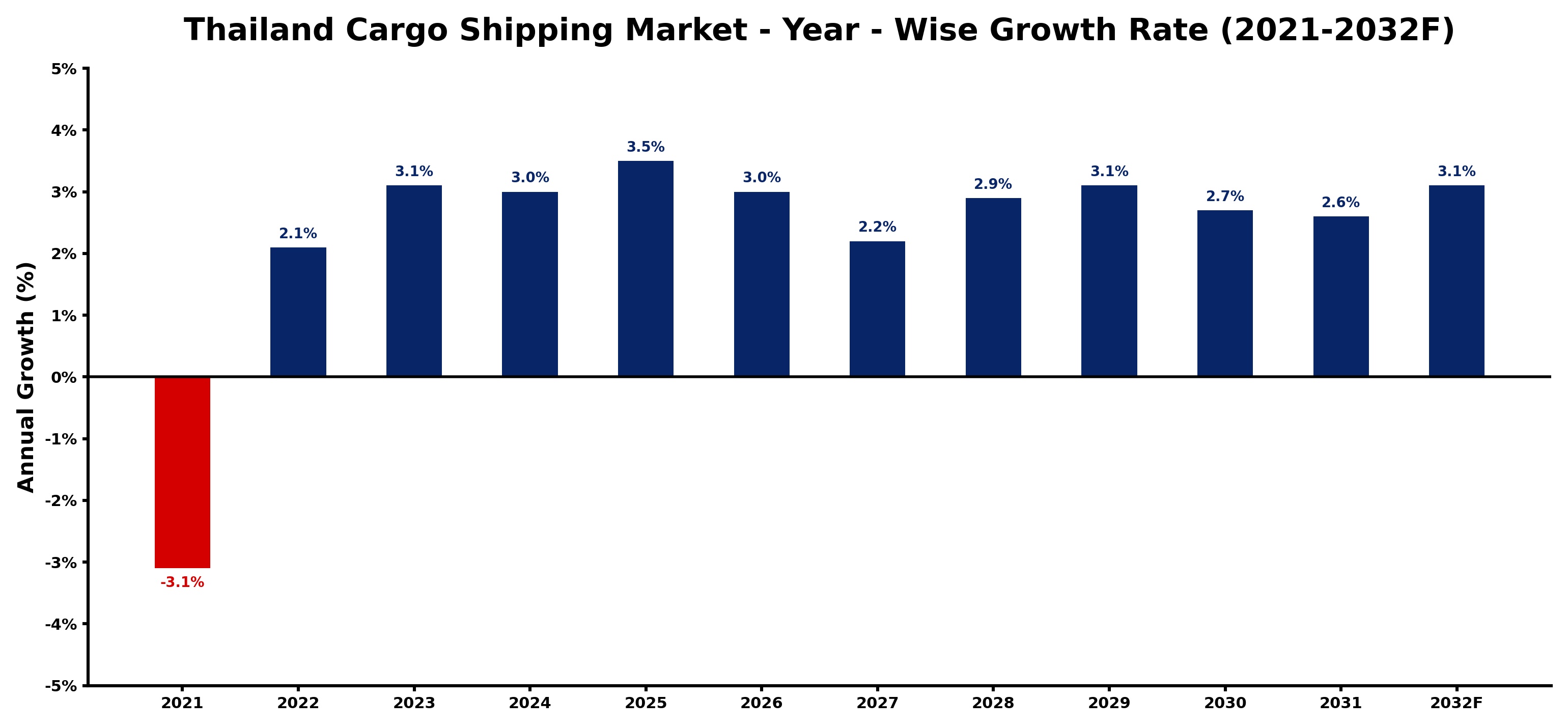
The table below presents the year‑wise growth rates along with the key drivers influencing the market
| Year | Growth Rate | Major Drivers |
| 2021 | -3.1% | Government infrastructure modernization initiatives |
| 2022 | 2.1% | Increasing adoption of advanced technologies |
| 2023 | 3.1% | Growing renewable energy integration projects |
| 2024 | 3.0% | Increasing industrial infrastructure investments |
| 2025 | 3.5% | Government infrastructure modernization initiatives |
| 2026 | 3.0% | Increasing industrial infrastructure investments |
| 2027 | 2.2% | Increasing industrial infrastructure investments |
| 2028 | 2.9% | Expansion of transportation and logistics networks |
| 2029 | 3.1% | Increasing smart city development projects |
| 2030 | 2.7% | Increasing industrial infrastructure investments |
| 2031 | 2.6% | Growing urbanization and commercial development |
| 2032 | 3.1% | Expansion of transportation and logistics networks |
Note - Market size estimations and growth projections presented in this report are based on 6Wresearch’s advanced forecasting approach, validated with industry datasets as of June 2026.
Thailand Cargo Shipping Market Synopsis
Currently, the cargo shipping market in Thailand is witnessing a surge in activity, thanks to its geographical advantages and improved port infrastructure. As a critical conduit for both domestic and international trade, Thailand's ports are essential for handling a diverse range of cargo, from agricultural products to high-tech goods.
Moreover, the interplay of sea, air, and land transport within the market provides comprehensive logistics solutions. This efficient multi-modal approach is vital for businesses looking to streamline operations and meet the growing demands of global commerce.
Thailand Cargo Shipping Market Key Takeaways
- Strategic geographic location enhances Thailand's role in global logistics.
- The market is supported by a strong export-oriented economy, particularly in manufacturing and agriculture.
- Increasing participation in trade agreements has expanded cargo volumes through Thai ports.
- Investment in logistics infrastructure is crucial for maintaining competitiveness.
- Recent trends indicate a shift towards digital solutions and e-commerce logistics.
Evaluation of Restraints in Thailand Cargo Shipping Market
Despite its potential, the Thailand cargo shipping market is navigating significant constraints. Chief among these is the growing competition from neighboring countries that are rapidly developing their port and logistics capabilities. To keep pace, Thailand must prioritize investment in modernizing existing infrastructure and enhancing logistical efficiency. Furthermore, with rising environmental concerns, the industry faces increasing pressure to adopt sustainable practices, which can drive up compliance costs. The disruption caused by the Covid-19 pandemic has also highlighted vulnerabilities in the supply chain, underlining the need for greater resilience in operations.
Thailand Cargo Shipping Market Trends
Several key trends are shaping the Thailand cargo shipping market. The ongoing digital transformation is enabling more efficient tracking and management of shipments, essential in today's fast-paced environment. Additionally, as e-commerce continues to grow, logistics providers are adapting their services to accommodate the unique demands of online retail, including last-mile delivery innovations. Moreover, heightened awareness of environmental sustainability is prompting shipping companies to explore greener technologies and practices.
Thailand Cargo Shipping Market Opportunities
Investment opportunities abound within Thailand's cargo shipping sector, particularly in infrastructure enhancement and technology adoption. There is a growing need for advanced logistics solutions that integrate digital tools and eco-friendly practices. Furthermore, the increasing volume of cross-border trade presents avenues for businesses to establish Thailand as a regional distribution hub, capitalizing on its strategic location and existing trade networks.
Government Initiatives in the Thailand Cargo Shipping Market
The Thai government is actively fostering growth in the cargo shipping sector through various initiatives aimed at enhancing port capabilities and promoting sustainable practices. Investments in modernizing port infrastructure and streamlining customs processes are part of broader efforts to position Thailand as a key logistics hub in Southeast Asia. Additionally, the government is encouraging public-private partnerships to spur innovation and improve service standards across the industry.
Future Insights of the Thailand Cargo Shipping Market
Looking ahead to 2026-2032, the Thailand cargo shipping market is poised for steady growth driven by ongoing investments in infrastructure and a robust export landscape. As global trade dynamics evolve, Thai ports are likely to enhance their capacities and technological capabilities, positioning themselves as vital links in international supply chains. Continued emphasis on sustainability will shape the future operational practices of the industry, aligning with global trends while meeting domestic needs.
Thailand Cargo Shipping Market Latest Developments (May 2025 - June 2026)
Recent developments in the Thailand cargo shipping market have focused on bolstering port infrastructure and integrating digital technologies into logistics operations. Initiatives aimed at reducing shipping times and improving cargo tracking capabilities are underway. Additionally, the industry has seen a marked interest in adopting greener practices in response to environmental pressures, prompting discussions around new regulations and industry standards.
Thailand Cargo Shipping Market - Key Attractiveness of the Report
- 10 Years of Market Numbers
- Historical Data Starting from 2022 to 2025
- Base Year: 2025
- Forecast Data until 2032
- Key Performance Indicators Impacting the Market
- Major Upcoming Developments and Projects
Key Highlights of the Report:
- Thailand Cargo Shipping Market Outlook
- Market Size of Thailand Cargo Shipping Market, 2025
- Forecast of Thailand Cargo Shipping Market, 2032
- Historical Data and Forecast of Thailand Cargo Shipping Revenues & Volume for the Period 2022-2032F
- Thailand Cargo Shipping Market Trend Evolution
- Thailand Cargo Shipping Market Drivers and Challenges
- Thailand Cargo Shipping Price Trends
- Thailand Cargo Shipping Porter's Five Forces
- Thailand Cargo Shipping Industry Life Cycle
- Historical Data and Forecast of Thailand Cargo Shipping Market Revenues & Volume By Cargo Infrastructure for the Period 2022-2032F
- Historical Data and Forecast of Thailand Cargo Shipping Market Revenues & Volume By Port Developments in Asia for the Period 2022-2032F
- Historical Data and Forecast of Thailand Cargo Shipping Market Revenues & Volume By Port Developments in Europe for the Period 2022-2032F
- Historical Data and Forecast of Thailand Cargo Shipping Market Revenues & Volume By Port Developments in North America for the Period 2022-2032F
- Historical Data and Forecast of Thailand Cargo Shipping Market Revenues & Volume By Port Developments in South America for the Period 2022-2032F
- Historical Data and Forecast of Thailand Cargo Shipping Market Revenues & Volume By Port Developments in Africa for the Period 2022-2032F
- Historical Data and Forecast of Thailand Cargo Shipping Market Revenues & Volume By Cargo Type for the Period 2022-2032F
- Historical Data and Forecast of Thailand Cargo Shipping Market Revenues & Volume By Container Cargo for the Period 2022-2032F
- Historical Data and Forecast of Thailand Cargo Shipping Market Revenues & Volume By Bulk Cargo for the Period 2022-2032F
- Historical Data and Forecast of Thailand Cargo Shipping Market Revenues & Volume By General Cargo for the Period 2022-2032F
- Historical Data and Forecast of Thailand Cargo Shipping Market Revenues & Volume By Oil & Gas for the Period 2022-2032F
- Historical Data and Forecast of Thailand Cargo Shipping Market Revenues & Volume By Industry Type for the Period 2022-2032F
- Historical Data and Forecast of Thailand Cargo Shipping Market Revenues & Volume By Food, Manufacturing for the Period 2022-2032F
- Historical Data and Forecast of Thailand Cargo Shipping Market Revenues & Volume By Oil & Ores for the Period 2022-2032F
- Historical Data and Forecast of Thailand Cargo Shipping Market Revenues & Volume By Electrical & Electronics for the Period 2022-2032F
- Thailand Cargo Shipping Import Export Trade Statistics
- Market Opportunity Assessment By Cargo Infrastructure
- Market Opportunity Assessment By Cargo Type
- Market Opportunity Assessment By Industry Type
- Thailand Cargo Shipping Top Companies Market Share
- Thailand Cargo Shipping Competitive Benchmarking By Technical and Operational Parameters
- Thailand Cargo Shipping Company Profiles
- Thailand Cargo Shipping Key Strategic Recommendations






































