Thailand Copper Forged Market Summary
The thailand copper forged market was estimated at USD 178 Million in 2025 and is projected to reach USD 204 Million by 2032, growing at a CAGR of 3.3% from 2026 to 2032.
Thailand Copper Forged Market Year-wise Growth Rate and Key Drivers
This graph highlights how the Thailand Copper Forged Market has steadily grown over the past five years, supported by major growth factors.
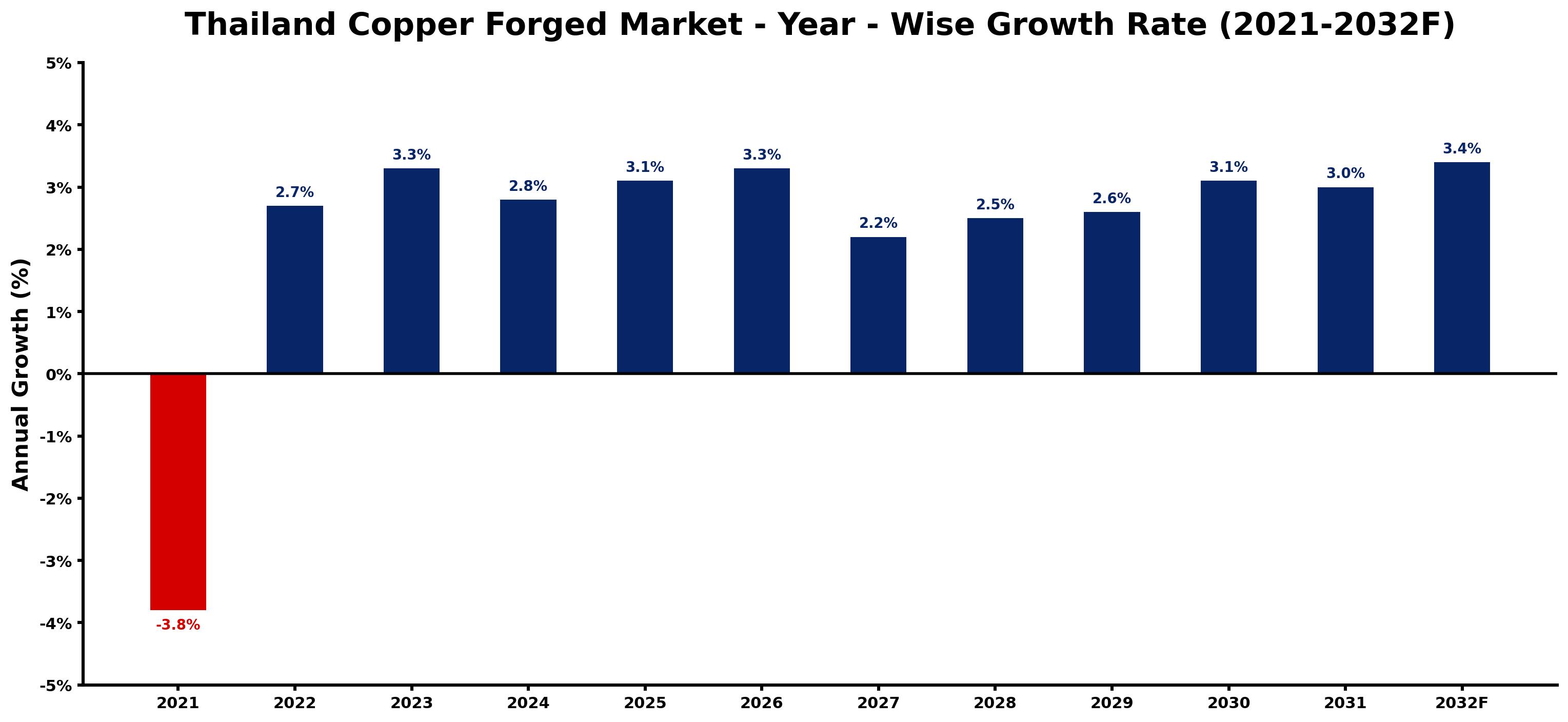
The table below presents the year wise growth rates along with the key drivers influencing the market
| Year | Growth Rate | Major Drivers |
| 2021 | -3.8% | Global supply chain disruptions hindered production efficiency, significantly impacting the availability of forged copper products. |
| 2022 | 2.7% | Increasing investments in renewable energy bolster copper requirements for wiring and components. |
| 2023 | 3.3% | Emerging electric vehicle markets create opportunities for advanced copper forging applications. |
| 2024 | 2.8% | Rising urbanization results in greater needs for efficient electrical infrastructure development. |
| 2025 | 3.1% | Technological innovations in manufacturing enhance the quality of copper forged components. |
| 2026 | 3.3% | International trade agreements facilitate easier access to copper materials and markets. |
| 2027 | 2.2% | Local industries prioritize sustainable practices, requiring high-quality copper from eco-friendly sources. |
| 2028 | 2.5% | Supply chain disruptions underscore the importance of domestic copper forging capabilities. |
| 2029 | 2.6% | Increased demand for smart home technologies drives the need for specialized copper products. |
| 2030 | 3.1% | Collaboration between manufacturers and tech firms leads to new copper applications. |
| 2031 | 3.0% | Long-term infrastructure projects necessitate enhanced copper solutions for durability and efficiency. |
| 2032 | 3.4% | Consumer preferences shift towards sustainable products, boosting demand for responsibly sourced copper. |
Note - Market size estimations and growth projections presented in this report are based on 6Wresearch's advanced forecasting approach, validated with industry datasets as of June 2026.
Thailand Copper Forged Market Synopsis
The Thailand Copper Forged Market is projected to reach 3.3% and witness significant growth during the forecast period (2026-2032). The expansion of this market is primarily driven by the increasing demand for copper-forged components across various sectors, notably in the automotive and electrical electronics industries. The reliance on copper-forged parts in these sectors ensures that the market will play a crucial role in supporting technological advancements and manufacturing efficiency.
Thailand Copper Forged Market Growth Drivers
Several factors are contributing to the robust growth of the Thailand Copper Forged Market. The continual rise in automotive production and the push for enhanced electrical components underscore the increasing need for high-quality copper-forged products. Furthermore, investments in research and development activities are fostering innovation, leading to improved manufacturing processes and product offerings. Additionally, advancements in computer numerical control (CNC) machinery are enhancing production capabilities, enabling manufacturers to meet the rising demand efficiently.
- The automotive sector is evolving rapidly, increasing the need for lightweight and durable materials, which bolsters the demand for copper-forged components.
- Emerging trends in the electrical and electronics sectors, where precision and quality are paramount, are driving further acceptance of copper-forged products.
- Innovations in forging techniques, such as hot and cold forging, are enabling the production of more cost-effective and high-performance components.
- The integration of advanced manufacturing technologies is enhancing operational efficiencies, which translates into lower production costs and faster turnaround times.
- Government initiatives aimed at reducing vehicular emissions through the utilization of lightweight materials are expected to further stimulate market growth.
Thailand Copper Forged Market Trends and Opportunities
The Thailand Copper Forged Market is witnessing several trends that signify a potential for growth and expansion. One key trend is the increasing focus on sustainability, where manufacturers are seeking methods to reduce waste and energy consumption during production. Moreover, the industry is gradually shifting toward adopting Industry 4.0 practices, which emphasize automation and data exchange in manufacturing technologies. This shift will likely enhance productivity and improve quality control. The rise of electric vehicles (EVs) is creating new opportunities for copper-forged components, as these vehicles require high-performance materials for better efficiency.
- Sustainable manufacturing practices are becoming a priority, prompting investments in environmentally friendly technologies.
- The transition to electric vehicles is opening up avenues for innovative copper-forged solutions that meet the specific demands of the EV market.
- The trend towards lightweighting in automotive design is positioning copper-forged components as an ideal choice for manufacturers.
- Integration of advanced materials science is leading to the development of new copper alloys that enhance performance characteristics.
- Collaborations and partnerships among industry players are fostering innovation and improving market access.
Thailand Copper Forged Market Challenges and Restraints
Despite the promising growth trajectory, the Thailand Copper Forged Market faces several challenges and restraints. Fluctuations in raw material prices, specifically copper, can significantly impact production costs and profitability. Additionally, the market is characterized by intense competition, which compels manufacturers to continually innovate while keeping prices competitive. Supply chain disruptions, particularly as witnessed during global crises, can hinder production efficiency and market stability. Furthermore, the need for skilled labor in advancing manufacturing technologies poses a challenge to the industry's growth.
- Volatility in copper prices can negatively affect the overall profitability for manufacturers in the copper forged sector.
- The competitive landscape necessitates constant innovation, which can strain resources and impact margins.
- Supply chain challenges can lead to delays in production schedules, affecting delivery times and client satisfaction.
- A shortage of skilled labor in advanced manufacturing techniques can slow down production growth and technological adoption.
- Regulatory compliance and the need for adherence to environmental standards can impose additional operational costs.
Thailand Copper Forged Market Government Investment and Initiatives
Recognizing the significance of the Thailand Copper Forged Market in bolstering industrial growth, the government has enacted several policies aimed at enhancing investment and development within this sector. These initiatives include public spending aimed at modernizing manufacturing facilities, as well as financial incentives for companies that prioritize sustainable practices. Furthermore, the government is supporting research and development efforts through grants and partnerships with educational institutions, thereby fostering innovation in material science and production techniques. Investment in infrastructure improvements also plays a crucial role by facilitating better supply chain management and logistics within the industry.
- The government is investing in upgrading manufacturing infrastructure to improve efficiency and competitiveness in the copper forged market.
- Financial incentives are offered to companies that adopt environmentally friendly practices, promoting sustainability in production.
- Collaborations between government bodies and educational institutions are fostering innovation in material science and manufacturing processes.
- Investment in skill development programs aims to address the shortage of skilled labor in advanced manufacturing sectors.
- Government initiatives to support the automotive industry indirectly benefit the copper forged market by boosting demand for lighter, high-performance components.
Thailand Copper Forged Market Latest Developments (May 2025 - June 2026)
Between May 2025 and June 2026, the Thailand Copper Forged Market has experienced notable developments that signal a shift towards greater innovation and efficiency. Manufacturers are increasingly investing in advanced CNC machinery to enhance precision in the forging process, allowing for the production of more intricate and specialized components. Furthermore, collaboration within the industry has surged, with companies partnering to leverage technological advancements and improve production capabilities. Sustainability initiatives have also gained momentum, as companies are actively adopting practices that reduce their environmental footprint. This period reflects a concerted effort to align production techniques with market demands, particularly in the automotive sector.
- Investment in CNC technology is on the rise, allowing for more precise and efficient forging operations.
- Collaborative efforts amongst manufacturers to enhance technological capabilities are becoming more common.
- Sustainability practices are being prioritized as companies seek to lower their environmental impact.
- The automotive industry's shift towards lighter components is driving innovation in the copper forging sector.
- Improvements in production efficiency are being sought through investments in modern manufacturing technologies.
Thailand Copper Forged Market - Key Attractiveness of the Report
- 10 Years of Market Numbers
- Historical Data Starting from 2022 to 2025
- Base Year: 2025
- Forecast Data until 2032
- Key Performance Indicators Impacting the Market
- Major Upcoming Developments and Projects
Government initiatives focusing on sustainability, infrastructure updates, and R&D investments are designed to support market growth and innovation.
Key Highlights of the Report:
- Thailand Copper Forged Market Outlook
- Market Size of Thailand Copper Forged Market, 2025
- Forecast of Thailand Copper Forged Market, 2032F
- Historical Data and Forecast of Thailand Copper Forged Revenues & Volume for the Period 2022-2032F
- Thailand Copper Forged Market Trend Evolution
- Thailand Copper Forged Market Drivers and Challenges
- Thailand Copper Forged Price Trends
- Thailand Copper Forged Porter's Five Forces
- Thailand Copper Forged Industry Life Cycle
- Historical Data and Forecast of Thailand Copper Forged Market Revenues & Volume By Product Types for the Period 2022-2032F
- Historical Data and Forecast of Thailand Copper Forged Market Revenues & Volume By Closed Die Forging for the Period 2022-2032F
- Historical Data and Forecast of Thailand Copper Forged Market Revenues & Volume By Open Die Forging for the Period 2022-2032F
- Historical Data and Forecast of Thailand Copper Forged Market Revenues & Volume By Rolled Ring Forging for the Period 2022-2032F
- Historical Data and Forecast of Thailand Copper Forged Market Revenues & Volume By Applications for the Period 2022-2032F
- Historical Data and Forecast of Thailand Copper Forged Market Revenues & Volume By Automotive for the Period 2022-2032F
- Historical Data and Forecast of Thailand Copper Forged Market Revenues & Volume By Aerospace for the Period 2022-2032F
- Historical Data and Forecast of Thailand Copper Forged Market Revenues & Volume By Oil & Gas for the Period 2022-2032F
- Historical Data and Forecast of Thailand Copper Forged Market Revenues & Volume By Construction for the Period 2022-2032F
- Historical Data and Forecast of Thailand Copper Forged Market Revenues & Volume By Agriculture for the Period 2022-2032F
- Historical Data and Forecast of Thailand Copper Forged Market Revenues & Volume By Others for the Period 2022-2032F
- Thailand Copper Forged Import Export Trade Statistics
- Market Opportunity Assessment By Product Types
- Market Opportunity Assessment By Applications
- Thailand Copper Forged Top Companies Market Share
- Thailand Copper Forged Competitive Benchmarking By Technical and Operational Parameters
- Thailand Copper Forged Company Profiles
- Thailand Copper Forged Key Strategic Recommendations






































