Thailand Distilled Water Market Size, Share & Growth Rate
The Thailand Distilled Water Market was estimated at USD 111 Million in 2025 and is projected to reach USD 127 Million by 2032, growing at a CAGR of 1.9% from 2026 to 2032. This growth trajectory is underpinned by heightened health awareness among consumers and an escalating demand for high-quality drinking water. Additionally, industrial applications across sectors like pharmaceuticals and electronics are propelling the market forward, with a clear emphasis on maintaining the highest purity standards.
Thailand Distilled Water Market Year-wise Growth Rate and Key Drivers
This graph highlights how the Thailand Distilled Water Market has steadily grown over the years, supported by major growth factors.
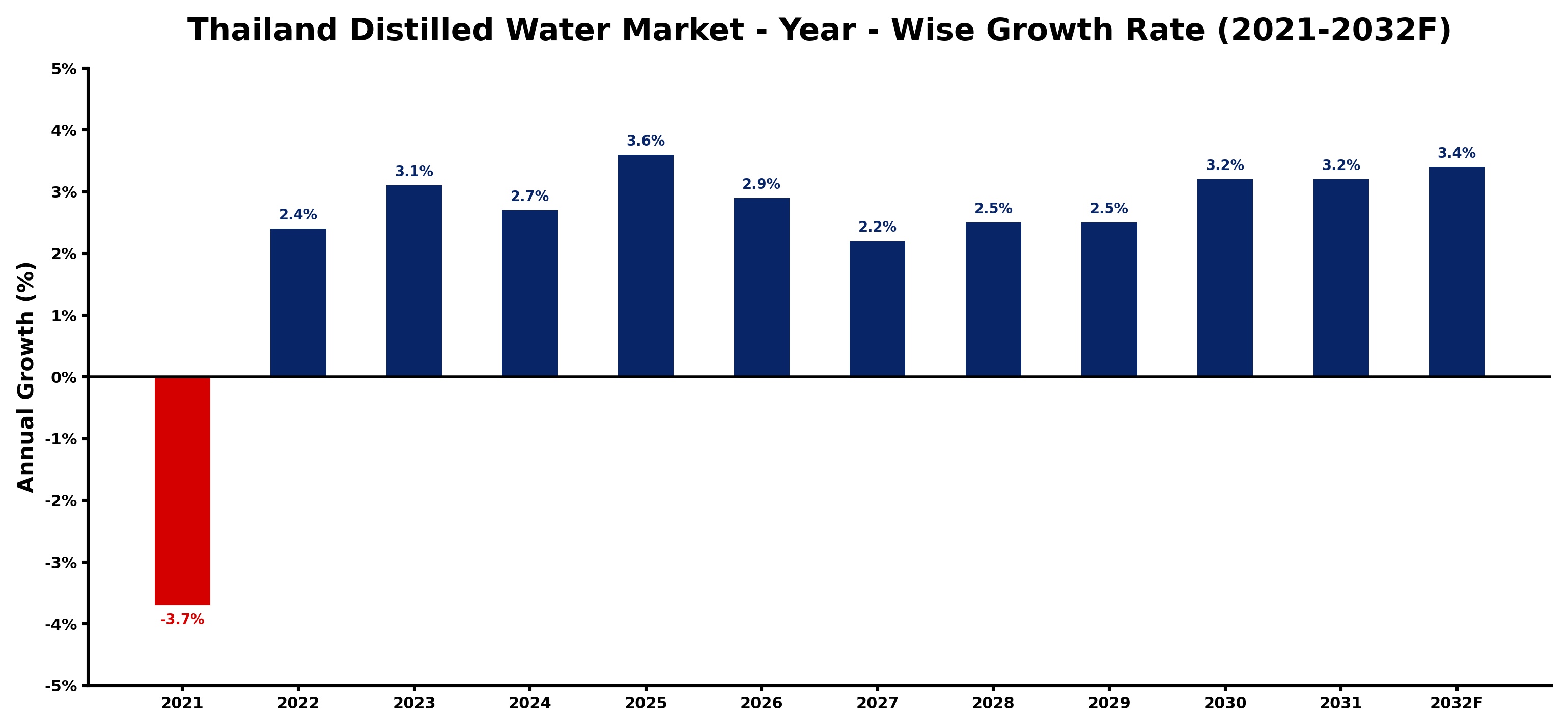
The table below presents the year‑wise growth rates along with the key drivers influencing the market
| Year | Growth Rate | Major Drivers |
| 2021 | -3.7% | Consumer demand for alternatives fell |
| 2022 | 2.4% | Health awareness drove market growth |
| 2023 | 3.1% | Beverage industry expansion increased demand |
| 2024 | 2.7% | Sustainable packaging adoption gained traction |
| 2025 | 3.6% | Home delivery services enhanced access |
| 2026 | 2.9% | Water purification technology advanced significantly |
| 2027 | 2.2% | Corporate wellness programs promoted usage |
| 2028 | 2.5% | Eco-friendly product preferences increased |
| 2029 | 2.5% | Retail partnerships expanded distribution channels |
| 2030 | 3.2% | E-commerce platforms boosted sales |
| 2031 | 3.2% | Brand loyalty initiatives strengthened market |
| 2032 | 3.4% | Innovation in product offerings increased |
Note - Market size estimations and growth projections presented in this report are based on 6Wresearch’s advanced forecasting approach, validated with industry datasets as of June 2026.
Thailand Distilled Water Market Synopsis
The strongest force shaping the Thailand distilled water market today is the increasing focus on health and safety in water consumption. With consumers becoming more discerning about the quality of their drinking water, there is a noticeable shift towards using distilled water, recognized for its purity and safety.
Moreover, the influence of government initiatives promoting clean water access further strengthens market dynamics. The Thai government is actively involved in ensuring the population has access to safe drinking water, thus creating opportunities for growth in the distilled water sector.
Thailand Distilled Water Market Key Takeaways
- The market is poised for steady growth driven by rising consumer health awareness and industrial demand.
- Pharmaceuticals and electronics are the primary sectors utilizing distilled water for their operations.
- Government initiatives aimed at promoting clean water access bolster market potential.
- Consistent quality control remains a priority due to the critical applications of distilled water.
- The pandemic has accelerated the demand for distilled water in medical applications, altering supply chain dynamics.
Evaluation of Restraints in Thailand Distilled Water Market
Despite the optimistic outlook, the Thailand distilled water market grapples with several constraints that could impede growth. Chief among these is the challenge of maintaining consistent water quality across various applications. The demand for distilled water in laboratories and medical facilities necessitates rigorous quality control and sophisticated treatment processes, which can be resource-intensive. Additionally, fluctuations in supply chain logistics, exacerbated during the pandemic, continue to pose challenges in meeting the rising consumer demand.
Thailand Distilled Water Market Trends
Emerging trends within the Thailand distilled water market are significantly influenced by technological advancements in water purification processes. Innovative filtration systems and improved distillation techniques are not only enhancing water quality but also boosting production efficiency. Moreover, there is a growing inclination towards eco-friendly packaging solutions, as consumers increasingly prefer sustainable options. The integration of e-commerce platforms is also reshaping distribution strategies, enabling wider access to distilled water for households and businesses alike.
Thailand Distilled Water Market Opportunities
The Thailand distilled water market presents several genuine growth opportunities, particularly within niche segments. As urbanization continues to rise, the demand for distilled water in residential households is expected to increase. Furthermore, expanding industries such as cosmetics and food and beverage are likely to create new avenues for distilled water application. Investment in advanced purification technologies will also position companies to meet the highest quality standards, catering to discerning consumers and health-conscious individuals.
Government Initiatives in the Thailand Distilled Water Market
The Thai government is actively promoting various initiatives aimed at improving water quality and access across the nation. Policies focused on enhancing public health through safe drinking water supply are paramount. Investment in infrastructure projects to support clean water initiatives is also a key aspect of the government's agenda, fostering a conducive environment for growth within the distilled water sector. Through partnerships with private companies, these initiatives aim to ensure that the population benefits from reliable and safe drinking water.
Future Insights of the Thailand Distilled Water Market
Looking ahead to 2026-2032, the Thailand distilled water market is expected to evolve significantly. With ongoing government support and increased public awareness of water quality issues, the market is likely to witness a steady upward trend. Technological innovations will continue to play a crucial role, ensuring that production processes are optimized and that consumers have access to the purest distilled water available. Additionally, as sustainability becomes a focal point for many consumers, companies that prioritize eco-friendly practices will likely gain a competitive edge.
Thailand Distilled Water Market Latest Developments (May 2025 - June 2026)
Recent developments in the Thailand distilled water market indicate a shift toward greater transparency in production processes. Companies are increasingly adopting advanced quality assurance measures to bolster consumer trust. Furthermore, there has been a notable increase in partnerships between government entities and private sector players to enhance distribution networks, ensuring wider access to distilled water throughout urban and rural areas alike. Additionally, the move towards digital transformation is leading to more robust e-commerce strategies in the market.
Thailand Distilled Water Market - Key Attractiveness of the Report
- 10 Years of Market Numbers
- Historical Data Starting from 2022 to 2025
- Base Year: 2025
- Forecast Data until 2032
- Key Performance Indicators Impacting the Market
- Major Upcoming Developments and Projects
Key Highlights of the Report:
- Thailand Distilled Water Market Outlook
- Market Size of Thailand Distilled Water Market, 2025
- Forecast of Thailand Distilled Water Market, 2032
- Historical Data and Forecast of Thailand Distilled Water Revenues & Volume for the Period 2022-2032F
- Thailand Distilled Water Market Trend Evolution
- Thailand Distilled Water Market Drivers and Challenges
- Thailand Distilled Water Price Trends
- Thailand Distilled Water Porter's Five Forces
- Thailand Distilled Water Industry Life Cycle
- Historical Data and Forecast of Thailand Distilled Water Market Revenues & Volume By Types for the Period 2022-2032F
- Historical Data and Forecast of Thailand Distilled Water Market Revenues & Volume By Pharmaceutical Grade for the Period 2022-2032F
- Historical Data and Forecast of Thailand Distilled Water Market Revenues & Volume By Industrial Grade for the Period 2022-2032F
- Historical Data and Forecast of Thailand Distilled Water Market Revenues & Volume By Applications for the Period 2022-2032F
- Historical Data and Forecast of Thailand Distilled Water Market Revenues & Volume By Drinking for the Period 2022-2032F
- Historical Data and Forecast of Thailand Distilled Water Market Revenues & Volume By Chemical and Biological Laboratories for the Period 2022-2032F
- Historical Data and Forecast of Thailand Distilled Water Market Revenues & Volume By Automotive Cooling Systems and Batteries for the Period 2022-2032F
- Historical Data and Forecast of Thailand Distilled Water Market Revenues & Volume By Medical for the Period 2022-2032F
- Historical Data and Forecast of Thailand Distilled Water Market Revenues & Volume By Others for the Period 2022-2032F
- Thailand Distilled Water Import Export Trade Statistics
- Market Opportunity Assessment By Types
- Market Opportunity Assessment By Applications
- Thailand Distilled Water Top Companies Market Share
- Thailand Distilled Water Competitive Benchmarking By Technical and Operational Parameters
- Thailand Distilled Water Company Profiles
- Thailand Distilled Water Key Strategic Recommendations






































