Thailand Feldspar Market Size, Share & Growth Rate
The Thailand Feldspar Market was estimated at USD 240 Million in 2025 and is projected to reach USD 273 Million by 2032, growing at a CAGR of 1.9% from 2026 to 2032. This growth is primarily fueled by the robust demand from the ceramic and glass industries, where feldspar serves as a vital raw material due to its high melting point and thermal stability. Additionally, the increasing inclination towards decorative ceramic tiles in residential applications further augments the market's trajectory, reflecting evolving consumer preferences.
Thailand Feldspar Market Year-wise Growth Rate and Key Drivers
This graph highlights how the Thailand Feldspar Market has steadily grown over the years, supported by major growth factors.
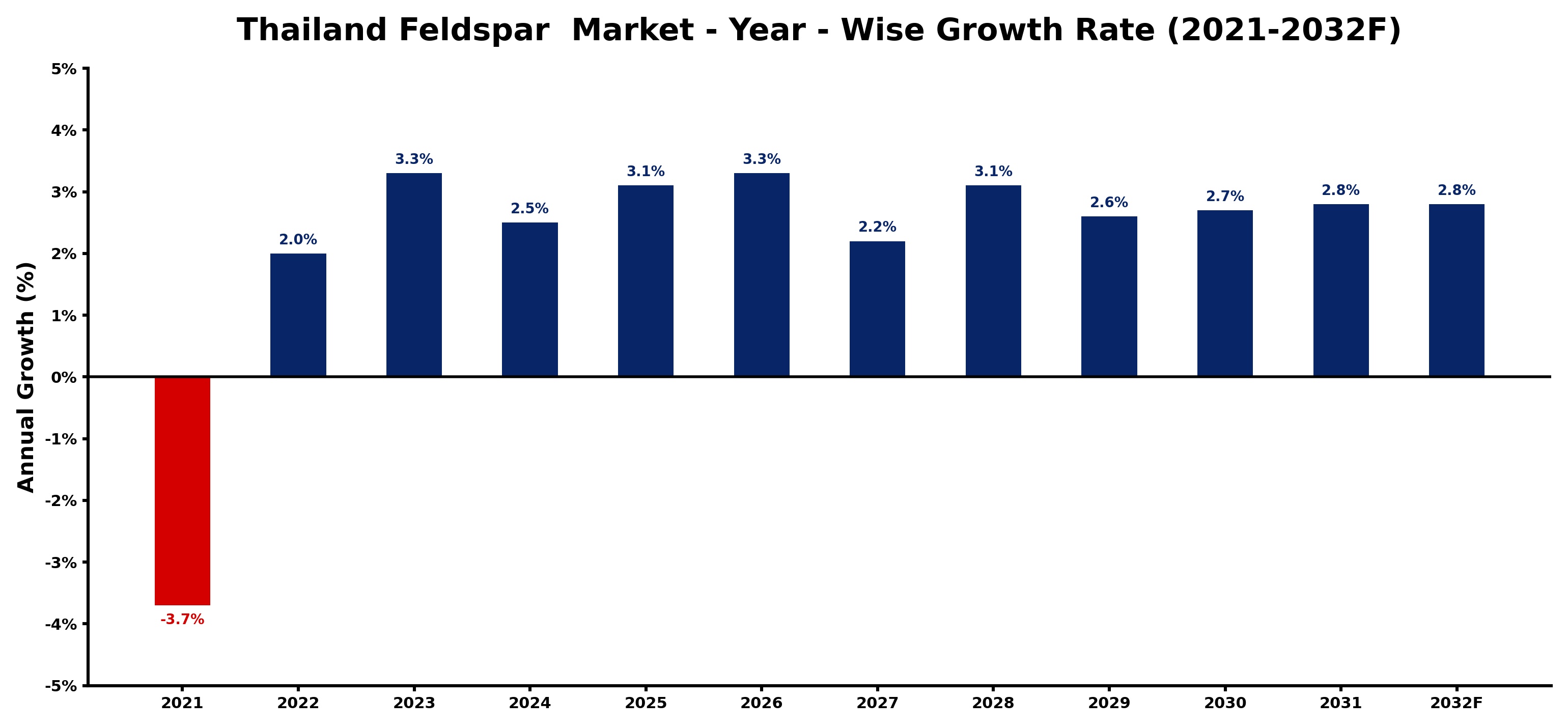
The table below presents the year‑wise growth rates along with the key drivers influencing the market
| Year | Growth Rate | Major Drivers |
| 2021 | -3.7% | Supply chain disruptions hinder feldspar production and market availability |
| 2022 | 2.0% | Higher construction sector investment boosted feldspar demand in ceramics |
| 2023 | 3.3% | Local ceramics manufacturers boost feldspar demand through capacity upgrades |
| 2024 | 2.5% | Domestic manufacturing investments boost feldspar supply for ceramics production |
| 2025 | 3.1% | Technology integration in mining enhances feldspar production efficiency |
| 2026 | 3.3% | Regional ceramic manufacturers boost feldspar sourcing for export demand |
| 2027 | 2.2% | Local ceramics production boosts feldspar demand for quality enhancements |
| 2028 | 3.1% | Upgraded milling technologies boosted feldspar quality for ceramics industry |
| 2029 | 2.6% | Ceramic sector demand surge bolstered feldspar processing facility investments |
| 2030 | 2.7% | Increased local manufacturing investment boosts Thailand's feldspar production capacity |
| 2031 | 2.8% | Technology integration streamlined feldspar processing and enhanced export competitiveness |
| 2032 | 2.8% | Domestic feldspar producers expanded capacity to meet rising ceramic demand |
Note - Market size estimations and growth projections presented in this report are based on 6Wresearch's advanced forecasting approach, validated with industry datasets as of June 2026.
Thailand Feldspar Market Synopsis
The feldspar market in Thailand is characterized by a dynamic interplay of local demand and export opportunities, particularly in the ceramic sector. With the continuous expansion of construction activities and a surge in the popularity of ceramics, the market exhibits a stable growth outlook.
Moreover, factors such as increased purchasing power parity (PPP) are fostering a renovation boom, further driving the consumption of feldspar in various applications. As industries seek high-quality materials, the Thai feldspar market is positioned to adapt and innovate in response to these demands.
Thailand Feldspar Market Key Takeaways
- The market size is projected to grow from USD 240 Million in 2025 to USD 273 Million by 2032.
- Ceramic and glass industries are the primary demand drivers for feldspar in Thailand.
- Increased PPP is leading to a rise in home renovation activities, boosting feldspar consumption.
- The market is expected to experience a consistent growth rate of 1.9% from 2026 to 2032.
- Quality assurance and innovation are essential for Thai exporters to enhance global competitiveness.
Evaluation of Restraints in Thailand Feldspar Market
Despite the positive market outlook, the Thailand feldspar market is confronted by several constraints that could hinder growth. Key among these is the challenge of maintaining a competitive edge in the face of global competition, which can lead to price pressures and fluctuating demand. Additionally, the market's heavy reliance on export activities makes it vulnerable to geopolitical shifts and trade regulations. Establishing a diverse export portfolio and focusing on value-added products could be vital in overcoming these challenges and enhancing market resilience.
Thailand Feldspar Market Trends
Several trends are currently influencing the feldspar market in Thailand. A significant movement towards eco-friendly and sustainable manufacturing practices is evident, as consumers become more environmentally conscious. This trend is prompting manufacturers to seek out sustainably sourced materials, which could elevate the importance of quality certification in the supply chain. Furthermore, advancements in technology are facilitating more efficient extraction and processing methods, thus improving product quality and operational efficiency.
Thailand Feldspar Market Opportunities
The Thai feldspar market holds substantial growth opportunities, particularly in niche sectors such as specialty ceramics and composite materials. There is an increasing potential for Thai exporters to penetrate new international markets, specifically in Asia-Pacific and Europe, where demand for high-quality feldspar is on the rise. Additionally, leveraging digital marketing and establishing strategic partnerships with international buyers can further enhance market penetration and revenue generation.
Government Initiatives in the Thailand Feldspar Market
The Thai government has implemented various initiatives aimed at boosting the mining and minerals sector, which includes feldspar. Supportive policies and incentives are in place to encourage investment in modern extraction technologies and sustainable practices. Additionally, public spending on infrastructure projects stimulates demand for construction materials, indirectly benefiting the feldspar market. By promoting research and development, the government also aims to position Thailand as a competitive player in the global minerals market.
Future Insights of the Thailand Feldspar Market
Looking ahead to 2026-2032, the Thailand feldspar market is expected to evolve with the growing emphasis on product diversification and quality. As the construction and ceramics industries continue to thrive, increased collaboration between stakeholders in these sectors can drive innovation and efficiency. Furthermore, a stronger focus on sustainability and eco-friendly practices will likely become a determining factor for competitiveness, pushing market players to invest in greener technologies and sustainable sourcing methods.
Thailand Feldspar Market Latest Developments (May 2025 - June 2026)
Recent developments in the Thailand feldspar market indicate a proactive approach towards innovation and sustainability. Companies are increasingly investing in research to improve the extraction processes while focusing on the production of high-quality feldspar tailored to specific industry needs. Additionally, trade missions and international collaborations are fostering opportunities for Thai exporters, enhancing their visibility in the global market.
Thailand Feldspar Market - Key Attractiveness of the Report
- 10 Years of Market Numbers
- Historical Data Starting from 2022 to 2025
- Base Year: 2025
- Forecast Data until 2032
- Key Performance Indicators Impacting the Market
- Major Upcoming Developments and Projects
Key Highlights of the Report:
- Thailand Feldspar Market Outlook
- Market Size of Thailand Feldspar Market, 2025
- Forecast of Thailand Feldspar Market, 2032
- Historical Data and Forecast of Thailand Feldspar Revenues & Volume for the Period 2022-2032F
- Thailand Feldspar Market Trend Evolution
- Thailand Feldspar Market Drivers and Challenges
- Thailand Feldspar Price Trends
- Thailand Feldspar Porter's Five Forces
- Thailand Feldspar Industry Life Cycle
- Historical Data and Forecast of Thailand Feldspar Market Revenues & Volume By Type for the Period 2022-2032F
- Historical Data and Forecast of Thailand Feldspar Market Revenues & Volume By Plagioclase feldspar for the Period 2022-2032F
- Historical Data and Forecast of Thailand Feldspar Market Revenues & Volume By K-feldspar for the Period 2022-2032F
- Historical Data and Forecast of Thailand Feldspar Market Revenues & Volume By End-users for the Period 2022-2032F
- Historical Data and Forecast of Thailand Feldspar Market Revenues & Volume By Glassmaking for the Period 2022-2032F
- Historical Data and Forecast of Thailand Feldspar Market Revenues & Volume By Ceramics for the Period 2022-2032F
- Historical Data and Forecast of Thailand Feldspar Market Revenues & Volume By Pottery for the Period 2022-2032F
- Historical Data and Forecast of Thailand Feldspar Market Revenues & Volume By Others for the Period 2022-2032F
- Thailand Feldspar Import Export Trade Statistics
- Market Opportunity Assessment By Type
- Market Opportunity Assessment By End-users
- Thailand Feldspar Top Companies Market Share
- Thailand Feldspar Competitive Benchmarking By Technical and Operational Parameters
- Thailand Feldspar Company Profiles
- Thailand Feldspar Key Strategic Recommendations






































