Thailand Fiber Optic Cable Market Size Growth Rate
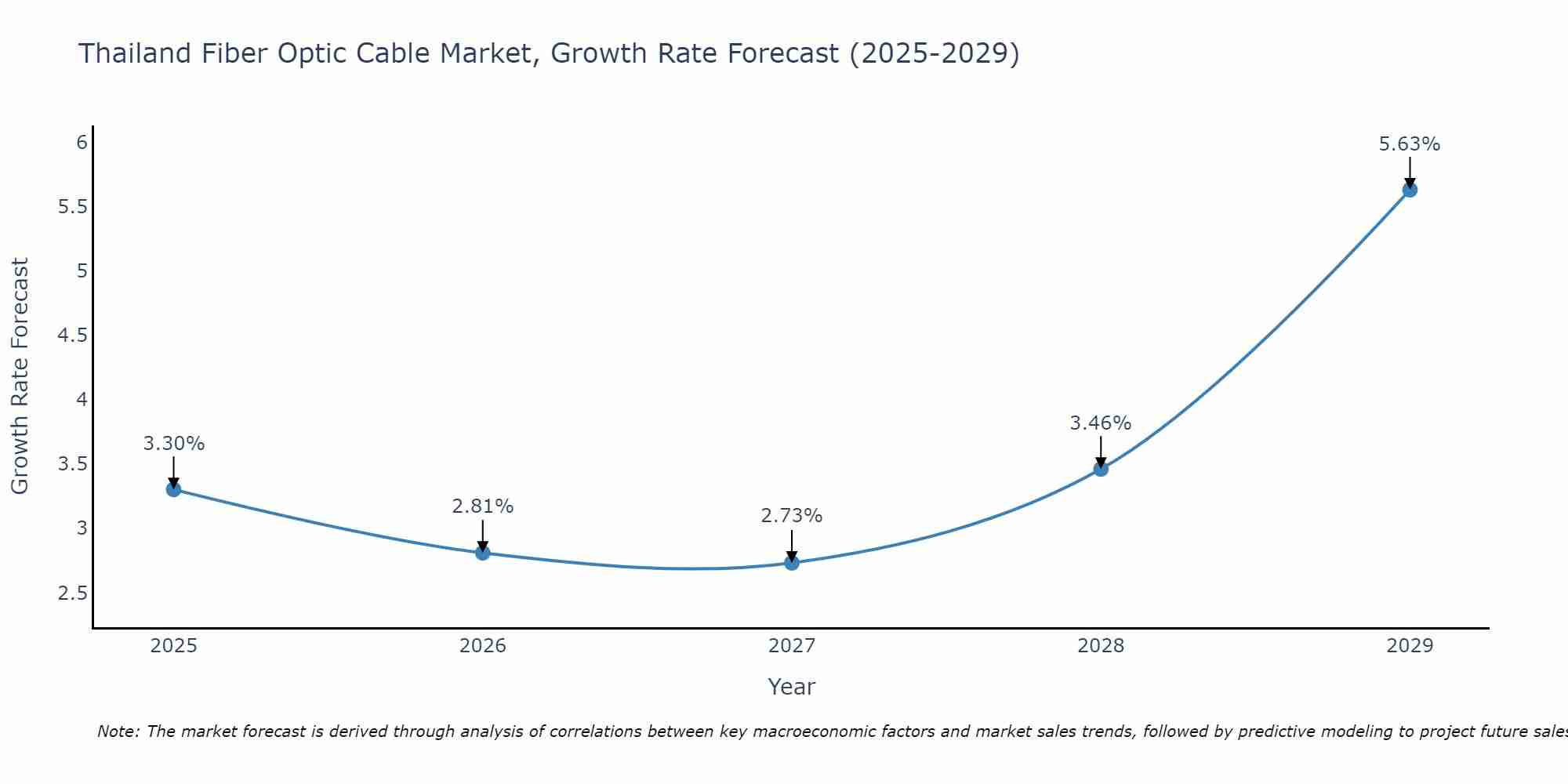
The Thailand Fiber Optic Cable Market is projected to witness mixed growth rate patterns during 2025 to 2029. From 3.30% in 2025, the growth rate steadily ascends to 5.63% in 2029.
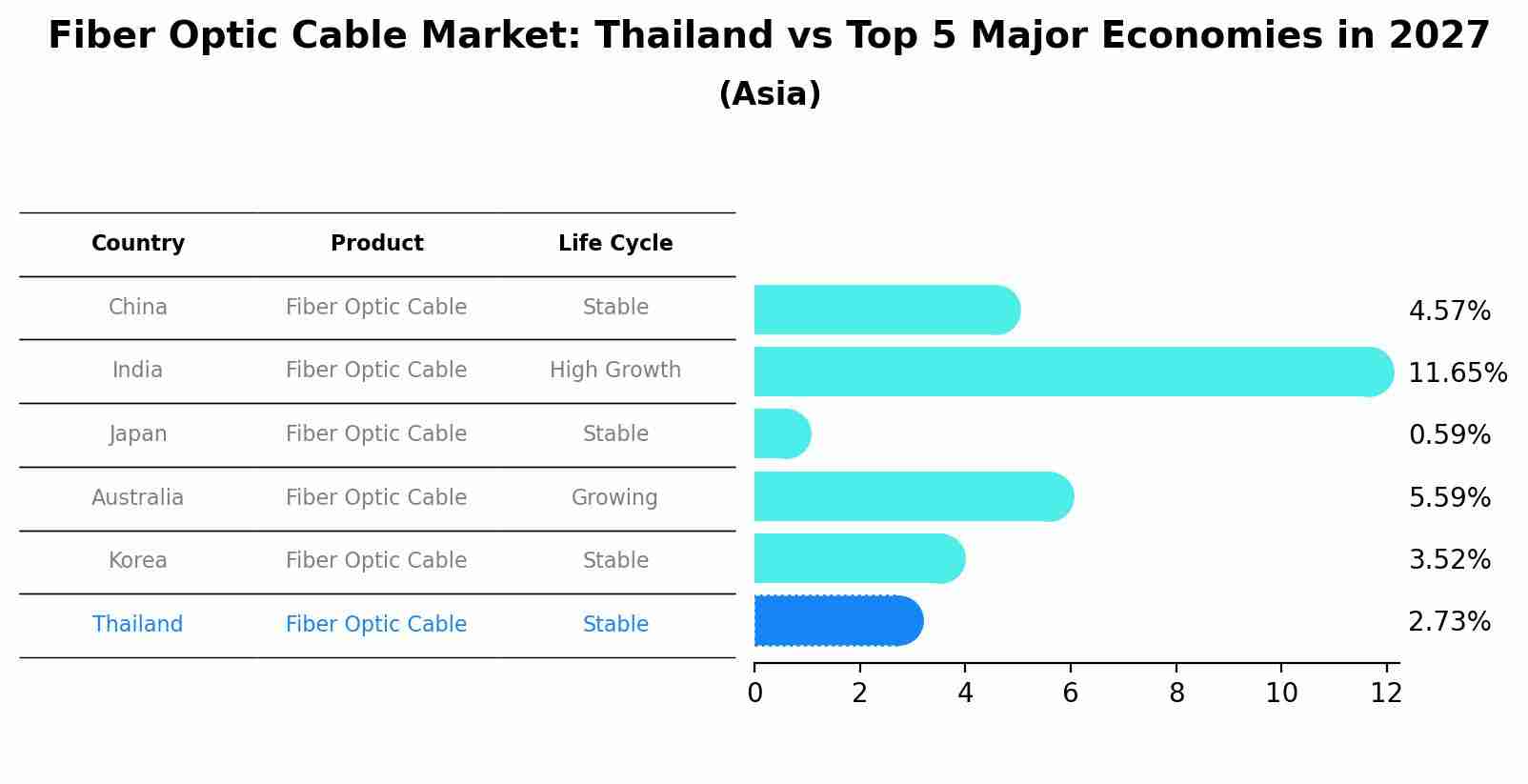
Fiber Optic Cable Market: Thailand vs Top 5 Major Economies in 2027 (Asia)
Thailand's Fiber Optic Cable market is anticipated to experience a stable growth rate of 2.73% by 2027, reflecting trends observed in the largest economy China, followed by India, Japan, Australia and South Korea.
Thailand Fiber Optic Cable Market Synopsis
The Thailand fiber optic cable market has experienced substantial growth as the country continues to invest in expanding its telecommunications and internet infrastructure. Fiber optic cables are at the forefront of high-speed data transmission, and their use is critical for delivering fast and reliable internet connectivity, as well as supporting the growing demand for digital services. Telecom operators, businesses, and government initiatives have all contributed to the expansion of fiber optic networks across Thailand. The market is expected to maintain its upward trajectory, driven by the need for enhanced broadband connectivity and the adoption of emerging technologies like 5G.
Drivers of the Market
The Thailand Fiber Optic Cable market is growing rapidly due to several drivers. Firstly, the demand for high-speed and reliable internet connectivity is propelling the expansion of fiber optic networks across the country. The increasing adoption of online services, including video streaming, e-commerce, and remote work, is driving the need for robust communication infrastructure. Moreover, government initiatives to improve digital connectivity and the development of smart cities are accelerating the deployment of fiber optic cables. Additionally, the advantages of fiber optic technology, such as high bandwidth and low latency, are fueling its adoption in various sectors, including telecommunications and data centers.
Challenges of the Market
Challenges in the Thailand Fiber Optic Cable market include the need for extensive infrastructure development and maintenance to support high-speed connectivity. Market players must also address concerns related to cable quality, reliability, and data security. Moreover, competition and pricing pressure can impact profitability.
COVID-19 Impact on the Market
The Thailand Fiber Optic Cable market remained resilient during the COVID-19 pandemic. The increased demand for high-speed internet and connectivity, driven by remote work, online education, and entertainment, sustained the market. The pandemic highlighted the importance of reliable internet infrastructure, leading to investments in expanding and upgrading fiber optic networks. This trend is expected to continue in the post-pandemic era as digitalization remains a priority.
Key Players in the Market
The Thailand fiber optic cable market features leading players known for their advanced optical communication solutions. Companies like Corning Incorporated, Prysmian Group, and Furukawa Electric Co., Ltd. are key contributors to this sector. They manufacture a wide range of fiber optic cables, connectors, and accessories, supporting high-speed data transmission and telecommunications infrastructure. Their commitment to innovation and connectivity has established them as leaders in the Thailand fiber optic cable market.
Key Highlights of the Report:
- Thailand Fiber Optic Cable Market Outlook
- Market Size of Thailand Fiber Optic Cable Market, 2024
- Forecast of Thailand Fiber Optic Cable Market, 2031
- Historical Data and Forecast of Thailand Fiber Optic Cable Revenues & Volume for the Period 2021-2031
- Thailand Fiber Optic Cable Market Trend Evolution
- Thailand Fiber Optic Cable Market Drivers and Challenges
- Thailand Fiber Optic Cable Price Trends
- Thailand Fiber Optic Cable Porter's Five Forces
- Thailand Fiber Optic Cable Industry Life Cycle
- Historical Data and Forecast of Thailand Fiber Optic Cable Market Revenues & Volume By Cable Type for the Period 2021-2031
- Historical Data and Forecast of Thailand Fiber Optic Cable Market Revenues & Volume By Single-Mode for the Period 2021-2031
- Historical Data and Forecast of Thailand Fiber Optic Cable Market Revenues & Volume By Multi-Mode for the Period 2021-2031
- Historical Data and Forecast of Thailand Fiber Optic Cable Market Revenues & Volume By Material for the Period 2021-2031
- Historical Data and Forecast of Thailand Fiber Optic Cable Market Revenues & Volume By Glass for the Period 2021-2031
- Historical Data and Forecast of Thailand Fiber Optic Cable Market Revenues & Volume By Plastic for the Period 2021-2031
- Historical Data and Forecast of Thailand Fiber Optic Cable Market Revenues & Volume By Application for the Period 2021-2031
- Historical Data and Forecast of Thailand Fiber Optic Cable Market Revenues & Volume By Communication for the Period 2021-2031
- Historical Data and Forecast of Thailand Fiber Optic Cable Market Revenues & Volume By Power Transmission for the Period 2021-2031
- Historical Data and Forecast of Thailand Fiber Optic Cable Market Revenues & Volume By Sensor for the Period 2021-2031
- Historical Data and Forecast of Thailand Fiber Optic Cable Market Revenues & Volume By Others for the Period 2021-2031
- Thailand Fiber Optic Cable Import Export Trade Statistics
- Market Opportunity Assessment By Cable Type
- Market Opportunity Assessment By Material
- Market Opportunity Assessment By Application
- Thailand Fiber Optic Cable Top Companies Market Share
- Thailand Fiber Optic Cable Competitive Benchmarking By Technical and Operational Parameters
- Thailand Fiber Optic Cable Company Profiles
- Thailand Fiber Optic Cable Key Strategic Recommendations






































