Thailand Home Mortgage Finance Market (2026-2032) | Segmentation, Competitive Landscape, Outlook, Share, Industry, Trends, Forecast, Growth, Value, Analysis, Size & Revenue, Companies
Market Forecast By Application (home purchase, refinance, home improvement, Others), By Providers (Banks, Housing Finance Companies, Real Estate Agents), By interest rate (fixed rate mortgage loan, adjustable rate mortgage loan) And Competitive Landscape
| Product Code: ETC9689635 | Publication Date: Sep 2024 | Updated Date: May 2026 | Product Type: Market Research Report | |
| Publisher: 6Wresearch | Author: Shubham Padhi | No. of Pages: 75 | No. of Figures: 35 | No. of Tables: 20 |
Thailand Home Mortgage Finance Market Growth Rate
According to 6Wresearch internal database and industry insights, the Thailand Home Mortgage Finance Market is anticipated to grow at a compound annual growth rate (CAGR) of 8.6% during the forecast period (2026–2032).
Thailand Home Mortgage Finance Market Year-wise Growth Rate and Key Drivers
This graph highlights how the Thailand Home Mortgage Finance Market has steadily grown over the past five years, supported by major growth factors.
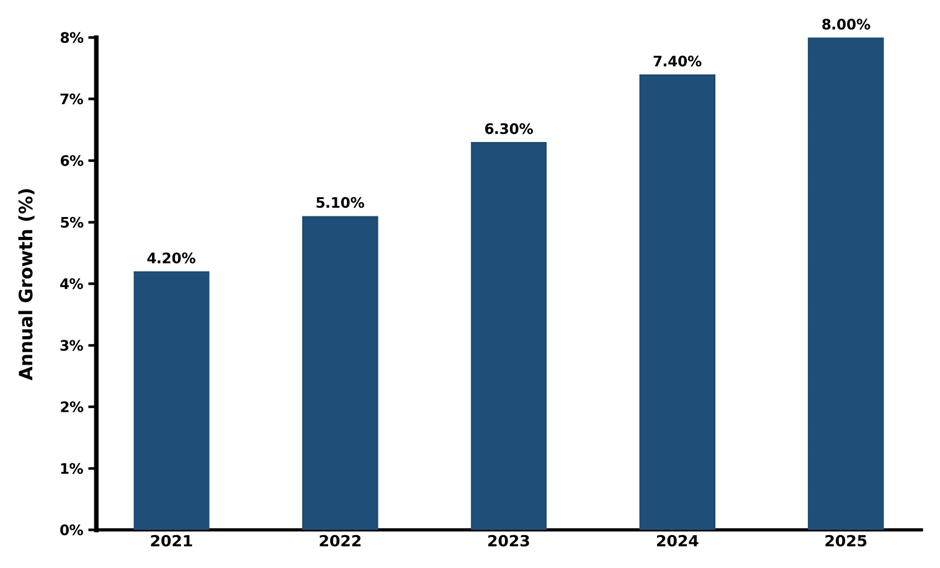
The table below presents the year‑wise growth rates along with the key drivers influencing the market
| Year | Est. Annual Growth (%) | Growth Drivers |
| 2021 | 4.2% | Gradual post-pandemic recovery in housing demand backed by low interest rates and government stimulus. |
| 2022 | 5.1% | Rising urbanisation and increased appetite for residential property ownership in Bangkok and surrounding provinces. |
| 2023 | 6.3% | The growing participation of housing finance companies in retail lending. |
| 2024 | 7.4% | Increased foreign investment in Thai real estate and improved credit accessibility through NBFCs and commercial banks. |
| 2025 | 8% | A surge in affordable housing schemes and rising middle-class homeownership aspirations. |
Topics Covered in the Thailand Home Mortgage Finance Market Report
The Thailand Home Mortgage Finance Market report covers market by application, providers, and interest rate. The report highlights key opportunities and strategic insights for stakeholders to align with evolving housing finance trends.
Thailand Home Mortgage Finance Market Highlights
| Report Name |
Thailand Home Mortgage Finance Market |
| Forecast period | 2026-2032 |
| CAGR | 8.6% |
| Market Size |
Housing & Financial Services Sector |
Thailand Home Mortgage Finance Market Synopsis
The Thailand Home Mortgage Finance Industry has been experiencing a steady growth owing to growing shift of rural population to urban areas and government actions supporting affordable housing development. Improved credit access through commercial banks, specialised housing finance companies, and digital lending platforms is further strengthening market development. The market is also benefiting from streamlined loan documentation processes, growing financial literacy among first-time homebuyers, and increasing demand for structured mortgage solutions at competitive interest rates across Bangkok, Chiang Mai, Phuket, and emerging tier-2 cities.
Evaluation of Growth Drivers in Thailand Home Mortgage Finance Market
Below mentioned are some growth drivers and their impact on market dynamics:
| Drivers | Primary Segment Affected | Why It Matters (Evidence) |
| Rising Urbanisation | Housing Demand, Lending | Increasing migration to Bangkok and major cities boosts residential property loan demand. |
| Government Housing Schemes | Credit Access, Affordable Housing | State-sponsored schemes help improve borrowing opportunities for those in the lower and middle-income brackets. |
| Low and Competitive Interest Rates | Loan Demand, Affordability | Low borrowing costs from commercial banks push people to apply for home loans. |
| Digital Lending Platforms | Loan Processing, Distribution | Distribution Streamlined applications and faster approvals improve the overall borrower experience. |
| Increasing Income Levels | Consumer Borrowing Capacity | Increasing middle-class income of individuals strengthens eligibility and repayment capacity for home financing. |
The Thailand Home Mortgage Finance Market is deemed to grow at a steady pace of 8.6% CAGR over the forecast period (2026–2032), backed by some important factors, such as government's supportive policy frameworks and a strong demand for residential properties. Also, the introduction of digital lending platforms from banks and housing finance companies with improved credit accessibility is further supporting market development. Moreover, infrastructure development and upcoming smart city projects across the Eastern Economic Corridor (EEC) are contributing to higher demand for residential housing loans.
Evaluation of Restraints in Thailand Home Mortgage Finance Market
Below mentioned are some major restraints and their influence on market dynamics:
| Restraints | Primary Segment Affected | What This Means (Evidence) |
| Soaring Property Prices | Loan Accessibility | Surging real estate prices in Bangkok reduce affordability for lower and middle-income groups. |
| Strict Credit Requirements | Borrower Eligibility | Stringent lending norms of banks may restrict loan approvals for low-credit or self-employed customers. |
| Changes in Interest Rate | EMI Burden | Due to major changes in home loan interest rates, long-term repayment stability can also be affected. |
| Economic Uncertainty | Lending Growth | The volatility of the tourism industry and economic slowdowns can negatively impact housing demand and the procurement of loans. |
| Informal Income Structure | Credit Assessment | The informal nature of income for a large part of Thailand’s labor force creates obstacles for lenders in conducting credit checks. |
Thailand Home Mortgage Finance Market Challenges
The Thailand Home Mortgage Finance Market faces several obstacles. Some of them are affordability constraints in urban centres and changing interest rates of lending companies. Besides that, limited financial literacy in semi-urban as well as rural provinces restricts mortgage penetration to the broader population. However, these challenges can be addressed by implementing improved credit scoring models, targeted awareness campaigns on home financing benefits, and by expanding the digital lending ecosystem across underserved regions.
Thailand Home Mortgage Finance Market Trends
Below mentioned are some of the major trends responsible for Thailand Home Mortgage Finance Market Growth:
- Digital Transformation in Mortgage Lending: The mortgage finance sector is shifting from traditional branch-based operations to digital lending platforms and improving overall operational efficiency across commercial banks and housing finance companies.
- Strong Growth of First-Time Homebuyers: Flexible EMI options and enhanced credit systems are pushing young urban professionals in Bangkok to make early homeownership decisions.
- Expansion into Tier-2 Cities: As infrastructure development progresses, demand for mortgages is on the rise in semi-urban areas such as Chiang Mai, Khon Kaen, and Pattaya, moving beyond Bangkok.
Investment Opportunities in the Thailand Home Mortgage Finance Market
Given below is the detailed overview of investment opportunities available in Thailand Home Mortgage Finance Market:
- Expansion in Affordable Housing Finance Segment: One of the strongest opportunities lies in affordable housing loans, which are growing faster than premium housing loans. Housing finance companies are witnessing rapid expansion due to unmet credit demand and limited banking penetration in lower-income segments.
- Growth in Tier-2 and Tier-3 City Lending: Non-metro cities are emerging as growth engines owing to their improving infrastructure, lower property prices, and increasing self-employed and salaried-class borrowers, improving long-term loan portfolio scalability.
- Rise of Housing Finance Companies and Fintech Lenders: Specialised HFCs and fintech-driven mortgage platforms are becoming key investment vehicles in country's housing mortgage ecosystem on account of expeditious loan approvals and presence in semi-urban markets.
Top 5 Leading Players in Thailand Home Mortgage Finance Market
Stated below are some of the leading companies holding majority of Thailand Home Mortgage Finance Market Shares:
1. Government Housing Bank (GHB)
| Company Name | Government Housing Bank (GHB) |
|---|---|
| Established Year | 1953 |
| Headquarters | Bangkok, Thailand |
| Official Website | Click Here |
Government Housing Bank is the largest and most prominent housing finance institution in Thailand, established specifically to support residential property ownership. It dominates the market through its state-backed mandate, competitive interest rates, and extensive branch network.
2. Kasikorn Bank (KBank)
| Company Name | Kasikorn Bank (KBank) |
|---|---|
| Established Year | 1945 |
| Headquarters | Bangkok, Thailand |
| Official Website | Click Here |
Kasikorn Bank is one of Thailand's largest and most innovative commercial banks, known for its digital banking capabilities and strong retail mortgage portfolio. It leads in digital mortgage processing, fast loan approvals, and a broad customer base spanning urban and semi-urban markets.
3. Bangkok Bank
| Company Name | Bangkok Bank |
|---|---|
| Established Year | 1944 |
| Headquarters | Bangkok, Thailand |
| Official Website | Click Here |
Bangkok Bank is Thailand's largest commercial bank by total assets and a significant player in the home mortgage finance market. It offers a comprehensive range of home loan products for both Thai nationals and foreign residents.
4. Krungthai Bank (KTB)
| Company Name | Krungthai Bank (KTB) |
|---|---|
| Established Year | 1966 |
| Headquarters | Bangkok, Thailand |
| Official Website | Click Here |
Krungthai Bank is a state-owned commercial bank with a strong presence in Thailand's retail lending market. It is a major provider of home mortgage loans, particularly to government employees, public sector workers, and middle-income borrowers.
5. SCB (Siam Commercial Bank)
| Company Name | SCB (Siam Commercial Bank) |
|---|---|
| Established Year | 1906 |
| Headquarters | Bangkok, Thailand |
| Official Website | Click Here |
Siam Commercial Bank is one of Thailand's oldest and most established financial institutions, offering a wide range of competitive home loan products. SCB is known for its strong digital banking transformation and growing presence in affordable and mid-segment housing finance.
Government Initiatives Being Implemented in the Thailand Home Mortgage Finance Market
Based on Thai government data, some key measures have been undertaken by the above-mentioned authorities in order to improve the home mortgage finance market. These include the provision of subsidy programs through the Government Housing Bank for home mortgages in favour of low and middle-income groups of people, thereby decreasing the EMI burden for such people. Furthermore, the National Housing Authority (NHA) works on developing and financing affordable housing schemes for the Thai citizens who meet their criteria. The loan-to-value policy of the Bank of Thailand makes the system stable and ensures security for lenders.
Future Insights of the Thailand Home Mortgage Finance Market
There will be significant growth in the Thailand Home Mortgage Finance Market, due to factors such as increasing income levels, high demand for affordable houses, and ongoing developments in infrastructure under the Eastern Economic Corridor project. Moreover, the adoption of digital technology will enhance the lending process significantly. There will also be a move into tier-2 and tier-3 cities from Bangkok. Government housing schemes and favourable interest rate environments will continue to support demand. Overall, the market is likely to evolve into a more technology-driven, risk-managed ecosystem with strong long-term growth potential.
Market Segmentation Analysis
The report offers a comprehensive study of the following market segments and their leading categories in Thailand Home Mortgage Finance Market:
By Application – Home Purchase Dominates the Market
According to Mansi, Senior Research Analyst, 6Wresearch, Home purchase dominates the segment, driven by strong end-user demand for residential ownership, urbanisation, and government support for affordable housing. First-time homebuyers and salaried individuals form the largest borrower base, making it the primary driver of mortgage lending across Thailand.
By Providers – Banks to Lead the Market
Banks dominate this segment, primarily due to their wide branch network, lower interest rates, strong customer trust, and large balance sheets, which enable high-value loan disbursements across both urban and provincial markets.
Key Attractiveness of the Report:
- 10 Years of Market Numbers
- Historical Data Starting from 2022 to 2025
- Base Year: 2025
- Forecast Data until 2032
- Key Performance Indicators Impacting the Market
- Major Upcoming Developments and Projects
Key Highlights of the Report:
- Thailand Home Mortgage Finance Market Outlook
- Market Size of Thailand Home Mortgage Finance Market, 2025
- Forecast of Thailand Home Mortgage Finance Market, 2032
- Historical Data and Forecast of Thailand Home Mortgage Finance Revenues & Volume for the Period 2022–2032
- Thailand Home Mortgage Finance Market Trend Evolution
- Thailand Home Mortgage Finance Market Drivers and Challenges
- Thailand Home Mortgage Finance Price Trends
- Thailand Home Mortgage Finance Porter's Five Forces
- Thailand Home Mortgage Finance Industry Life Cycle
- Historical Data and Forecast of Thailand Home Mortgage Finance Market Revenues & Volume By Application for the Period 2022–2032
- Historical Data and Forecast of Thailand Home Mortgage Finance Market Revenues & Volume By Home Purchase for the Period 2022–2032
- Historical Data and Forecast of Thailand Home Mortgage Finance Market Revenues & Volume By Refinance for the Period 2022–2032
- Historical Data and Forecast of Thailand Home Mortgage Finance Market Revenues & Volume By Home Improvement for the Period 2022–2032
- Historical Data and Forecast of Thailand Home Mortgage Finance Market Revenues & Volume By Others for the Period 2022–2032
- Historical Data and Forecast of Thailand Home Mortgage Finance Market Revenues & Volume By Providers for the Period 2022–2032
- Historical Data and Forecast of Thailand Home Mortgage Finance Market Revenues & Volume By Banks for the Period 2022–2032
- Historical Data and Forecast of Thailand Home Mortgage Finance Market Revenues & Volume By Housing Finance Companies for the Period 2022–2032
- Historical Data and Forecast of Thailand Home Mortgage Finance Market Revenues & Volume By Real Estate Agents for the Period 2022–2032
- Historical Data and Forecast of Thailand Home Mortgage Finance Market Revenues & Volume By Interest Rate for the Period 2022–2032
- Historical Data and Forecast of Thailand Home Mortgage Finance Market Revenues & Volume By Fixed Rate Mortgage Loan for the Period 2022–2032
- Historical Data and Forecast of Thailand Home Mortgage Finance Market Revenues & Volume By Adjustable Rate Mortgage Loan for the Period 2022–2032
- Thailand Home Mortgage Finance Import Export Trade Statistics
- Market Opportunity Assessment By Application
- Market Opportunity Assessment By Providers
- Market Opportunity Assessment By Interest Rate
- Thailand Home Mortgage Finance Top Companies Market Share
- Thailand Home Mortgage Finance Competitive Benchmarking By Technical and Operational Parameters
- Thailand Home Mortgage Finance Company Profiles
- Thailand Home Mortgage Finance Key Strategic Recommendations
Market Covered
The report offers an extensive study of the following market segments:
By Application
- Home Purchase
- Refinance
- Home Improvement
- Others
By Providers
- Banks
- Housing Finance Companies
- Real Estate Agents
By Interest Rate
- Fixed Rate Mortgage Loan
- Adjustable Rate Mortgage Loan
Thailand Home Mortgage Finance Market (2026-2032): FAQs
Thailand Home Mortgage Finance Market is anticipated to grow at the compound annual growth rate (CAGR) of 8.6% during the forecast period (2026–2032).
Thailand Home Mortgage Finance Market is rapidly evolving with digital-first lending and increasing use of AI-driven credit assessment systems.
Government Housing Bank programmes and Bank of Thailand macroprudential lending policies are strengthening Thailand's home mortgage finance market.
Thailand Home Mortgage Finance Market offers strong growth opportunities through affordable housing finance expansion and growing private equity and foreign investments.
6Wresearch actively monitors the Thailand Home Mortgage Finance Market and publishes its comprehensive annual report, highlighting emerging trends, growth drivers, revenue analysis, and forecast outlook. Our insights help businesses to make data-backed strategic decisions with ongoing market dynamics. Our analysts track relevent industries related to the Thailand Home Mortgage Finance Market, allowing our clients with actionable intelligence and reliable forecasts tailored to emerging regional needs.
Yes, we provide customisation as per your requirements. To learn more, feel free to contact us on sales@6wresearch.com
| 1 Executive Summary |
| 2 Introduction |
| 2.1 Key Highlights of the Report |
| 2.2 Report Description |
| 2.3 Market Scope & Segmentation |
| 2.4 Research Methodology |
| 2.5 Assumptions |
| 3 Thailand Home Mortgage Finance Market Overview |
| 3.1 Thailand Country Macro Economic Indicators |
| 3.2 Thailand Home Mortgage Finance Market Revenues & Volume, 2022 & 2032F |
| 3.3 Thailand Home Mortgage Finance Market - Industry Life Cycle |
| 3.4 Thailand Home Mortgage Finance Market - Porter's Five Forces |
| 3.5 Thailand Home Mortgage Finance Market Revenues & Volume Share, By Application, 2022 & 2032F |
| 3.6 Thailand Home Mortgage Finance Market Revenues & Volume Share, By Providers, 2022 & 2032F |
| 3.7 Thailand Home Mortgage Finance Market Revenues & Volume Share, By interest rate, 2022 & 2032F |
| 4 Thailand Home Mortgage Finance Market Dynamics |
| 4.1 Impact Analysis |
| 4.2 Market Drivers |
| 4.3 Market Restraints |
| 5 Thailand Home Mortgage Finance Market Trends |
| 6 Thailand Home Mortgage Finance Market, By Types |
| 6.1 Thailand Home Mortgage Finance Market, By Application |
| 6.1.1 Overview and Analysis |
| 6.1.2 Thailand Home Mortgage Finance Market Revenues & Volume, By Application, 2022- 2032F |
| 6.1.3 Thailand Home Mortgage Finance Market Revenues & Volume, By home purchase, 2022- 2032F |
| 6.1.4 Thailand Home Mortgage Finance Market Revenues & Volume, By refinance, 2022- 2032F |
| 6.1.5 Thailand Home Mortgage Finance Market Revenues & Volume, By home improvement, 2022- 2032F |
| 6.1.6 Thailand Home Mortgage Finance Market Revenues & Volume, By Others, 2022- 2032F |
| 6.2 Thailand Home Mortgage Finance Market, By Providers |
| 6.2.1 Overview and Analysis |
| 6.2.2 Thailand Home Mortgage Finance Market Revenues & Volume, By Banks, 2022- 2032F |
| 6.2.3 Thailand Home Mortgage Finance Market Revenues & Volume, By Housing Finance Companies, 2022- 2032F |
| 6.2.4 Thailand Home Mortgage Finance Market Revenues & Volume, By Real Estate Agents, 2022- 2032F |
| 6.3 Thailand Home Mortgage Finance Market, By interest rate |
| 6.3.1 Overview and Analysis |
| 6.3.2 Thailand Home Mortgage Finance Market Revenues & Volume, By fixed rate mortgage loan, 2022- 2032F |
| 6.3.3 Thailand Home Mortgage Finance Market Revenues & Volume, By adjustable rate mortgage loan, 2022- 2032F |
| 7 Thailand Home Mortgage Finance Market Import-Export Trade Statistics |
| 7.1 Thailand Home Mortgage Finance Market Export to Major Countries |
| 7.2 Thailand Home Mortgage Finance Market Imports from Major Countries |
| 8 Thailand Home Mortgage Finance Market Key Performance Indicators |
| 9 Thailand Home Mortgage Finance Market - Opportunity Assessment |
| 9.1 Thailand Home Mortgage Finance Market Opportunity Assessment, By Application, 2022 & 2032F |
| 9.2 Thailand Home Mortgage Finance Market Opportunity Assessment, By Providers, 2022 & 2032F |
| 9.3 Thailand Home Mortgage Finance Market Opportunity Assessment, By interest rate, 2022 & 2032F |
| 10 Thailand Home Mortgage Finance Market - Competitive Landscape |
| 10.1 Thailand Home Mortgage Finance Market Revenue Share, By Companies, 2025 |
| 10.2 Thailand Home Mortgage Finance Market Competitive Benchmarking, By Operating and Technical Parameters |
| 11 Company Profiles |
| 12 Recommendations |
| 13 Disclaimer |
Global Go To Market Strategy - 2030
Export potential enables firms to identify high-growth global markets with greater confidence by combining advanced trade intelligence with a structured quantitative methodology. The framework analyzes emerging demand trends and country-level import patterns while integrating macroeconomic and trade datasets such as GDP and population forecasts, bilateral import–export flows, tariff structures, elasticity differentials between developed and developing economies, geographic distance, and import demand projections. Using weighted trade values from 2020–2024 as the base period to project country-to-country export potential for 2030, these inputs are operationalized through calculated drivers such as gravity model parameters, tariff impact factors, and projected GDP per-capita growth. Through an analysis of hidden potentials, demand hotspots, and market conditions that are most favorable to success, this method enables firms to focus on target countries, maximize returns, and global expansion with data, backed by accuracy.
By factoring in the projected importer demand gap that is currently unmet and could be potential opportunity, it identifies the potential for the Exporter (Country) among 190 countries, against the general trade analysis, which identifies the biggest importer or exporter.
To discover high-growth global markets and optimize your business strategy:
Click Here
Pricing
- Single User License$ 1,995
- Department License$ 2,400
- Site License$ 3,120
- Global License$ 3,795

Leadership Perspectives from Industry Events
Search
Thought Leadership and Analyst Meet





Our Clients








6WResearch In News
- India Export Attractiveness Tracker 2026
- India Air Conditioner Market Set for Strong Rebound in 2026 After Weather-Led Correction and GST-Driven Recovery: 6Wresearch
- ADAS in India: How Automatic Emergency Braking, Blind Spot Detection & Driver Monitoring are Transforming Road Safety
- Doha a strategic location for EV manufacturing hub: IPA Qatar
- Demand for luxury TVs surging in the GCC, says Samsung
- Empowering Growth: The Thriving Journey of Bangladesh’s Cable Industry
Latest Reports
- Qatar Access and Home Network Market (2026-2032)
- Nicaragua RPG Gaming Market (2026-2032)
- New Zealand RPG Gaming Market (2026-2032)
- Netherlands RPG Gaming Market (2026-2032)
- Nauru RPG Gaming Market (2026-2032)
- Namibia RPG Gaming Market (2026-2032)
- Mozambique RPG Gaming Market (2026-2032)
- Montenegro RPG Gaming Market (2026-2032)
- Mongolia RPG Gaming Market (2026-2032)
- Monaco RPG Gaming Market (2026-2032)
Industry Events and Analyst Meet

EV India Expo 2026

HIMTEX 2026

India Refining Summit 2026

India EV Show 2026

EV tech India Expo 2026
Whitepaper
- Middle East & Africa Commercial Security Market Click here to view more.
- Middle East & Africa Fire Safety Systems & Equipment Market Click here to view more.
- GCC Drone Market Click here to view more.
- Middle East Lighting Fixture Market Click here to view more.
- GCC Physical & Perimeter Security Market Click here to view more.


