Thailand Intruder Detection Systems Market (2026-2032) | Outlook, Industry, Value, Size, Revenue, Forecast, Companies, Analysis, Growth, Share & Trends
Market Forecast By Components (Hardware, Software), By Deployment (Infrastructure based, Cloud Based), By End-users (BFSI, IT& Communication, Aerospace & Defense, Software Industry, Manufacturing) And Competitive Landscape
| Product Code: ETC027105 | Publication Date: Jul 2023 | Updated Date: Jun 2026 | Product Type: Report | |
| Publisher: 6Wresearch | Author: Ravi Bhandari | No. of Pages: 70 | No. of Figures: 35 | No. of Tables: 5 |
Thailand Intruder Detection Systems Market Summary
The thailand intruder detection systems market was estimated at USD 83 Million in 2025 and is projected to reach USD 95 Million by 2032, growing at a CAGR of 3.3% from 2026 to 2032.
Thailand Intruder Detection Systems Market Growth Rate Analysis (2021-2032)
The Thailand Intruder Detection Systems market is projected to experience a rebound, moving from a decline of -3.7% in 2021 to a steady recovery with growth rates of 2.3% in 2022 and 3.2% from 2023 through 2024. This upward momentum can be attributed to heightened consumer demand for enhanced security solutions, particularly in response to increasing urbanization and safety concerns. As investment in technology grows, including digital surveillance systems, the market is expected to continue flourishing with growth rates peaking at 3.5% in 2025. However, the anticipated slowdown to around 2.1% by 2027 suggests potential market saturation and shifts in technological preferences that may challenge sustained growth.
Thailand Intruder Detection Systems Market Year-wise Growth Rate and Key Drivers
This graph highlights how the Thailand Intruder Detection Systems Market has steadily grown over the past five years, supported by major growth factors.
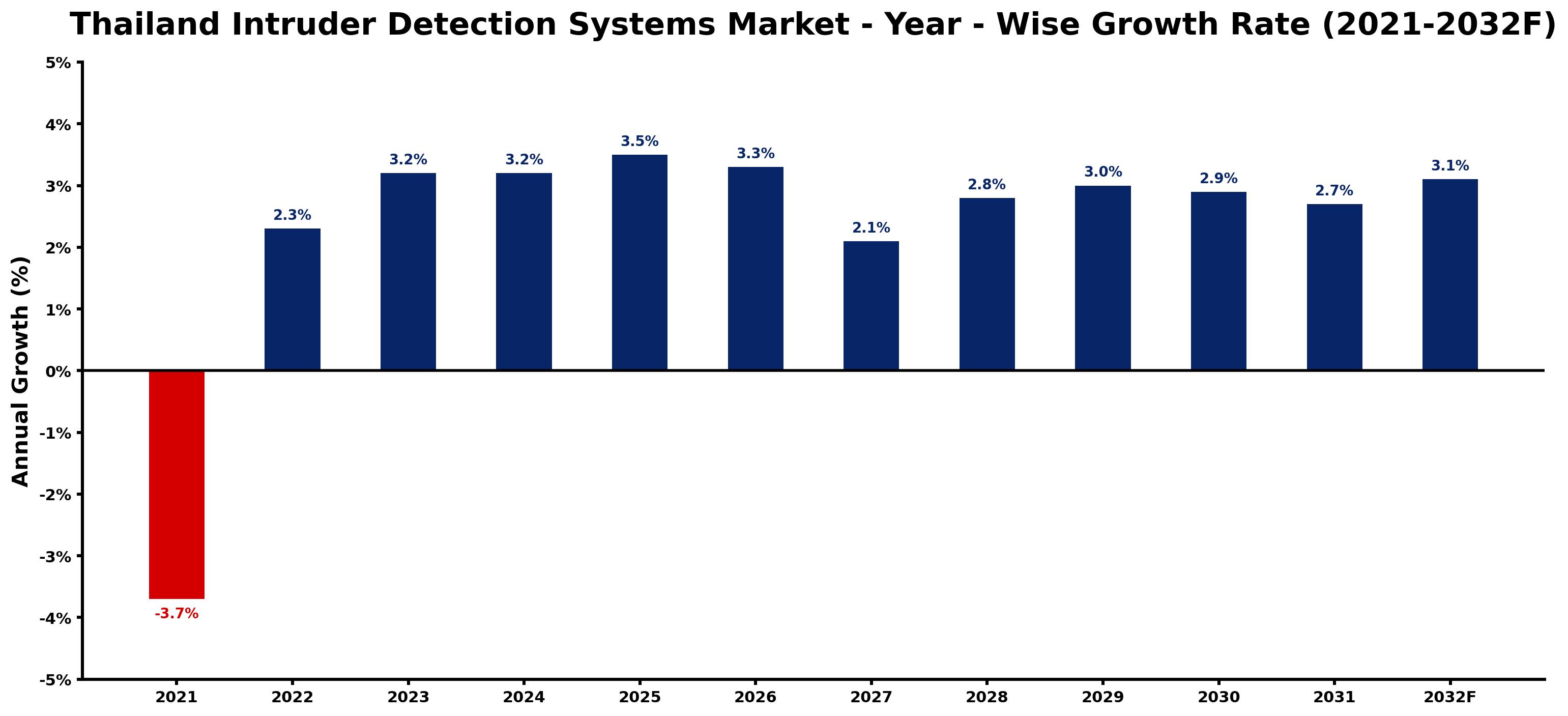
The table below presents the year wise growth rates along with the key drivers influencing the market
| Year | Growth Rate | Major Drivers |
| 2021 | -3.7% | Heightened economic uncertainty led to decreased investment in security infrastructure across commercial sectors. |
| 2022 | 2.3% | Increased urbanization fuels demand for advanced security solutions in metropolitan areas. |
| 2023 | 3.2% | Technological advancements enable integration of AI for smarter intruder detection systems. |
| 2024 | 3.2% | Rising concerns over burglary rates push consumers towards high-tech security options. |
| 2025 | 3.5% | Growing middle-class wealth enhances consumer spending on premium security installations. |
| 2026 | 3.3% | Smart home technology adoption drives demand for interconnected security systems. |
| 2027 | 2.1% | Insurance companies offer discounts for homes equipped with modern detection systems. |
| 2028 | 2.8% | Corporate investments in security systems reflect heightened focus on employee safety. |
| 2029 | 3.0% | Increased construction activities create opportunities for integrated security solutions in new builds. |
| 2030 | 2.9% | Enhanced public awareness campaigns promote safety, boosting market interest in intruder detection. |
| 2031 | 2.7% | Emerging tech startups introduce innovative solutions, expanding the competitive landscape significantly. |
| 2032 | 3.1% | Sustainability trends influence consumers to opt for eco-friendly security technologies. |
Note - Market size estimations and growth projections presented in this report are based on 6Wresearch's advanced forecasting approach, validated with industry datasets as of June 2026.
Thailand Intruder Detection Systems Market Synopsis
The Thailand Intruder Detection Systems Market is projected to reach 3.3% and witness significant growth during the forecast period (2026-2032). This market is poised to expand due to the increasing recognition of the need for advanced security measures in both public and private sectors. With the threat landscape becoming increasingly complex, there is a rising demand for reliable intruder detection solutions capable of monitoring and responding to potential security breaches.
Thailand Intruder Detection Systems Market Growth Drivers
Several factors are driving the growth of the Thailand Intruder Detection Systems Market. Firstly, the heightened fear of terrorist activities has compelled businesses and governmental bodies to invest in sophisticated security measures. The implementation of advanced technologies, such as AI and IoT, facilitates better surveillance and quicker response times, making these systems more attractive to users.
- Increasing geopolitical tensions globally have raised concerns about national security, leading to heightened investments in intruder detection systems.
- Commercial establishments, including shopping malls and retail stores, are adopting these systems to safeguard their assets and ensure customer safety.
- Government facilities and public venues like airports and metro stations require heightened security measures, thus driving demand for robust intruder detection systems.
- The integration of innovative technologies enhances system efficiency, leading to increased adoption rates across various sectors.
- Awareness and training regarding the importance of security solutions foster a culture of safety, further propelling market growth.
Thailand Intruder Detection Systems Market Challenges and Restraints
Despite the promising growth trajectory, the Thailand Intruder Detection Systems Market faces several challenges that may hinder its expansion. High installation costs associated with advanced security technologies can present a barrier, particularly for small-scale businesses.
- The high expense of sophisticated systems limits accessibility for smaller entities, resulting in a skewed market favoring larger corporations.
- Maintenance and operational costs associated with these technologies can deter long-term investments from budget-constrained organizations.
- The speed at which technology evolves can lead to obsolescence, prompting businesses to constantly invest in upgrades.
- Concerns over privacy and civil liberties arise when implementing extensive surveillance systems, leading to public resistance in certain areas.
- Operational complexity and the need for specialized staff to manage these systems can further complicate their adoption.
Thailand Intruder Detection Systems Market Impact of COVID-19
The COVID-19 pandemic has had a profound impact on various sectors globally, including the Thailand Intruder Detection Systems Market. While many industries struggled, this segment has shown resilience owing to increased concerns about personal security and the potential for future threats.
- Organizations have heightened their focus on employee safety and security measures, leading to increased spending on detection systems.
- Government bodies and larger corporations are re-evaluating their security budgets, often increasing allocations for advanced protection systems.
- The shift to remote operations has prompted businesses to invest in surveillance technologies to monitor vacant properties and ensure continued security.
- Concerns regarding potential civil unrest and security challenges during and post-pandemic have also driven investments in intruder detection.
- Overall, the pandemic has underscored the importance of modern security solutions in safeguarding assets and personnel.
Thailand Intruder Detection Systems Market Government Investment and Initiatives
The Thai government has initiated various programs and policies aimed at enhancing national security, which positively influences the intruder detection systems market. Investments in public safety and infrastructure improvements have been prioritized to address rising security concerns.
- The government is actively funding initiatives to upgrade security infrastructure in public transport systems, enhancing intruder detection capabilities.
- Policy frameworks are being developed to encourage businesses to adopt advanced security measures, providing incentives for the installation of state-of-the-art systems.
- Collaborative efforts between public and private sectors aim to create a safer environment, driving demand for intruder detection technologies.
- Public spending on security and defense has increased, reflecting a strategic focus on protecting citizens and assets against potential threats.
- Training programs for law enforcement and security personnel are being implemented to effectively utilize modern detection technologies.
Thailand Intruder Detection Systems Market Latest Developments (May 2025 - June 2026)
The Thailand Intruder Detection Systems Market has seen notable developments between May 2025 and June 2026, reflecting the dynamic nature of this sector. Companies are increasingly focusing on developing integrated solutions that combine multiple technologies to provide comprehensive security coverage.
- There has been a surge in partnerships aimed at integrating AI with existing intruder detection systems to enhance threat detection accuracy.
- Government initiatives continue to prioritize funding for technologies that reinforce national security, impacting adoption rates positively.
- Public awareness campaigns are being launched to educate citizens on the benefits of intruder detection systems, leading to increased consumer interest.
- Advancements in mobile technology are enabling remote monitoring capabilities, allowing users to oversee security systems from anywhere.
- Technological innovations, including smart sensors and real-time analytics, are gaining traction, driving the market toward modernization.
Thailand Intruder Detection Systems Market - Key Attractiveness of the Report
- 10 Years of Market Numbers
- Historical Data Starting from 2022 to 2025
- Base Year: 2025
- Forecast Data until 2032
- Key Performance Indicators Impacting the Market
- Major Upcoming Developments and Projects
Key Highlights of the Report:
- Thailand Intruder Detection Systems Market Outlook
- Market Size of Thailand Intruder Detection Systems Market, 2025
- Forecast of Thailand Intruder Detection Systems Market, 2032
- Historical Data and Forecast of Thailand Intruder Detection Systems Revenues & Volume for the Period 2022-2032F
- Thailand Intruder Detection Systems Market Trend Evolution
- Thailand Intruder Detection Systems Market Drivers and Challenges
- Thailand Intruder Detection Systems Price Trends
- Thailand Intruder Detection Systems Porter's Five Forces
- Thailand Intruder Detection Systems Industry Life Cycle
- Historical Data and Forecast of Thailand Intruder Detection Systems Market Revenues & Volume By Components? for the Period 2022-2032F
- Historical Data and Forecast of Thailand Intruder Detection Systems Market Revenues & Volume By Hardware for the Period 2022-2032F
- Historical Data and Forecast of Thailand Intruder Detection Systems Market Revenues & Volume By Software for the Period 2022-2032F
- Historical Data and Forecast of Thailand Intruder Detection Systems Market Revenues & Volume By Deployment for the Period 2022-2032F
- Historical Data and Forecast of Thailand Intruder Detection Systems Market Revenues & Volume By Infrastructure based for the Period 2022-2032F
- Historical Data and Forecast of Thailand Intruder Detection Systems Market Revenues & Volume By Cloud Based for the Period 2022-2032F
- Historical Data and Forecast of Thailand Intruder Detection Systems Market Revenues & Volume By End-users for the Period 2022-2032F
- Historical Data and Forecast of Thailand Intruder Detection Systems Market Revenues & Volume By BFSI for the Period 2022-2032F
- Historical Data and Forecast of Thailand Intruder Detection Systems Market Revenues & Volume By IT& Communication for the Period 2022-2032F
- Historical Data and Forecast of Thailand Intruder Detection Systems Market Revenues & Volume By Aerospace & Defense for the Period 2022-2032F
- Historical Data and Forecast of Thailand Intruder Detection Systems Market Revenues & Volume By Software Industry for the Period 2022-2032F
- Historical Data and Forecast of Thailand Intruder Detection Systems Market Revenues & Volume By Manufacturing for the Period 2022-2032F
- Thailand Intruder Detection Systems Import Export Trade Statistics
- Market Opportunity Assessment By Components?
- Market Opportunity Assessment By Deployment
- Market Opportunity Assessment By End-users
- Thailand Intruder Detection Systems Top Companies Market Share
- Thailand Intruder Detection Systems Competitive Benchmarking By Technical and Operational Parameters
- Thailand Intruder Detection Systems Company Profiles
- Thailand Intruder Detection Systems Key Strategic Recommendations
Frequently Asked Questions About the Market Study (FAQs):
The growth is primarily driven by increasing concerns over security threats, enhanced investment in technology like AI and IoT, and rising demand from commercial and government sectors.
The pandemic has led to heightened security awareness, resulting in increased spending on intruder detection systems as organizations prioritize safety and protection.
Key challenges include high installation and maintenance costs, operational complexities, and potential public resistance regarding surveillance privacy issues.
The government is investing in public safety initiatives and developing policies to incentivize the adoption of advanced security measures, thus promoting growth in this market.
6Wresearch actively monitors the Thailand Intruder Detection Systems Market and publishes its comprehensive annual report, highlighting emerging trends, growth drivers, revenue analysis, and forecast outlook. Our insights help businesses to make data-backed strategic decisions with ongoing market dynamics. Our analysts track relevent industries related to the Thailand Intruder Detection Systems Market, allowing our clients with actionable intelligence and reliable forecasts tailored to emerging regional needs.
Yes, we provide customisation as per your requirements. To learn more, feel free to contact us on sales@6wresearch.com
1 Executive Summary |
2 Introduction |
2.1 Key Highlights of the Report |
2.2 Report Description |
2.3 Market Scope & Segmentation |
2.4 Research Methodology |
2.5 Assumptions |
3 Thailand Intruder Detection Systems Market Overview |
3.1 Thailand Country Macro Economic Indicators |
3.2 Thailand Intruder Detection Systems Market Revenues & Volume, 2022 & 2032F |
3.3 Thailand Intruder Detection Systems Market - Industry Life Cycle |
3.4 Thailand Intruder Detection Systems Market - Porter's Five Forces |
3.5 Thailand Intruder Detection Systems Market Revenues & Volume Share, By Components , 2022 & 2032F |
3.6 Thailand Intruder Detection Systems Market Revenues & Volume Share, By Deployment, 2022 & 2032F |
3.7 Thailand Intruder Detection Systems Market Revenues & Volume Share, By End-users, 2022 & 2032F |
4 Thailand Intruder Detection Systems Market Dynamics |
4.1 Impact Analysis |
4.2 Market Drivers |
4.3 Market Restraints |
5 Thailand Intruder Detection Systems Market Trends |
6 Thailand Intruder Detection Systems Market, By Types |
6.1 Thailand Intruder Detection Systems Market, By Components |
6.1.1 Overview and Analysis |
6.1.2 Thailand Intruder Detection Systems Market Revenues & Volume, By Components , 2022-2032F |
6.1.3 Thailand Intruder Detection Systems Market Revenues & Volume, By Hardware, 2022-2032F |
6.1.4 Thailand Intruder Detection Systems Market Revenues & Volume, By Software, 2022-2032F |
6.2 Thailand Intruder Detection Systems Market, By Deployment |
6.2.1 Overview and Analysis |
6.2.2 Thailand Intruder Detection Systems Market Revenues & Volume, By Infrastructure based, 2022-2032F |
6.2.3 Thailand Intruder Detection Systems Market Revenues & Volume, By Cloud Based, 2022-2032F |
6.3 Thailand Intruder Detection Systems Market, By End-users |
6.3.1 Overview and Analysis |
6.3.2 Thailand Intruder Detection Systems Market Revenues & Volume, By BFSI, 2022-2032F |
6.3.3 Thailand Intruder Detection Systems Market Revenues & Volume, By IT& Communication, 2022-2032F |
6.3.4 Thailand Intruder Detection Systems Market Revenues & Volume, By Aerospace & Defense, 2022-2032F |
6.3.5 Thailand Intruder Detection Systems Market Revenues & Volume, By Software Industry, 2022-2032F |
6.3.6 Thailand Intruder Detection Systems Market Revenues & Volume, By Manufacturing, 2022-2032F |
7 Thailand Intruder Detection Systems Market Import-Export Trade Statistics |
7.1 Thailand Intruder Detection Systems Market Export to Major Countries |
7.2 Thailand Intruder Detection Systems Market Imports from Major Countries |
8 Thailand Intruder Detection Systems Market Key Performance Indicators |
9 Thailand Intruder Detection Systems Market - Opportunity Assessment |
9.1 Thailand Intruder Detection Systems Market Opportunity Assessment, By Components , 2022 & 2032F |
9.2 Thailand Intruder Detection Systems Market Opportunity Assessment, By Deployment, 2022 & 2032F |
9.3 Thailand Intruder Detection Systems Market Opportunity Assessment, By End-users, 2022 & 2032F |
10 Thailand Intruder Detection Systems Market - Competitive Landscape |
10.1 Thailand Intruder Detection Systems Market Revenue Share, By Companies, 2025 |
10.2 Thailand Intruder Detection Systems Market Competitive Benchmarking, By Operating and Technical Parameters |
11 Company Profiles |
12 Recommendations |
13 Disclaimer |
Global Go To Market Strategy - 2030
Export potential enables firms to identify high-growth global markets with greater confidence by combining advanced trade intelligence with a structured quantitative methodology. The framework analyzes emerging demand trends and country-level import patterns while integrating macroeconomic and trade datasets such as GDP and population forecasts, bilateral import–export flows, tariff structures, elasticity differentials between developed and developing economies, geographic distance, and import demand projections. Using weighted trade values from 2020–2024 as the base period to project country-to-country export potential for 2030, these inputs are operationalized through calculated drivers such as gravity model parameters, tariff impact factors, and projected GDP per-capita growth. Through an analysis of hidden potentials, demand hotspots, and market conditions that are most favorable to success, this method enables firms to focus on target countries, maximize returns, and global expansion with data, backed by accuracy.
By factoring in the projected importer demand gap that is currently unmet and could be potential opportunity, it identifies the potential for the Exporter (Country) among 190 countries, against the general trade analysis, which identifies the biggest importer or exporter.
To discover high-growth global markets and optimize your business strategy:
Click Here
Pricing
- Single User License$ 1,995
- Department License$ 2,400
- Site License$ 3,120
- Global License$ 3,795

Leadership Perspectives from Industry Events
Search
Thought Leadership and Analyst Meet





Our Clients








6WResearch In News
- India Air Conditioner Market Set for Strong Rebound in 2026 After Weather-Led Correction and GST-Driven Recovery: 6Wresearch
- ADAS in India: How Automatic Emergency Braking, Blind Spot Detection & Driver Monitoring are Transforming Road Safety
- Doha a strategic location for EV manufacturing hub: IPA Qatar
- Demand for luxury TVs surging in the GCC, says Samsung
- Empowering Growth: The Thriving Journey of Bangladesh’s Cable Industry
- Demand for luxury TVs surging in the GCC, says Samsung
Latest Reports
- Poland Fire Protection Systems Market (2026-2032)
- Cape Verde Portable Hand-Thrown Extinguisher Market (2026-2032)
- Canada Portable Hand-Thrown Extinguisher Market (2026-2032)
- Cameroon Portable Hand-Thrown Extinguisher Market (2026-2032)
- Burundi Portable Hand-Thrown Extinguisher Market (2026-2032)
- Burkina Faso Portable Hand-Thrown Extinguisher Market (2026-2032)
- Bulgaria Portable Hand-Thrown Extinguisher Market (2026-2032)
- Brunei Portable Hand-Thrown Extinguisher Market (2026-2032)
- Botswana Portable Hand-Thrown Extinguisher Market (2026-2032)
- Bosnia and Herzegovina Portable Hand-Thrown Extinguisher Market (2026-2032)
Industry Events and Analyst Meet

HIMTEX 2026

India Refining Summit 2026

India EV Show 2026

EV tech India Expo 2026

Auto Tech Asia 2026
Whitepaper
- Middle East & Africa Commercial Security Market Click here to view more.
- Middle East & Africa Fire Safety Systems & Equipment Market Click here to view more.
- GCC Drone Market Click here to view more.
- Middle East Lighting Fixture Market Click here to view more.
- GCC Physical & Perimeter Security Market Click here to view more.


