Thailand Isoprene Market Size, Share & Growth Rate
The Thailand Isoprene Market was estimated at USD 177 Million in 2025 and is projected to reach USD 202 Million by 2032, growing at a CAGR of 1.9% from 2026 to 2032. This growth trajectory is underpinned by an increasingly robust automotive sector that continues to drive demand for isoprene-derived synthetic rubber. The expansion of industries such as construction and electronics is also contributing to the market's upward momentum, ensuring that isoprene remains a critical raw material in multiple applications.
Thailand Isoprene Market Year-wise Growth Rate and Key Drivers
This graph highlights how the Thailand Isoprene Market has steadily grown over the years, supported by major growth factors.
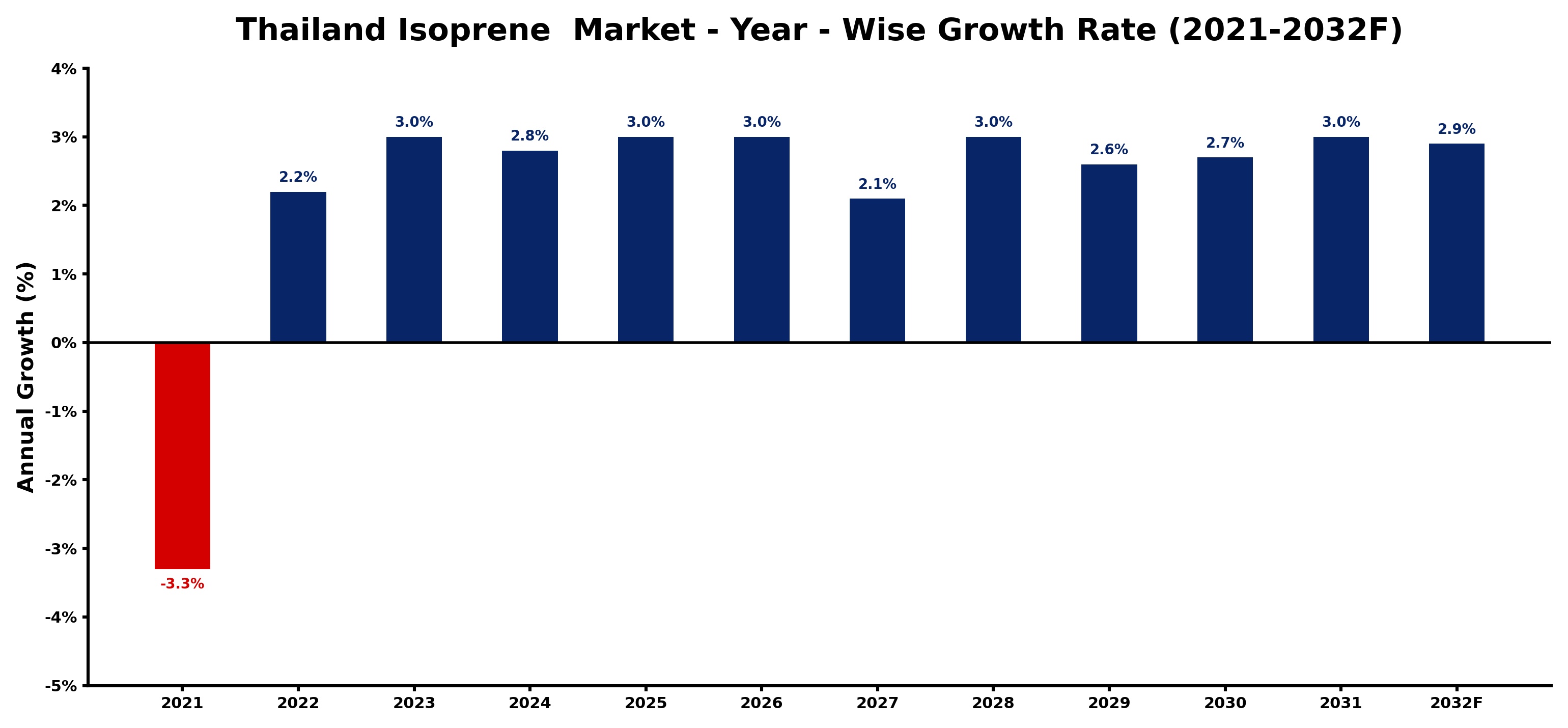
The table below presents the year‑wise growth rates along with the key drivers influencing the market
| Year | Growth Rate | Major Drivers |
| 2021 | -3.3% | Increasing adoption of advanced technologies |
| 2022 | 2.2% | Increasing smart city development projects |
| 2023 | 3.0% | Expansion of transportation and logistics networks |
| 2024 | 2.8% | Rising electricity demand across industries |
| 2025 | 3.0% | Expansion of commercial construction activities |
| 2026 | 3.0% | Increasing industrial automation investments |
| 2027 | 2.1% | Increasing industrial automation investments |
| 2028 | 3.0% | Increasing industrial infrastructure investments |
| 2029 | 2.6% | Government infrastructure modernization initiatives |
| 2030 | 2.7% | Rising electricity demand across industries |
| 2031 | 3.0% | Growing urbanization and commercial development |
| 2032 | 2.9% | Growing urbanization and commercial development |
Note - Market size estimations and growth projections presented in this report are based on 6Wresearch's advanced forecasting approach, validated with industry datasets as of June 2026.
Thailand Isoprene Market Synopsis
The Thailand isoprene market has exhibited resilience in recent years, rebounding from pandemic-induced disruptions. As automotive production ramps up and demand for synthetic rubber surges, the market is poised for sustained growth. However, it faces evolving challenges associated with regulatory pressures and environmental sustainability.
Looking forward, the market is adapting to new demand patterns and seeking innovative solutions that align with stricter environmental regulations. The diversification of applications—from tires to medical supplies—further enriches the market landscape and underscores the necessity for continuous development.
Thailand Isoprene Market Key Takeaways
- Significant growth driven by the booming automotive and tire manufacturing sectors.
- Isoprene's versatility makes it indispensable in various industries, including construction and electronics.
- The market is witnessing increased demand for sustainable production methods amid environmental concerns.
- Regulatory pressures and raw material price volatility are pivotal factors impacting market dynamics.
- Global export opportunities are providing a valuable avenue for market expansion and resilience.
Evaluation of Restraints in Thailand Isoprene Market
Despite its positive trajectory, the Thailand isoprene market is grappling with several restraints that could impede growth. Volatility in raw material prices not only affects isoprene production but also creates uncertainty for downstream industries. Furthermore, as environmental regulations grow more stringent, companies are under increasing pressure to enhance sustainability practices. This pressure often requires significant investment and innovation, which can be challenging for smaller players. Balancing profitability with compliance in a rapidly evolving regulatory landscape remains a key concern for market stakeholders.
Thailand Isoprene Market Trends
A notable trend shaping the Thailand isoprene market is the increasing emphasis on sustainability. Manufacturers are actively exploring bio-based alternatives and eco-friendly production methods to meet regulatory expectations. Additionally, the rise of electric vehicles is expected to influence demand dynamics, as these vehicles often utilize different materials in their production processes. The incorporation of advanced technologies and automation in manufacturing processes is also enhancing efficiency and reducing costs.
Thailand Isoprene Market Opportunities
Significant opportunities exist for investment in R&D, particularly in developing greener alternatives for synthetic rubber production. The automotive sector continues to expand, presenting a consistent demand for isoprene. Furthermore, tapping into emerging markets within Southeast Asia could enhance export potential. Collaborative partnerships between manufacturers and research institutions are also poised to drive innovations that can further diversify applications and enhance competitiveness.
Government Initiatives in the Thailand Isoprene Market
The Thai government has been proactive in fostering growth within the chemicals sector, including isoprene production. Initiatives aimed at supporting sustainable industrial practices, along with various subsidies and incentives for environmentally-friendly technologies, play a crucial role in shaping the market landscape. Public investment in infrastructure and development programs also aids in streamlining supply chains and enhancing manufacturing capabilities.
Future Insights of the Thailand Isoprene Market
Looking ahead to 2026-2032, the Thailand isoprene market is expected to evolve significantly. As global demand for synthetic rubber continues to rise, driven by automotive and industrial applications, local manufacturers will likely adapt to changing consumer preferences and sustainability mandates. Strategic investments in technology and innovation will be vital for capturing new market segments and maintaining competitive advantages. This evolving landscape, supported by government initiatives, positions the Thailand isoprene market for steady, sustainable growth.
Thailand Isoprene Market Latest Developments (May 2025 - June 2026)
Recent developments in the Thailand isoprene market highlight a trend towards modernization and sustainability. Companies are exploring advancements in production techniques to reduce waste and emissions. Additionally, there has been an uptick in collaborative efforts between industry players to drive innovation in product development and market reach. The growing focus on medical applications for isoprene, particularly in personal protective equipment, is also emerging as a key area of interest for stakeholders.
Thailand Isoprene Market - Key Attractiveness of the Report
- 10 Years of Market Numbers
- Historical Data Starting from 2022 to 2025
- Base Year: 2025
- Forecast Data until 2032
- Key Performance Indicators Impacting the Market
- Major Upcoming Developments and Projects
Key Highlights of the Report:
- Thailand Isoprene Market Outlook
- Market Size of Thailand Isoprene Market, 2025
- Forecast of Thailand Isoprene Market, 2032
- Historical Data and Forecast of Thailand Isoprene Revenues & Volume for the Period 2022-2032F
- Thailand Isoprene Market Trend Evolution
- Thailand Isoprene Market Drivers and Challenges
- Thailand Isoprene Price Trends
- Thailand Isoprene Porter's Five Forces
- Thailand Isoprene Industry Life Cycle
- Historical Data and Forecast of Thailand Isoprene Market Revenues & Volume By Type for the Period 2022-2032F
- Historical Data and Forecast of Thailand Isoprene Market Revenues & Volume By Polymer Grade for the Period 2022-2032F
- Historical Data and Forecast of Thailand Isoprene Market Revenues & Volume By Chemical Grade for the Period 2022-2032F
- Historical Data and Forecast of Thailand Isoprene Market Revenues & Volume By Application for the Period 2022-2032F
- Historical Data and Forecast of Thailand Isoprene Market Revenues & Volume By Polyisoprene (IR) for the Period 2022-2032F
- Historical Data and Forecast of Thailand Isoprene Market Revenues & Volume By Styrene-isoprene-styrene (SIS) for the Period 2022-2032F
- Historical Data and Forecast of Thailand Isoprene Market Revenues & Volume By Isobutylene-isoprene rubber (IIR) for the Period 2022-2032F
- Historical Data and Forecast of Thailand Isoprene Market Revenues & Volume By Others for the Period 2022-2032F
- Historical Data and Forecast of Thailand Isoprene Market Revenues & Volume By End-use Industry for the Period 2022-2032F
- Historical Data and Forecast of Thailand Isoprene Market Revenues & Volume By Tires for the Period 2022-2032F
- Historical Data and Forecast of Thailand Isoprene Market Revenues & Volume By Non-tires for the Period 2022-2032F
- Historical Data and Forecast of Thailand Isoprene Market Revenues & Volume By Adhesives for the Period 2022-2032F
- Historical Data and Forecast of Thailand Isoprene Market Revenues & Volume By Others for the Period 2022-2032F
- Thailand Isoprene Import Export Trade Statistics
- Market Opportunity Assessment By Type
- Market Opportunity Assessment By Application
- Market Opportunity Assessment By End-use Industry
- Thailand Isoprene Top Companies Market Share
- Thailand Isoprene Competitive Benchmarking By Technical and Operational Parameters
- Thailand Isoprene Company Profiles
- Thailand Isoprene Key Strategic Recommendations






































