Thailand Kaolin Market: Import Trend Analysis
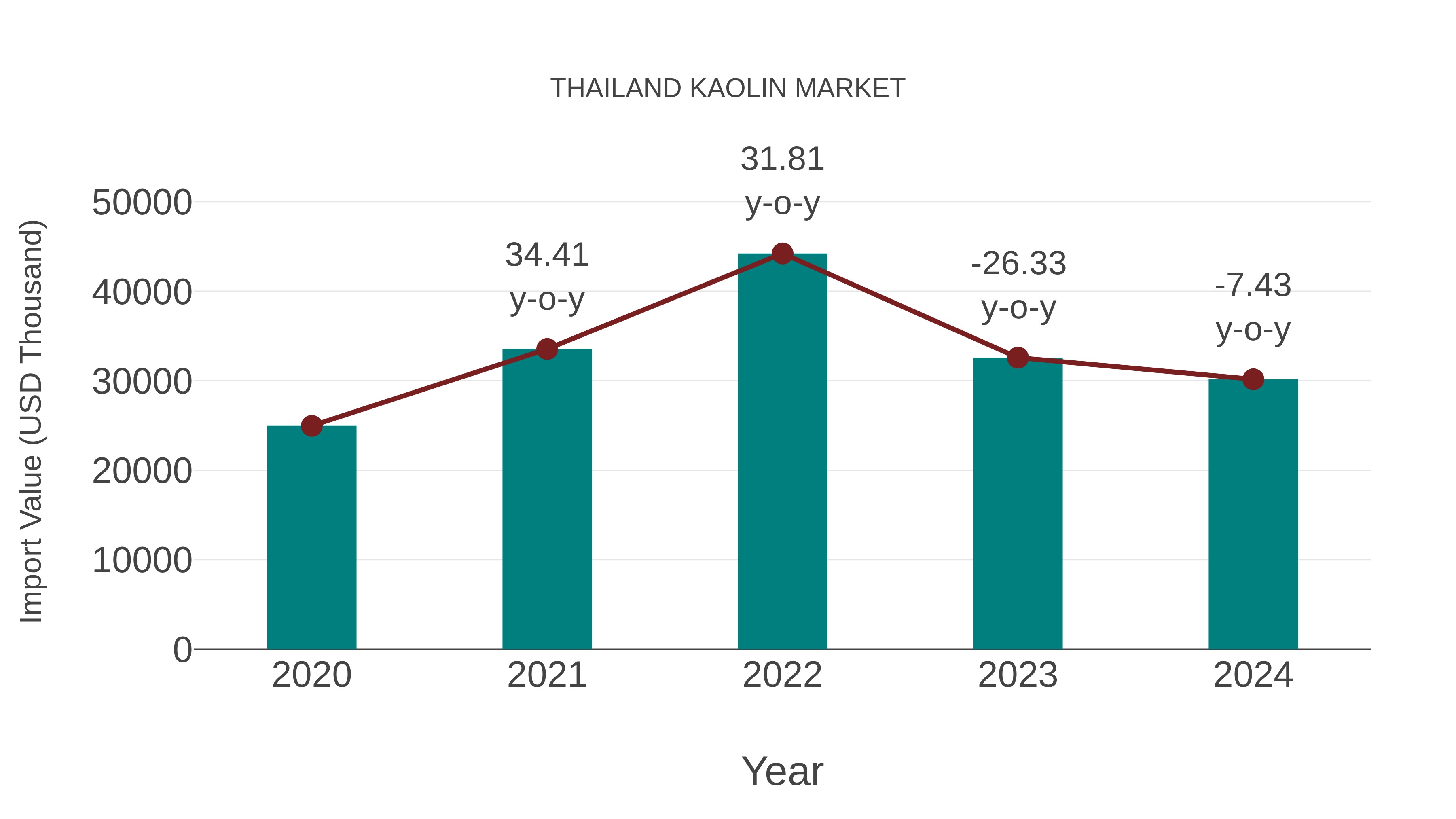
Thailand import trend for the kaolin market experienced a decline in growth rate from 2023 to 2024, with a rate of -7.43%. However, the compound annual growth rate (CAGR) for the period 2020-2024 stood at 4.84%. This could be attributed to shifts in demand dynamics or changes in global trade policies affecting market stability.
Kaolin Market: Thailand vs Top 5 Major Economies in 2027 (Asia)
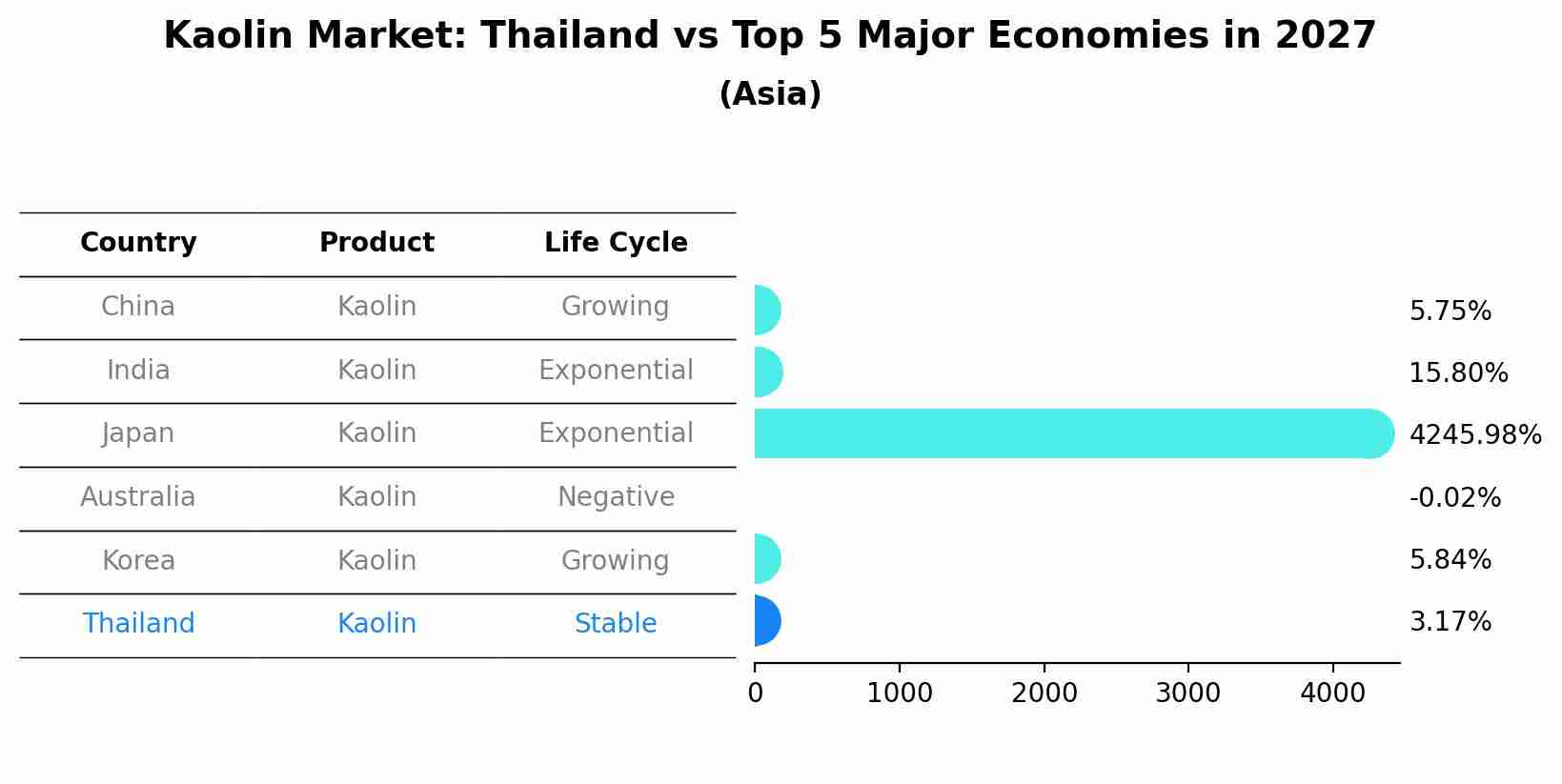
The Kaolin market in Thailand is projected to grow at a stable growth rate of 3.17% by 2027, highlighting the country's increasing focus on advanced technologies within the Asia region, where China holds the dominant position, followed closely by India, Japan, Australia and South Korea, shaping overall regional demand.
Thailand Kaolin Market Synopsis
The kaolin market in Thailand is estimated to be worth USD 604 million in 2025. The demand for kaolin is expected to grow at a CAGR of 5.7% over the forecast period. In terms of volume, the total production capacity of kaolin was 942 kilo tons in 2025 and is anticipated to reach 1,109 kilo tons over the forecast period. China and India are the major exporters of kaolin into Thailand, accounting for around 80% of its imports in value terms.
Drivers of the Market
The kaolin market in Thailand is driven by its applications in ceramics, paper, cosmetics, and construction materials. Kaolin is valued for its versatility, white color, and fine particle size. The expansion of construction projects, urban development, and industries requiring raw materials for manufacturing contribute to the demand for kaolin.
Challenges of the Market
Challenges in the kaolin market include quality consistency, competition, and sustainable mining practices. Maintaining consistent quality standards for kaolin products is crucial for customer satisfaction. Additionally, competing with other industrial minerals and adopting sustainable mining practices to minimize environmental impact are ongoing challenges.
COVID-19 Impact on the Market
Kaolin, a clay mineral, finds applications in ceramics, paper, and cosmetics. The pandemic`s effects on manufacturing and construction activities might have influenced kaolin demand. As construction projects and manufacturing activities resume, the kaolin market is likely to recover.
Key Players in the Market
The kaolin market in Thailand involves players like Thiele Kaolin Company and Imerys. These companies produce kaolin, a clay mineral used in ceramics, paper, and other industries. Their products contribute to Thailandmanufacturing and materials sectors.
Key Highlights of the Report:
- Thailand Kaolin Market Outlook
- Market Size of Thailand Kaolin Market, 2025
- Forecast of Thailand Kaolin Market, 2032
- Historical Data and Forecast of Thailand Kaolin Revenues & Volume for the Period 2022-2032F
- Thailand Kaolin Market Trend Evolution
- Thailand Kaolin Market Drivers and Challenges
- Thailand Kaolin Price Trends
- Thailand Kaolin Porter's Five Forces
- Thailand Kaolin Industry Life Cycle
- Historical Data and Forecast of Thailand Kaolin Market Revenues & Volume By Process for the Period 2022-2032F
- Historical Data and Forecast of Thailand Kaolin Market Revenues & Volume By Water-washed for the Period 2022-2032F
- Historical Data and Forecast of Thailand Kaolin Market Revenues & Volume By Airfloat for the Period 2022-2032F
- Historical Data and Forecast of Thailand Kaolin Market Revenues & Volume By Calcined for the Period 2022-2032F
- Historical Data and Forecast of Thailand Kaolin Market Revenues & Volume By Delaminated for the Period 2022-2032F
- Historical Data and Forecast of Thailand Kaolin Market Revenues & Volume By Surface-modified & Unprocessed for the Period 2022-2032F
- Historical Data and Forecast of Thailand Kaolin Market Revenues & Volume By End-users for the Period 2022-2032F
- Historical Data and Forecast of Thailand Kaolin Market Revenues & Volume By Ceramics & Sanitarywares for the Period 2022-2032F
- Historical Data and Forecast of Thailand Kaolin Market Revenues & Volume By Fiberglass for the Period 2022-2032F
- Historical Data and Forecast of Thailand Kaolin Market Revenues & Volume By Paints & Coatings for the Period 2022-2032F
- Historical Data and Forecast of Thailand Kaolin Market Revenues & Volume By Rubber for the Period 2022-2032F
- Historical Data and Forecast of Thailand Kaolin Market Revenues & Volume By Adhesives & Sealants for the Period 2022-2032F
- Historical Data and Forecast of Thailand Kaolin Market Revenues & Volume By Plastics for the Period 2022-2032F
- Historical Data and Forecast of Thailand Kaolin Market Revenues & Volume By Others for the Period 2022-2032F
- Thailand Kaolin Import Export Trade Statistics
- Market Opportunity Assessment By Process
- Market Opportunity Assessment By End-users
- Thailand Kaolin Top Companies Market Share
- Thailand Kaolin Competitive Benchmarking By Technical and Operational Parameters
- Thailand Kaolin Company Profiles
- Thailand Kaolin Key Strategic Recommendations






































