Thailand Ladders Market Size, Share & Growth Rate
The Thailand Ladders Market was estimated at USD 206 Million in 2025 and is projected to reach USD 237 Million by 2032, growing at a CAGR of 2.0% from 2026 to 2032. This growth trajectory is primarily fueled by increasing construction and renovation activities across Thailand, driven by urbanization and infrastructure development. Additionally, the rising safety regulations in various sectors are pushing demand for high-quality ladder products, enhancing their role as indispensable tools in both residential and industrial environments.
Thailand Ladders Market Year-wise Growth Rate and Key Drivers
This graph highlights how the Thailand Ladders Market has steadily grown over the years, supported by major growth factors.
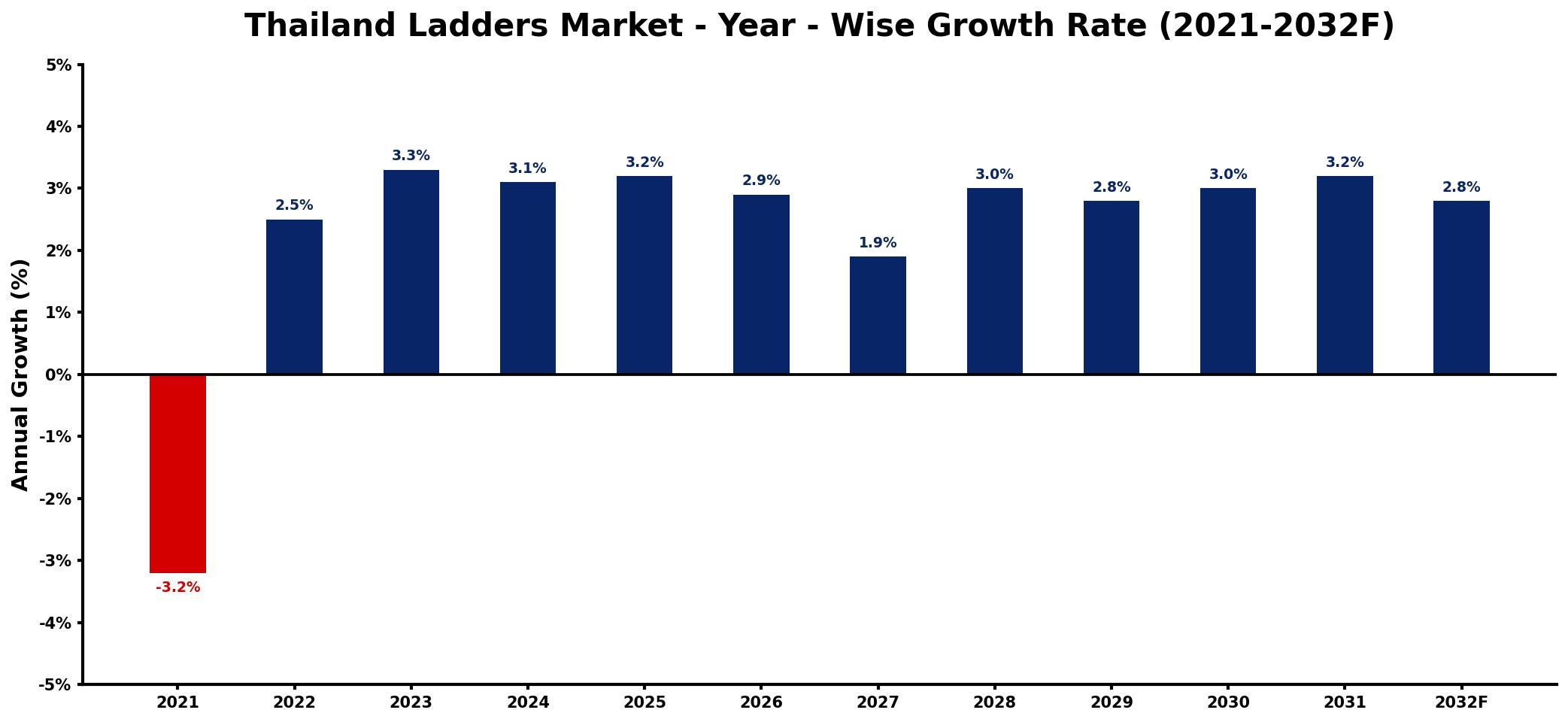
The table below presents the year‑wise growth rates along with the key drivers influencing the market
| Year | Growth Rate | Major Drivers |
| 2021 | -3.2% | construction projects decreased significantly |
| 2022 | 2.5% | increased residential construction activities |
| 2023 | 3.3% | growing industrial infrastructure investments |
| 2024 | 3.1% | surge in home renovation projects |
| 2025 | 3.2% | expansion of commercial real estate |
| 2026 | 2.9% | growing downstream application demand |
| 2027 | 1.9% | increased focus on safety regulations |
| 2028 | 3.0% | growing popularity of modular buildings |
| 2029 | 2.8% | expanding industrial usage applications |
| 2030 | 3.0% | increased investment in urban development |
| 2031 | 3.2% | growing demand for energy efficiency |
| 2032 | 2.8% | rise in sustainable construction practices |
Note: Market size estimations and growth projections presented in this report are based on 6Wresearch's proprietary forecasting methodology, utilizing the latest available industry data, government publications, and primary research inputs.
Thailand Ladders Market Synopsis
The Thailand ladders market is characterized by a vibrant interplay between rising safety standards and growing consumer awareness. With a significant proportion of the population engaged in do-it-yourself home improvement projects, the demand for versatile and reliable ladder products has surged in recent years. Concurrently, robust construction activities and the industrial sector's need for elevated access solutions are major contributors to market vitality.
Manufacturers are adapting to consumer preferences by developing ladders that prioritize safety and ease of use. Innovations in materials—leading to lighter yet more durable products—are becoming commonplace, reflecting the industry's response to the unique challenges posed by safety regulations. This emphasis on quality and functionality is essential in maintaining market competitiveness.
Thailand Ladders Market Key Takeaways
- The Thailand ladders market is driven by substantial growth in the construction and DIY sectors.
- Safety regulations are pushing the demand for high-quality, compliant ladder products across industries.
- Innovative materials are being adopted to enhance product durability and portability.
- Manufacturers are focusing on versatile ladder designs to cater to diverse consumer needs.
- Despite economic challenges, the market shows resilience and potential for sustained growth.
Evaluation of Restraints in Thailand Ladders Market
While the Thailand ladders market exhibits promising growth potential, several restraints are worth noting. Chief among these is the rigorous adherence to safety regulations, which demands continual investment in compliance and innovation. Companies must navigate not only the costs associated with maintaining these standards but also the competitive landscape that includes alternative access solutions. Furthermore, consumer expectations regarding convenience and portability require manufacturers to stay on the cutting edge of design and engineering, pushing them to adapt quickly in a dynamic environment.
Thailand Ladders Market Trends
Several key trends are shaping the Thailand ladders market. Firstly, the growing focus on ergonomic designs is making ladders more user-friendly, catering to a broader demographic, including older consumers who may have mobility concerns. Secondly, smart technology integration, such as the development of ladders with built-in safety features, is gaining traction. Additionally, eco-friendly materials are becoming increasingly relevant as sustainability becomes a priority for consumers. Lastly, online retail channels are expanding access to a wider audience, allowing consumers to compare products and prices more easily.
Thailand Ladders Market Opportunities
The Thailand ladders market presents several opportunities for growth and investment. As urbanization continues, the demand for ladders in construction, maintenance, and home improvement projects is set to rise. Additionally, the booming DIY culture among homeowners offers a lucrative target market for ladder manufacturers. Companies that invest in innovative materials and ergonomic design can tap into this expanding consumer base. Furthermore, fostering partnerships with construction firms and retail outlets can enhance distribution channels and market penetration.
Government Initiatives in the Thailand Ladders Market
The Thai government has implemented various initiatives aimed at promoting safety standards across industrial sectors, which indirectly benefits the ladders market. Public spending on infrastructure projects has seen an uptick, creating additional demand for construction-related tools. Programs aimed at enhancing workplace safety compliance are also critical, as they encourage the adoption of high-quality ladder products. These initiatives foster an environment conducive to market growth and innovation.
Future Insights of the Thailand Ladders Market
Looking ahead to 2026-2032, the Thailand ladders market is expected to continue its upward trajectory. Urbanization will drive increased construction and renovation activities, thereby enhancing ladder demand across various applications. Innovations in design and materials will likely dominate the market landscape, responding to evolving consumer needs for safety and functionality. As awareness around safety compliance grows, the market will position itself for sustained growth, reflecting the pivotal role of ladders in both residential and industrial environments.
Thailand Ladders Market Latest Developments (2025 - 2026)
In recent months, the Thailand ladders market has seen a noticeable shift towards integrating smart technology into ladder designs. Manufacturers are focusing on enhancing product safety features, responding to the increasing emphasis on worker safety in industrial settings. Concurrently, there is a growing trend of sustainable manufacturing practices, with companies investing in eco-friendly materials. Additionally, the post-pandemic recovery phase has reignited construction activities, positively impacting ladder sales across both residential and commercial sectors.
Thailand Ladders Market - Key Attractiveness of the Report
- 10 Years of Market Numbers
- Historical Data Starting from 2022 to 2025
- Base Year: 2025
- Forecast Data until 2032
- Key Performance Indicators Impacting the Market
- Major Upcoming Developments and Projects
Key Highlights of the Report:
- Thailand Ladders Market Outlook
- Market Size of Thailand Ladders Market, 2025
- Forecast of Thailand Ladders Market, 2032
- Historical Data and Forecast of Thailand Ladders Revenues & Volume for the Period 2022-2032F
- Thailand Ladders Market Trend Evolution
- Thailand Ladders Market Drivers and Challenges
- Thailand Ladders Price Trends
- Thailand Ladders Porter's Five Forces
- Thailand Ladders Industry Life Cycle
- Historical Data and Forecast of Thailand Ladders Market Revenues & Volume By Application for the Period 2022-2032F
- Historical Data and Forecast of Thailand Ladders Market Revenues & Volume By Industrial for the Period 2022-2032F
- Historical Data and Forecast of Thailand Ladders Market Revenues & Volume By Domestic for the Period 2022-2032F
- Historical Data and Forecast of Thailand Ladders Market Revenues & Volume By Commercial for the Period 2022-2032F
- Thailand Ladders Import Export Trade Statistics
- Market Opportunity Assessment By Application
- Thailand Ladders Top Companies Market Share
- Thailand Ladders Competitive Benchmarking By Technical and Operational Parameters
- Thailand Ladders Company Profiles
- Thailand Ladders Key Strategic Recommendations






































