Thailand Managed Security Services Market Summary
The thailand managed security services market was estimated at USD 85 Million in 2025 and is projected to reach USD 97 Million by 2032, growing at a CAGR of 2.7% from 2026 to 2032.
Thailand Managed Security Services Market Year-wise Growth Rate and Key Drivers
This graph highlights how the Thailand Managed Security Services Market has steadily grown over the past five years, supported by major growth factors.
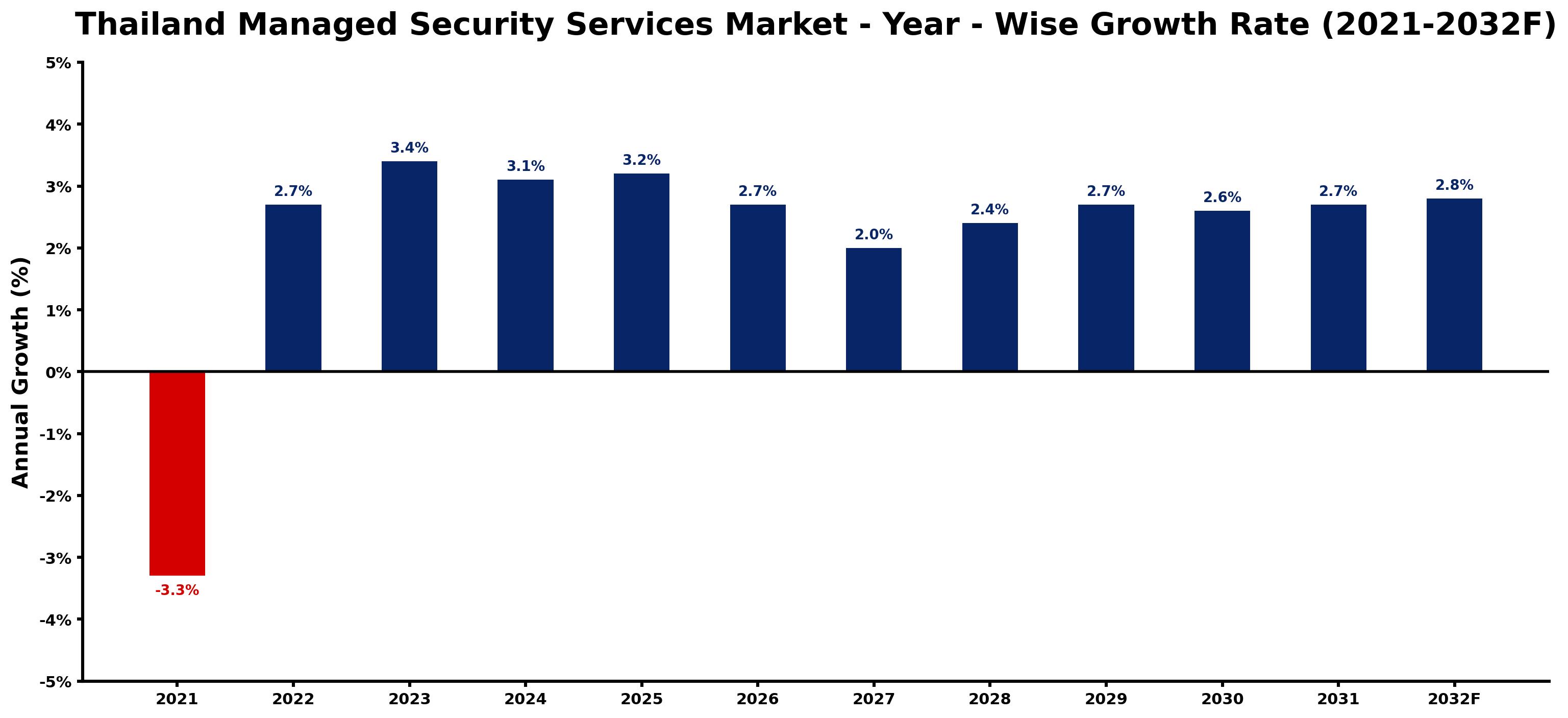
The table below presents the year wise growth rates along with the key drivers influencing the market
| Year | Growth Rate | Major Drivers |
| 2021 | -3.3% | Increased cyber threats prompted businesses to prioritize internal security measures over managed services. |
| 2022 | 2.7% | Increased digitization accelerated the need for robust managed security solutions across sectors. |
| 2023 | 3.4% | Emerging threats from cybercriminals heightened awareness of security vulnerabilities among enterprises. |
| 2024 | 3.1% | Investment in cloud services expanded, necessitating tighter security measures for data protection. |
| 2025 | 3.2% | Corporate mergers and acquisitions raised concerns about data integrity and security integration. |
| 2026 | 2.7% | Challenges in security compliance prompted firms to seek specialized managed security services. |
| 2027 | 2.0% | Shift towards remote working environments increased reliance on managed security solutions. |
| 2028 | 2.4% | Advanced analytics and AI capabilities made managed security services more appealing to enterprises. |
| 2029 | 2.7% | Local cybersecurity talent development improved service delivery and client trust significantly. |
| 2030 | 2.6% | Increasing awareness of data privacy regulations enforced compliance requirements across industries. |
| 2031 | 2.7% | Partnerships with global cybersecurity firms enhanced local service offerings and expertise. |
| 2032 | 2.8% | Emerging technologies such as IoT necessitated comprehensive security frameworks in enterprises. |
Note - Market size estimations and growth projections presented in this report are based on 6Wresearch's advanced forecasting approach, validated with industry datasets as of June 2026.
Thailand Managed Security Services Market Synopsis
The Thailand Managed Security Services Market is projected to reach 2.7% and witness significant growth during the forecast period (2026-2032). The expected growth trajectory is driven by an escalating landscape of cyber threats, an increased necessity for robust data protection mechanisms, and a swift uptake of cloud computing solutions. As organizations grapple with stringent data privacy regulations, there is a noticeable shift towards managed security service providers (MSSPs), which deliver enhanced security solutions essential for safeguarding business operations in today's digital environment.
Thailand Managed Security Services Market Growth Drivers
The growth of the Thailand Managed Security Services Market can be attributed to various factors that are transforming the cybersecurity landscape. One major driver is:
- Rising Cyber Threats: The prevalence of advanced cyber-attacks, including phishing schemes, malware incidents, and distributed denial-of-service (DDoS) attacks, is significantly increasing. With more enterprises deploying internet-connected devices, the demand for proactive security measures is becoming essential, thus driving organizations to seek managed security services.
- Data Security Needs: As businesses accumulate more sensitive data, the requirement for secure storage solutions has intensified. Many organizations are now investing in managed security services to ensure the confidentiality and integrity of their data, thereby fostering market growth.
- Cloud Computing Adoption: The rapid transition to cloud computing services has necessitated advanced security strategies. As businesses increasingly migrate to cloud infrastructures, there is a parallel rise in the demand for managed security services that can provide comprehensive protective measures in these environments.
- Regulatory Compliance: Strict regulations regarding data privacy are prompting companies to implement higher levels of security. Managed security service providers offer tailored solutions that help organizations comply with these regulations while ensuring data protection.
- Investment in IT Modernization: Many enterprises in Thailand are modernizing their IT infrastructure to improve operational efficiency. This transformation is accompanied by an increasing demand for managed security services to protect new technologies and standards.
Thailand Managed Security Services Market Challenges and Restraints
Despite the positive outlook, the Thailand Managed Security Services Market faces several challenges that may hinder its growth. Key challenges include:
- Awareness Gaps: There is a notable lack of awareness among enterprises about the full range of managed security services available. Many businesses remain uncertain about the benefits these services can offer, which may slow down adoption rates.
- High Maintenance Costs: The high costs associated with implementing and maintaining managed security solutions can deter smaller companies from investing in these services. This financial barrier may limit market penetration, particularly among budget-constrained organizations.
- Talent Shortages: The cybersecurity field is experiencing a significant skills gap. The shortage of qualified cybersecurity professionals can impact the ability of MSSPs to deliver high-quality service, affecting customer confidence and satisfaction.
- Rapidly Evolving Threat Landscape: As cyber threats continue to evolve, managed security service providers must consistently update their offerings. This need for continual adaptation can pose operational challenges and increase the complexity of service delivery.
- Integration Challenges: Organizations may face difficulties in integrating managed security services with existing technologies and systems. This complexity can discourage potential clients from fully utilizing MSSP offerings.
Thailand Managed Security Services Market Covid-19 Impact
The COVID-19 pandemic has had a profound impact on global markets, and the Thailand Managed Security Services Market is no exception. The pandemic brought about disruptions that led to decreased economic activity and constrained business operations. Notably, the temporary closure of several enterprises resulted in reduced investment in IT infrastructure, limiting opportunities for new cybersecurity implementations during this challenging period. However, as organizations pivot towards digital transformation initiatives in the aftermath of the pandemic, there is a potential for renewed interest and investment in managed security services, marking a recovery for the sector.
Thailand Managed Security Services Market Government Investment and Initiatives
The Thai government has recognized the importance of cybersecurity and has begun to invest in initiatives that bolster the managed security services landscape. Key government efforts include:
- Cybersecurity Strategy Implementation: The government has implemented national strategies aimed at enhancing national cybersecurity frameworks. These strategies encourage collaboration with private-sector providers to improve overall cybersecurity resilience.
- Public Sector Cybersecurity Spending: Increased public funding aimed at developing cybersecurity infrastructure is being allocated to enhance the capabilities of government agencies and enterprise systems.
- Incentives for Cybersecurity Training: Various initiatives have been established to promote skills development in the cybersecurity domain, helping to address the talent gap and ensuring a skilled workforce for the future.
- Promotion of Cybersecurity Standards: The government is actively working to establish standardized best practices within the industry, thus facilitating a more secure operating environment for enterprises.
- Public Awareness Campaigns: Efforts are being made to increase awareness surrounding the importance of cybersecurity, encouraging businesses to adopt managed security services as a preventive measure against cyber threats.
Thailand Managed Security Services Market Latest Developments (May 2025 - June 2026)
In the period from May 2025 to June 2026, several developments have taken place within the Thailand Managed Security Services Market. The industry has seen a heightened focus on the integration of artificial intelligence and machine learning into managed security solutions, enabling faster response times and enhanced threat detection. Additionally, investment in innovative service delivery models has gained traction, with MSSPs offering more flexible subscription-based services tailored to the specific needs of organizations. Furthermore, the market has witnessed a surge in partnerships between MSSPs and local tech firms, enhancing service capabilities and broadening the scope of offerings to better serve clients.
Thailand Managed Security Services Market - Key Attractiveness of the Report
- 10 Years of Market Numbers
- Historical Data Starting from 2022 to 2025
- Base Year: 2025
- Forecast Data until 2032
- Key Performance Indicators Impacting the Market
- Major Upcoming Developments and Projects
Key Highlights of the Report:
- Thailand Managed Security Services Market Outlook
- Market Size of Thailand Managed Security Services Market, 2025
- Forecast of Thailand Managed Security Services Market, 2032
- Historical Data and Forecast of Thailand Managed Security Services Revenues & Volume for the Period 2022-2032F
- Thailand Managed Security Services Market Trend Evolution
- Thailand Managed Security Services Market Drivers and Challenges
- Thailand Managed Security Services Price Trends
- Thailand Managed Security Services Porter's Five Forces
- Thailand Managed Security Services Industry Life Cycle
- Historical Data and Forecast of Thailand Managed Security Services Market Revenues & Volume By Type for the Period 2022-2032F
- Historical Data and Forecast of Thailand Managed Security Services Market Revenues & Volume By Unified threat management for the Period 2022-2032F
- Historical Data and Forecast of Thailand Managed Security Services Market Revenues & Volume By DDoS for the Period 2022-2032F
- Historical Data and Forecast of Thailand Managed Security Services Market Revenues & Volume By Managed SIEM for the Period 2022-2032F
- Historical Data and Forecast of Thailand Managed Security Services Market Revenues & Volume By Managed endpoint threat detection for the Period 2022-2032F
- Historical Data and Forecast of Thailand Managed Security Services Market Revenues & Volume By Managed two factor authentication for the Period 2022-2032F
- Historical Data and Forecast of Thailand Managed Security Services Market Revenues & Volume By Compliance management for the Period 2022-2032F
- Historical Data and Forecast of Thailand Managed Security Services Market Revenues & Volume By Vulnerability management for the Period 2022-2032F
- Historical Data and Forecast of Thailand Unified threat management Managed Security Services Market Revenues & Volume By Others for the Period 2022-2032F
- Historical Data and Forecast of Thailand Managed Security Services Market Revenues & Volume By Deployment for the Period 2022-2032F
- Historical Data and Forecast of Thailand Managed Security Services Market Revenues & Volume By Cloud-based for the Period 2022-2032F
- Historical Data and Forecast of Thailand Managed Security Services Market Revenues & Volume By On-premise for the Period 2022-2032F
- Historical Data and Forecast of Thailand Managed Security Services Market Revenues & Volume By Organization for the Period 2022-2032F
- Historical Data and Forecast of Thailand Managed Security Services Market Revenues & Volume By Small and medium enterprises for the Period 2022-2032F
- Historical Data and Forecast of Thailand Managed Security Services Market Revenues & Volume By Large enterprises for the Period 2022-2032F
- Historical Data and Forecast of Thailand Managed Security Services Market Revenues & Volume By Applications for the Period 2022-2032F
- Historical Data and Forecast of Thailand Managed Security Services Market Revenues & Volume By BFSI for the Period 2022-2032F
- Historical Data and Forecast of Thailand Managed Security Services Market Revenues & Volume By Government/defense for the Period 2022-2032F
- Historical Data and Forecast of Thailand Managed Security Services Market Revenues & Volume By Healthcare for the Period 2022-2032F
- Historical Data and Forecast of Thailand Managed Security Services Market Revenues & Volume By Manufacturing for the Period 2022-2032F
- Historical Data and Forecast of Thailand Managed Security Services Market Revenues & Volume By Telecom & IT for the Period 2022-2032F
- Historical Data and Forecast of Thailand Managed Security Services Market Revenues & Volume By Retail for the Period 2022-2032F
- Historical Data and Forecast of Thailand Managed Security Services Market Revenues & Volume By Others for the Period 2022-2032F
- Thailand Managed Security Services Import Export Trade Statistics
- Market Opportunity Assessment By Type
- Market Opportunity Assessment By Deployment
- Market Opportunity Assessment By Organization
- Market Opportunity Assessment By Applications
- Thailand Managed Security Services Top Companies Market Share
- Thailand Managed Security Services Competitive Benchmarking By Technical and Operational Parameters
- Thailand Managed Security Services Company Profiles
- Thailand Managed Security Services Key Strategic Recommendations






































