Thailand Oil and Gas Hydraulic Equipment Market Size, Share & Growth Rate
The Thailand Oil and Gas Hydraulic Equipment Market was estimated at USD 102 Million in 2025 and is projected to reach USD 116 Million by 2032, growing at a CAGR of 1.9% from 2026 to 2032. This growth trajectory is fueled by the increasing exploration and production activities in Thailand's oil and gas sector, where hydraulic systems play a pivotal role in enhancing operational efficiency. Additionally, the demand for advanced hydraulic technologies, which offer improved precision and energy efficiency, is steadily rising, driving market dynamics.
Thailand Oil and Gas Hydraulic Equipment Market Year-wise Growth Rate and Key Drivers
This graph highlights how the Thailand Oil and Gas Hydraulic Equipment Market has steadily grown over the years, supported by major growth factors.
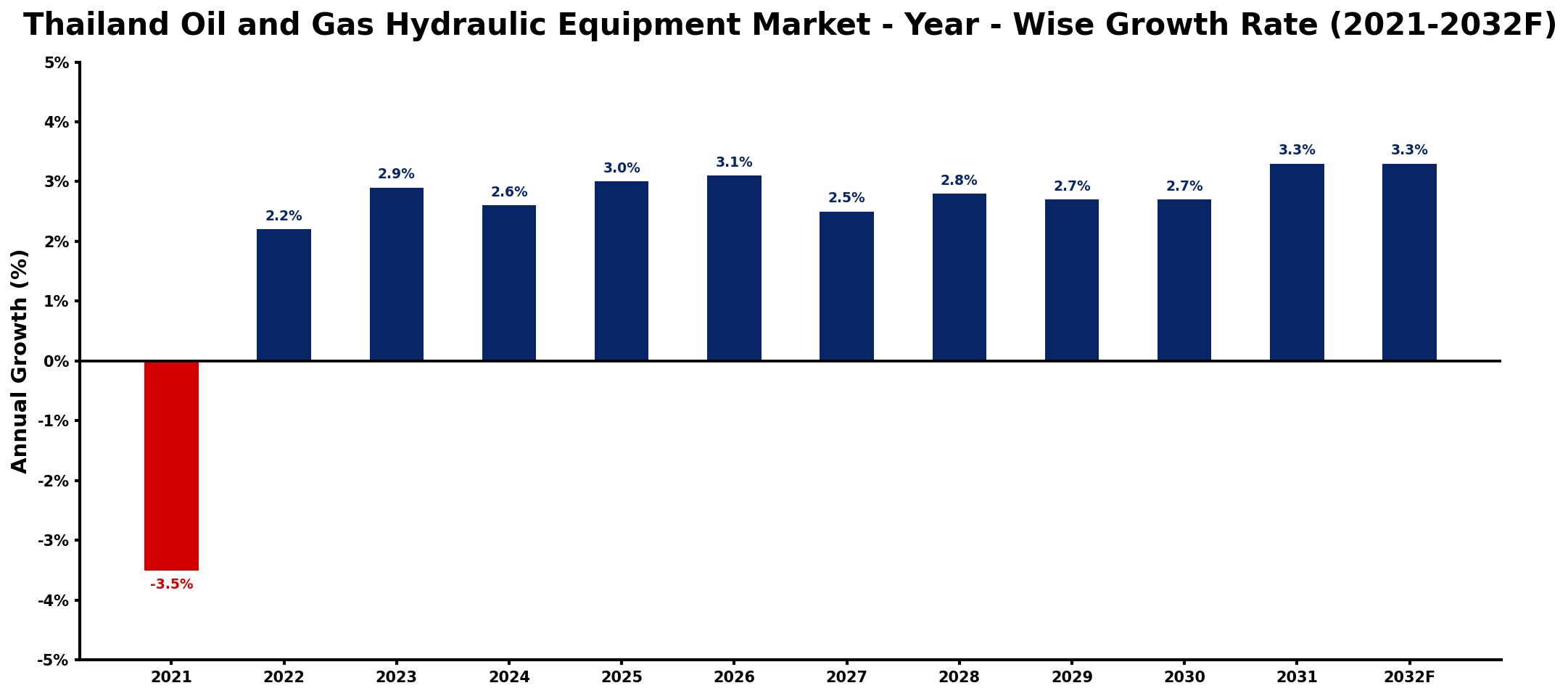
The table below presents the year‑wise growth rates along with the key drivers influencing the market
| Year | Growth Rate | Major Drivers |
| 2021 | -3.5% | global demand for energy sources |
| 2022 | 2.2% | renewable energy sector investments |
| 2023 | 2.9% | increased industrial production activities |
| 2024 | 2.6% | expansion of infrastructure projects |
| 2025 | 3.0% | rising transportation sector needs |
| 2026 | 3.1% | growing construction industry requirements |
| 2027 | 2.5% | enhanced technological advancements adoption |
| 2028 | 2.8% | increased foreign direct investments |
| 2029 | 2.7% | emerging market opportunities expansion |
| 2030 | 2.7% | strengthening regional trade agreements |
| 2031 | 3.3% | growing environmental regulations compliance |
| 2032 | 3.3% | increased focus on sustainability initiatives |
Note: Market size estimations and growth projections presented in this report are based on 6Wresearch's proprietary forecasting methodology, utilizing the latest available industry data, government publications, and primary research inputs.
Thailand Oil and Gas Hydraulic Equipment Market Synopsis
The Thailand Oil and Gas Hydraulic Equipment market is increasingly crucial to the national energy landscape, addressing the pressing needs of the oil and gas industry. Hydraulic equipment such as valves, pumps, and cylinders not only supports operational workflows but also enhances safety protocols, a vital concern in such a hazardous field.
As Thailand continues to advance its oil and gas exploration capabilities, the market is evolving with innovative solutions tailored for the harsh operational environments. The integration of cutting-edge hydraulic systems reflects a broader trend towards modernization and efficiency within the industry.
Thailand Oil and Gas Hydraulic Equipment Market Key Takeaways
- The market is witnessing consistent growth driven by robust exploration and production activities.
- Advanced hydraulic technologies are becoming critical for enhancing operational safety and efficiency.
- Investment opportunities are emerging in response to government initiatives and economic recovery strategies.
- Collaboration between key stakeholders is essential for navigating market challenges and optimizing performance.
- Post-COVID recovery is expected to rejuvenate demand, leading to increased project investments.
Evaluation of Restraints in Thailand Oil and Gas Hydraulic Equipment Market
The Thailand Oil and Gas Hydraulic Equipment market faces notable restraints related to the need for specialized equipment and a skilled workforce. As the industry adapts to evolving exploration and drilling methods, businesses must ensure their hydraulic solutions meet stringent operational demands. Furthermore, fluctuating global oil prices can impact investment levels, leading to uncertainty in project financing and equipment procurement.
Thailand Oil and Gas Hydraulic Equipment Market Trends
Several trends are shaping the Thailand Oil and Gas Hydraulic Equipment market. The move towards automation in hydraulic systems is gaining traction, allowing for more precise control and reducing the risk of human error. Additionally, there is a significant push towards energy-efficient solutions, driven by both environmental concerns and regulatory pressure. Companies are increasingly investing in R&D to develop sustainable hydraulic technologies that align with global energy transition goals.
Thailand Oil and Gas Hydraulic Equipment Market Opportunities
Opportunities for growth in the Thailand Oil and Gas Hydraulic Equipment market abound, particularly in the context of government initiatives aimed at boosting the national energy sector. Investments in infrastructure improvements and the promotion of sustainable practices are providing a fertile ground for innovative hydraulic solutions. Furthermore, expanding offshore exploration activities present avenues for the development of specialized hydraulic systems tailored to marine applications.
Government Initiatives in the Thailand Oil and Gas Hydraulic Equipment Market
The Thai government is actively promoting policies aimed at revitalizing the oil and gas sector post-COVID-19, which indirectly benefits the hydraulic equipment market. Public spending in infrastructure development and incentives for adopting advanced technologies are crucial elements of this support. Additionally, environmental regulations are pushing companies to invest in greener, more efficient hydraulic systems that comply with sustainability objectives.
Future Insights of the Thailand Oil and Gas Hydraulic Equipment Market
Looking forward to 2026-2032, the Thailand Oil and Gas Hydraulic Equipment market is poised for a rebound as investment in exploration and production resumes. Continued advancements in technology and a focus on operational efficiency will be paramount. As the industry adapts to evolving standards, companies that embrace innovation and sustainability are likely to capture significant market share. Increased government support and favorable economic conditions will also facilitate growth in this essential sector.
Thailand Oil and Gas Hydraulic Equipment Market Latest Developments (2025 - 2026)
Recent developments in the Thailand Oil and Gas Hydraulic Equipment market have focused on enhancing the efficiency and reliability of hydraulic systems. Companies are prioritizing the launch of innovative products that meet the rigorous demands of the oil and gas industry. Furthermore, collaborations between technology providers and local manufacturers are gaining momentum, fostering an environment of shared expertise and advanced solutions tailored for local operational challenges.
Thailand Oil and Gas Hydraulic Equipment Market - Key Attractiveness of the Report
- 10 Years of Market Numbers
- Historical Data Starting from 2022 to 2025
- Base Year: 2025
- Forecast Data until 2032
- Key Performance Indicators Impacting the Market
- Major Upcoming Developments and Projects
Key Highlights of the Report:
- Thailand Oil and Gas Hydraulic Equipment Market Outlook
- Market Size of Thailand Oil and Gas Hydraulic Equipment Market, 2025
- Forecast of Thailand Oil and Gas Hydraulic Equipment Market, 2032
- Historical Data and Forecast of Thailand Oil and Gas Hydraulic Equipment Revenues & Volume for the Period 2022-2032F
- Thailand Oil and Gas Hydraulic Equipment Market Trend Evolution
- Thailand Oil and Gas Hydraulic Equipment Market Drivers and Challenges
- Thailand Oil and Gas Hydraulic Equipment Price Trends
- Thailand Oil and Gas Hydraulic Equipment Porter's Five Forces
- Thailand Oil and Gas Hydraulic Equipment Industry Life Cycle
- Historical Data and Forecast of Thailand Oil and Gas Hydraulic Equipment Market Revenues & Volume By Sector for the Period 2022-2032F
- Historical Data and Forecast of Thailand Oil and Gas Hydraulic Equipment Market Revenues & Volume By Upstream for the Period 2022-2032F
- Historical Data and Forecast of Thailand Oil and Gas Hydraulic Equipment Market Revenues & Volume By Mid-stream for the Period 2022-2032F
- Historical Data and Forecast of Thailand Oil and Gas Hydraulic Equipment Market Revenues & Volume By Downstream for the Period 2022-2032F
- Historical Data and Forecast of Thailand Oil and Gas Hydraulic Equipment Market Revenues & Volume By Location for the Period 2022-2032F
- Historical Data and Forecast of Thailand Oil and Gas Hydraulic Equipment Market Revenues & Volume By Onshore for the Period 2022-2032F
- Historical Data and Forecast of Thailand Oil and Gas Hydraulic Equipment Market Revenues & Volume By Offshore for the Period 2022-2032F
- Historical Data and Forecast of Thailand Oil and Gas Hydraulic Equipment Market Revenues & Volume By Application for the Period 2022-2032F
- Historical Data and Forecast of Thailand Oil and Gas Hydraulic Equipment Market Revenues & Volume By Drill Floor Hydraulics for the Period 2022-2032F
- Historical Data and Forecast of Thailand Oil and Gas Hydraulic Equipment Market Revenues & Volume By Ballast Control System for the Period 2022-2032F
- Historical Data and Forecast of Thailand Oil and Gas Hydraulic Equipment Market Revenues & Volume By Deck Crane Systems for the Period 2022-2032F
- Historical Data and Forecast of Thailand Oil and Gas Hydraulic Equipment Market Revenues & Volume By Motion Compensation Systems for the Period 2022-2032F
- Historical Data and Forecast of Thailand Oil and Gas Hydraulic Equipment Market Revenues & Volume By Top Drives for the Period 2022-2032F
- Historical Data and Forecast of Thailand Oil and Gas Hydraulic Equipment Market Revenues & Volume By Manifolds for the Period 2022-2032F
- Historical Data and Forecast of Thailand Oil and Gas Hydraulic Equipment Market Revenues & Volume By Winches for the Period 2022-2032F
- Historical Data and Forecast of Thailand Oil and Gas Hydraulic Equipment Market Revenues & Volume By Others for the Period 2022-2032F
- Thailand Oil and Gas Hydraulic Equipment Import Export Trade Statistics
- Market Opportunity Assessment By Sector
- Market Opportunity Assessment By Location
- Market Opportunity Assessment By Application
- Thailand Oil and Gas Hydraulic Equipment Top Companies Market Share
- Thailand Oil and Gas Hydraulic Equipment Competitive Benchmarking By Technical and Operational Parameters
- Thailand Oil and Gas Hydraulic Equipment Company Profiles
- Thailand Oil and Gas Hydraulic Equipment Key Strategic Recommendations






































