Thailand Pliers Market Summary
The thailand pliers market was estimated at USD 245 Million in 2025 and is projected to reach USD 281 Million by 2032, growing at a CAGR of 3.2% from 2026 to 2032.
Thailand Pliers Market Year-wise Growth Rate and Key Drivers
This graph highlights how the Thailand Pliers Market has steadily grown over the past five years, supported by major growth factors.
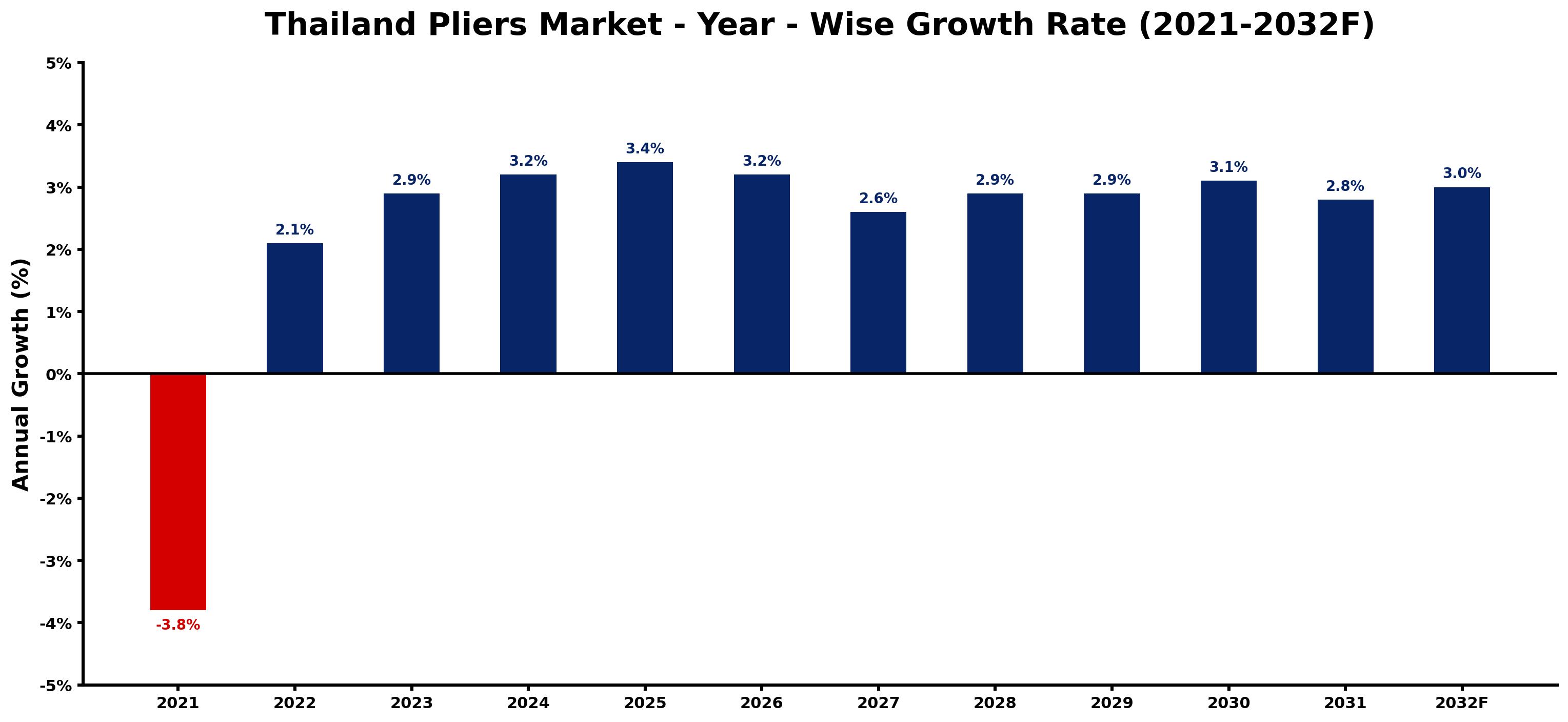
The table below presents the year wise growth rates along with the key drivers influencing the market
| Year | Growth Rate | Major Drivers |
| 2021 | -3.8% | Intense competition from lowcost imports severely undermined local manufacturers' market position and profitability. |
| 2022 | 2.1% | Urban construction projects expanded, elevating the importance of reliable plier tools. |
| 2023 | 2.9% | E-commerce platforms flourished, making pliers more accessible to diverse consumer segments. |
| 2024 | 3.2% | Local manufacturers embraced sustainable practices, prompting innovations in plier designs. |
| 2025 | 3.4% | Collaboration among firms enhanced supply chain efficiency, boosting availability of pliers. |
| 2026 | 3.2% | Emerging DIY culture in urban areas significantly influenced plier sales trends. |
| 2027 | 2.6% | Technological integrations within tools improved ergonomic designs for enhanced user experience. |
| 2028 | 2.9% | Government investments in infrastructure projects created substantial demand for quality tools. |
| 2029 | 2.9% | Increased foreign investments attracted global manufacturers to localize plier production. |
| 2030 | 3.1% | Advancements in material science allowed for lighter, more durable pliers in the market. |
| 2031 | 2.8% | Growing interest in home improvement projects spurred hobbyist purchases of specialized pliers. |
| 2032 | 3.0% | Market consolidation among major brands led to wider distribution and competitive pricing. |
Note - Market size estimations and growth projections presented in this report are based on 6Wresearch's advanced forecasting approach, validated with industry datasets as of June 2026.
Thailand Pliers Market Synopsis
The Thailand Pliers Market is projected to reach 3.2% and witness significant growth during the forecast period (2026-2032). This anticipated growth is largely driven by the surge in construction projects and infrastructure investments within the country. As the Thai economy continues to expand, the demand for tools, particularly pliers, is expected to increase, fueled by both professional sectors and individual consumers engaging in DIY activities.
Thailand Pliers Market Growth Drivers
Several key factors are propelling the Thailand Pliers Market forward. Prominent among these are:
- Government investments in infrastructure are on the rise, driving demand for pliers among construction professionals and tradespeople involved in various projects across Thailand.
- An increase in disposable incomes is influencing consumer behavior, leading to greater investments in high-quality tools for both professional and recreational use.
- The growing trend towards DIY projects among households is augmenting the demand for versatile and reliable pliers, enticing consumers to upgrade their tool kits.
- Rising urbanization is boosting residential and commercial construction activities, which in turn increases the need for construction and maintenance tools, including pliers.
- Technological advancements in tool production are enhancing the efficiency and functionality of pliers, attracting consumers and professionals alike.
Thailand Pliers Market Challenges and Restraints
Despite the positive growth outlook, the Thailand Pliers Market faces several challenges. Key barriers include:
- Intense competition from unorganized players poses a significant threat, as low entry barriers allow many to enter the market with lower-cost offerings.
- Economic fluctuations may impact consumer spending power, potentially leading to reduced purchases of premium tools amidst competition from lower-priced alternatives.
- Supply chain disruptions, exacerbated by the global pandemic, have led to production delays and material shortages, complicating market operations.
- Changing consumer preferences towards electronics and machinery could affect the traditional hand tool market, including pliers.
- Environmental regulations and sustainability concerns are prompting manufacturers to innovate, which may require significant investment in research and development.
Thailand Pliers Market Government Investment and Initiatives
The Thai government is playing a pivotal role in shaping the landscape of the pliers market through various initiatives aimed at infrastructure development. Significant allocations of public spending have been directed towards enhancing transportation networks, urban development, and housing projects. These initiatives not only boost economic growth but also create demand for essential tools like pliers among construction and maintenance professionals.
Moreover, the government has launched programs to promote local manufacturing and reduce reliance on imports, which is expected to bolster domestic production of pliers and other hand tools. These initiatives reflect a commitment to fostering a conducive environment for market growth, ultimately benefiting both consumers and businesses. The integration of technology in manufacturing processes has also been supported through government partnerships with private sectors, enhancing the quality and competitiveness of locally produced pliers.
Thailand Pliers Market Latest Developments (May 2025 - June 2026)
From May 2025 to June 2026, the Thailand Pliers Market has seen notable developments in response to shifting industry dynamics. Manufacturers are increasingly focusing on innovation, with several companies investing in advanced materials and ergonomic designs to cater to the growing DIY market. Additionally, there has been an increased emphasis on sustainability, leading to the development of eco-friendly pliers that appeal to environmentally conscious consumers.
Furthermore, the recovery phase post-pandemic has sparked renewed interest in home renovations and improvement projects, resulting in heightened demand for pliers and related tools. Trade shows and exhibitions have resumed, providing platforms for companies to showcase new products and technologies, thereby facilitating market engagement. As the sector adjusts to these changing conditions, the overall outlook remains positive, indicating robust opportunities for growth.
Thailand Pliers Market - Key Attractiveness of the Report
- 10 Years of Market Numbers
- Historical Data Starting from 2022 to 2025
- Base Year: 2025
- Forecast Data until 2032
- Key Performance Indicators Impacting the Market
- Major Upcoming Developments and Projects
Key Highlights of the Report:
- Thailand Pliers Market Outlook
- Market Size of Thailand Pliers Market, 2025
- Forecast of Thailand Pliers Market, 2032
- Historical Data and Forecast of Thailand Pliers Revenues & Volume for the Period 2022-2032F
- Thailand Pliers Market Trend Evolution
- Thailand Pliers Market Drivers and Challenges
- Thailand Pliers Price Trends
- Thailand Pliers Porter's Five Forces
- Thailand Pliers Industry Life Cycle
- Historical Data and Forecast of Thailand Pliers Market Revenues & Volume By Types for the Period 2022-2032F
- Historical Data and Forecast of Thailand Pliers Market Revenues & Volume By Cutting pliers for the Period 2022-2032F
- Historical Data and Forecast of Thailand Pliers Market Revenues & Volume By Crimping pliers for the Period 2022-2032F
- Historical Data and Forecast of Thailand Pliers Market Revenues & Volume By Linesman?s Pliers for the Period 2022-2032F
- Historical Data and Forecast of Thailand Pliers Market Revenues & Volume By Locking Pliers for the Period 2022-2032F
- Historical Data and Forecast of Thailand Pliers Market Revenues & Volume By Needle-Nose Pliers for the Period 2022-2032F
- Historical Data and Forecast of Thailand Pliers Market Revenues & Volume By Water-Pump Pliers for the Period 2022-2032F
- Historical Data and Forecast of Thailand Pliers Market Revenues & Volume By Diagonal Pliers for the Period 2022-2032F
- Historical Data and Forecast of Thailand Cutting pliers Pliers Market Revenues & Volume By Others for the Period 2022-2032F
- Historical Data and Forecast of Thailand Pliers Market Revenues & Volume By Applications for the Period 2022-2032F
- Historical Data and Forecast of Thailand Pliers Market Revenues & Volume By Industrial for the Period 2022-2032F
- Historical Data and Forecast of Thailand Pliers Market Revenues & Volume By Automotive professional mechanic for the Period 2022-2032F
- Historical Data and Forecast of Thailand Pliers Market Revenues & Volume By Electrician for the Period 2022-2032F
- Historical Data and Forecast of Thailand Pliers Market Revenues & Volume By General maintenance for the Period 2022-2032F
- Thailand Pliers Import Export Trade Statistics
- Market Opportunity Assessment By Types
- Market Opportunity Assessment By Applications
- Thailand Pliers Top Companies Market Share
- Thailand Pliers Competitive Benchmarking By Technical and Operational Parameters
- Thailand Pliers Company Profiles
- Thailand Pliers Key Strategic Recommendations






































