Thailand Potassium chlorate Market Size, Share & Growth Rate
The Thailand Potassium chlorate Market was estimated at USD 185 Million in 2025 and is projected to reach USD 211 Million by 2032, growing at a CAGR of 1.9% from 2026 to 2032. This growth trajectory is largely driven by the increasing application of potassium chlorate in the production of explosives and fireworks, which remains a significant component of Thailand's pyrotechnics sector. Additionally, emerging uses in diverse sectors such as electroplating and water treatment further bolster market demand.
Thailand Potassium chlorate Market Year-wise Growth Rate and Key Drivers
This graph highlights how the Thailand Potassium chlorate Market has steadily grown over the years, supported by major growth factors.
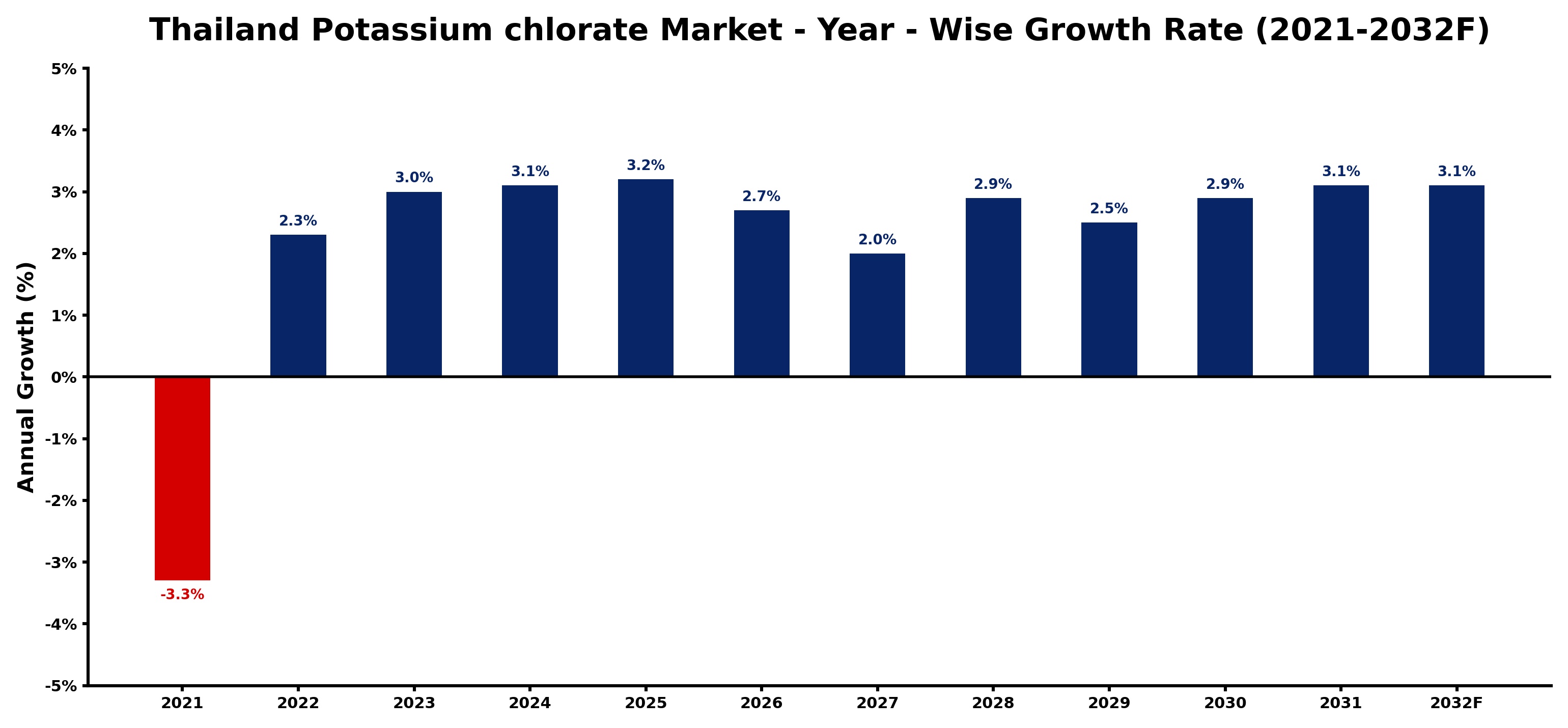
The table below presents the year‑wise growth rates along with the key drivers influencing the market
| Year | Growth Rate | Major Drivers |
| 2021 | -3.3% | High inflation reduced demand for potassium chlorate in manufacturing |
| 2022 | 2.3% | High export demand drives potassium chlorate production capacity expansion |
| 2023 | 3.0% | Investment in eco friendly technologies boosts potassium chlorate production efficiency |
| 2024 | 3.1% | Increased agricultural exports drive potassium chlorate production demands |
| 2025 | 3.2% | Advanced production technology boosts potassium chlorate manufacturing efficiency |
| 2026 | 2.7% | Local chemical manufacturers boost potassium chlorate production capacity investments |
| 2027 | 2.0% | Increased demand for fireworks boosts potassium chlorate production rates |
| 2028 | 2.9% | Manufacturers boost potassium chlorate output for agricultural applications |
| 2029 | 2.5% | Supply chain optimization enhanced potassium chlorate production efficiency |
| 2030 | 2.9% | Local manufacturers boost potassium chlorate production for agricultural exports |
| 2031 | 3.1% | Advanced manufacturing technologies optimize potassium chlorate production processes |
| 2032 | 3.1% | Higher precision in potassium chlorate production boosts export competitiveness |
Note - Market size estimations and growth projections presented in this report are based on 6Wresearch’s advanced forecasting approach, validated with industry datasets as of June 2026.
Thailand Potassium chlorate Market Synopsis
The strongest force shaping the Thailand potassium chlorate market is the heightened demand from the pyrotechnics and explosives industries. With the rise in festivities and celebrations, there is a marked increase in the production of fireworks, which directly impacts the demand for potassium chlorate, a critical ingredient.
In addition, the evolving landscape of chemical applications is also influencing market dynamics. Newer applications such as bleaching agents and electroplating solutions are gaining traction, reflecting an expansion of the traditional usage of potassium chlorate beyond pyrotechnics and into broader industrial applications.
Thailand Potassium chlorate Market Key Takeaways
- The market is poised for steady growth due to robust demand in fireworks and explosives.
- New applications are emerging, broadening the scope of potassium chlorate usage.
- Price fluctuations between THB 10-25/kg reflect varying quality and market volatility.
- Regulatory frameworks continue to shape production practices and safety standards in the industry.
- COVID-19 has temporarily impacted demand, but recovery is anticipated as economic activities normalize.
Evaluation of Restraints in Thailand Potassium chlorate Market
Despite the growth opportunities, the Thailand potassium chlorate market faces significant restraints primarily linked to safety and regulatory challenges. The volatile nature of potassium chlorate, coupled with its potential hazards, necessitates stringent safety protocols during storage and transportation. Additionally, compliance with environmental regulations and hazardous substance laws poses an ongoing challenge for manufacturers, ultimately affecting market expansion. These factors not only heighten operational costs but also limit the ability to scale production efficiently.
Thailand Potassium chlorate Market Trends
The Thailand potassium chlorate market is witnessing several trends that are reshaping its landscape. Notably, the shift towards more sustainable and safer chemical processes is leading manufacturers to innovate their production methods. Furthermore, the growing popularity of environmentally friendly fireworks is prompting a reevaluation of traditional formulations. Technological advancements in chemical synthesis and processing also contribute to improved efficiency and product quality.
Thailand Potassium chlorate Market Opportunities
There are considerable opportunities for growth within the Thailand potassium chlorate market, particularly through diversification into new application areas. Investment in research and development could yield innovative solutions, allowing manufacturers to cater to sectors like water treatment and advanced chemical synthesis. Additionally, as safety standards evolve, there is an opportunity for companies to differentiate their products with enhanced safety profiles, potentially capturing greater market share.
Government Initiatives in the Thailand Potassium chlorate Market
The Thai government has introduced several initiatives aimed at fostering safety and sustainability within the chemical industry. These efforts include regulatory frameworks designed to ensure the safe production and handling of hazardous substances, including potassium chlorate. There are also incentives for companies investing in eco-friendly technologies and practices, encouraging industry players to transition towards more responsible production methods.
Future Insights of the Thailand Potassium chlorate Market
Looking ahead to the 2026-2032 period, the Thailand potassium chlorate market is expected to navigate a path of moderate growth. Continued demand from the fireworks industry, alongside the emergence of new applications, will drive market dynamics. However, ongoing regulatory scrutiny and the need for safety compliance will remain crucial factors that shape the operational landscape. As manufacturers adapt to these challenges, the market may see innovative approaches that enhance safety and product efficacy.
Thailand Potassium chlorate Market Latest Developments (May 2025 - June 2026)
Recent developments in the Thailand potassium chlorate market reflect a concerted effort towards enhancing safety standards and improving production efficiency. Many manufacturers are investing in state-of-the-art facilities equipped with advanced safety protocols. Additionally, there is a noticeable shift towards collaborative efforts between industry players and regulatory bodies to refine compliance measures, thus fostering a more resilient market environment.
Thailand Potassium chlorate Market - Key Attractiveness of the Report
- 10 Years of Market Numbers
- Historical Data Starting from 2022 to 2025
- Base Year: 2025
- Forecast Data until 2032
- Key Performance Indicators Impacting the Market
- Major Upcoming Developments and Projects
Key Highlights of the Report:
- Thailand Potassium chlorate Market Outlook
- Market Size of Thailand Potassium chlorate Market, 2025
- Forecast of Thailand Potassium chlorate Market, 2032
- Historical Data and Forecast of Thailand Potassium chlorate Revenues & Volume for the Period 2022-2032F
- Thailand Potassium chlorate Market Trend Evolution
- Thailand Potassium chlorate Market Drivers and Challenges
- Thailand Potassium chlorate Price Trends
- Thailand Potassium chlorate Porter's Five Forces
- Thailand Potassium chlorate Industry Life Cycle
- Historical Data and Forecast of Thailand Potassium chlorate Market Revenues & Volume By Product type for the Period 2022-2032F
- Historical Data and Forecast of Thailand Potassium chlorate Market Revenues & Volume By Pharmaceutical Grade for the Period 2022-2032F
- Historical Data and Forecast of Thailand Potassium chlorate Market Revenues & Volume By Chemical Grade for the Period 2022-2032F
- Historical Data and Forecast of Thailand Potassium chlorate Market Revenues & Volume By End-use for the Period 2022-2032F
- Historical Data and Forecast of Thailand Potassium chlorate Market Revenues & Volume By Explosives for the Period 2022-2032F
- Historical Data and Forecast of Thailand Potassium chlorate Market Revenues & Volume By Matches for the Period 2022-2032F
- Historical Data and Forecast of Thailand Potassium chlorate Market Revenues & Volume By Disinfectants for the Period 2022-2032F
- Historical Data and Forecast of Thailand Potassium chlorate Market Revenues & Volume By Bleaches for the Period 2022-2032F
- Historical Data and Forecast of Thailand Potassium chlorate Market Revenues & Volume By Medical for the Period 2022-2032F
- Thailand Potassium chlorate Import Export Trade Statistics
- Market Opportunity Assessment By Product type
- Market Opportunity Assessment By End-use
- Thailand Potassium chlorate Top Companies Market Share
- Thailand Potassium chlorate Competitive Benchmarking By Technical and Operational Parameters
- Thailand Potassium chlorate Company Profiles
- Thailand Potassium chlorate Key Strategic Recommendations






































