Thailand Refrigeration and Heating Equipment Market Summary
The thailand refrigeration and heating equipment market was estimated at USD 163 Million in 2025 and is projected to reach USD 187 Million by 2032, growing at a CAGR of 2.8% from 2026 to 2032.
Thailand Refrigeration and Heating Equipment Market Year-wise Growth Rate and Key Drivers
This graph highlights how the Thailand Refrigeration and Heating Equipment Market has steadily grown over the past five years, supported by major growth factors.
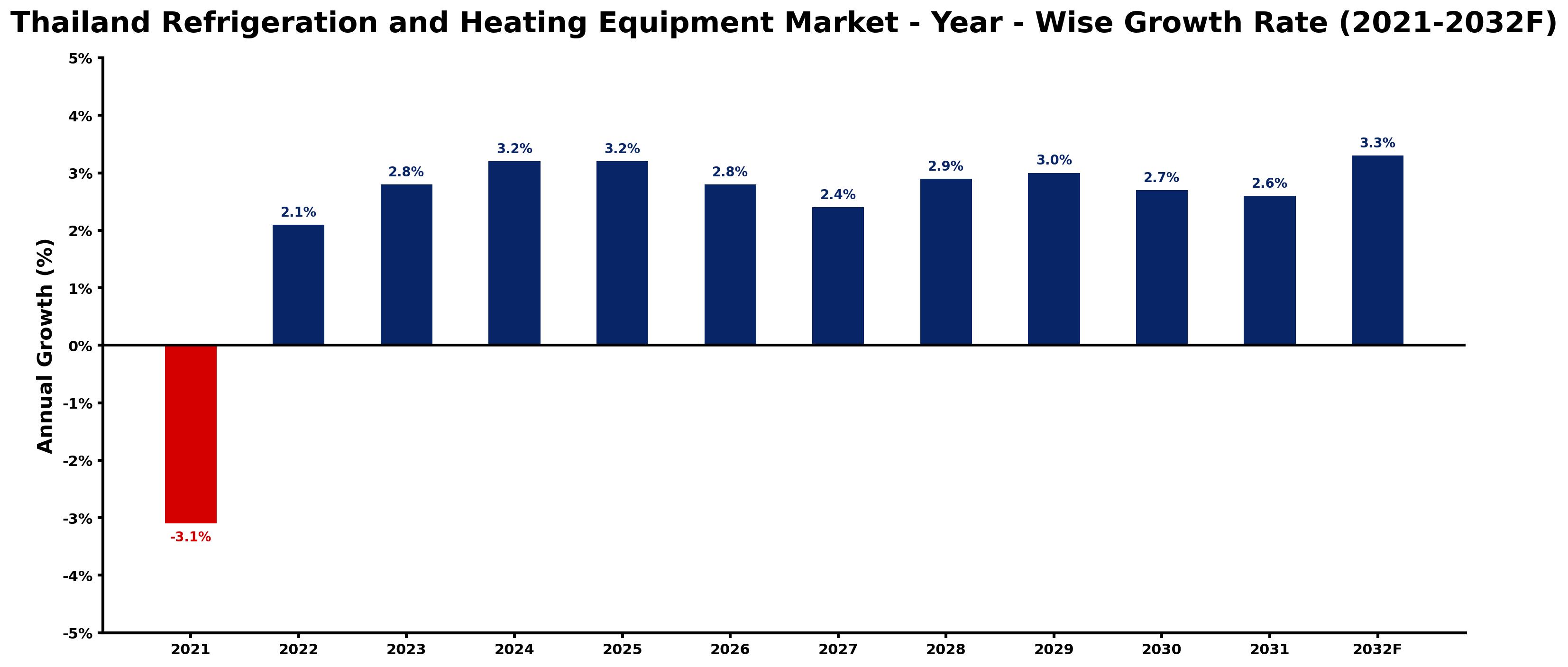
The table below presents the year wise growth rates along with the key drivers influencing the market
| Year | Growth Rate | Major Drivers |
| 2021 | -3.1% | Supply chain disruptions during the pandemic hindered equipment availability, diminishing overall market activity and investment. |
| 2022 | 2.1% | Local manufacturers began enhancing product offerings to cater to diverse climate conditions. |
| 2023 | 2.8% | Emerging urban areas prioritized advanced HVAC solutions to support rapid development projects. |
| 2024 | 3.2% | Rising awareness of energy conservation influenced consumer preferences toward eco-friendly appliances. |
| 2025 | 3.2% | Increased construction activities led to higher demand for commercial refrigeration units. |
| 2026 | 2.8% | The hospitality sector witnessed a surge in upgrades for efficient temperature control systems. |
| 2027 | 2.4% | Technological collaborations emerged, focusing on smart home integration in HVAC solutions. |
| 2028 | 2.9% | Changing consumer lifestyles prompted shifts towards portable and miniaturized refrigeration options. |
| 2029 | 3.0% | Sector-specific innovations targeted challenges in rural areas with intermittent power supply. |
| 2030 | 2.7% | Investment in renewable energy sources offered new pathways for cooling and heating technologies. |
| 2031 | 2.6% | An expanding middle class drove demand for high-end, energy-efficient home appliances. |
| 2032 | 3.3% | Environmental awareness campaigns further supported the shift towards sustainable refrigeration systems. |
Note - Market size estimations and growth projections presented in this report are based on 6Wresearch's advanced forecasting approach, validated with industry datasets as of June 2026.
Thailand Refrigeration and Heating Equipment Market Synopsis
The Thailand Refrigeration and Heating Equipment Market is projected to reach 2.8% and witness significant growth during the forecast period (2026-2032). Refrigeration and heating equipment play a crucial role in various sectors, including food and beverage, healthcare, hospitality, and commercial establishments, which are integral to Thailand's economic landscape. With consumers increasingly focused on energy efficiency and sustainability, the market is poised to expand as innovations drive the adoption of more efficient systems.
Thailand Refrigeration and Heating Equipment Market Growth Drivers
Several factors are propelling the growth of the Thailand Refrigeration and Heating Equipment Market. Firstly, an increase in consumer preference for energy-efficient solutions is evident as end-users prioritize long-term savings on energy costs. Secondly, government initiatives advocating green infrastructure contribute significantly to market expansion, fostering the development and adoption of advanced refrigeration and heating technologies. Thirdly, the trend towards smart connected devices is shaping the industry, enhancing operational efficiency and user convenience through mobile applications and remote access. Additionally, the rising awareness of environmental concerns has led to a shift towards sustainable practices across various industries, further fueling demand for efficient equipment. Lastly, as commercial activities ramp up post-pandemic, the need for reliable refrigeration and heating solutions in sectors like healthcare and hospitality is expected to rise.
Thailand Refrigeration and Heating Equipment Market Challenges and Restraints
Despite the promising growth, several challenges may hinder the Thailand Refrigeration and Heating Equipment Market. A significant hurdle is the high initial cost associated with advanced refrigeration systems, which can deter consumers from opting for imported products and lead to a preference for cheaper, locally available options. This preference could stifle the adoption of superior technology and slow the market's overall growth. Furthermore, the industry faces a shortage of skilled labor, complicating the integration of new technologies such as heat pumps and chillers. The lack of qualified personnel to handle advanced systems can significantly impact productivity and sales potential. Additionally, fluctuations in raw material prices could pose further challenges, affecting manufacturers' ability to maintain competitive pricing while ensuring quality.
Thailand Refrigeration and Heating Equipment Market Government Investment and Initiatives
The government of Thailand recognizes the importance of the refrigeration and heating equipment sector in driving economic growth and environmental sustainability. As such, it has initiated various policies and funding programs aimed at promoting energy-efficient technologies. These initiatives include grants and subsidies for businesses investing in modern, eco-friendly refrigeration systems to reduce greenhouse gas emissions. Additionally, the government is encouraging research and development in the sector through partnerships with academic institutions and private firms to advance innovative solutions that can enhance energy efficiency. Furthermore, regulatory frameworks are being strengthened to ensure compliance with international environmental standards, thus promoting a more sustainable industrial sector.
Thailand Refrigeration and Heating Equipment Market Latest Developments (May 2025 - June 2026)
The Thailand Refrigeration and Heating Equipment Market has experienced significant developments in recent months leading up to mid-2026. Manufacturers have been increasingly focusing on integrating advanced technologies such as Internet of Things (IoT) applications into their heating and cooling systems, enabling enhanced operational efficiency and remote monitoring capabilities. Additionally, there has been a noticeable rise in partnerships among companies to promote sustainable refrigeration practices and share best practices in energy management. The government has also ramped up its efforts by setting clearer guidelines on energy consumption for refrigeration equipment, aiming to standardize efficiency levels across the industry. Moreover, as consumer awareness grows regarding the importance of eco-friendly solutions, products featuring natural refrigerants are gaining traction in the market. This shift signals a transformation in consumer preferences, aligning with the overarching push towards sustainability.
Thailand Refrigeration and Heating Equipment Market - Key Attractiveness of the Report
- 10 Years of Market Numbers
- Historical Data Starting from 2022 to 2025
- Base Year: 2025
- Forecast Data until 2032
- Key Performance Indicators Impacting the Market
- Major Upcoming Developments and Projects
Key Highlights of the Report:
- Thailand Refrigeration and Heating Equipment Market Outlook
- Market Size of Thailand Refrigeration and Heating Equipment Market, 2025
- Forecast of Thailand Refrigeration and Heating Equipment Market, 2032
- Historical Data and Forecast of Thailand Refrigeration and Heating Equipment Revenues & Volume for the Period 2022-2032F
- Thailand Refrigeration and Heating Equipment Market Trend Evolution
- Thailand Refrigeration and Heating Equipment Market Drivers and Challenges
- Thailand Refrigeration and Heating Equipment Price Trends
- Thailand Refrigeration and Heating Equipment Porter's Five Forces
- Thailand Refrigeration and Heating Equipment Industry Life Cycle
- Historical Data and Forecast of Thailand Refrigeration and Heating Equipment Market Revenues & Volume By Heating equipments for the Period 2022-2032F
- Historical Data and Forecast of Thailand Refrigeration and Heating Equipment Market Revenues & Volume By Heating Pumps for the Period 2022-2032F
- Historical Data and Forecast of Thailand Refrigeration and Heating Equipment Market Revenues & Volume By Furnaces for the Period 2022-2032F
- Historical Data and Forecast of Thailand Refrigeration and Heating Equipment Market Revenues & Volume By Boilers for the Period 2022-2032F
- Historical Data and Forecast of Thailand Refrigeration and Heating Equipment Market Revenues & Volume By Space heaters for the Period 2022-2032F
- Historical Data and Forecast of Thailand Refrigeration and Heating Equipment Market Revenues & Volume By Unitary heaters for the Period 2022-2032F
- Historical Data and Forecast of Thailand Refrigeration and Heating Equipment Market Revenues & Volume By Others for the Period 2022-2032F
- Historical Data and Forecast of Thailand Refrigeration and Heating Equipment Market Revenues & Volume By Cooling Equipments for the Period 2022-2032F
- Historical Data and Forecast of Thailand Refrigeration and Heating Equipment Market Revenues & Volume By Cooling towers for the Period 2022-2032F
- Historical Data and Forecast of Thailand Refrigeration and Heating Equipment Market Revenues & Volume By Chillers for the Period 2022-2032F
- Historical Data and Forecast of Thailand Refrigeration and Heating Equipment Market Revenues & Volume By Coolers for the Period 2022-2032F
- Historical Data and Forecast of Thailand Refrigeration and Heating Equipment Market Revenues & Volume By Air conditioners for the Period 2022-2032F
- Historical Data and Forecast of Thailand Refrigeration and Heating Equipment Market Revenues & Volume By Others for the Period 2022-2032F
- Historical Data and Forecast of Thailand Refrigeration and Heating Equipment Market Revenues & Volume By General Components for the Period 2022-2032F
- Historical Data and Forecast of Thailand Refrigeration and Heating Equipment Market Revenues & Volume By Condensers for the Period 2022-2032F
- Historical Data and Forecast of Thailand Refrigeration and Heating Equipment Market Revenues & Volume By Compressors for the Period 2022-2032F
- Historical Data and Forecast of Thailand Refrigeration and Heating Equipment Market Revenues & Volume By Radiators for the Period 2022-2032F
- Historical Data and Forecast of Thailand Refrigeration and Heating Equipment Market Revenues & Volume By Sensors for the Period 2022-2032F
- Historical Data and Forecast of Thailand Refrigeration and Heating Equipment Market Revenues & Volume By Transducers for the Period 2022-2032F
- Historical Data and Forecast of Thailand Refrigeration and Heating Equipment Market Revenues & Volume By Others for the Period 2022-2032F
- Historical Data and Forecast of Thailand Refrigeration and Heating Equipment Market Revenues & Volume By End-User Industries for the Period 2022-2032F
- Historical Data and Forecast of Thailand Refrigeration and Heating Equipment Market Revenues & Volume By Residential for the Period 2022-2032F
- Historical Data and Forecast of Thailand Refrigeration and Heating Equipment Market Revenues & Volume By Commercial for the Period 2022-2032F
- Historical Data and Forecast of Thailand Refrigeration and Heating Equipment Market Revenues & Volume By Healthcare Industry for the Period 2022-2032F
- Historical Data and Forecast of Thailand Refrigeration and Heating Equipment Market Revenues & Volume By Educational and government institutions for the Period 2022-2032F
- Historical Data and Forecast of Thailand Refrigeration and Heating Equipment Market Revenues & Volume By Others for the Period 2022-2032F
- Thailand Refrigeration and Heating Equipment Import Export Trade Statistics
- Market Opportunity Assessment By Heating equipments
- Market Opportunity Assessment By Cooling Equipments
- Market Opportunity Assessment By General Components
- Market Opportunity Assessment By End-User Industries
- Thailand Refrigeration and Heating Equipment Top Companies Market Share
- Thailand Refrigeration and Heating Equipment Competitive Benchmarking By Technical and Operational Parameters
- Thailand Refrigeration and Heating Equipment Company Profiles
- Thailand Refrigeration and Heating Equipment Key Strategic Recommendations






































