Thailand Rubber Vulcanization Market Size, Share & Growth Rate
The Thailand Rubber Vulcanization Market was estimated at USD 185 Million in 2025 and is projected to reach USD 211 Million by 2032, growing at a CAGR of 1.9% from 2026 to 2032. This growth trajectory is driven primarily by the robust performance of the automotive sector, which increasingly relies on high-quality rubber components. Additionally, the expansion of global trade and local production initiatives are reinforcing the demand for advanced rubber vulcanization techniques.
Thailand Rubber Vulcanization Market Year-wise Growth Rate and Key Drivers
This graph highlights how the Thailand Rubber Vulcanization Market has steadily grown over the years, supported by major growth factors.
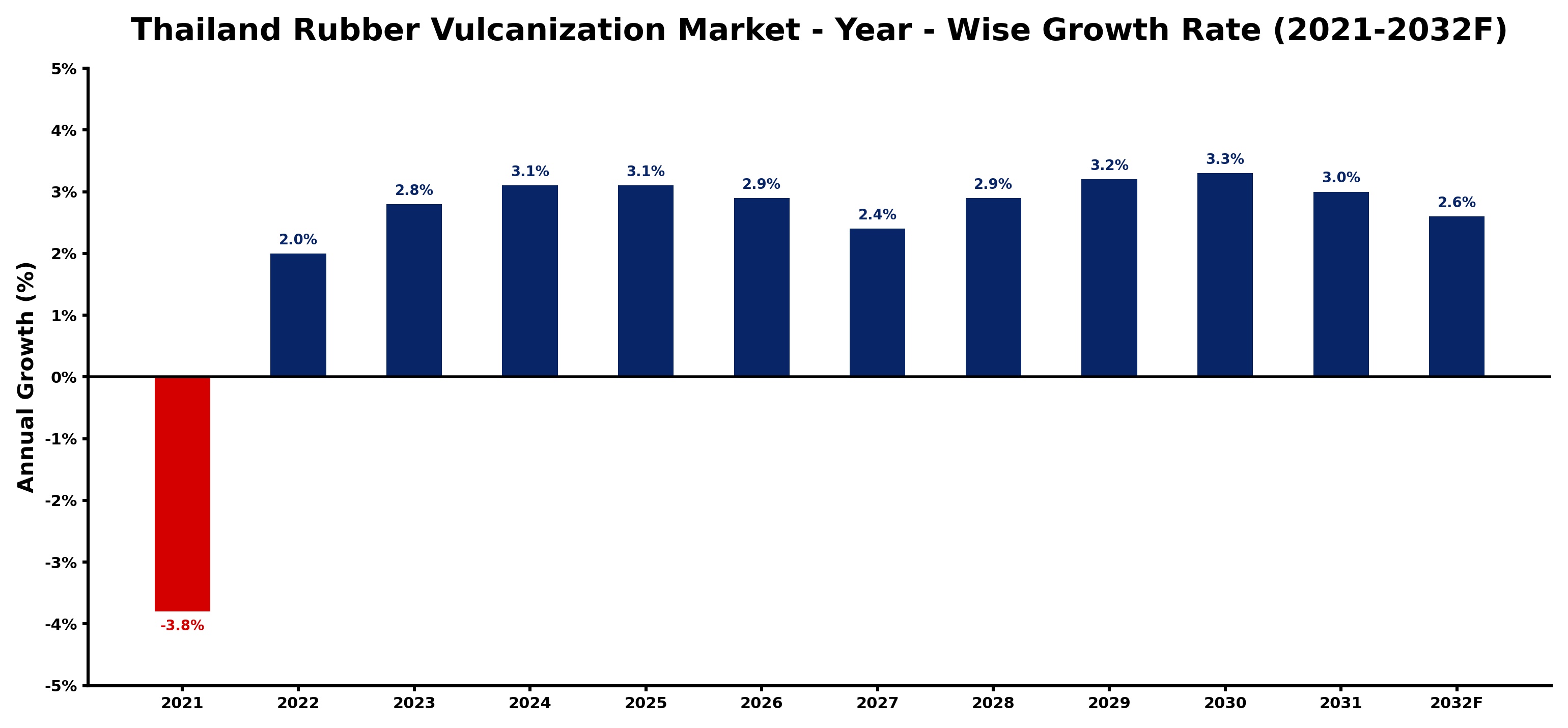
The table below presents the year‑wise growth rates along with the key drivers influencing the market
| Year | Growth Rate | Major Drivers |
| 2021 | -3.8% | Lower manufacturing investments decreased demand for rubber vulcanization products |
| 2022 | 2.0% | OEM orders surge, boosting local rubber component manufacturing output |
| 2023 | 2.8% | Technological upgrades in vulcanization processes boost production efficiency |
| 2024 | 3.1% | Local rubber producers invest in upgraded vulcanization technologies |
| 2025 | 3.1% | Smart sensor adoption optimized rubber processing efficiency in Thailand |
| 2026 | 2.9% | Expanded tire manufacturing capacity boosted rubber compound demand significantly |
| 2027 | 2.4% | Export driven demand for automotive parts boosts vulcanization plant output |
| 2028 | 2.9% | Local tire manufacturers invest in advanced rubber processing technologies |
| 2029 | 3.2% | Export driven innovation in rubber processing technology boosts production efficiency |
| 2030 | 3.3% | Export driven automotive sector growth boosts rubber vulcanization demand |
| 2031 | 3.0% | Sustained automotive recovery drives rubber compound manufacturing expansion |
| 2032 | 2.6% | Local manufacturers boost capacity through new rubber processing technologies |
Note - Market size estimations and growth projections presented in this report are based on 6Wresearch's advanced forecasting approach, validated with industry datasets as of June 2026.
Thailand Rubber Vulcanization Market Synopsis
In Thailand, the rubber vulcanization market plays a crucial role in enhancing the performance characteristics of rubber products used in various industrial applications. The automotive industry is a major consumer, with a rising need for durable and efficient rubber components, particularly tires and seals. This, combined with the country's reputation as one of the largest rubber producers globally, ensures a steady demand for vulcanization agents.
Moreover, government policies promoting local manufacturing and reducing import duties on raw materials have spurred investment in rubber vulcanization technologies. This positive environment encourages local producers to innovate and adapt to changing market requirements, further solidifying Thailand's position in the global rubber supply chain.
Thailand Rubber Vulcanization Market Key Takeaways
- The market is poised for steady growth, driven by the automotive and construction sectors.
- Government initiatives are enhancing local production capabilities and reducing dependency on imports.
- There is increasing pressure on producers to adopt environmentally friendly vulcanization processes.
- Ongoing innovations in vulcanization technology are improving product quality and performance.
- The global demand for sustainable rubber products presents opportunities for market expansion.
Evaluation of Restraints in Thailand Rubber Vulcanization Market
While the Thailand Rubber Vulcanization Market exhibits strong growth potential, it is not without its challenges. Environmental concerns are paramount, especially as traditional vulcanization processes often rely on sulfur, resulting in harmful emissions. As regulations tighten and consumer preferences shift towards sustainable products, companies may struggle to balance production efficiency with ecological responsibility. Moreover, maintaining product quality while adopting greener practices poses a significant challenge that industry players must navigate to remain competitive.
Thailand Rubber Vulcanization Market Trends
Several trends are currently shaping the Thailand Rubber Vulcanization Market. First, there is a significant push towards sustainable production methods as consumers become more environmentally conscious. This includes the exploration of bio-based vulcanization agents and processes that reduce emissions. Second, technological advancements in rubber processing are leading to enhanced product performance, particularly in high-demand sectors such as automotive and construction. Lastly, the increasing integration of digital technologies in manufacturing processes is streamlining operations, improving efficiency, and reducing costs.
Thailand Rubber Vulcanization Market Opportunities
The Thailand Rubber Vulcanization Market is ripe with opportunities for growth and investment. The continuous demand from the automotive industry presents a lucrative avenue for companies specializing in rubber products. Additionally, the rise of electric vehicles is expected to create new demands for specific rubber components that can withstand varying operational conditions. Furthermore, investments in R&D to develop eco-friendly vulcanization techniques could position companies as leaders in a rapidly evolving market. The potential for exports also remains high, particularly as global markets seek reliable rubber sources.
Government Initiatives in the Thailand Rubber Vulcanization Market
The Thai government is actively involved in promoting the rubber sector through various initiatives aimed at enhancing local production. Policies that support research and development in rubber processing technologies are in place, encouraging innovations that boost efficiency and sustainability. Additionally, the introduction of incentives for businesses adopting environmentally friendly practices demonstrates the government's commitment to fostering a responsible rubber industry. Such initiatives create a conducive environment for market growth and encourage collaboration between public and private sectors.
Future Insights of the Thailand Rubber Vulcanization Market
Looking ahead to 2026-2032, the Thailand Rubber Vulcanization Market is expected to evolve significantly. As global demand for sustainable products grows, companies that prioritize environmentally friendly practices are likely to gain a competitive edge. The integration of advanced technologies in production processes will further enhance product quality and operational efficiency. Moreover, with the automotive sector's shift toward electric vehicles, there will be a pressing need for innovative rubber solutions tailored to new technologies and applications. Overall, the market is set to thrive amidst changing consumer preferences and technological advancements.
Thailand Rubber Vulcanization Market Latest Developments (May 2025 - June 2026)
In recent months, the Thailand Rubber Vulcanization Market has witnessed several developments aimed at enhancing production capabilities and addressing environmental concerns. Notable advancements in eco-friendly vulcanization techniques are being explored, with many companies investing in R&D. Additionally, collaborations between local manufacturers and international technology firms are becoming more common, focusing on developing cutting-edge rubber processing methods that align with sustainability goals. The overall industry sentiment is positive, reflecting a proactive approach to market demands and environmental challenges.
Thailand Rubber Vulcanization Market - Key Attractiveness of the Report
- 10 Years of Market Numbers
- Historical Data Starting from 2022 to 2025
- Base Year: 2025
- Forecast Data until 2032
- Key Performance Indicators Impacting the Market
- Major Upcoming Developments and Projects
Key Highlights of the Report:
- Thailand Rubber Vulcanization Market Outlook
- Market Size of Thailand Rubber Vulcanization Market, 2025
- Forecast of Thailand Rubber Vulcanization Market, 2032
- Historical Data and Forecast of Thailand Rubber Vulcanization Revenues & Volume for the Period 2022-2032F
- Thailand Rubber Vulcanization Market Trend Evolution
- Thailand Rubber Vulcanization Market Drivers and Challenges
- Thailand Rubber Vulcanization Price Trends
- Thailand Rubber Vulcanization Porter's Five Forces
- Thailand Rubber Vulcanization Industry Life Cycle
- Historical Data and Forecast of Thailand Rubber Vulcanization Market Revenues & Volume By Type for the Period 2022-2032F
- Historical Data and Forecast of Thailand Rubber Vulcanization Market Revenues & Volume By Accelerator for the Period 2022-2032F
- Historical Data and Forecast of Thailand Rubber Vulcanization Market Revenues & Volume By Vulcanizing Agent for the Period 2022-2032F
- Historical Data and Forecast of Thailand Rubber Vulcanization Market Revenues & Volume By Activator for the Period 2022-2032F
- Historical Data and Forecast of Thailand Rubber Vulcanization Market Revenues & Volume By Other for the Period 2022-2032F
- Historical Data and Forecast of Thailand Rubber Vulcanization Market Revenues & Volume By Application for the Period 2022-2032F
- Historical Data and Forecast of Thailand Rubber Vulcanization Market Revenues & Volume By Automotive for the Period 2022-2032F
- Historical Data and Forecast of Thailand Rubber Vulcanization Market Revenues & Volume By Medical for the Period 2022-2032F
- Historical Data and Forecast of Thailand Rubber Vulcanization Market Revenues & Volume By Industrial for the Period 2022-2032F
- Historical Data and Forecast of Thailand Rubber Vulcanization Market Revenues & Volume By Consumer Goods for the Period 2022-2032F
- Historical Data and Forecast of Thailand Rubber Vulcanization Market Revenues & Volume By Other for the Period 2022-2032F
- Thailand Rubber Vulcanization Import Export Trade Statistics
- Market Opportunity Assessment By Type
- Market Opportunity Assessment By Application
- Thailand Rubber Vulcanization Top Companies Market Share
- Thailand Rubber Vulcanization Competitive Benchmarking By Technical and Operational Parameters
- Thailand Rubber Vulcanization Company Profiles
- Thailand Rubber Vulcanization Key Strategic Recommendations






































